
Making Disciples: Catechesis in History, Theory, and Practice. By Alex Fogleman. Reviewed by Kayla Brion. (skip to review)
Bread Grows in Winter. By Ida Friederike Görres. Translated by Jennifer S. Bryson. Reviewed by Rev. Dillon Vita. (skip to review)
Christ, Science, and Reason: What We Can Know about Jesus, Mary, and Miracles. By Rev. Robert J. Spitzer, S.J. Reviewed by Joseph R. Blaney. (skip to review)
Search No More: The Keys to Truth and Happiness. By Steven R. Hemler. Reviewed by Matthew B. Rose. (skip to review)
The Lion Has Conquered: An Introduction to Catholic Soteriology. By Daniel Robert Waldow. Reviewed by Matthew McKenna. (skip to review)
Making Disciples – Alex Fogleman
Fogleman, Alex. Making Disciples: Catechesis in History, Theory, and Practice. Grand Rapids, MI: Eerdmans, 2025. 191 pages.
Reviewed by Kayla Brion.
 “Catechesis is basic but comprehensive instructions in what Christians believe, hope, and love” (2). This working definition presented by Fogleman in the introduction to his book provides an important foundation for what is meant by catechesis and understanding its importance for the Church historically and today. He introduces catechesis, not only as intellectual instruction on the faith, but as human formation of the whole person — intellect, will, and emotions. Fogleman writes from an Anglican perspective, but he intentionally draws from the wisdom of the early Church to make his analysis applicable to people of all Christian traditions. Although the suggestions that Fogleman gives are nothing new, his ability to compile the wisdom of the Church on catechesis is a gift to those involved in the new evangelization.
Fogleman writes in a style that draws heavily from his expertise in theology and patristics, while keeping it easily readable for all Christians regardless of their formal theological training. The book is separated into nine chapters, each divided beneath various headings, making it easy to read in smaller sections. This is particularly helpful for those working in evangelization and catechesis who may not have extensive time to devote to study but are looking to further their formation amid busy schedules.
The first three chapters of Making Disciples focus primarily on the historical context of catechesis from the time of the Apostles leading up to today. He starts by analyzing the extensive catechetical process that the Church in its early centuries used. During this time the Church in various areas used the Creed to instruct about faith and form the intellect, the Our Father to instruct in hope and form the affective/spiritual aspect of man, and the Ten Commandments to instruct in love and form the will along with moral formation. This early Church method is expanded upon through each chapter of the book and applied in various ways as a primal method of catechesis. He continues to move through his historical analysis, rejecting the claim that catechesis was abandoned during the Middle Ages and the Reformation. Fogleman explores the ways that the Church has continued to catechise and adapt various methods over the centuries. Simultaneously, Fogleman proposes various possibilities for the needed revitalization of catechesis in the modern Church to return to the fruitfulness seen in the early centuries.
In the following chapters Fogleman transitions into exploring the ways which catechesis can reach beyond simply providing information about who God is. Chapter four looks at the way that true worship is one of the best spaces for catechesis that, if utilized well, provides a time and opportunity for community and formation that reaches beyond Sunday into the rest of the week. In chapter five, he explores the importance that catechesis holds for living the Great Commission, especially in a world where the gap between the Church and the culture is so great. Chapters six and seven provide suggestions for how catechesis can present the truths of salvation in a way that shapes the whole life of the catechumen. Fogleman exemplifies how education in truth as well as an understanding of the sacraments and scriptures open the way for the world to be touched by Christ.
For readers familiar with the efforts of the new evangelization, the final two chapters echo many familiar ideas. Fogleman emphasises the relational dimension of catechesis to bring individuals into the Church, to a community and family. He highlights that catechesis is for everyone and invites churches to make it a priority for every Christian so that it ceases to be seen as important for children and embarrassing for adults. He presents various ways that this model of catechesis can be applied, both drawing from his own experiences and from the history of Christianity. Overall, he relies on timeless principles to help individuals and Churches determine how to apply these methods of catechesis best in their own situations.
Ultimately, Making Disciples: Catechesis in History, Theology, and Practice provides readers with a solid understanding of both the historical usage of catechesis and principles for applying these same methods within their own contexts. Fogleman inspires readers to be more intentional about the catechetical process so that, inspired by the early Church, they can form true disciples of Jesus Christ. Today, perhaps more than in previous centuries, the world needs proper catechetical formation that will awaken spiritual senses. He encourages all Christians to return to the roots of catechesis and explore how they can best apply this wisdom in their own churches and personal apostolates.
Kayla Brion is the director of campus ministry at the St. Pier Giorgio Frassati Newman House at Chadron State College in Nebraska. She received her BA in Theology from Catholic International University and is continuing to work on her MA in Theology.
Bread Grows in Winter – Ida Friederike Görres
Görres, Ida Friederike. Bread Grows in Winter. Trans. Jennifer S. Bryson. San Francisco: Ignatius Press, 2025. 222 pages.
Reviewed by Rev. Dillon Vita.
 Ida Görres’s newly translated collection of lectures reads as if it were written this past year rather than six decades ago. Görres undoubtedly had a prescient intellect, as she was able to diagnose the problematic movements of the 1960s in Germany even as she lived through them. Jennifer Bryson undertook a truly important task when she endeavored to translate the work of this underappreciated woman of faith.
Bread Grows in Winter consists of six articles and lectures that Ida Görres wrote or delivered between 1967 and 1970. They each spring from a tumultuous time in the Church, and particularly in Germany, shortly after the Second Vatican Council. As Joseph Ratzinger points out in his eulogy for Görres, which has been included in this volume by Bryson, she was a much-needed voice of reason during a time of such turmoil.1 In her articles and lectures, Görres addresses the way in which we can know Christ in the modern age, the changes of Vatican II, the contemporary antipathy toward tradition, the necessity of doing theology from a posture of prayer, the celibate priesthood, and the posture of the faithful toward the Church. Görres did not write for the purpose of an intellectual exercise; rather, each of these was an occasional writing. However, as one reads these articles, one is struck by the fact that, although they were intended to be occasional, they remain relevant today.
If there is one throughline in this collection, it would be Görres’s attempt to confront the modern tendency toward individualism and pragmatism. For her, the Church must be seen as a living organism that we cannot domesticate to our own intellect and will. In the first article, “Our Image of Christ: A Letter,” she develops the image of a mountain to illustrate how we ought to understand the nature of the Church. She explains that there are different modes of knowing the mountain that depend on one’s relationship with it. Some study it using topographical maps, some live beside it in an adjacent town, and some are accustomed to hiking on it. In each of these cases, a person comes to know the mountain differently, but the most profound way of knowing it is found in the person whose life is dictated by its presence. The Church is not known exclusively by those who study it or even by those who are so in the weeds of its administration that they cannot look upon its majesty. Of course, in their proper perspectives, these are all valid ways of knowing the Church. Yet, the one who most profoundly knows the Church is the one who day in and day out finds his or her rhythm of life governed by it.2 Today, Görres finds that this mode of depending on the Church has been waning. Instead, people treat the Church as something they can control. A relational mode of engaging with the Church requires trust, and trust requires that one take the risk of being dependent on an other.
Görres maintains that there has been too much emphasis on the masculine in the Church, so that today she suffers from a crisis of femininity. The Church is naturally feminine in that she must first receive before doing. However, today it seems as if modernity has deemed that only masculine productivity is of value. Görres sees this attitude as catastrophic insofar as it pervades Holy Mother Church, since she is one of the few remaining feminine figures in modernity.3 Moreover, she maintains that it is due to overlooking the value of femininity that celibacy has been judged irrational and outdated. It is precisely because nothing is deemed of value unless it is functional that celibacy is seen as nonsensical. Celibacy is by its very nature a self-giving for the sake of intimacy with Christ and his Church. It is not inherently fruitful except in that it demands one depend on the other, who is Christ.
In a world that is continually being reshaped and lacks solidity, Görres rejects the notion — one that has all but attained consensus — that one must impose one’s own structure and stability.4 She sees this as nonsensical and dangerous. She, like a voice crying out in the wilderness, repeatedly reminds us that modernity’s only hope is to return to Christ and allow him to be our foundation once again. She counsels us to rely not on ourselves, but on the one who, despite the obstacles of recent history, has made his way to us. Undoubtedly, this is counsel worth reading today.
Father Dillon Vita is a newly-ordained priest in the Diocese of Rockville Centre.
Christ, Science, and Reason – Robert J. Spitzer, S.J.
Spitzer, Robert J., S.J. Christ, Science, and Reason: What We Can Know about Jesus, Mary, and Miracles. San Francisco: Ignatius Press, 2024. 361 pages.
Reviewed by Joseph R. Blaney.
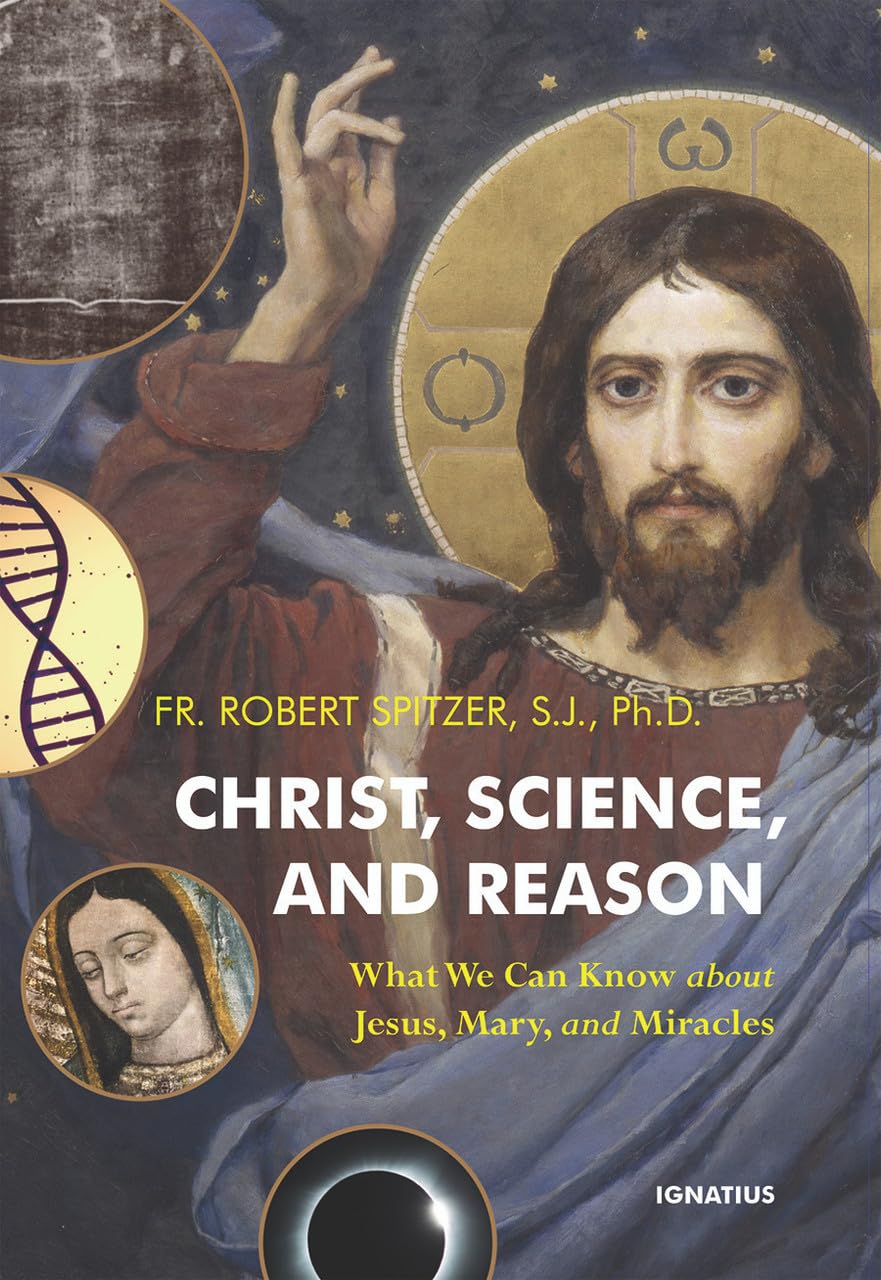 Jesuit Father Robert Spitzer has provided Catholic priests and deacons a colossal service with this title. It has compiled in one coherent volume a collection of evidence speaking to the historic and scientific evidence not just for Jesus but the miraculous nature of the Eucharistic and Marian devotions which testify to the living Lord and his church. It begs to be mined by preachers seeking to enliven homilies on feast days devoted to the Eucharist (e.g., Feast of Corpus Christi, Holy Thursday’s Altar of Repose, Solemnity of the Sacred Heart of Jesus) and the Blessed Mother (e.g., the Solemnity of Mary, Our Lady of Lourdes, Our Lady of Guadalupe, Immaculate Conception). Of course, this list excludes so many more days which could be included along with the feast days of saints who had particularly strong devotion to the Eucharist and/or Mary. Father Spitzer begins and ends with two gentle reminders: (1) our faith is not contingent upon the evidence presented in the book, but it does detail overwhelming evidence consistent with tenets of the faith; and (2) the miracles discussed cannot be “proven” per se, but the evidence points to no natural scientific explanation to date and a high likelihood that future scientific reduction of the events is highly improbable.
The book begins with the assertion of Jesus as a figure of established historical methods and scientific testing processes. Here Spitzer delineates how historic claims are discerned and applies that method to the five sources producing the four canonical Gospels. He proceeds to offer tremendous detail in support of scientific claims surrounding the Shroud of Turin (including a discussion of sampling flaws in previous studies misdating the shroud) and multiple Eucharistic and Marian miracles. For sake of brevity, this review points to two such miracles: The Eucharistic Miracle of Tixtla, Mexico in 2006 and the cure of Pierre de Rudder after visiting the Shrine of Our Lady of Lourdes in Oostakker, Belgium.
The Eucharistic Miracle of Tixtla occurred in October of 2006 and thus benefited from analytical technology and scientific procedures/control not available during previous miracles (e.g., Bolsena, Italy in 1263). During a parish retreat in Tixtla, Mexico the host began exuding a reddish substance. Maintaining integrity of tissue possession, both church authorities and independent laboratories (unaware of the source of substance) began investigations whereupon human blood with red and white blood cells was discovered and typed as AB+, consistent with other Eucharistic miracles and the Shroud of Turin. Moreover, histological reports indicated myocardial inflammation consistent with cardiac stress in line with crucifixion. Analysts concluded that the tissue was living when the blood was produced and ruled out preservation, contamination, and fraud. The disciplines of pathology, immunology, and histology converged to admit that what occurred has no scientific explanation to this day. Spitzer again pointed out that while divine intervention cannot be proven, what could be proven was consistent with Eucharistic theology.
The case of Pierre de Rudder in April of 1875 is also illustrative of a miracle almost certain to lack scientific explanation in perpetuity. Following a compound fracture of his tibia and fibula in 1867 (a tree trunk crushed his leg while assisting in its removal), de Rudder was left with an open infected wound (pre-antibiotic), jagged bone separation, loss of bone tissue, leg shortening, and attendant loss of muscle mass due to inability to use the leg. Multiple physicians examined the leg and diagnosed it as incurable over a period of eight years. In a dramatic visit to the Lourdes shrine in Oostakker, de Rudder experienced instant healing which the same and additional physicians described as complete. The wound closed with no scarring, the previously separated bones had fused, tissue was restored, and leg length was restored comparably to the other uninjured leg. Previously unable to walk, de Rudder dropped to his knees excitedly praising God and moving freely with restored muscle mass. Spitzer again reminds us that divine intervention cannot be proven, but scientific explanations for de Rudder’s cure will in all reasonable probability never emerge.
Christ, Science, and Reason is replete with examples such as these, with Spitzer differentiating between miracles with much scientific evidence from those with overwhelming evidence. Pastors’ ability to augment preaching on related church calendar days is greatly enhanced due to this volume.
Spitzer closes the book by debunking the notion that the Church is anti-science, pointing to faithful Catholics who made transformative scientific discoveries and countering narratives such as the Church’s alleged persecution of Galileo for his advancement of heliocentrism. Indeed, Copernicus, a church canon lawyer in good standing, advanced heliocentrism years before Galileo. The Church punished Galileo for breach of a promise to refrain from making his scientific arguments at the time due to procedural, scientific irregularities combined with pressures arising with Protestant, reformed thought. Spitzer admits that the Church overreacted but debunks the incident as an example of anti-science sentiment.
In sum, as stated before, priests and deacons will benefit from this book not only as a faith and reason narrative, but it could serve as an excellent reference tool as well. For that matter, theologically inclined laity will also find it nourishing. The worst that can be said about it is that its level of detail and repetitive turn to the standards of scientific method might require a longer digestion period for the various chapters. Father Spitzer can be praised for this attention to minutiae.
Joseph R. Blaney, Ph.D., is Professor of Communication at Illinois State University.
Search No More – Steven R. Hemler
Hemler, Steven R. Search No More: The Keys to Truth and Happiness. Charlotte, NC: TAN Books, 2018. 310 pages.
Reviewed by Matthew B. Rose.
 Works of apologetics traditionally emphasize arguments demonstrating the reasonableness of the faith. Recent apologetic works, however, shift their focus beyond the mere reasonableness of the Faith, more widely to its beauty and goodness. This more broadly Transcendental approach is on full display in Steven Hemler’s Search No More. Hemler presents not merely arguments for particular portions of the Faith (i.e., the reliability of the Gospels, the immortality of the soul, the importance of the Church, etc), but rather a whole, overarching argument about life itself. The central thesis is that the key to happiness lies in Jesus Christ, and most fully in the Church He founded. This book seeks to lay out a reasonable, beautiful case for this claim, and Hemler does so admirably, in clear, accessible language which will appeal to readers of varying levels of catechetical formation.
Hemler divides his book into four major parts, each separated into smaller chapters. The first part looks at the question of happiness, the starting point of many works of contemporary catechesis and apologetics (compare Hemler’s project, for example, with the Augustine Institute’s The Search, which follows a similar structure to, and shares similar themes with, Search No More). We feel the lack in our human experience, the drive and desire for something the pleasures of this life, however good they are, cannot satisfy. These desires open us to ask questions about who we are and why we are here. Ultimately, Hemler concludes, we can only find fulfillment for these eternal longings through union with the eternal God, and we can only achieve this union by seeking relationship with him; the wonderful surprise is, as we seek God, we realize that He has been “constantly waiting for us, running after us. He never relents, never gives up. The more we run from God, the more God runs after us; the more we resist, the more God persists” (45). The purpose of this reflection on God is not to prove His existence; this Hemler did in a previous work, The Reality of God (St. Benedict Press, 2014; Hemler notes this on p. 51). Rather, it is an invitation to know Him, to see how He works in our lives.
These reflections lead to the book’s second part, concerning God Incarnate, Jesus Christ. Here, Hemler devotes just two chapters to the question of Jesus’ identity, working through the historical, scriptural, and logical evidence for Christ’s divinity. In particular, Hemler explicates C. S. Lewis’ famous trilemma: Jesus clearly claimed to be God, so either Jesus did not really think he was God (thus a liar), or Jesus thought he was God but was not (thus a lunatic), or Jesus was actually God (and thus Lord). Hemler then moves to look at counterclaims to the bodily resurrection of Jesus, such as the Hallucination Theory or the Swoon Theory, as well as presenting the “positive evidence of the Resurrection of Jesus,” that is, why one would think that Jesus rose from the dead (i.e., eyewitness accounts, the “radically transformed lives of Jesus’s followers afterwards” [102], etc).5
God is the source of our happiness, and through the Incarnation we access that grace. This gives us hope for life beyond this life, that is, Heaven; this is the focus of the third part of this book. Hemler begins by looking at evidence for our immortality, not in classical arguments based on the soul’s powers (intelligence, abstraction, etc) but in the exciting and controversial world of parapsychology, specifically claims of near-death experiences. These experiences, Hemler argues, show that we are not merely our material bodies, but have an immaterial aspect of ourselves, that is, our souls. Hemler then connects the work of the previous chapter (concerning the life, death, and resurrection of Jesus) to this question of our afterlife. The Passion of Christ, Hemler explains, is the work of God saving us, enabling us to accept Him and be with Him in Heaven. We are saved by this gratuitous gift of God.
Christ, in establishing the Church as a lasting institution, set out the way and means to receive God’s grace, ordinarily through the sacraments; this is the focus of the final part of the book. This system was willed by Christ, who similarly erected the hierarchy of the Church, beginning with the pope and bishops in union with him (the heirs of St. Peter and the Apostles). In essence, “If we want to do what Jesus Christ wills for us, we must seek to follow the teachings of the Church rather than trying to seek God all on our own” (272). Hemler then focuses on the “source and summit” of the Christian life, that is, the Mass. In doing so, he provides ten reasons to attend Mass, each worth of lengthier reflections in their own right.
Hemler concludes his reflections on Truth and Happiness with directions for the next stage of the reade’’s faith journey, an invitation to deeper faith, tailored to one’s stages along this journey. The book concludes with a summary of each chapter’s main ideas, discussion questions, and an appendix of Bible abbreviations, as well as endnotes and a more general Bibliography. These end portions, especially the chapter points and discussion questions, might assist any formal book study program within a parish or school. Such a program might likewise use the resources listed in the Notes or Bibliography for further study and reflection.
Matthew B. Rose (BA, MA, Christendom College) teaches Theology at Bishop O’Connell High School in Arlington, VA; he writes for a variety of online resources, especially his blog, Quidquid Est, Est.
The Lion Has Conquered – Daniel Robert Waldow
Waldow, Daniel Robert. The Lion Has Conquered: An Introduction to Catholic Soteriology. Lincoln, Nebraska: Os Justi Press, 2026. 219 pages.
Reviewed by Matthew McKenna.
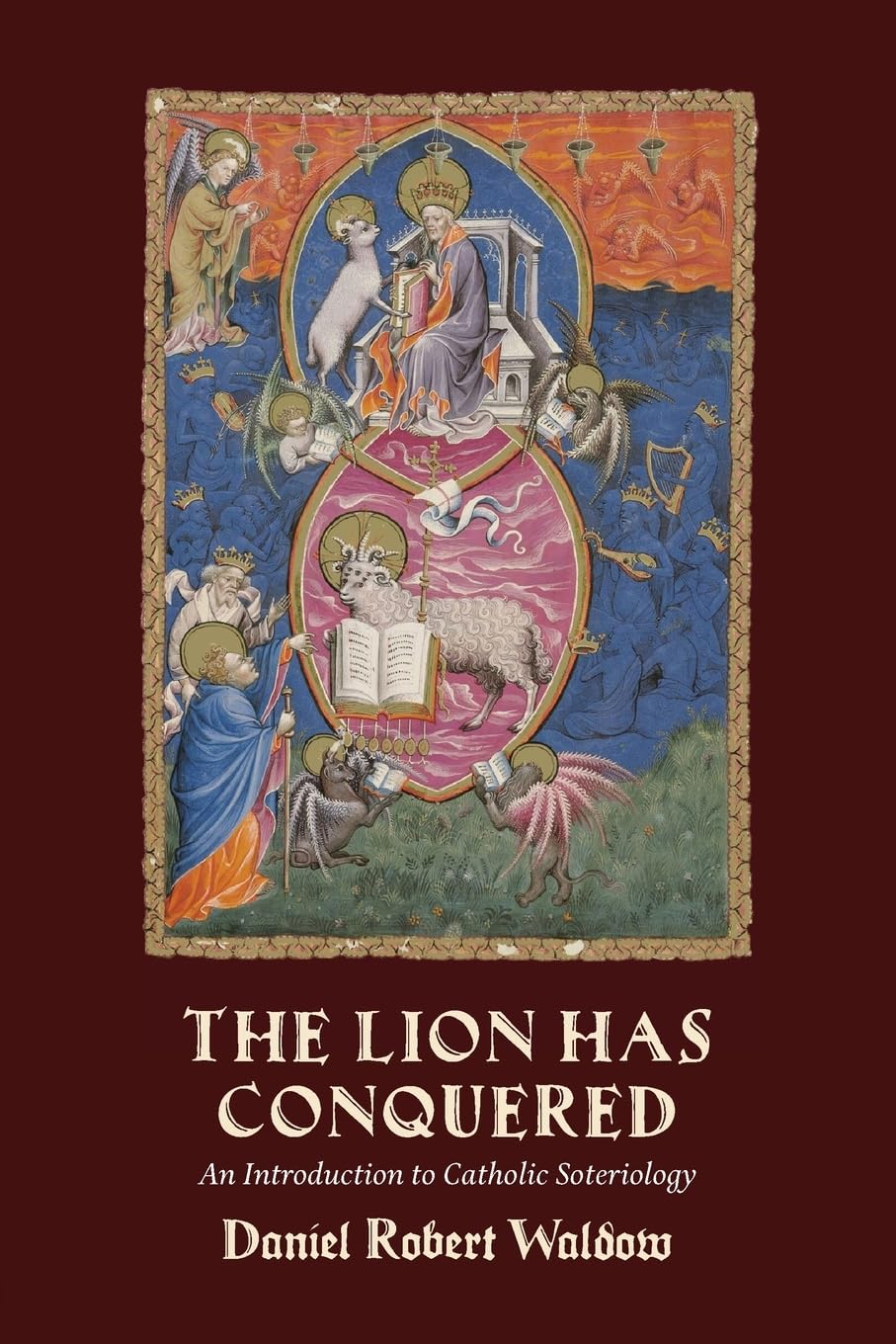 What is soteriology and why does it matter? Such an odd-sounding and misunderstood word might often be overlooked and forgotten. Through The Lion Has Conquered, Daniel Waldow offers the definitive solution to this problem.
The word “soteriology” comes from two Greek words, soter, which means “savior,” and logos. Thus, soteriology is the study of salvation and the savior. This text is an academic introduction to Catholic soteriology. It is designed to be easily accessible, function well as a course textbook, or serve as a helpful reference to preachers and teachers. As an introductory textbook, this book focuses on explaining the key scriptural and magisterial texts concerning our salvation.
The Lion Has Conquered begins with an introduction where the speculative and sapiential nature of theology is briefly explained. This allows Waldow to show where soteriology fits into the larger theological picture, describe the method and sources of soteriology, and introduce the basic questions it seeks to answer. Throughout the text, two fundamental questions frame the discussion: what does Christ save us from and how does He save us? Additionally, Waldow consistently distinguishes between the ends and the means of salvation. The final overarching concern studied throughout the book is the interplay between God’s gift of grace and our free cooperation with it which enables us to participate in Christ’s saving work.
This work has seven chapters, each with two to three major sections. Each chapter considers soteriology from a different source. The chapters progress organically, starting with Genesis and culminating with the liturgy.
Chapter one treats “Sin and Sacrifice in Genesis.” From the very beginning of scripture, God answers the two fundamental soteriological questions: from what does God save us and how? Genesis answers quite clearly that sin is the main problem from which God saves us; sin and its consequences. Among the consequences of sin, Genesis highlights our disordered inclinations, vulnerability, mortality, and estrangement from God. How does God save us? In two ways, Genesis answers that sacrifice is the fundamental way that God saves us. First, the protoevangelium in Genesis 3:15 promises a savior who defeats the snake, but at the cost of being wounded in the heel. This implies that the victory over sin will cost him something, referring to the victory’s sacrificial nature. Second, God provides clothing to Adam and Eve to ease the burden of sin’s consequences, yet this necessitates the death of animals and was the first animal sacrifice. Thus, the early chapters of Genesis give basic but clear answers: God saves us from sin by means of sacrifice.
In the second chapter Waldow discusses the rest of the sacrifices in the Old Testament. First, he gives a detailed yet lucid account of the ritual sacrifices of Moses and the Levities as well as their meaning and purpose. They key to the ritual sacrifices in the Old Testament is their symbolic nature. While the Old Testament is clear that ritual sacrifices are good, moral sacrifices are far superior. Waldow draws this from Saul’s illicit ritual sacrifices and Psalms 50–51. This shows that the type of sacrifice which will save us from sin will be, primarily, a moral sacrifice, not ritual sacrifices. By the story of the Maccabees, the Old Testament ends by presenting martyrdom as the best form of moral sacrifice.
The third chapter examines Christ’s name, titles, and public ministry from a soteriological perspective. Throughout His ministry, Christ identifies Himself as a new Davidic king, and the final judge, and as one with the power to forgive sin. His miracles prove that He truly has such power.
In Chapter four, Waldow explains how Christ’s Passion saves us. Christ’s reasons for enduring the passion were twofold: obedience to the Father and love for us whom He desired to save. Because Christ died out of perfect obedience and love, His death was the supreme moral sacrifice and thus is pleasing to God. Christ’s death is also the best witness to the truth of His teachings, for He did not recant them to avoid death. Thus, by choosing death rather than sin, Christ conquers sin and, by conquering sin, conquers its consequences. The Passion saves us since Christ enables us to participate in it by the New Passover which is the Eucharist and our own moral sacrifices.
Having completed a walkthrough of scriptural soteriology, Waldow next considers the chief magisterial teachings on soteriology in chapter five. There, he summarizes the teachings of Trent in its decrees on original sin, justification, and penance, and also summarizes the Catechism of the Catholic Church’s soteriological synthesis. The summary of the Catechism is especially helpful as a summary of Catholic soteriology.
The final two chapters (six and seven) consider the soteriology in the Eucharist and how it is celebrated in various liturgical traditions. These chapters are quite beautiful for they explain how the ordinary Catholic participates in Christ’s saving work at Mass every week, according to the teaching of Trent and the recent popes. While the first four scriptural chapters will prove invaluable in preparing homilies and in theological exegesis, these final two chapters impact how we approach the Eucharist every day. Essentially, the Eucharist re-presents Christ’s sacrifice in a different, unbloody mode which enables the faithful to unite themselves to Christ’s sacrifice and thus participate in His victory over sin and its consequences. This fundamental truth about the Eucharist and its purpose is clear in all the main liturgical traditions of the Church, as Waldow shows in chapter seven. For those looking for the bare basics, Waldow provides a concise synthesis of the whole book in the conclusion.
This fine text balances deep and foundational truths, clear expression and readability, and scholarly rigor with the appropriate amount of secondary literature in the footnotes. For these reasons, The Lion Has Conquered is sure to revitalize soteriology in Catholic education and make this often misunderstood and underappreciated topic accessible to and loved by the next generation of priests and students.
Matthew McKenna, Ph.D., teaches at Ave Maria University’s new Ireland Campus and focuses on moral theology and the priesthood.
- Joseph Ratzinger, “Eulogy for Ida Friederike Görres” in Bread Grows in Winter, trans. Jennifer S. Bryson (San Francisco: Ignatius Press, 2025), 184. ↩
- Ida Friederike Görres, “Our Image of Christ: A Letter” in Bread Grows in Winter, 43–5. ↩
- Ida Friederike Görres, “Remarks on Celibacy” in Bread Grows in Winter, 138. ↩
- Ida Friederike Görres, “Demolition Troops in the Church” in Bread Grows in Winter, 74. ↩
- Much of this chapter draws on Carl Olson’s Did Jesus Really Rise from the Dead, which was reviewed on this same site back in 2018. ↩
 About Book Reviews
Recent Comments