
Introduction
Christ-centered counseling is a cyclical step-by-step procedure designed to initiate, promote, and maintain positive, healthy change. It holds out hope that gains made in counseling can be retained without serious backsliding. The cyclical nature of change is emphasized showing how therapeutic goals are achieved and maintained. Progress is attained by adding individual effort to God’s abundant grace.
This paper is written with counseling clients in mind and for counselors, clergy, spiritual directors, and pastoral ministers.
Orientation to the Counseling Field
It can be beneficial to briefly mention the concept of “paradigm.” A paradigm is a set of theories (for example, Psychoanalysis; Behaviorism; Cognitive Behavioral Therapy) which seek to explain that which is observed in nature, that is, human nature (as in the social sciences: psychology and sociology) and the natural sciences (biology; chemistry; physics). Theories lend themselves to be proved or disproved by scientific research. Such research will show the theory, and ultimately the paradigm, to be valid or invalid, retained or rejected.
Research in the area of psychological counseling or psychotherapy (used interchangeably) currently yields inconsistent results. “After decades of psychotherapy research we cannot provide an evidence-based explanation for how or why even our most well-studied interventions produce change” (italics added) also, “evidence-based . . . treatments (and) effect sizes . . . are small to moderate, gains may not persist, and there is a proportion of patients who derive little or no benefit.”1 And “Based on randomized control trial results,” mild, incremental change has been the standard of successful therapy. . .”2 Further, Eich refers to “the replication crisis in psychology, whereby findings have failed to hold upon further investigation.”3 This constitutes a serious challenge to the validity of psychotherapy research.
Validated, confirmed research is crucial. Without valid research there is no paradigm and “Without commitment to a paradigm there can be no normal science.”4
It’s been said that human beings have a God-shaped void inside themselves (Teilhard de Chardin). Christ-Centered Counseling proposes seeking a paradigm that doesn’t leave God out of the equation. To facilitate such an achievement it proposes a mediator, specifically, “one that mediates; esp: one that mediates between parties at variance.”5 Scripture states, “There is one Mediator between God and the human race, Jesus Christ” (1 Tim 2:5, NAB). “(And) even if God is not consciously acknowledged and intentionally sought . . . the (gracious) Lord of life aids those who (seek to help others) during life’s journey, whether or not they acknowledge Him as their source of empowerment.”6 As Scripture states, “Unless the Lord builds the house, they who build labor in vain” (Psalm 127:1, NAB).
Such a conclusion is contrary to the prevailing secular culture regarding psychotherapy research. “[T]herapeutic processes (typically) operate under the worldview assumptions of secularism . . .”7 which “. . . situate matters pertaining to religion and God on the periphery of psychological theorizing and research.”8
Additionally stated, “The modern therapeutic process is often informed by the underlying philosophical and ethical assumptions and goals of a secular worldview.”9 Some (many?) might believe that inclusion of God in research is unscientific and that religious beliefs have no place in the scientific endeavor. Yet, is secularism not also a belief system?
Certainly, there are psychologists whose faith is as strong or stronger than their patients, and without demeaning the religious faith of any particular individual the following findings are noteworthy: “Psychologists (258 members of APA)10 remain much less religious than the population they serve, e.g., 35% of psychologists compared to 72% of the public agreed with the statement, ‘My whole approach to life is based on my religion.’ Similarly, 48% of psychologists compared to only 15% of the public indicated that religion was not very important in their life. Psychologists were also five times more likely than the public to deny belief in God, and of those individuals that reported having ever believed in God, 25% of psychologists compared to only 4% of the public reported that they no longer do.”11
New, different research and treatment approaches could hopefully aid in the search for the thus far elusive paradigm necessary for sound counseling practice. The pre-paradigmatic state of psychotherapy research could and should give way to consistently replicated treatment outcomes that include the whole subject under study, that is , the whole person. Referring to Cognitive Behavioral Therapy (CBT) as “the gold standard” (David, Christea & Hoffman, 2018, p.3) is premature. Though CBT is most studied it does not indicate causative relationship. Counseling intervention (A) and positive change (B) can be correlated, that is, occur in some proximity to each other. However, this does not prove that (A) caused (B).
CBT is a necessary part of a counselor’s armamentarium (available treatment methods) but not sufficient. It ignores consideration of the whole person. CBT omits emotional, psychodynamic, and spiritual aspects of functioning, three essential dimensions of every human being.
Cyclical Change in Counseling vs Regression
When a client understands the cyclical nature of therapeutic progress as typical and expected in the course of therapy, he or she can further come to understand that seeming regression is actually the back side of a therapeutic cycle that includes, for example, adapting, incorporating, and consolidating certain therapeutic gains (see Figure 1, Table 1, and descriptions, a. to g.). This novel insight can help to reduce anxiety and bolster self-esteem, two reasons why a person would resort to a defense mechanism such as regression, which involves reverting to an earlier developmental level of functioning. Such understanding more accurately reflects the reality of what happens, or can happen in therapy rather than the client utilizing regression, one of the more primitive defense mechanisms that work against obtaining healthy change. Such insight can also help to prevent premature termination in therapy by the client.
B.E. Wampold has proposed that an understanding of therapeutic change “. . .should come from outside the psychotherapy field.” He wrote that “understanding change in psychotherapy is desperately seeking theory and, somewhat controversially said, not psychotherapy theory.”12
Appropriately, George Weigel, in his biography of Karol Wojtyla (a philosopher), also known as St. John Paul II, explains Wojtyla’s approach to change, analysis, and problem-solving that supports a cyclical understanding of therapeutic progress.
“Many philosophers think in a linear way: they state a problem, examine a variety of possible solutions, and then, by a step-by-step process of logic, reach and state a conclusion. Wojtyla did not think linearly. His method was circular (though) not going round-and-round a closed circle. He, too, would begin by identifying a problem (for example, what is the nature of change). Then he would walk around the problem, examining it from different angles and perspectives. When he had gotten back to the starting point, he and his students would know a little more, so they would now start at a deeper level of analysis and reflection. This continued through any number of perambulations (walkthroughs), never forcing a conclusion before the question had been exhaustively examined from every possible point of view. It was a powerful method . . .” of problem-solving.13
Such an approach from outside the field of psychotherapy exemplifies how psychological growth, diagrammed as in Figure 1, to follow, can be conceptualized.
Figure 1
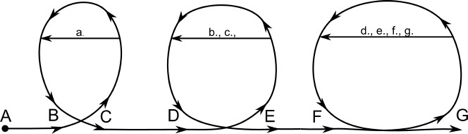
Table 1
| I. Sense of Well-being can return (A to B) in 2-4 sessions. A client can feel relieved by an experience of being heard and understood; also, by the hope that this person, the therapist, will be helpful. | II. Symptom Reduction (B to C) 4-13 sessions: Can consist of decrease in anxiety and/or depression; gaining some insight; renewal; restoration of inner peacefulness; perhaps some return of harmony in a difficult relationship; modifying; a. adapting. | III. Positive Change becoming more lasting (D to E) [14-24 sessions]: Can consist of b. adjusting to new ideas, trying out new insights attained, re-thinking; experience of new and different feelings; re-organization of thoughts, ideas, and feelings, c. ingesting. | IV. Lasting Change being solidified (F to G) [25 or more sessions]: Relationships more anchored in a new and better way of initiating interactions, and of responding to the initiations of the other person;
d. absorbing; e. internalizing; f. incorporating; g. consolidating. |
This model is not appropriate for everyone. People find resolution of issues in varying lengths of time. It is offered here as an example of a way that psychological treatment can progress. Such progress varies according to motivation, severity of issues, and goals of therapy.
The following descriptions of a. to g. above, are processes which occur as parts of the cyclical nature of therapeutic change. They are proposed as an integral part of on-going treatment. These clearly have nothing in common with regression:
- Adapt: To make fit for a specific or new use by modifying that which previously existed.
- Adjust: To bring differing aspects of one’s personality together into a more satisfying state and a more effective position in order to favorably impact one’s relationships.
- Ingest: To take in new understanding of oneself for a good purpose, e.g., improved communication in marriage.
- Absorb: To take in new learning as one’s own that which was previously unknown or not understood.
- Internalize: To take what is being learned in counseling and what has proven to be useful in real life and relationships; for use as guiding principles; putting insight into effect.
- Incorporate: To take new insights and work them into a person’s pre-existing personality; to combine thoroughly.
- Consolidate: To join together various understandings into one whole; to make firm or secure; to strengthen.14
We are cyclical beings who live out our lives in 24-hour daily cycles, seven-day weeks, 52-week years. It can take two to four sessions for an individual to go from A to B above with restoration of a sense of well-being.15 However, getting to C is not a straightforward process. There is, necessarily, time spent gaining insight and modifying thoughts and ideas before forward movement once again occurs. Going from C to B is not regression or going backwards. It is a time of adaptation with emotional equilibrium being restored, possibly followed by some new and different feelings. It is part of the work and substance of therapy, and part of how therapeutic progress occurs. Not many humans, if any, move forward by means of one-trial learning.
In view of the model above regarding the therapeutic process, movement from point B to point C with significant symptom reduction can occur in approximately thirteen sessions of therapy.16 In my counseling experience, movement from point D to point E including good potential for practical and lasting change for the better can happen with fourteen to twenty-four sessions.
It has also been my counseling experience that solidifying lasting change for the better (point F to point G) can take twenty-five or more sessions of consistent effort blessed by God’s grace.
If significant symptom reduction is the most a client cares about, such has little or nothing to do with lasting change for the better. Symptoms can and do return after a time when there is insufficient follow-up and underlying dynamics have not been addressed.
The Therapeutic Alliance
What does the therapeutic alliance look like? What is necessary on the part of the counselor? What is needed from the client?
From the counselor:
- atmosphere of welcome and safety.
- service-oriented attitude; the counselor as servant-leader.
- broad structure that includes respect for the client’s free will, and yet provides helpful treatment recommendations.
- worksheets that reinforce useful therapeutic principles and new learning.
- commitment to changing and growing personally.
- professional growth, including regular continuing education.
- gradual and judicious use of counselor self-disclosure as counseling progresses, and in accord with the latest research findings. This is provided when, in the judgment of the counselor, such self-revelation will benefit the client and promote progress in the counseling process.
- review of previous session notes in preparation before each visit.
- provision and review of educational materials: in-session; providing relevant materials for use by the client in-between visits.
- sensitivity to the client. A counselor can have an agenda for the up-coming session, for example, going over educational materials to promote and reinforce agreed-upon counseling goals, including review of publications important for counseling progress. Nevertheless, this is set aside as the counselor orients himself to the client’s present reality and certain influences in their life. The counselor’s “agenda” can usually wait.
From the client:
- regular attendance at counseling sessions.
- arrival on time. Please call if you anticipate being late.
- a minimum of 24-hour notice is needed for cancellation (exceptions: valid emergency or sudden illness).
- honest, open, and full self-disclosure, holding nothing back. What might interfere with this?
For example:
- a) Fear: “How much emotional pain will I have to endure to effectively deal with these matters?”
- b) Embarrassment: “Oh, I can’t reveal that! What will the counselor think of me?”
- c) A power issue: Counseling is a relationship of unequal power. Since knowledge is power, and the counselor knows or comes to know the client but this is not immediately reciprocal, the client can feel at a disadvantage. Trust is a key.
- trust in the counselor’s ability and goodwill on your behalf.
- be aware of your expectations and goals for the counseling. What outcomes do you want to see? Share these with the counselor.
- engage in note-taking to help with retention of new self-understanding and new ideas. Review notes regularly and before each session. New concepts are not easily retained.
- think about your upcoming session. What do you need to talk about? Being open and forthcoming about your desires for the session and for counseling in general is essential.
- consider that counseling is a collaborative endeavor, with both counselor and client working towards the accomplishment of shared goals.
- believe that your daily life can be better and stay better.
- be aware of the influence of current significant persons in your life. Are they in favor of your participation in counseling? Unsupportive? Indifferent?
- be aware that in marriage counseling, unresolved issues for husband or wife from previous relationships and/or the primary family (the family in which one grew up) can and will interfere with therapeutic progress if not honestly and openly addressed in the counseling session.
- have a willingness to think about the end of therapy from the beginning: How many sessions do you expect to attend? More than one or two? Fewer than 10 or 20? Open-ended? Sometimes, a sense of well-being can return in as little as two to four sessions. Some clients, however, may need many more sessions for significant symptom reduction, which can and do return without sufficient follow-up. For those who stay in therapy past initial stages: let’s have a good ending.
Note: Symptom reduction, such as those involving depression or anxiety, is an important goal. It’s more important to learn what caused symptoms, and learn what is necessary to prevent recurrence, for example, gaining and applying insight and new self-awareness to help make change lasting.
Joyful Transformation
What else is required from counselor and client in order for Christ-centered therapy to be effective? Believe that the Spirit of God is the healer in any counseling endeavor. In Christ-centered counseling the counselor seeks, by grace and as much as humanly possible, to be an empty channel of God’s healing love and understanding to the client. The client is requested to do their best to not engage in controlling behavior throughout the course of counseling. This calls for trust: trust in God, trust in the counselor, and trust in one’s own potential for growth and healing.
The client allows God to do a transformational work within to achieve the goal of healthy human function — to love unselfishly, and be open to receive love from God and others, resulting in a satisfying, fruitful life, forgiving one’s own shortcomings and those of others.
Christ-centered counseling proposes that feelings of happiness come and go in life, but deeper joy can be a more permanent reality for those who learn to trust in God and truly know His love and understanding for each personally. For the counselor, the secret lies in the discovery that there is joy in serving the client and seeing new life come forth. Joy for the client comes from being open to receive grace and healing from God during the counseling experience, that is, the joy of knowing we are constantly loved.
A Time To Grow
Aleksandr Solzhenitsyn, who escaped from the oppressive Soviet Union, said, “The meaning of earthly existence lies not, as we have grown used to thinking, in prospering but in the development of the soul (psyche’).”17
Hence, I believe God is vitally interested in three things:
- your love for Him.
- your love for others.
- the unchanging truth about your immortal soul (psyche’) and spirit.
In regard to this third point, God’s word says, “I consecrate Myself for them, so that they also may be consecrated in truth,” (John 17:19, NAB), including the truth about the meaning of life, personal growth, and its far-reaching effect on self and others.
Are you being called to understand the immeasurable worth of one human soul and the mystery of one human person — yourself?
Prayer
The important part: recognition that “More things are wrought by prayer than this world dreams of”18 In prayer, a client can invite the Spirit of God into all phases of the treatment process. If one is willing to have their Creator as a partner to their therapy, he or she can begin by inviting Him before coming to each session. Pray on the way to the session to surrender ideas and expectations, and receive from God the grace to trust and receive His truth and healing.
When a person enters therapy it means, among other things, that there is an internal yearning for something more. Every believing person knows the Source of that yearning. It is a human yearning for the divine.
Pray that God gives you the grace to let Him choose the focus or subject matter, and the direction in which He wants the session to go. Pray for grace to accept His pace for your therapy and healing. Few are content with it. Most wish it to speed up. It usually doesn’t. But there is a certain “wisdom of the unconscious”19 if the Lord has been welcomed therein. Trust that God is working there, and in the timing with which it yields fruit.
Pray to the Sovereign God who made Heaven, earth . . . and you!
Additional Related Thoughts
A. Christ-Centered Counseling and Spiritual Direction
There are basic distinctions between Christ-Centered Counseling and spiritual direction, but also some similarities: a.) both are biblically oriented,20 b.) both consider the working arrangement of counselor and counselee, called the therapeutic alliance, and that between spiritual director and directee, called the working alliance to be crucial,21 c.) both can have resistance arise in those they seek to serve,22 d.) both work for the attainment of similar goals, such as, individual growth, inner peace, and growing freedom to love and receive love.
However, differences set the two endeavors apart in important ways. Most, if not all types of counseling typically follow an agreed-upon timeline. On the other hand, spiritual direction is a life-long exercise with some persons seeking spiritual direction once a month or once every three to four months, looking to deepen their life with God.23 Furthermore, spiritual direction is not weekly as is typical in psychotherapy. If that is needed, the person might require psychological counseling for a period of time. The spiritual director “should know when to refer someone” for psychological or psychiatric treatment.24 Spiritual directors focus on the person’s life with God, and do not deal with mental health issues.25
The person in spiritual direction is encouraged to look at their life’s circumstances as well as engage in prayer and Scripture reading to discern where God is showing direction.26 The spiritual director asks appropriate questions to aid in such discernment. The person seeks to listen to God to answer the question, “How is God speaking in and through my life?”
B. Therapeutic Progress
Learning what caused symptoms or dysfunctional relationship dynamics and what is necessary to prevent recurrence includes:
- Timely completion and putting into use educational materials provided.
- Cognitive modification: re-thinking and thinking anew about the past and about harmful experiences primarily by means of the process of forgiveness.
- Examination and re-examination of thoughts, emotions, and motivations.
- Psychological insight; new and better self-understanding; re-organizing or re-ordering of thoughts, ideas, and feelings.
- Solidifying lasting change for the better. This is accomplished, in part, by thoroughly incorporating new insight, and working this into one’s relationships and personality structure, thereby changing these for the better.
- Important: Awareness of one’s inner world, and the object-images of significant others in us, e.g., mother, father, siblings, spouse, with which we have internal relationships.27
- Some understanding of the dynamic unconscious and its influence in one’s life; making what is unconscious conscious and thereby gaining power, self-control, and self-mastery.
- Some understanding of the psychoanalytic concept of transference, that is, the effects of past significant relationships on present relations, including the therapeutic relationship.
- Potentiating or making permanent, healthy change a reality. This has a necessary requirement: including the Lord God in the on-going process during and after treatment.
C. Unconscious Dynamics: A Brief Note
Upon seeing a person in therapy over a period of time, it is not uncommon for a therapist to be able to identify unconscious processes operating to ill-effect in the person’s life. At that point an important part of therapy includes bringing that which was unconscious into conscious awareness; consequently, unconscious matters can begin to lose power over attitudes, emotions, and behavior and the person gains power. This significant area of therapy empowers the client to gain self-mastery and control over previously vexing matters in life. In this part of therapy there can be help with answer(s) to the question so aptly stated by St. Paul: “Why is it that what I want to do I do not, and what I hate, that I do?” (Romans 7:15, NIV), that is “The heart has reasons about which reason knows nothing” (Pascal).
D. Marriage Counseling
Christ-Centered marriage counseling shares much in common with Christ-Centered Counseling for individuals with some notable exceptions. Primarily, the therapeutic alliance — how the counselor and couple will work together — presents a greater challenge for the marital therapist. Agreement on significant issues, goals of counseling, and methods used to achieve those goals must now be shared by three rather than two persons, at times a difficult task to accomplish. The counselor must establish a rapport with each spouse who can be totally at odds with each other.
Nevertheless, some basic principles must be agreed upon in order for therapeutic progress in the marriage to take place, starting with laying a foundation of mutual love and respect.28 On this foundation is built communication and conflict resolution skills.29 Marriage counseling is much more of a teaching process than individual counseling, involving educational materials and systematic instruction that includes unlearning dysfunctional ways of interacting on the part of the couple, as well as the teaching of effective alternative attitudes, principles, and behaviors by the therapist.
Finally, no marriage can prosper and grow without at least three basic commitments made by each partner:
1) Commit to forgiving each other’s faults and shortcomings, and
2) Commit to praying together, particularly after an argument for which each accepts some responsibility, and
3) Commit to placing each other and the marriage relationship first after God. Of course, children require a great deal of time, attention, and love from each spouse. Nevertheless, it is very important that couples set aside time for each other at every opportunity.
Please note that this is a brief synopsis. The essential elements of marriage counseling involve much more than what is outlined here.
Marital therapy is one of the biggest challenges and potential source of joy and satisfaction that can be experienced by clients and counselors.
Conclusion
Christ-Centered Counseling emphasizes a series of cycles that include absorbing and assimilating new, effective ways of being in relationship with oneself and others. Formation of the therapeutic alliance is a key, referring to basic agreement between therapist and client about issues, goals, and methods of treatment. Christ-Centered Counseling is a most efficacious or effective method of promoting emotional, mental, and spiritual health leading to lasting change for anyone willing to allow the Spirit of God to show the way in therapy and beyond.
It is my happy experience that counseling sessions begin to actually take on a certain joyous quality for those who have remained in therapy past the time of sorrow and pain. There comes a point of laughter, joy, and even fun. Joy and good humor are like yeast that causes the dough to rise. New growth and release from the effects of harmful past experiences result in peace and freedom, freedom to enjoy God’s real presence, healing, growth, and love.
The work we do in this life to grow in Christ has an impact on self and relationships that is lasting and far-reaching. There is not only a profound effect on earthly existence and current and future generations, but also important implications for the hereafter. Good changes made now affect self, others, the future, and eternity in ways we don’t foresee. Please consider: a certain urgency can be seen in Scripture with regard to time: “You do not know about tomorrow. What is your life? . . . you are a mist that appears for a little time and then vanishes.” (James 4:14, RSVCE). The opportunity for individual growth with its implications for eternity and a positive impact on others comes to a definite end. We must do our best in the here and now to become what God intends us to be.
The author wishes to express gratitude to the Holy Spirit and these others: Louis Loumos, Paul Bell, Barbara Cook, Deacon Peter Lemoncelli, and Rev. Richard Burke, C.P.
References
Alfred, Lord Tennyson (1869). Idylls of the King: the Passing of Arthur. Strahan, London.
Barry and Connolly, W. J. (2009). The Practice of Spiritual Direction. Harper Collins Publishers, New York, New York.
Baskin, T. W. & Enright, R. D. (2004). Intervention studies on forgiveness: A meta-analyses. Journal of Counseling and Development, Vol. 82.
Cioni, P. F. (2007). Forgiveness, cognitive restructuring and object transformation. Journal of Religion and Health, Vol. 46, No. 3.
Cuijpers, Reijnders & Huibers (2019). The role of common factors in psychotherapy outcomes. Annual Review of Clinical Psychology, 15, 207-231.
David, D., Christea, I., & Hoffmann, S. G. (2018). Why cognitive behavioral therapy is the current gold standard of psychotherapy. Frontiers in Psychiatry 9:4.
Delaney, H. D., Miller, W. R., & Bisono, A.M. (2007). Religiosity and spirituality among psychologists: A survey of clinician members of the American psychological association. Professional Psychology: Research and Practice, 38, 538-546.
Downs, T. and J. (2003). Fight fair, Moody Publishers. Chicago, IL.
Eggerichs, E. (2004). Love and respect, Integrity Publishers. Nashville, TN.
Eich, E. (2014). Business not as usual. Psychological Science, 25, 3-6.
Fincham, F. D. (2022). Towards a psychology of divine forgiveness. Psychology of Religion and Spirituality, Vol. 14, No. 4, 451-466.
Gartner, J. (1988). The capacity to forgive: An object relation’s perspective. Journal of Religion and Health, 27, 313-320.
Goldfried, M. R. (2019). Obtaining consensus in psychotherapy: What holds us back? American Psychologist, Vol. 74, No. 4, 484-496.
Gray, S. (2022). Faith-based counseling vs traditional psychotherapy: A phenomenological evaluation of African American Protestant experience. National Louis University. Dissertations 708.
Harvey, A. G., Lee, J., Williams, J., Hollom, S. D., Walker, M. P., Thompson, M. A., et al. (2014). Improving outcome of psychosocial treatments by enhancing memory and learning. Perspectives on Psychological Science, 9(2), 161-179.
Hayes, A. M., et al. (2007). Change is not always linear: The study of non-linear and discontinuous patterns of change in psychotherapy. Clinical Psychology Review, 27(6): 517-523.
Jung, C., in Peck, S. (1993). The road less traveled. Simon & Schuster. New York, (p. 247).
Kazdin, A. E. (2007). Mediators and mechanisms of change in psychotherapy research. Annual Review of Clinical Psychology, 3, 1-27.
Kernberg, Otto F. (1995). Object relations theory and clinical psychoanalysis, Jason Aronson, Incorporated Publisher.Kihlstrom, J. F. (1993). The psychological unconscious and the self. Wiley, Chickester (Ciba Foundation Symposium 174), p. 147-167.
Krause, N. & Ellison, C. G. (2003). Forgiveness by God, forgiveness of others, and psychological well-being in late life. Journal for the Scientific Study of Religion, 42(1): 77-94.
Kuhn, T. S. (1970). The structure of scientific revolutions. University of Chicago Press, Second Edition, Vol. 2, No. 2.
Mack, K. J. (2020). Unveiling God in counseling: The compatibility of Christian theology and the modern therapeutic process. Senior Theses. 330. University of South Carolina-Columbia.
Merton, T. (1987). Spiritual direction and meditation. The Liturgical Press, Collegeville, MN.
Moss, D.B. (1986). Revenge and forgiveness. American Imago, 43, 191-320.
Norcross, J. C. (2012) Changeology. Simon & Schuster. New York, (pp. 20, 180).
Nouwen, H. (2006). Spiritual Direction. Harper Collins. New York, New York.
Olson, D. H. & Olson, A. K. (2000). Empowering couples, Life Innovations Incorporated, Minneapolis, MN.
Peck, M. S. (1978). The Road Less Traveled. Simon & Schuster. New York, New York.
Peterson, J. & Nisenholz, B., (1987). Orientation to counseling, Allyn and Bacon.
Post, B.C. & Wade, N. G. (2009). Religion and spirituality in psychotherapy: A practice-friendly review of research. Journal of Clinical Psychology, vol. 65(2), 131-146.
Reber, J. S. (2006). Secular psychology: What’s the problem? Journal of Psychology and Theology, 34(3), 193-204.
Richards, R. S. & Worthington, E. L. (2010). The need for evidence-based spiritually oriented psychotherapies. Professional Psychology: Research and Practice, 41, 363-370.
Shedler, J. (2015) in Ecker & Vaz (2022). Memory reconsolidation and the crisis of mechanism in psychotherapy. New Ideas in Psychology, 66.
Smith, T. B., Bart, J. & Richards, P. S. (2007). Outcomes of religious and spiritual adaptations to psychotherapy: A meta-analytic review. Psychotherapy Research, 17, 643-655.
Solzhenitsyn, A. (2003). Cancer ward: A novel; Translated by Bethell, N., and Burg, D., Vintage (Rand).
Swift, J. (2020, May 22). Addressing psychotherapy dropout: Strategies for engaging clients and improving outcomes, TZK Live Seminar, Clarksville, MO.
Wampold, B. E. (2013). The good, the bad, and the ugly: A 50-year perspective on the outcome problem. Psychotherapy, 50(1), 16-24.
Warren, N. C. (1990). Make anger your ally, Focus on the Family Publishing. Colorado Springs, Colorado.
Webster’s 7th New Collegiate Dictionary, (1972), G. & C. Merriam Co., Publishers, p. 526.
Weigel, G. (2001). Witness to Hope. Harper Collins Publishers, Inc., New York, (p. 138).
Worthington, E. L., Karuso, T. A., McCullough, M. E. & Sandage, S. J. (1996). Empirical research on religion and psychotherapeutic processes and outcomes: A 10-year review and research prospectus. Psychological Bulletin, vol. 119, No. 3, 448-487.
Reference is made to the following Bible translations: New American Bible (NAB); Revised Standard Version Catholic Edition (RSVCE); New International Version (NIV).
- A. G. Harvey, J. Lee, J. Williams, S.D. Hollom, M.P Walker, M.A. Thompson, et al., “Improving outcome of psychosocial treatments by enhancing memory and learning,” in Perspectives on Psychological Science, 9(2) (2014), p. 161. ↩
- J. Shedler, “Memory reconsolidation and the crisis of mechanism in psychotherapy,” in Ecker & Vaz, New Ideas in Psychology (2022), 66. ↩
- E. Eich, “Business not as usual,” Psychological Science, 25 (2014), 3–6. ↩
- T.S. Kuhn, The Structure of Scientific Revolutions, Vol. 2, No. 2, Second Edition (Chicago: University of Chicago Press, 1970), 100. ↩
- Webster’s 7th New Collegiate Dictionary (Springfield, MA: G. & C. Merriam Co. Publishers, 1972), p. 526. ↩
- Patrick Cioni, “Forgiveness, cognitive restructuring and object transformation,” in Journal of Religion and Health, Vol. 46, No. 3, 2007, p. 391. ↩
- K.J. Mack, Unveiling God in Counseling: The Compatibility of Christian Theology and the Modern Therapeutic Process. (Senior Theses, 330: University of South Carolina-Columbia, 2020), p. 3. ↩
- J.S. Reber, “Secular Psychology: What’s the Problem?” in Journal of Psychology and Theology, 34(3), 2006, pp. 193–204. ↩
- Mack, Unveiling God in Counseling, p. 5. ↩
- B.C. Post & N.G. Wade, “Religion and spirituality in psychotherapy: A practice-friendly review of research,” Journal of Clinical Psychology, vol. 65(2) (2009), p. 132. ↩
- Post & Wade, “Religion and spirituality in psychotherapy,” 131–146. ↩
- B.E. Wampold, “The good, the bad, and the ugly: A 50-year perspective on the outcome problem,” Psychotherapy, 50(1), 2013, 16–24. ↩
- George Weigel, Witness to Hope (New York, NY: Harper Collins Publishers, 2001), p. 138. ↩
- J.C. Norcross, Changeology (New York, NY: Simon & Schuster, 2012) pp. 20, 180. ↩
- J. Swift, “Addressing Psychotherapy Dropout: Strategies for Engaging Clients and Improving Outcomes,” TZK Live Seminar, Clarksville, MO (May 22, 2020). ↩
- Swift, “Addressing Psychotherapy Dropout.” ↩
- Aleksandr Solzhenitsyn, Cancer Ward: A Novel, translated by N. Bethell, N. and D. Burg (Vintage (Rand), 2003). ↩
- Alfred, Lord Tennyson, Idylls of the King: The Passing of Arthur (London: Strahan, 1869). ↩
- Carl Jung, in Peck, The Road Less Traveled, p. 247. ↩
- W. J. Barry and Connolly, The Practice of Spiritual Direction (New York: Harper Collins Publishers, 2009), p. 138. ↩
- Barry and Connolly, The Practice of Spiritual Direction, p. 218. ↩
- Barry and Connolly, The Practice of Spiritual Direction, pp. 87, 94, 98; M.S. Peck, The Road Less Traveled (New York, New York: Simon & Schuster, 1993), p. 301; Henri Nouwen, Spiritual Direction (New York, New York: Harper Collins, 2006), pp. 18, 19). ↩
- Thomas Merton, Spiritual Direction and Meditation (Collegeville, MN: The Liturgical Press, 1987), pp. 13, 50, 51. ↩
- Merton, Spiritual Direction and Meditation, p. 50. ↩
- Merton, Spiritual Direction and Meditation, pp.14, 49, 50; Nouwen, Spiritual Direction, p. 23. ↩
- Nouwen, Spiritual Direction, pp. xv, xvi. ↩
- Otto F. Kernberg, “Object relations theory and clinical psychoanalysis,” Jason Aronson, Incorporated Publisher; F. Kihlstrom, “The psychological unconscious and the self,” Wiley, Chickester (Ciba Foundation Symposium 174), 1995, p. 147–167. ↩
- E. Eggerichs, “Love and Respect,” in Integrity Publishers, Nashville, TN, 2004. ↩
- N.C. Warren, “Make Anger Your Ally,” in Focus on the Family Publishing, Colorado Springs, Colorado, 1990; J. and T. Downs, “Fight Fair,” in Moody Publishers, Chicago, IL., 2003; D.H. and A.K. Olson, “Empowering Couples,” in Life Innovations Incorporated, Minneapolis, MN, 2000. ↩
 About Patrick F. Cioni
Investing in professional marriage and relationship counseling helps partners improve communication, resolve conflicts constructively, and rebuild emotional intimacy.