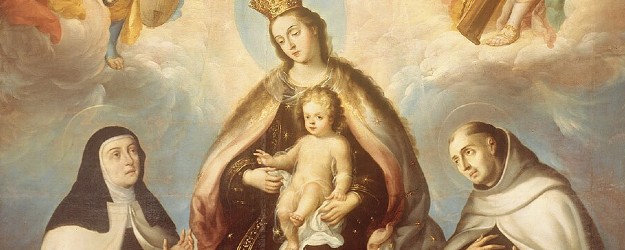
In the thirteenth century, a small band of lay hermits settled on the slopes of Mount Carmel in Israel. They were former pilgrims, merchants, penitents, and soldiers who wanted to live a simple, quiet life centered on the Gospels and consecrated to Christ. They built a chapel to honor his mother, Mary, and took her for their patroness. These solitary and silent hermits were unknown. They lived in the presence of God, attended to their prayers, worked with their hands, and meditated on the mysteries of God. Their life was imaged on the figures of Elijah the prophet and Mary the Mother of God. They became known as the Brothers of the Blessed Virgin Mary of Mount Carmel. Around 1209 a rule was written for them by their bishop Albert, Patriarch of Jerusalem, which unified the elements of their lifestyle. Thus the Carmelites became the first order dedicated to Mary in the Catholic Church.
In 1247 Pope Innocent IV made some changes in the rule that allowed the brothers and priests to adapt to living in cities as friars as they migrated to Europe. A friar’s way of life is mendicant and itinerant like the Franciscans, Dominicans, and Augustinians. Even though the times for solitude were reduced for the Carmelite friars, they remain an important part of their day.
In the fifteenth century John Soreth, the Father General of the Carmelites, received three houses of pious women, called beguines, into the order and established them as Carmelite nuns. Several Carmelite monasteries of nuns were founded during his time as Father General. This took place twenty-one years after the mitigation of the Rule of St. Albert. In 1452, lay members were included in the order.
A Spanish Carmelite nun of the sixteenth century, Teresa of Avila, brought a new lived expression of the ancient rule of St. Albert into the Church. She restored this rule, which had been relaxed, and infused into it a deeper spirit of service to the Church through prayer. Her new community of cloistered nuns was dedicated to a life of prayer, solitude, sacrifice, poverty, and sisterly charity. During her life, Teresa founded seventeen monasteries of nuns, and with the help of John of the Cross, restored the primitive rule to newly established houses of Spanish Carmelite friars. Before she died, her foundations of nuns and friars were established as a separate province of the Carmelite Order, having its own distinct spirit and government. In due course they became known as Discalced Carmelites and today they include friars, nuns, sisters, diocesan priests, permanent deacons and seculars, who are the laity and the largest group of Discalced Carmelites today. At the present time, the Rule of St. Albert can be adapted and used as a guide for Discalced Carmelites in every situation and lifestyle.
Why a Rule?
A religious rule of life helps people to seek God, bonds them with their deepest self, and anchors them during hard times. Every order in the Catholic Church is known by an attribute of Christ. The Franciscans exemplify poverty, Dominicans preaching, Augustinians unity, and Carmelites prayer. The Rule of St. Albert offers a framework for a life of spiritual discipline that supports prayer leading to service. The original rule was written by St. Albert of Jerusalem (d. 1214) and is rooted in hope. Hope is the cradle for Carmelite life lived in allegiance to Jesus Christ. Through hope, Carmelites believe in him and his love for them. Carmelites turn to him with every step on the rugged trail that ascends Mount Carmel. They trust Mary to be their primary guide. She helps them over rough spots, and holds their hands when they are afraid.
Albert’s rule is not a tome of regulations, regimentation, details, or time schedules. His rule is brief, unpretentious, and rather familial in its plainness. He left the details about how to live up to the hermits. He established values, but not when and how to live them. The rule is remarkable in maintaining basic elements that support the primary purpose of contemplative life: loyalty to Christ. The content resembles a loose, informal gathering of conventional regulations, maxims, and scriptural phrases, with no particular style. Because Albert knew much of the Bible by heart, most of his phrases were taken from the Bible. It was so much a part of his life that it is difficult to distinguish between his own words and those from the Bible. He did not give references. He also introduced a few community activities into the rule so that the hermits would gather as brothers.
Characteristics of the Rule
The foundation for the rule is, and forever will be, Jesus Christ. He is the person to whom all attributes of Carmel are directed and the Carmelite’s life, companion, goal, and most marvelous mystery. “There is much to fathom in Christ, for he is like an abundant mine with many recesses of treasures, so that however deep individuals go, they never reach the bottom, but rather in every recess find new veins with new richness everywhere.” (John of the Cross) For all its brevity, Albert’s rule provides a sound guide for those who aspire to union with God through prayer.
Carmelite spirituality fosters and facilitates openness to the Christian contemplative milieu. Contemplative prayer is a gift from God. The attributes of Carmel prepare us for this gift. Reflective prayer is the primary attribute and focal point of the Carmelite Order. It is a prayer without frills, peak occurrences, or extraordinary mystical experiences. It resembles the prayer of Jesus when he got up early in the morning and went to a place of solitude to pray. Today, it is the prayer we dwell upon when we go into a room, shut the door, and pray to God in secret. It is a prayer from the heart in which we enter into our own center and flow through it to unite with the God who abides deep within us. When we are serious about prayer, there are no excuses for omitting it from our daily schedule. Prayer is far beyond a duty or an obligation. It is the way to build a loving friendship with God.
Albert’s rule said, “An oratory should be built as conveniently as possible among the cells.” An oratory is a small chapel. It is a beautiful spiritual custom to have a prayer corner or sacred space in our home that is a refuge, a quiet place for family members. Our little oratory would be a peaceful refuge for prayer and reflection in our home. Prayer embraces the concerns of our family, church, and world, lovingly holds them, and then places them in the heart of Jesus. Reflective prayer is the interior reality of Carmel’s call. The external reality is growth in virtue, along with a direct or indirect service to others. Teresa of Avila wrote, “I would never want any prayer that would not make the virtues grow within me.” Indeed, the criteria of our life of prayer is our life outside of prayer.
Another part of the rule stresses a good conscience. A good conscience is based on sound knowledge of the catechism, reception of grace for reasonable good decisions, and common sense, meaning to make sound and prudent conclusions based on an accurate perception of the situation, evidence, and facts. Common sense also includes a balance in daily activities. This means not over doing one activity at the cost of excluding another, doing more than we can manage or putting off things that need to be done. Silence helps us go beyond obvious externals to a deeper reality. We need to find God, and he cannot be found in noise, restlessness, or hyperactivity. If we are overly preoccupied with something, we can step back into silence, relax, and then return to the situation refreshed. Silence guides us to acknowledge, cultivate and ponder unknown areas within ourselves as well as a longing and love for God. We become open and receptive to the holy since silence unveils a spiritual need and whets the appetite for divine nourishment. “The Father spoke one Word, which was his Son, and the Word he speaks ever in eternal silence, and in silence must it be heard by the soul.” (John of the Cross)
Solitude welcomes us to find God, and find ourselves through a deeper immersion into what is truly “real” and, therefore, beyond the daily hustle and bustle. We should not fear periods of solitude, because they can lead to creative endeavors never imagined. Dwell upon the beautiful hymns, poems, books, and works of art that were created in solitude that express our unique worth as God’s own sons and daughters. In solitude, we are alone but our seclusion unites us to God and encompasses the world. Solitude is a place for our private personal prayer that puts us behind the scenes in prayer yet very much in loving communion with others, “We need no wings to go in search of him, but have only to find a place where we can be alone and look upon him present within us.” (Teresa of Avila) Elizabeth of the Trinity tells us, “Take advantage of your solitude to recollect yourself with God. While your body is resting, think how he is rest for your soul.” The fruits of solitude are lived out wherever we find community.
Purity of heart is notable in the rule. Through purity we clear out negative emotional reactions that inhibit our growth in faith and in seeking God. Purity is blocked by attitudes that pull us away from the lights of God’s truth because they stop us from facing our need for God and seeing him working in the negative events in our lives. To protect purity of heart we stay away from dark places in our hearts, in our minds, and on the street. To enhance purity we strive to be upright, sincere, and unswerving in the pursuit of God and of good. It opposes the false trends and the idle or crude talk of today.
Humility is fundamental to Carmel. It reveals a transparency that is refreshing and authentic, and puts limits on trying to figure things out. The Carmelite nun Jessica Powers tells us humility is “to have a place to hide / when all is hurricane outside.” We know when to stop analyzing or evaluating and set things in God’s hands. Teresa said progress in prayer is not made by thinking much but by loving much. She adds, “Love does not consist in shedding tears nor in lasting sweetness and that tenderness in which one seeks consolation; it consists in serving God in justice, in strength of soul, and in humility.” Through strength of soul we acknowledge that our prayers lead us to good actions of some kind. And, no matter how small, our actions lead us back to prayer.
Simplicity is another characteristic of Carmel. With the exception of social obligations for secular Carmelites, Carmelites strive to be plain and simple. This is evident in the sobriety of Carmelite liturgical ceremonies by the friars and the chanting of the Liturgy of the Hours by the nuns. In simplicity, we stand before God with our hearts and hands open. We do not keep what he places in our hands but share it with others without fanfare. Simplicity is a remedy for the sicknesses of consumerism and materialism that plague our society. We do our best with what we have and refrain from thinking that some jobs are more important than others. Teresa of Avila asks, “What does it matter if we are serving in one way or another?” Carmelite living is a continual letting go of things that clutter, things we do not use, or things that mess up our spiritual endeavors. We are easier to understand if we keep what we say simple and direct. Through the simplicity and ordinariness of life, we can touch the depths of God. Thérèse of Lisieux believed that the closer we get to God, the simpler we become.
The nature and content of Albert’s rule should motivate generations which are historically or culturally distant from the time of its origin. Albert’s rule has a rich vision and the capacity to show direction and values to anyone who is seeking God. Elizabeth of the Trinity gives us a core meditation about God: “He wants you to go out from yourself to leave all preoccupations, in order to retire into that solitude which he is choosing for himself in the depths of your heart. He is always there, even when you do not feel him. He is waiting for you, to establish with you . . . an intimate union.”
Virgin of the Incarnation,
in the mysteries of grace
God has made His habitation
in our soul’s most secret place.
Toward that bright and inner kingdom
all our words and ways compel
for the Father, Son and Spirit
in its sacred silence dwell.
Queen and Beauty of Mount Carmel,
Virgin of the solitude,
in the wilderness of Carmel
lies the world’s eternal good.
Draw us to the deep seclusion
and make God alone our goal
in the mystical Mount Carmel
that lies hidden in the soul.
Jessica Powers
 About Carolyn Humphreys, OCDS
Recent Comments