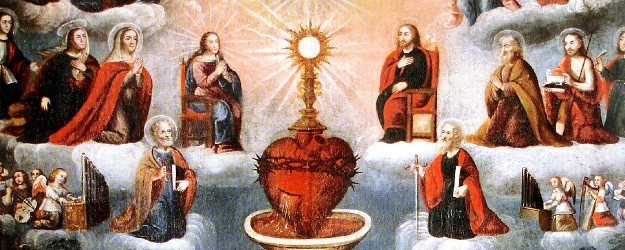
For June 7 (Corpus Christi), June 12 (Sacred Heart), June 14, June 21, and June 28
Solemnity of the Body and Blood of Christ – June 7, 2026
Readings: Dt 8:2–3, 14b–16a • Ps 147:12–13, 14–15, 19–20 • 1 Cor 10:16–17 • Jn 6:51–58
bible.usccb.org/bible/readings/060726.cfm
It can often be said that married couples, as the years roll on, begin to act alike, talk alike, and even look alike. For many, the data of experience corroborates this. How interesting it can be to see a husband and wife, whose many years together are so great and whose love for one another is undoubtedly so great, that their physical beings become so intertwined that it becomes difficult to think of one without the other. But this, indeed, is what Love is: it is so powerful that it can do nothing other than be united to the object it so desires. This is not only true of the love between husband and wife, but more so, it is true of the love between the Creator and His creation; between our good and gracious God and us, His people.
Today, on this Solemn Feast of the Most Holy Body and Blood of Christ, we celebrate the fact that our God is so enamored with us, that He allows Himself to become food and drink for our nourishment; that He allows His own Body and Blood to intertwine with our body and blood, so that we can act like Him, talk like Him, perhaps even bear the marks of His Body like Him.
This intimacy between our God and us is not only an amazing thing, but a challenging one as well. The challenge comes on two levels. The first is the level of mere believability: “How can it be that this tiny piece of bread and this small droplet of wine contain the King of the Universe?” It is a valid question, for in many ways it does not add up. It is like trying to fit a square peg into a round hole, trying to fit a God who is infinite into the “fruit of the earth and work of human hands.” But so is a God who takes on human flesh; so is a God who allows Himself to suffer, die, and be buried; so is a God who entrusts His message of salvation to twelve insignificant fishermen in an insignificant region of the world. God does not do things conventionally, and although we might scratch our heads as to how this or that can be, we have to be comfortable with divine mystery and, as our Sequence, Lauda Sion, reminds us, rest assured that though “sight has failed…dauntless faith believes.” This is hard, for we human beings do like rational explanations to our questions. However, we have to remember that love is less expressed in syllogistic formulae, and more in the affections of the heart that are not so easily expressed in words.
The second level in which God’s intimacy with us is challenging is the demand that we take upon ourselves in our eating and drinking the Body and Blood of Christ. St. Paul tells us in our second reading that the cup we bless is a participation in the Blood of Christ, and the bread we break is a participation in the Body of Christ. What does this mean to participate in the Body and Blood of Christ? Perhaps it would be easier to discuss what this does not mean: this does not mean that we receive Holy Communion nonchalantly, without truly meditating on the great Mystery of Love that it signifies. It is all too easy to get into the habit of going to Holy Communion simply out of rout habit: “I receive Holy Communion because that is what is expected;” or “I approach Our Lord in the Eucharist because everyone else in my pew is doing so, and I do not want to disrupt the traffic pattern; or “I present myself for Communion because I do not want to be left out.” The motivation to receive Holy Communion should not be that of convenience or routine, but rather of love.
To receive the Body and Blood of Christ in Holy Communion is to receive Love incarnate. To receive the Body and Blood of Christ in Holy Communion is to receive the body of teachings that Christ has passed down to His Church—teachings that challenge us to be counter-cultural, teachings that nourish us in the struggle to be faithful Catholics in an age where every idea is tolerated except the idea that holds to an objective truth that is unchangeable, even when it might not match up with the fleeting trends of the day. To receive Christ in Holy Communion is to receive the commission to do as Christ did, to speak as Christ spoke, to be as Christ was and is.
Love is a powerful thing. It forever intertwines the lives of those with whom it comes into contact. May our lives forever be intertwined with the God of Love, who day in and day out nourishes us with the food from Heaven, which makes our bodies a lovely dwelling place for Him who wants nothing more than for us to live with Him forever in a life of perfect and perpetual Communion.
Solemnity of the Sacred Heart of Jesus – June 12, 2026
Readings: Deuteronomy 7:6–11 • Psalm 103:1–2, 3–4, 6–7, 8, 10 • 1 John 4:7–16 • Matthew 11:25–30
bible.usccb.org/bible/readings/061226.cfm
By Fr. Nicholas M. Colalella, SSL
“[T]he Lord set his heart on you and chose you.” Moses’ words from today’s first reading beautifully reflect the meaning of today’s Solemnity of the Most Sacred Heart of Jesus. God does not love in the abstract. The object of his love is not the idea of humanity. God has set his heart on us. It is a love for each individual person, a love for you and me. The Sacred Heart of Jesus is the revelation that God’s love is not distant or theoretical, but intensely personal and passionate.
But what does this love actually look like? In the Gospels, we see this divine love take form in the person of Jesus Christ who, through the Incarnation, enters into our human situation and experiences the gamut of human emotion.
In the Gospel, we see a Savior who knows anger. When he enters the Temple and sees his Father’s house turned into a marketplace, Jesus overturns the tables of the money changers. His Sacred Heart burns with zeal for justice and shares our longing for what is right and true.
Jesus knows joy. St. Luke tells us that Jesus “rejoiced in the Holy Spirit” when the disciples returned proclaiming the works God has done through them. His Sacred Heart shares the joy of friendship and the joy of seeing goodness triumph.
Jesus knows compassion. Again and again the Gospels say that he was “moved with pity.” Jesus sees the crowds and recognizes them as sheep without a shepherd. He touches lepers, he feeds the hungry, he stops for Bartimaeus, the blind beggar, whom everyone else ignored. Jesus’ Sacred Heart is never indifferent to human suffering.
Jesus knows anguish. In the Garden of Gethsemane, his sweat becomes like drops of blood. His Sacred Heart feels the pain of abandonment, betrayal, and agony. Jesus also knows sorrow. Standing before the tomb of his friend Lazarus, Jesus wept. God Himself enters into human grief and His Most Sacred Heart cries out in anguish at the experience of loss.
Jesus knows love. On Calvary, Jesus forgives those who put him there, manifesting the sacrificial love of God. On the Cross, his Sacred Heart is pierced, and from it flowed blood and water, a vivid symbol of the boundless love and mercy God offers to all of us.
All of this means that none of our human experiences are endured alone. There is no sorrow that Christ has not touched, no joy he cannot share, no suffering he does not enter into, and no wound that he cannot carry with us. As Fr. Ronald Knox once said, the Sacred Heart of Jesus “translates the divine Nature into human terms for us.” In the Sacred Heart, the invisible love of God becomes visible, tangible, and approachable.
And once we encounter that love, it changes us. Pope Benedict XVI remarked that an authentic experience of Christ’s love leads us to “be completely enthralled by Christ.” We are therefore invited not merely to believe in Jesus intellectually, but to fall in love with him as a result of our encounter with the tenderness, love, and mercy flowing from his Sacred Heart.
This is the love that enriches the life of every Christian, and in particular, it is the love that informs the life and ministry of the priest. Since we also celebrate today the World Day of Prayer for the Sanctification of Priests, we can also highlight the profound connection between the Sacred Heart and the priesthood. The Catechism, quoting St. John Vianney, reminds us that “the priesthood is the love of the heart of Jesus” (1589). The Lord sets his heart and chooses men to be priests who will render visible and communicate God’s love to those whom he ministers; a love that heals, feeds, forgives, weeps, rejoices, and ultimately sacrifices itself for God and others. It is the love of Jesus’ Sacred heart that shapes the heart of every priest.
“The Lord set his heart on you and chose you.” This is the meaning of today’s feast. The Sacred Heart tells us that God’s love is real, that it entered into human history, and enters into our own personal story as well. May we therefore draw close to Jesus’ Sacred Heart today. May we entrust our fears, our joys, our sorrows, and our wounds to him. And may we become so enthralled by Christ that our own hearts might begin to resemble his own Sacred Heart more and more each day.
Eleventh Sunday in Ordinary Time – June 14, 2026
Readings: Ex 19:2–6a • Ps 100:1–2, 3, 5 • Rom 5:6–11 • Mt 9:36–10:8
bible.usccb.org/bible/readings/061426.cfm
The “heart” can be a challenging organ to describe, both from an aesthetic point of view and from a moral point of view. I have always been intrigued by how we depict the heart in images, as two symmetrically-shaped lobes at the top of the organ that then come together in a perfect point at the bottom. If you were to compare our standard image of the heart in iconography with what this crucial organ looks like in reality, you might be struck by the seeming incongruities, for the actual organ is a somewhat unappealing object to behold: a thick, oblong reality, with arteries, veins, and aortas poking out all over. Similarly, when describing the moral reality of “having a heart” or, conversely, “being heartless,” we might likewise struggle with articulating specific characteristics of such people: do they act willfully and in a stable manner? Is it habitual and episodic? Ultimately, our spiritual and moral sense of the heart is that it is the core of one’s being where, as the Catechism reminds us, the person “decides for or against God” (§368) and serves as “the place of decision . . . the place of truth . . . the place of encounter” (§2563).
That is the human heart. But what about the heart of the God-Man, Jesus Christ? Today’s Gospel gives us an insight: “At the sight of the crowds, Jesus’ heart was moved with pity for them because they were troubled and abandoned, like sheep without a shepherd.” The original Greek text is more direct: it speaks less of “the heart” and more of Our Lord’s “insides,” that is, His “bowels” or His “viscera,” emphasizing how deep His response was to the wandering nature of His sheep (cf. Erasmo Leiva-Merikakis [Father Simeon, OCSO], Fire of Mercy, Heart of the Word: Meditations on the Gospel According to St. Matthew, Vol. 1, Chapters 1–11 [San Francisco: Ignatius, 1996], 515). This is the amazing fact of Christian revelation, that the Lord God was not merely content with teaching us about beatitude, nor was He merely content with showing us the way to beatitude; rather, the amazing mystery of Christian revelation was that the Lord God desired to suffer with us, and thus elevate our suffering to beatitude: “At the sight of the crowds, Jesus’ heart was moved with pity . . .”
What does the Sacred Heart of Jesus do in response to this very human feeling of sadness, of “pity”? Did He wallow in it, as so many of us can feel tempted to do when we fall on hard times or when we encounter something that is disagreeable to us? Did He ignore it, as, again, so many of us can feel tempted to do when we seek to quickly anesthetize the pain that comes from living in this fallen world? No, Our Lord does neither of these things. Rather, what Christ does is act: “Then he summoned his twelve disciples and gave them authority over unclean spirits . . . and to cure every disease and every illness.” A difficulty is met with divine ingenuity. The Lord sees a need, and He responds to it by filling that need with grace, love, and mercy. What’s more, the Lord does not affect His response in a merely efficient manner, driving out unclean spirits and healing the bodies of the sick directly, but He calls forward chosen instruments to be the secondary causes of His love. They are even given individual names: “Simon called Peter, and his brother Andrew; James, the son of Zebedee, and his brother John,” and so on. These men, key figures, “pillars,” in the life of the Church, are essential; however, they are not altogether singular. In fact, they stand primarily as witnesses to an even vaster assembly of people who have been called, as our First Reading from the Book of Exodus reminds us, to be the Lord’s “special possession,” “dearer” to God “than all other people,” and elected to be “a kingdom of priests, a holy nation.”
Do you believe this? Do you believe that you have been chosen by God to be His instruments to transform the Church and the world, elevating them to a higher plane of reality? Some might say that the world today is “heartless,” that it lacks that central animating principle that leads it to that place of decision, truth, and encounter. We hear all too often, and perhaps know directly, of individuals who sadly experience only tragedy and little consolation in this life. Maybe this is partly accounted for by actions they themselves have personally taken and decisions they have personally made, but often this arid state can be the result of lacking divinely-sent instruments to arrest their “heart attacks” and recall them to their true status of citizens of a holy nation and a kingdom of priests.
The Church can only function the way Our Divine Head intended if the members of the Church respond to the invitation given to us by Our Divine Head to share in His sacred mission. Although our typical artistic rendering of the human heart is somewhat fanciful, there is a beauty to its logic. Two symmetrically-shaped lobes that join together at a point reflect well the reality of how God has chosen to interact with us, inviting us to share in His divine life and His work of restoring the world to its original state of perfection. The decision, though, rests with us as to whether we desire to decide for or against this invitation. May I suggest that we follow the Heart of Christ in everything, so that we may “go . . . to the lost sheep of the house of Israel” with a sense of urgency, giving what we have received without cost.
Twelfth Sunday in Ordinary Time – June 21, 2026
Readings: Jer 20:10–13 • Ps 69:8–10, 14, 17, 33–35 • Rom 5:12–15 • Mt 10:26–33
bible.usccb.org/bible/readings/062126.cfm
God truly is a remarkable Creator. Take DNA, for instance. Contained within 23 minuscule pairs of chromosomes lay the blueprint of who we are as human persons: the contours of our bodies, the color of our eyes, the predispositions and susceptibilities we have to particular diseases. Every physical characteristic that God has created us to have is found in this double helix of information that we inherit from our parents at conception. Although we might sometimes toy with the notion of changing this or that part of our body, and although every day science becomes more and more advanced in its understanding of genes and its ability to manipulate them, which can lead to both great moral good and great moral evil, we know that we will never be able to completely erase the genes that reside within us — they will always be a part of our genetic makeup, and they will be passed on to our posterity.
Of course, that is our biological DNA, but there is also a spiritual DNA that we have received from our first parents that has caused us a great deal of anxiety as long as human beings have been inhabiting this planet. The inheritance we have received explains a lot about the often-unpleasant conditions that we live in. Sickness, war, violence, poverty, temptations, death, all have a common denominator, and that common denominator is found in our spiritual DNA: Original Sin.
In the second reading we heard this morning from the Letter to the Romans, St. Paul tells us about this defective gene of ours. He reminds us that through one man sin entered the world, and through sin death, and between sin and death a whole host of other abnormalities have crept into our lives, abnormalities that led the Prophet Jeremiah to call on God to protect his life from the power of the wicked who were trying to entrap him, abnormalities that led Our Lord to encourage His disciples to not be afraid of those who can kill the body.
But all of these abnormalities of life — violence, disease, death — are actually antithetical to God’s original plan for us. Our great ancestors, Adam and Eve, were created by God as perfectly complete human persons living in paradise with God, walking and talking with Him as if He were an intimate friend. Everything was going just fine for our first parents until those two fateful moments when Eve and then Adam decided that they no longer wanted to live in perfect communion with God; rather, they desired to be God, and so they ate of the fruit of the tree that God specifically told them not to partake of. As such, their eyes were opened, and they recognized that they were naked and were, for the very first time, ashamed. It is because of this Original Sin that sin and death entered the world, and as we are interconnected beings, the sin of the first two persons has been transmitted to us, their posterity.
Now I recognize that this is not the cheeriest of topics to discuss on a Sunday morning. To know that our first parents had it all, that they were living carefree in Paradise with God, and to know that our lives on this earth could have reflected that same tranquility is somewhat of a sobering concept. It is like someone having won a lottery ticket worth millions of dollars to be paid out over a lifetime, and trading it to a person who was willing to give him a thousand dollars right there and then. A lifetime of immortal bliss traded in for a moment of fleeting pleasure is an extremely sobering concept.
So basically, we have a problem with some of our spiritual DNA, specifically the sin we have inherited from our first parents. But fortunately for us, there is another inheritance that we received: the redemption wrought for us by Our Lord, Jesus Christ. One of the greatest consolations that we receive from our Faith is knowing that we are worth so much to our God, that He looks past our failings, looks past our spiritual deformities, and gives us a second chance at life. There is nothing that we can do, no sin that we can commit, that God is not willing to forgive if we only come before Him in humility and acknowledge His Son before others.
We live in a world that has its definite share of difficulties, but we also live in a world that has experienced God Himself walking on its ground and breathing in its air. What we have to help us combat the difficulties of life — the difficulties of our human condition — is the hope that God has in store for those who love Him. All of us belong to the Church because we love God and we want to do His will in our lives. But to do His will, we have to be comfortable with the fact that by being a follower of Christ we receive a cross — many crosses to be exact — and that we will be called to carry those crosses with patience and hope, trusting that the One Who carried His Cross before us will be there to guide us in whatever trials may come or have come our way.
Our biological DNA is not perfect, nor is our spiritual DNA, but what is perfect is the God who made both — a God who knows the number of the hairs on our heads; a God who knows what it is like to live in an imperfect world comprised of imperfect people. What a remarkable God we have, a God who never gives up on His creation.
Thirteenth Sunday in Ordinary Time – June 28, 2026
Readings: 2 Kgs 4:8–11, 14–16a • Ps 89:2–3, 16–17, 18–19 • Rom 6:3–4, 8–11 • Mt 10:37–42
bible.usccb.org/bible/readings/062826.cfm
A key detail found in the realm of hospitality is that of making room for another, whether in the home, at table, or in conversation. If one is hospitable, then one “makes room.” Indeed, there is no clearer sign of being unwelcome than to have no space to maneuver in the company of others or no place to really call our own in the midst of community.
Our readings for this Thirteenth Sunday in Ordinary Time, and especially our First Reading and Gospel, point to this important notion of hospitality — of being welcome in the home of another. In the First Reading from 2 Kings, we hear of a woman and her husband who prepare a room in their home for the Prophet Elisha. Elisha is somewhat nomadic, moving throughout the region in order to call the people of Israel to fidelity to the Lord God. He does not have the luxury of time to remain in one place for long, for his mission is too urgent. And even though the number of times that Elisha will actually stay with this particular husband and wife will be relatively few and far between, this does not prevent this couple from making sure that the room will always be ready for Elisha whenever he arrives. He is not a direct member of their family, but he is a prophet of God, and this fact alone makes Elisha a member of their household and, thus, a room will always be prepared for him.
The hospitality that this couple offered Elisha foreshadows the message that Our Lord gives in today’s Gospel. Speaking to the Apostles, in which He is preparing them for their prophetic mission, Christ reminds His chosen band that “Whoever receives you receives me, and whoever receives me, receives the One who sent me.” And then, perhaps calling to mind this couple who received the Prophet Elisha, Our Lord outlines what it truly means to be a Christian: “Whoever receives a prophet because he is a prophet will receive a prophet’s reward, and whoever receives a righteous man because he is a righteous man will receive a righteous man’s reward.” Here, Our Lord gives us a greater sense of what it truly is that binds us together as a people. Certainly, there is never a moment in our lives when we are not called to love our neighbor, regardless of whether our neighbor loves us. However, here we get a sense that the ideal form of love is for our neighbor to call us to a deeper level of commitment to God, and that we, in turn, open up all that we have to our neighbor because we know that we belong to the same household as him, the household of God.
In his reflection on this passage in his commentary on the Gospel of St. Matthew, Erasmo Leiva-Merikakis (Fr. Simeon, OCSO) notes that Our Lord in this passage appears to be connecting “two trinities.” The first and principal one is that of “the uncreated and eternal Blessed Trinity” and the second is the “earthly, created trinity constituted by the precious humanity of the Word, the apostles he sends forth, and all those that the Son himself has commanded the apostles to communicate” (Fire of Mercy, Heart of the Word: Meditations on the Gospel According to St. Matthew, Vol. 1, Chapters 1-11 [San Francisco: Ignatius, 1996] 621). The Church — you and I, joined together under the headship of Christ in His Mystical Body — is a supernatural family where our worldly concerns and values are elevated to a higher plane. This is what St. Paul reminds us about in our Second Reading. When we allow ourselves to be buried in Christ’s life and death, we reach a new and more perfect reality. When we allow ourselves to be transformed by Christ, then we will transform others and, thus, have nothing to fear.
In the given reality of our lives, it might be difficult to be completely hospitable to those around us, whether a neighbor or a prophet. The world in which we live is one in which it feels that dangers lurk on every side, or, at least, one in which we have to keep our guards up. And while there is certainly a need to maintain a healthy application of the virtue of prudence in all we do, we cannot fail to live out the queen of all the virtues — the virtue of charity, the true mark of the Christian. Let us, then, strive to continue to support one another as we, individually and as a Church, aim to make room for those who belong to our household — the household of God — which shows no impartiality or limits, but strives to anticipate not only the arrival of prophets and saints in our midst, but also the Lord God Himself.
 About Fr. Ryan Ruiz
 About Fr. Nicholas M. Colalella, SSL
Recent Comments