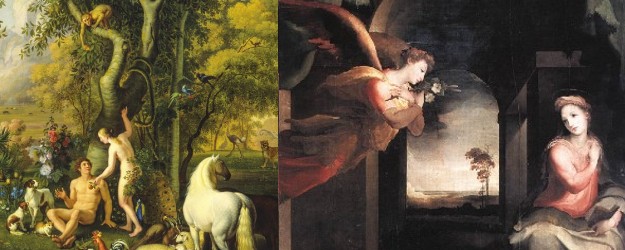
Everything’s changed since Eve and Adam saw the apple in the garden and ate it. It’s a shame, said one preacher, that all that didn’t happen down here with our Cajun folks in Louisiana. If it had happened down here alongside the bayou with Marie and Pierre, they would have thrown away the apple and eaten the snake!
In the medieval world they realized that with the coming of Mary everything is reversed. Even the Latin word that started the change shows the reversal. Adam called his wife EVA, but when the angel first spoke to Mary he said: AVE (“Hail”). EVA reversed is AVE. Adam called his wife EVA because she was to become the “mother of all the living.” (Gn 2:23) The angel said AVE to Mary out of respect because Mary was being asked to become the mother of the Son of God (Lk 1:28), and her human-divine Son would ask her from the cross to consider the disciple John her son: “Woman, behold your son.” (Jn 19:26–7)
When Eve saw the tree in the middle of the garden that they were forbidden to touch or to eat from, even before touching it, she observed three things about it:
- it was good for food (nourishment enabling life to continue),
- it was a delight to the eyes (giving the enjoyment of color and shape),
- it was desirable to make you wise (granting curiosity and learning to the mind. (Gn 3:6)
The apple, the fruit of the tree, was, in other words, Food, Beauty, and Wisdom. Surely there can be nothing wrong for a human being to choose to ingest food, beauty, and wisdom. Unless, of course, it is being handed to you by a venomous snake. Eve was misled by the apparently well-disposed serpent who helpfully slid down the branch, selected the apple, and offered it to her. She should have been more careful. Snakes have no hands; they can’t hand the apple to you; instead, they have to seize it with their mouth, and as their curved fangs puncture the beautiful red skin, they penetrate deeply into the apple with its nourishment, beauty and wisdom, and fill it with poison.
It isn’t always whether or not an object is good; what matters is: who hands it to you. When Pontius Pilate attempted to release Jesus, the people were given a choice: Jesus or Barabbas. The people preferred Barabbas. The people chose a thief and murderer whose name had the apparent beauty of bar.abbas, “son of the father,” rather than the person who really was the Son of the Father. They did not seem to be wary of the fact that this opinion was urged on them by those whose clothes promised piety but who even Pilate knew were hostile to Jesus. “[Pilate] realized that it was out of jealousy that the chief priests had handed him over. But the chief priests stirred up the crowd to have him release Barabbas for them instead.” (Mk 15:10–11) Be wary of who it is who urges you toward the apple.
In Mary’s case it was an angel. And the angel offered her to be the mother of Jesus, king on David’s throne forever (Lk 1:32–3); with, we might say, three familiar characteristics:
- He will have life in his body, which, broken and risen, will be Food for your eternal life,
- He will be a beautiful Delight to see in Bethlehem, and in his kindness, forever,
- He will be Wisdom, making you wise forever in knowing him.
And Mary trusted the angel messenger and said “Fiat,” “Let it be with me according to your [the messenger’s] word.” (Lk 1:26–38)
For though Eve held the apple, Mary held the Messiah. Both women are in our origins and in our behavior. We acknowledge both, but we say “Hail!” to only one.
When her Son came, on the eve before he suffered, he took Passover bread and made it into a golden apple of the Tree of Life. He took the bread into his human and divine hands and gave it to the sons and daughters of the same Eve and Adam who had stolen and eaten the poisoned apple. Jesus broke the bread just as his life would be broken on the tree, deadly nails puncturing and penetrating hands and feet, and he gave the bread to them and said: This is food for life, beautiful forever, filled with the wisdom of God: my body, myself, for you.
Like bread that has been fully and lovingly leavened with the yeast of divinity, he rose. He rose holding mankind with his hands, Adam and Eve, his ancient biblical ancestors,1 and their descendants. Unlike the snake that holds with lethal fangs, Jesus holds with gentle human hands. And to eat, he gives life-giving communion with himself to the children of Adam and Eve, his relatives, with his hands. The effect of eating the deadly snake-bitten apple is reversed by the antidote of eating the life-filled Host handed to us by him from the Tree.
- Lk 3: 23–38: “Jesus was the son (as was thought) of Joseph . . . son of Enos, son of Seth, son of Adam, son of God.” ↩
 About Fr. G. Ronald Murphy, SJ

Speak Your Mind