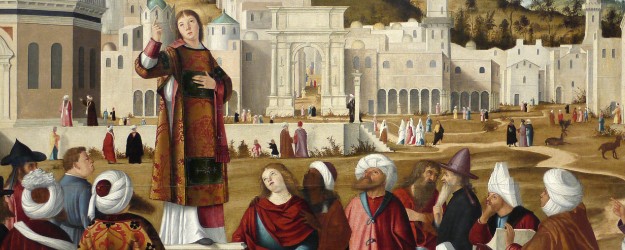
Picture St. Ignatius of Antioch, bishop and martyr, set down without warning in a parish today. He may recognize the vestments, the altar, and the shape of the Liturgy well enough, but would he recognize the relationship between the priest at the altar and the deacon serving with him? This type of thought experiment uncovers a deeper question about how the history, hermeneutic, and trajectory of the modern diaconate are understood in relation to its apostolic roots. Ignatius insisted that a Christian assembly is not fully a church without her bishop, presbyters, and deacons, each exercising a distinct and necessary office reflective of the heavenly banquet. The liturgy is the living tradition of the Church; as the Church professes: Lex Orandi, Lex Credendi, Lex Vivendi — as we worship, so we believe, so we live. However, one cannot help but observe the breakdown that emerges when what we will call the “apostolic diaconate” and the “modern diaconate” are set side by side. A full account of why and how this happened cannot be contained in a single article. But clarifying the nature and essence of the diaconate through the lens of Scripture and Tradition supplies the framework in which an authentic expression of the office can both honor its sources and meet the modern needs of the Church.
Unity of the Sacramental Offices
St. Ignatius did not think of the deacon as an occasional helper, deployed when convenient and set aside when not. Rather, he thought of the deacon as the bishop’s own man: the emissary through whom the bishop’s paternal care reaches the parts of the flock the bishop, and priest for that matter, cannot reach. A priest who treats his deacon chiefly as extra hands during the Liturgy, and a deacon who understands his own office chiefly as a list of permitted functions, would both leave Ignatius wondering where the rest of the mystery had gone. This is not merely nostalgia for a lost custom; the Christian East never lost the permanence of its diaconate, but Rome restored it only in 1967, after the medieval West had reduced it to little more than a brief step on the way to priesthood. The restoration brought real opportunity, but also real confusion: little agreement existed, even among bishops, about who the deacon was or how he should be deployed. More than half a century later, the office is still finding its footing, unevenly: absorbed fully into sacramental and pastoral life in some parishes or treated as little more than a semi-retired volunteer or an ecclesiastical social worker in others. This may seem harsh, and perhaps a gross overgeneralization, but too often the deacon remains a functionary without being understood as necessary, and merely ornamental without being recognized as paternal. If the faithful are to honor tradition, what must be recovered has to be the apostolic office: a father to the whole community and not merely his own household, the same office any early Church Father would still recognize, not a modern ornament that happens to wear vestments.
Ideally, priests and deacons are meant to work as a team, as one ministerial unit in a non-competitive way. This follows from the unity of Holy Orders and the uniqueness of each cleric’s office: one in three. Daily practice in many parishes tells a different story. The theology and visibility of the presbyterate are well established; the diaconate, given its recent deployment at scale, still requires that priest and deacon internalize being of one mind and one body, with distinctly necessary roles, in the work of salvation. How can they become cognizant of this essentiality? For the priest, the aim is a working theology substantial enough to shape how he deploys the deacon assigned to him. The deacon is not a stand-in, nor a utility man filling parish gaps, but, in the Church’s own ancient pattern, the bishop’s other hand. If the priest is the sacramental hand, acting in the person of Christ the Head to consecrate and absolve, the deacon is the ministerial hand, acting in the person of Christ the Servant to carry that same Christ-like care into the ordinary life of the parish. A pastor who understands the difference, and forms and deploys his deacon accordingly, gives his people something truly reflective of the heavenly banquet and life in Christ. For the deacon himself, the aim is more personal: a clear enough grasp of his own sacramental identity, not merely functional but beyond the sum of his actions as an essential servant and spiritual father, to exercise his ministry with the confidence and apostolicity the office was always meant to carry.
The Paternal Modus of Diakonia
In the Christian East, the deacon is addressed as “Father,” or “Father Deacon.” This is not a courtesy title, but settled recognition that the deacon shares, in his own distinct way, in the fatherhood proper to ordained ministry. In 2006, Pope Benedict XVI and the Ecumenical Patriarch Bartholomew I described the patrimony shared by East and West as something “which must be continually shared, proposed, and interpreted anew.”1 Few places in the Church’s life stand to benefit more from that exchange than a Western clergy still working out what to make of its own deacons. Byzantine usage traditionally distinguishes deacons by training. Evlavestatos, “most devout,” describes a man with vocational formation, and ierologiotatos, “most erudite,” one who has completed academic theological study.2 In ordinary parish life, though, both collapse into a single word: father. It is applied without distinction to married or celibate clergy. Addressing a man as “Deacon” may not be the more precise or humble usage it appears to be. It names the office rather than the man who is called by name and sent by the bishop and guided by the local pastor. The purpose behind the Eastern title is not a custom to be imported for its own sake, whether out of clericalism or a misplaced ecumenism, but a recognition of what the Church’s own theology of Holy Orders already affirms. What is this tradition? Drawing on Scripture, patristic witness, and the Church’s liturgical and magisterial tradition, this article traces the deacon’s spiritual fatherhood along four interlocking lines: 1) Christological configuration to Christ the Servant; 2) participation in the angelic allegory; 3) typological inheritance from the Levites of the Old Covenant; and 4) his ecclesiastical fatherhood as an emissary who proceeds from, and is bound inseparably to, his bishop. Together these threads reveal a coherent theology of diaconal spiritual fatherhood and clarify the character and essence of the deacon himself. The deacon is a man sacramentally configured to exercise a real, if distinct, spiritual paternity to the people he serves, and the priest is responsible for knowing, forming, and helping present this reality in an orthodox manner to the faithful.
The Three Kinds of Fatherhood
Any treatment of diaconal fatherhood must begin by clarifying what fatherhood means, since the word carries several distinct senses. First is biological fatherhood, which requires nothing beyond the act of generation. Second is natural fatherhood, the work of providing for, presiding over, and protecting one’s household, whether or not one is a biological parent. Third and highest is spiritual fatherhood, oriented not toward a child’s bodily welfare alone, but toward the eternal welfare of the soul.3 Spiritual parenthood, it should be stressed, is a grace rather than an office as such; it is not restricted by gender, age, or ordination, and the Church’s history offers no shortage of women, from St. Nina of Georgia to St. Catherine of Siena, who exercised a genuine and recognized spiritual motherhood.4 What this article examines is narrower: the specific, sacramentally grounded form of spiritual fatherhood the Church’s tradition has consistently recognized; a fatherhood every cleric enters at ordination, whether or not his formation ever named it, toward the wider Christian community beyond his own household.
Christ’s Diakonia — Icon of Christ the Servant
The only adequate starting point for a theology of spiritual fatherhood is the one Mediator, Jesus Christ. Christ’s sonship perfectly represents the fatherhood of God the Father, and it is a governing principle of Christian spirituality that no one can become a spiritual father without first being a spiritual son.5 The spiritual father has been united to Christ and, by his vocation, becomes a true partner in the divine work by which the Father draws souls into the image of his Son. Spiritual fatherhood, paradoxically, is at root “the imitation of this fatherhood of Christ,” exercised through ordained ministers as instruments by which the Lord continues to beget spiritual children and gather them into his body.6
The deacon’s share in this imitation is not incidental to his office; it is written into the language the Church uses to describe him. From the earliest post-apostolic writings, the deacon has been understood as a living type of Christ the Servant. St. Ignatius of Antioch, writing to the Trallians within living memory of the apostles, urges the community: “It is for the rest of you to hold the deacon in as great respect as Jesus Christ; just as you should also look on the bishop as a type of the Father, and the presbyters as the apostolic circle forming his council, for without these three orders no church has any right to the name.”7 Elsewhere Ignatius entrusts deacons with “the service of Christ” himself.8 This is a striking claim from one of the earliest witnesses outside the New Testament: not merely that deacons are respected co-workers, but that they are correlated directly, and without hesitation, with the person of Jesus Christ. The magisterium uses the same language. Pope Paul VI, in his 1972 apostolic letter Ad Pascendum, describes the deacon as signum vel sacramentum ipsius Christi Domini, “a sign or sacrament of the Lord Christ himself.”9 Pope St. John Paul II, addressing the Italian diaconate, affirmed that the deacon shares in the “triple function of the sacrament of Orders” and personifies, in his degree, “Christ as servant of the Father.”10 And in its 1998 formation directives, the Congregation for the Clergy stated plainly that the deacon is constituted a specific sacramental sign of Christ the Servant and is therefore, in the Church’s words, a “living icon of Christ.”11
None of this is honorific embellishment. It describes an ontological configuration conferred at ordination, one which Pope Benedict XVI later formalized in canon law through his 2009 motu proprio Omnium in Mentem: where the bishop and presbyter act in persona Christi capitis and, read contextually, the deacon acts in persona Christi servi, in the person of Christ the Servant.12 This offers a visual and experiential distinction named at the outset of this article as the bishop’s two hands, sacramental in the priest and ministerial in the deacon. Both configurations are real; neither is superfluous. Where the priest is unmistakably the bishop’s sacramental hand, the deacon is, in a sense, everything else, which is why the office rests in ambiguity as a threshold ministry. This is not a defect to be corrected; it is the blessing of an office that reflects the multi-dimensional mission of the Church, an office defined by who, in essence, the man is rather than by a fixed list of what he does in function. However, the gift and blessing of the office only holds if priests understand it well enough to guide their deacons’ growth and help their people see, in the man beside the altar, a true minister of Christ’s mysteries instituted by the Lord from the beginning. The deacon’s fatherhood, in other words, is not borrowed from the priest’s; it flows directly from his own distinct sacramental character, from his share in the Son’s self-emptying mission. Furthermore, since every priest was first a deacon, he carries this same diaconal fatherhood into his priesthood. This sacramental ladder binds priest and deacon: the priest must see the deacon not as an independent or subordinate agent, but as a younger brother bonded through a shared spiritual paternity. Just as God’s revelation is familial, that familial grammar permeates the one-in-three unity of Holy Orders. St. Ignatius reads this self-emptying as the theological root of the deacon’s title, calling deacons his syndouloi, “fellow slaves,” precisely because their ordained service is a sacramental extension of Christ’s kenosis.13 He came not to receive service but to render it, giving his life for others. The priest does not abandon that reality in taking on presbyteral ministry; he builds upon it, draws fruit from it, and in this familial bond guides the deacon’s own growth in diaconal fatherhood.14
In the Image of the Angels
If the deacon’s Christological configuration supplies the deepest root of his spiritual fatherhood, a second, complementary allegory, especially rich in the Byzantine tradition, illuminates its character from another angle: the deacon as icon of the holy angels. Angels appear throughout the Hebrew Scriptures and the New Testament as guardians and intermediaries between God and man, an office embedded in the very meaning of the word itself. The Hebrew mal’akh and the Greek angelos both mean “messenger.”15 The Catechism of the Council of Trent describes the angels as an expression of God’s paternal solicitude for humanity; in this capacity they illuminate, instruct, purify, and guard.16 It is little wonder the early Church, seeking language adequate to her deacons, reached instinctively for the angel: the deacon occupies an analogous position, sent without authority of his own to accomplish a mission not his own. St. Ignatius of Antioch draws the connection explicitly, asking rhetorically of the deacons under his care: “what are the deacons but imitators of the angelic powers, fulfilling a pure and blameless ministry unto him?”17 Where the angel is essential to the liturgy celebrated in heaven, the deacon is essential to the liturgy celebrated on earth, mediating between God and his people at the altar and beyond it.18 Christ himself remains, of course, the one true High Priest, ministering in the company of his holy angels. Simultaneously in the liturgy, the faithful are joined mystically with the heavenly banquet; the priest standing in persona Christi capitis is fittingly attended by the deacons in the same way.19 In the East, this is written into the Byzantine liturgical tradition itself. Christ Our Pascha, the catechism of the Ukrainian Greek Catholic Church, explains that the orarion, the long stole the deacon wears over his left shoulder and raises as he calls the faithful to prayer, “symbolizes the wings of angels,” since deacons, “like the angels who are ‘ministering spirits’ (Ps 103[104]:4; Heb 1:14), are at the service of the liturgical community.”20 Every time a deacon lifts the orarion to call the faithful to attention, the gesture recalls a truth easy to forget: he ministers not merely as an assistant, but as a visible sign, sent with authority from the bishop, that heaven and earth meet at the altar. This also clarifies the deacon’s place in the community, as the angels serve rather than rule on behalf of another. But it is precisely this posture that the tradition has consistently recognized as an attribute of authentic spiritual fatherhood. The deacon guards a sacred threshold he does not possess himself, carries a message he did not author, and stands ready wherever the Lord’s word needs to be carried. A guardian and an illuminator is, by definition, oriented toward another’s growth and protection rather than his advancement; that orientation is fatherhood’s essential shape.
Heirs of the Levites
A third typology, perhaps less immediately visible to Western Catholics but no less deeply embedded in the Church’s liturgical memory, roots the deacon’s fatherhood in the Old Testament’s Levitical priesthood. St. Clement of Rome, writing at the very end of the first century, already compared the deacons of the Christian community to the Levites.21 St. Athanasius of Alexandria did the same a generation later, explicitly calling deacons “Levites” in the context of divine worship, a title that signals how central liturgy was to the diaconal office from its earliest years.22 This is not a patristic curiosity later ages set aside; it survives, essentially unchanged, in the consecratory prayer used at every diaconal ordination in the Roman Rite today, which explicitly recalls how God “chose the sons of Levi” to be “ministers of your tabernacle.”23 The bishop who prays those words is placing the man kneeling before him inside a line of ministry that begins in the Book of Numbers, where Moses, acting under the Lord’s instruction, set apart a distinct order of men to serve and assist in worship. Scripturally, the Tribe of Levi comprises the Levitical priests and the Levites who assist them in the worship of the tabernacle, in teaching, and in service. (Num. 1–8)
Father Anthony Dragani, a deacon of the Ukrainian Catholic Church, offers a helpful summary of why this matters:
This connection goes back to the early centuries of the Church and reflects the patristic tendency to find antetypes of the new covenant in the old . . . Just as Levites assisted the priests and the High Priest in the liturgy of the Temple, so deacons assist the priests and the bishop in the Liturgy of the Church.24
All priests were Levites, but not all Levites were priests. The non-priestly Levites occupied a distinct, divinely instituted rank between priest and people, existing for a single purpose: to make possible the worship the priests offered on behalf of the whole nation and to mediate the needs of the people. The tabernacle did not function without its Levites any more than it functioned without its priests; their ministry was written into the founding structure of Israel’s worship.
The Levitical type supplies a safeguard against two opposite errors: 1) a real and non-negotiable distinction between deacon and priest, since the deacon does not celebrate the sacrifice any more than the non-priestly Levites offered sacrifice at Aaron’s altar, and 2) the genuine necessity of the deacon’s own proper ministry, one that cannot simply be absorbed into another office; otherwise the distinct offices would have no reason to exist. This was not the case in the Tribe of Levi, nor should it be in the praxis of the Church: priest and deacon are co-essential to what the Lord designed for the salvation of souls. A father who serves at the altar without officiating there is not thereby a lesser father; he exercises the specific, sacramentally distinct paternity proper to his office. Just as the Levites carried the tabernacle through the wilderness so Israel could always find the Lord in her midst, the deacon carries the Gospel he received at his ordination, together with the sacramental presence of the bishop he represents, wherever he is sent.
Emissary of the Bishop
The Christological, angelic, and Levitical imagery, allegory, and typology converge, finally, on a fourth and decisive point: the deacon’s fatherhood is never self-generated but received and sustained by his bishop. The 2004 Directory for the Pastoral Ministry of Bishops teaches that the bishop, as the fullness of Holy Orders, stands as head of the local Church “in the name of the Father, whose image he makes present.”25 The Catechism of the Catholic Church explains that Holy Orders “configures the recipient to Christ by a special grace of the Holy Spirit, so that he may serve as Christ’s instrument for his Church. By ordination, one is enabled to act as a representative of Christ.”26 This configuration happens at diaconal ordination for every clergyman. The deacon receives a permanent sacramental character through the laying on of the bishop’s hands, uniting him to the bishop’s paternal ministry.
This bond between bishop and deacon is not a later theological development; it is attested from the very earliest post-apostolic sources. The Didascalia Apostolorum around A.D. 220 instructs the deacon “to obey and submit himself to the command of the bishop,” to “labor and toil in every place whether he is sent to minister or to speak of some matter to anyone,” and describes bishop and deacon together as being “of one counsel and of one purpose, and one soul dwelling in two bodies.”27 The deacon functions, in effect, as the bishop’s eyes, ears, voice, and heart to the people he serves; the Didascalia elsewhere insists that the community must have “free access to the deacons” so that the faithful may seek Christ in all their needs through him, the clear representative of the bishop, while freeing the priest to engage fully his own presbyteral office.28 St. Cyprian of Carthage reinforces the same from a more disciplinary angle. Addressing a deacon who had overstepped his authority, Cyprian reminds him that the Lord chose apostles, “that is bishops and overseers,” while the apostles in turn appointed deacons “as ministers of their episcopacy of the Church,” and that a deacon who forgets this dependent relationship must “acknowledge the honor of the priest and . . . satisfy the bishop set over him with full humility.”29 Cyprian is not scolding the deacon for being unimportant; quite the opposite. He reminds him that his considerable authority is entirely dependent, and must be exercised with humility, precisely because it is real and essential to the Church’s mission. St. Lawrence, one of seven deacons of third-century Rome, was entrusted with the goods of the Church. When the Roman prefect demanded he surrender the Church’s treasures, Lawrence instead gathered the poor and sick of the city and presented them, declaring, in St. Ambrose of Milan’s account, “These are the treasures of the Church.”30 Every deacon inherits something of that logic: whatever passes through his hands belongs, in the end, to those his ministry exists to serve.
The Church’s Diakonia — Deacon as the Sacramental Sign Personified
This theological architecture matters little unless bishops and priests honor it as a framework, and unless it shapes a deacon’s life among the people entrusted to him. His fatherhood cannot be reduced to social functionalism. Pope Benedict XVI, in his encyclical Deus Caritas Est, states the principle with a clarity only he could offer: “The Church’s deepest nature is expressed in her threefold responsibility: of proclaiming the Word of God (kerygma-martyria), celebrating the sacraments (leitourgia), and exercising the ministry of charity (diakonia) . . . charity is not a kind of welfare activity which could equally well be left to others, but is a part of her nature, an indispensable expression of her very being.”31 The deacon’s tripartite ministry of liturgy, word, and charity is the sacramental and personalized embodiment of this threefold responsibility of the Church; to reduce the diaconal office to any one dimension is to misunderstand not only the deacon but the Church herself. The National Directory for the Formation, Ministry, and Life of Permanent Deacons in the United States makes the same point liturgically: “For the Church gathered at worship, moreover, the ministry of the deacon is a visible, grace-filled sign of the integral connection between sharing at the Lord’s Eucharistic table and serving the many human hungers felt so keenly by all God’s children . . . the Church sees a reflection of her own diaconal character and is reminded of her mission to serve as Jesus did.”32 The deacon, in other words, does not merely perform diaconal tasks; he makes the Church’s diaconal nature visible to herself, to bishops, priests, and the faithful, and to the world they are called to serve.
Recovering Diaconal Fatherhood
None of what has been argued here rises to the level of binding Church doctrine. The custom of addressing clergy as “Father” has varied across history and remains, even today, a matter of pious custom rather than strict theological necessity in either East or West. But the reality underneath that custom is not arbitrary. The diaconate is rooted in the Levites and the holy angels; Christologically configured to the Servant who washed feet and gave his life; ecclesiastically bound to his bishop in a relationship the ancient Church described as “one soul dwelling in two bodies”; and entrusted, through the proclamation of the Gospel, with being the sacramental personification of the Church’s own diakonia. Whether or not the title “Father” or “Father Deacon” ever becomes common usage in the West, the reality it names is already present in every deacon’s vocation and the grammar of tradition. He is a man configured to Christ, entrusted with the Gospel, and exercising a genuine spiritual paternity to the people he serves, and clerics must understand the gravity of this reality. It falls to the deacon to know his own office fully, to exercise it, and to be known by it as more than a set of permitted functions. It falls to bishops and priests to know it as well, to teach and guide from that knowledge, and to expect it of deacons without reservation or compromise. This means consulting his deacon as a fellow minister of the altar, entrusting him with the ministry of the word and liturgical intercession in the image of St. Stephen and Philip, and in ministry beyond the altar in the image of St. Lawrence, all of which belong to him by the indelible mark and grace received at ordination, and showing the parish, in his own bearing and brotherliness toward his deacon, what the bishop’s two hands represent working together for the salvation of souls. A pastor who internalizes this does not merely make good use of a deacon; he gives his people access to a dimension of Christ’s own service they would otherwise be missing.
Orthodox historian Jaroslav Pelikan once distinguished tradition from traditionalism in a single memorable line: tradition, he wrote, “is the living faith of the dead,” while traditionalism is merely “the dead faith of the living.”33 None of the Levitical typology, the angelic imagery, or the patristic witness to the bishop-deacon bond is offered as traditionalism, a set of formulas recited out of nostalgia for a vanished past. It is offered as a living inheritance, one still capable of forming men and shaping a Church that has not yet finished receiving it. Recovering the fullness of the deacon’s spiritual fatherhood, in theological posture and in the ordinary texture of parish life alike, is not a matter of clericalizing the diaconate or importing foreign customs. It is a matter of seeing and honoring what God designed, remembering the beauty of the tradition so evident in the early Church, and deliberately reclaiming this apostolic and necessary reality for the glory of the body of Christ and the spreading of the Good News.
- Benedict XVI and Bartholomew I, Common Declaration, Vatican, December 1, 2006. ↩
- John Chryssavgis, Remembering and Reclaiming Diakonia: The Diaconate Yesterday and Today (Brookline, MA: Holy Cross Orthodox Press, 2009), 127–128, Appendix B, “The Appellation of Deacons.” ↩
- Timothy O’Donnell, The Deacon: Icon of Christ the Servant, Minister of the Threshold (New York: Paulist Press, 2020). ↩
- Gabriel Bunge, Spiritual Fatherhood: Evagrius Ponticus on the Role of the Spiritual Father (Yonkers, NY: St Vladimir’s Seminary Press, 2016), 10. An important caveat about what is, and is not, being claimed: the title “Father,” applied to male clergy, is a fitting and historic custom, but it is not doctrinally required in either East or West. See Carter Griffin, Why Celibacy? Reclaiming the Fatherhood of the Priest (Steubenville, OH: Emmaus Road Publishing, 2019), 31. ↩
- Bunge, Spiritual Fatherhood, 19. ↩
- Bunge, Spiritual Fatherhood, 40–41. ↩
- Ignatius of Antioch, “Letter to the Trallians,” ch. 3, in Bart D. Ehrman, ed. and trans., The Apostolic Fathers, vol. 1 (Cambridge, MA: Harvard University Press, 2003), 259. ↩
- Ignatius of Antioch, “Letter to the Magnesians,” ch. 6, in Ehrman, The Apostolic Fathers, 247. ↩
- Paul VI, Ad Pascendum (1972), sec. 9. ↩
- John Paul II, “Speech to the Italian Diaconate Convention” (March 16, 1985), §2. ↩
- Congregation for the Clergy, “Basic Norms for the Formation of Permanent Deacons” (Vatican, 1998). ↩
- Benedict XVI, Omnium in Mentem (2009), revising Canons 1008–1009 of the Code of Canon Law. ↩
- Ignatius of Antioch, “Letter to the Trallians,” ch. 2–3. ↩
- Owen F. Cummings, Deacons and the Church (New York: Paulist Press, 2004), 25. ↩
- Benjamin L. Hartley, “Deacons as Emissary-Servants: A Liturgical Theology,” Quarterly Review (vol. 19, no. 4, Winter 1999). ↩
- The Catechism of the Council of Trent (Hawthorne, CA: Christian Book Club of America, 1975), 485–486. ↩
- Ignatius of Antioch, “Letter to the Trallians,” ch. 7. ↩
- John Chryssavgis, Diakonia: The Diaconate Yesterday and Today (Brookline, MA: Holy Cross Orthodox Press, 2009), 33. ↩
- Chryssavgis, Diakonia, 33. ↩
- Christ Our Pascha: Catechism of the Ukrainian Catholic Church (Kyiv: Synod of the Ukrainian Greek-Catholic Church, 2016), §634. ↩
- Emmanuel Hatzidakis, The Heavenly Banquet: Understanding the Divine Liturgy, 3rd ed. (Clearwater, FL: Orthodox Witness, 2013), 222. ↩
- Chryssavgis, Diakonia, 33. ↩
- The Roman Pontifical: Ordination of Deacons, Priests, and Bishops, consecratory prayer for the ordination of deacons. ↩
- Anthony Dragani, “Deacons: Emissaries of the Kingdom,” Josephinum Diaconal Review 6 (2018): 22. ↩
- Congregation for Bishops, Directory for the Pastoral Ministry of Bishops (2004), 56. ↩
- Catechism of the Catholic Church, 2nd ed. (Vatican City: Libreria Editrice Vaticana, 2011), no. 1581. ↩
- R. Hugh Connolly, ed. and trans., Didascalia Apostolorum (Oxford: Oxford University Press, 1969), 148, ch. XVI. ↩
- Connolly, Didascalia Apostolorum, ch. IX. ↩
- Cyprian of Carthage, “On the Lapsed,” 54.3, in Ante-Nicene Fathers, vol. 5, ed. Alexander Roberts and James Donaldson (Edinburgh, 1919). ↩
- Ambrose of Milan, De Officiis Ministrorum I.41.214–215. ↩
- Benedict XVI, Encyclical Letter Deus Caritas Est (Boston: Pauline Books & Media, 2006), 33. ↩
- National Directory for the Formation, Ministry, and Life of Permanent Deacons in the United States (Washington, DC: USCCB, 2005), no. 33. ↩
- Jaroslav Pelikan, The Vindication of Tradition: The 1983 Jefferson Lecture in the Humanities (New Haven, CT: Yale University Press, 1984), 65. ↩
 About Michael Bracelin

Speak Your Mind