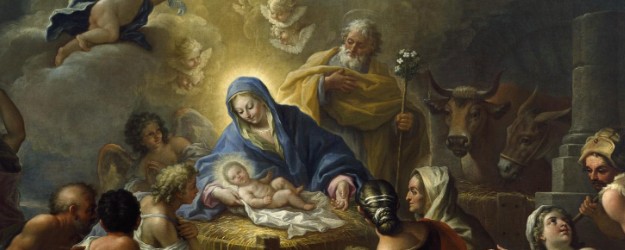
For the Second Sunday, Third Sunday, and Fourth Sunday of Advent, the Solemnity of the Immaculate Conception, the Nativity of Our Lord (Christmas), and the Feast of the Holy Family
Second Sunday of Advent – December 6, 2026
Readings: Isaiah 40:1–5, 9–11 • Psalm 85:9–10–11–12, 13–14 • 2 Peter 3:8–14 • Mark 1:1–8
bible.usccb.org/bible/readings/120626.cfm
Thomas Merton once observed, “The Advent mystery in our own lives is the beginning of the end of all, in us, that is not yet Christ.” This is the hope, in this season of hope, that does not disappoint. It is the hope that brings the comfort Isaiah cries out for in the first reading of today’s Mass. Heralded by John the Baptist in the first sentence of Mark’s gospel, this hope calls us to the repentance that will make straight the tortuous ways of our minds and hearts, assuring a clear and direct path for the Lord to come into our lives.
Like all things valuable, this hope comes at a price. St. Peter, in today’s second reading, clearly states the cost. He reminds us of the sort of persons we are to be: conducting ourselves in holiness and devotion, waiting for and hastening the coming of the day of God, awaiting new heavens and a new earth in which righteousness dwells and all that is not yet Christ in our tired, troubled world is renewed and invigorated by the coming of our God.
Because of this, St. Bernard of Clairvaux (who might well be considered the Advent voice among the Medieval writers) calls Advent a “sacrament.” Certainly not in the sense of the seven sacraments, but because in these brief but sacred days we seek God himself beyond visible things and he comes to us hidden in the Advent time. For Bernard, Advent is necessarily the presence of Christ in our own lives as our Savior.
We are challenged, therefore, in these sacred days to do all that is necessary to embrace this divine presence. The mountains of resentment must be leveled. The rough ways of our ego and entitlement must be smoothed over with greater humility and generosity. Our sometime desperate desire for our way must be converted to a deeper search for the way of the Gospel. All the beautiful poetry and rich imagery of these four short weeks cannot obscure the challenging interior work of surrender to the God who calls us to himself.
Perhaps the final words of an old Advent hymn can help us recognize both our hope and our mission as we pray to him whom we await: “Come and begin your reign of everlasting peace/Come take the kingdom to yourself/Great king of righteousness.”
Solemnity of the Immaculate Conception – December 8, 2026
Readings: Genesis 3:9–15, 20 • Psalm 98:1, 2–3ab, 3cd–4 • Ephesians 1:3–6, 11–12 • Luke 1:26–38
bible.usccb.org/bible/readings/120826.cfm
It is often said that Jesus was the founder of Christianity and Paul was its greatest preacher. Nowhere is that more apparent than in the second reading of this solemnity of Our Lady. Paul’s almost rhapsodic beginning of the Letter to the Ephesians tells us in an acclamation of praise of God’s ultimate plan for the human race. “. . . as he chose us in him . . . to be holy and without blemish before him. In love he destined us for adoption to himself through Jesus Christ.” God not only created us and redeemed us, he is determined to incorporate us into his own divine life. We are to be sons and daughters in the Son!
That divine plan was not without human resistance. Genesis tells us of the tragedy of our fall from grace. That fall, however, was not to be without hope. In
Genesis 3:15, the so-called protoevangelion, God promises, “I will put enmity between you and the woman, and between your offspring and hers; he will strike at your head, while you strike at his heel.” At the very moment of our fall, we are promised salvation. Is it any wonder that the words of Paul would echo down the centuries, “Praised be the God and Father of our Lord Jesus Christ who has blessed us with every spiritual blessing in the heavens.”
It is Luke’s Gospel that tells us how such a transformative adoption and blessing will come about. The familiar account of the Annunciation is the fulfillment of God’s promise of salvation in Genesis and Paul’s praise of our adoption in Christ in Ephesians. In the humility of God that fulfillment would involve a human instrument. That is where today’s solemnity comes in.
We celebrate today the dogma that tells us that, because of the foreseen merits of her Son’s redemption, Mary was preserved from original sin and its effects. Because of God’s favor, she truly is as Gabriel addresses her, “full of grace.” The dogma, while primarily about our Blessed Mother, also has profound implications for the way we understand our humanity. Mary was never limited by the alienation from God that characterizes so much of our human condition. Traditional theology refers to this alienation with the term carentia. The term indicates a lack or deprivation (not a destruction) in our ability to respond to God’s love in filial surrender. Mary was able to respond to God’s plan with her whole self: body, mind, and spirit. “Let it be done unto me according to thy word.” For us such a response is more difficult (not impossible) than God in his original plan ever intended it should be.
Mary’s Immaculate Conception points to what our humanity can be with God’s grace. Our Lady, like every good mother, points the way to the fulfillment of the sacred character of man created in the image and likeness of God. She shows us that alienation from God, the darkening of the mind and the weakening of the will (as Augustine says are the effects of original sin) are not the last word for us. Mary’s example tells us that now humanity can begin again. Eden is not all together a thing of the past. We can believe with renewed vigor what we sing on every Easter night: “Heaven is wedded to earth and man is reconciled with God.” Today we indeed honor Mary, but we also dare to hope for our own transformation in grace.
If you visit the lower basilica of the Immaculate Conception in Washington, D.C., you will find inscribed on the walls of a side chapel given by the Augustinians words of St. Thomas of Villanova about Our Lady: “If in this world any creature ever loved God with whole heart, with whole soul and with whole mind, she was that creature.” On this her solemnity we can give our mother no better honor than our continued struggle to follow her example as we pray, “O Mary conceived without sin, pray for us who have recourse to thee.”
Third Sunday of Advent – December 13, 2026
Readings: Isaiah 61:1–2a, 10–11 • Luke 1:46–48, 49–50, 53–54 • 1 Thessalonians 5:16–24 • John 1:6–8, 19–28
bible.usccb.org/bible/readings/121326.cfm
There is a scene in the Academy Award-winning film Moonstruck that provides a lighthearted but nonetheless instructive gloss on the self-declaration of John the Baptist in today’s Gospel. In the film, one of the main characters, Rose, realizes that her husband is being unfaithful. Feeling dejected, she takes herself out to dinner where she meets an eligible gentleman and consents to have supper with him. When he walks her home and they arrive at the house, he somewhat disappointedly observes that there must be people at home so Rose cannot invite him inside. She tells him there is no one home, but, “I can’t invite you inside because I’m married; I can’t invite you inside because I know who I am.”
The Baptist’s reply to the Pharisees exhibits similar self-knowledge. John clearly knows who he is and who he is not. “I am not the Christ.” Neither is he Elijah or the Prophet. He is the voice crying in the wilderness, pointing to one greater than himself whose sandal strap he is unworthy to untie. Herein lies one of the great messages of the forerunner for each of us. Making straight the way of the Lord often begins with knowing ourselves, recognizing, as Francis of Assisi pointed out, that what we are in God’s eyes, that we are and nothing more.
While such self-insight brings us face to face with our sins and imperfections, it can also underscore the great longing we have for the coming of the one who will redeem us from those foibles of our humanity. Here we can enter the spirit of Advent especially on this third Sunday traditionally called “Gaudete” (rejoice) from the first words of the entrance antiphon, “Gaudete in Domino semper — Rejoice in the Lord always.” There is almost a counterintuitive insight at work as we see the rose-colored vestments and the third candle of the Advent wreath burning brightly. We long for the perfection of our salvation, yet at the same time, we exult at the possibility of such a redemption. We understand more deeply why Isaiah can say that in the midst of such dryness, “I rejoice heartily in the Lord, in my God is the joy of my soul.”
For this reason, Paul can insist both to the Thessalonians and to us, “Rejoice always. Pray without ceasing. In all circumstances give thanks . . .” Advent is the time of this counterintuitive and hopeful rejoicing. We know ourselves to be great sinners, but we also know with an even greater certainty that Jesus is a great savior. We leave church today hearing Paul’s prayer for us ringing down through the centuries: “May the God of peace make you perfectly holy and may you entirely, spirit, soul, and body, be preserved blameless for the coming of our Lord Jesus Christ.” If that is not a reason for rejoicing and hope, then truly what is?
Fourth Sunday of Advent – December 20, 2026
Readings: 2 Samuel 7:1–5, 8b–12, 14a, 16 • Psalm 89:2–3, 4–5, 27, 29 • Romans 16:25–27 • Luke 1:26–38
bible.usccb.org/bible/readings/122026.cfm
In many ways the essence of Advent is pure poetry. From Isaiah’s longing, through the often startling apocalyptic of John the Baptist, we meet today the third great figure of Advent: Our Lady. Into the midnight of our waiting Mary shines like the silver glow of the moon which is her symbol. Having no light of her own, she reflects only the light of the infant growing in her virginal womb. She truly is, as Wordsworth called her, “our tainted nature’s solitary boast.”
To appreciate fully the Mother of God as the apex of this poetic season, we have to see the hidden relationship between today’s first reading from Samuel and Luke’s account of the Annunciation. Through Samuel God reveals that he will establish a house for Israel and raise up an heir for David. The Lord will be a father to him and the heir will be his son. The prophecy achieves dramatic fulfillment in Gabriel’s announcement to Mary. Her child (of the house of David) will be called the Son of God whose kingdom will have no end. This is almost word for word, promise for promise, God’s word to David through Samuel. God’s promise to establish a house for Israel has a poetic fulfillment in Mary “housing” the Son of God in her womb. When she visits Elizabeth in the following scene in Luke’s Gospel, John the Baptist leaps in his aged mother’s womb. Just as David danced before the ark of the old covenant, so does John leap before the ark of the new.
At the heart of the poetic fulfillment of these prophecies stands Our Lady’s response to the angel. We often call that response her “fiat,” the Latin for “let it be.” Raniero Cantalamessa makes the obvious point that Mary did not speak Latin and so he opines that her response could well have been the Hebrew equivalent of “Amen.” With that one word he posits that Mary placed her whole self, heart and mind, intellect and will at the service of the will of God. He further states, using a lovely Italian expression, a occhi chiusi (with closed eyes), that her “yes” to God was said in the darkness of faith. Mary did not have to know all the details of God’s plan in order to place herself at its disposal. What she did know was that, according to the Book of Deuteronomy, a betrothed woman found pregnant before living with her spouse was to be stoned to death at the house of her father. What Mary knew was exactly how dire were her straits. Nonetheless she wholeheartedly assents to God’s plan.
It is at this juncture that the poetry of Advent assumes a direct and demanding message for us today. The poetry of Advent is not mere lovely rhetoric. It constitutes a challenge to conduct our lives with the same courageous determination with which Mary consented to be the mother of the savior. Bernard of Clairvaux, whose appreciation of this Advent time we have already seen, says in one of his sermons for the season that every Christian, male or female, is called to be the mother of Christ in that we are to be bring Christ into our world in our way as Our Lady brought him into the world in hers.
That spiritual birthing of the savior is more often than not in the simplest and humblest of instances. If we are judgmental, we try to be less so. We refuse to say the ugly word to another even when no one would fault us for doing so. We do some shopping or housework for an elderly neighbor or help a fellow student do better in class. We think less of our convenience and volunteer our time in some service projects.
Such seemingly mundane actions allow the poetry of Advent to have practical expression in our lives. They allow us to make homes for Christ in our world as Mary made a home for him in Nazareth. As the Jesuit poet Fr. Gerard Manley Hopkins powerfully phrases it, “Of her flesh he took flesh: He does take fresh and fresh,/Though much the mystery how,/ Not flesh but spirit now/And makes, O marvellous!/New Nazareths in us . . .”
The Nativity of Our Lord – December 25, 2026
Readings (for Midnight Mass): Isaiah 9:1–6 • Psalm 96:1–2, 2–3, 11–12, 13 • Titus 2:11–14 • Luke 2:1–14
See readings for all Christmas Masses: bible.usccb.org/bible/readings/122526.cfm
Many years ago, quite close to Christmas, some dear friends texted me a picture of their then-high-school-aged daughter on a service trip with her class. The photo showed the girl coloring with a developmentally delayed young boy. Both had their heads resting on the table while their fingers held their crayons. The look of peace on both their faces was almost otherworldly. The caption on the text said simply, “Sammy [their daughter] making a difference.”
I was so moved by the picture that it became the starting point for my homily at Midnight Mass that year. For a reason I still do not fully understand, it reminded me of words from the second verse of the beautiful Christmas hymn, “O Holy Night.” We do not often hear that second verse but it says in part, “Led by the light of faith serenely beaming/ with glowing hearts by his cradle we stand . . . the King of kings lay thus in lowly manger/ in all our trials born to be our friend . . .” The mystery of standing at Christ’s birthplace and recognizing he knows all our needs, our deepest secrets, and profoundest longings were captured in the peace of two young people and their coloring books.
As we wend our way to church for Christmas Mass this year, it is worth remembering that the light which Isaiah says shines in our darkness is often imperceptible to common sight. It takes “the light of faith serenely beaming” to see its presence. Just as Luke’s account of the birth of the Messiah underlines his humble and obscure origins, first perceived by lowly outcasts, Paul clearly describes the true significance of the one born in apparent lowliness. “The grace of God has appeared saving all, training us to live devoutly in this age while awaiting the blessed hope, the appearance of our great God and savior Jesus Christ . . .”
Christmas indeed makes a difference — the definitive difference of God incarnate. Beyond the lights, beautifully wrapped gifts, and ornately decorated trees and houses rests in quiet silence the transforming grace of the child born to us, the son given to us, upon whose shoulders rests all power and dominion and by whose sufferings we are healed. We will not always immediately grasp such a deep difference regardless of how hard we look because, as G.K. Chesterton observed, it is “at the end of the way of the wandering star, of things that cannot be yet are.”
As once some time ago that young high school girl made a difference in the life of a developmentally disabled boy, so twenty centuries ago our God made the definitive difference in sending his Son not to condemn the world, but that the world might be saved through him. It now rests on our shoulders to live in such a manner that each in our own way contribute to that remarkable difference. “Behold your king; before him lowly bend.”
The Feast of the Holy Family – December 27, 2026
Readings: Sirach 3:2–6, 12–14 • Psalm 128:1–2, 3, 4–5 • Colossians 3:12–21 or Colossians 3:12–17 • Luke 2:22–40 (some alternative readings are also offered)
bible.usccb.org/bible/readings/122726.cfm
A great temptation in celebrating today’s feast is that of moralizing about family life and accommodating the Scriptures to support whatever prior ideas one may have about the nature of the family. A far better approach is to allow the sacred texts and tradition to speak for themselves.
The Book of Sirach gives simple instructions for family life. It does not enter into specifics, but, if you will, gives a general rule of conduct that every age must apply to its own circumstances. It offers a promise of material and spiritual blessings for those who treat their parents lovingly and wisely. Paul’s letter to the Colossians offers what Martin Luther in his Small Catechism called a haustafel or house code of conduct. Kindness; humility; gentleness together with forgiveness; patience and forbearance joined to love, that is, the bond of perfection; constitute the ideal for all Christian communities, including the family. The teachings of both Sirach and Colossians are given a remarkably vivid example in the obedience of Jesus to the earthly authority of Mary and Joseph. “They returned to Galilee, to their own town of Nazareth. The child grew and became strong, filled with wisdom, and the favor of God was upon him.” The power of that example of the Word made flesh, the source of all authority, lovingly obeying and living the majority of his life in the quiet of an obscure Galilean village, requires little if any comment.
While there are many insights in the tradition about family life, a lesser-known one is quite instructive. Richard of St. Victor was a twelfth-century Scottish-born theologian of the School of St. Victor in Paris. One of his greatest works was a treatise on the Trinity. Richard claimed that, since God the Father was the Supreme Good, he must possess supreme love. Such love cannot be solely self-centered; therefore, it must be directed toward an equal recipient — the Son. If this love remained only between Father and Son, it was liable to mutual self-absorption. Truly perfect love requires a third person whom Richard called the codelictus (co-beloved). This is the Holy Spirit, who is not merely a passive bond between Father and Son, but a distinct and equal third person co-loved by Father and Son. Richard, therefore, used the expression one love and three lovers.
This is more than just an obscure piece of medieval reasoning. It has direct bearing on family life. The family, like all human relationships, is grounded in a Trinitarian identity. It is ultimately a dynamic relationship of persons that by grace participates in the life of God himself. Hence the necessity of the virtues enumerated by Paul in our second reading, exemplified by Jesus’ loving submission and participation in the house of Nazareth. This deeply mystical dimension is so much richer than any moralizing view of family life.
May the Eucharist we celebrate on this feast give us the grace to create families that are true reflections of the eternal love of Father, Son and Holy Spirit.
 About Msgr. Thomas Caserta

Speak Your Mind