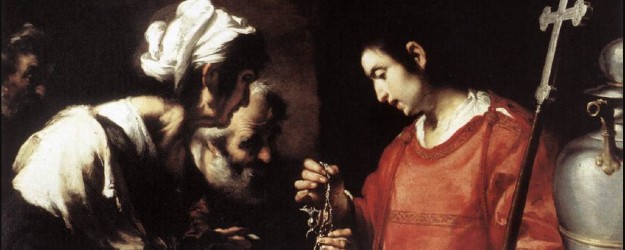
The Church’s tradition preserves a striking episode from the life of St. Lawrence, the great deacon and martyr of the Church of Rome. During the persecution of Emperor Valerian, the prefect of Rome ordered Lawrence to hand over the treasures of the Church. He was thinking, of course, of gold and silver. Lawrence asked for a few days. Then he gathered the poor, the sick, the orphans, and the beggars cared for by the Christian community, brought them before the prefect, and said: “These are the treasures of the Church.”1
Whether read devotionally or theologically, the episode reveals something essential about the diaconate. The deacon is the minister who holds together the altar and the poor, the mystery celebrated in the liturgy and charity lived in history. In him the Church remembers that the Body of Christ received sacramentally is like the body of Christ encountered in the suffering and the needy. The diaconate, therefore, is not a merely practical addition to ecclesial life. It is a sacramental form in which Christ the Servant becomes visible.
A particularly fruitful key for understanding this ministry is found in Benedict XVI’s Deus Caritas Est. There he writes that the Church’s deepest nature is expressed in a threefold responsibility: proclamation of the Word of God (kerygma-martyria), celebration of the sacraments (leitourgia), and the ministry of charity (diakonia). These three tasks, he adds, “presuppose each other and are inseparable.”2 That formula is not only a general description of the Church. It also provides a remarkably precise way of understanding the deacon’s place within her life. The deacon stands precisely where Word, liturgy, and charity must remain one.
The biblical roots of this ministry are traditionally seen in Acts 6. Faced with tensions concerning the care of widows, the apostles recognize that concrete charity is not secondary to the life of the Church but belongs to her very structure. They therefore establish a stable ministry so that the service of charity may be safeguarded and ordered without being separated from prayer and preaching. (Cf. Acts 6:1–6) From the beginning, then, Word, worship, and charity are not parallel activities but dimensions of one ecclesial life. The diaconate emerges precisely to guard that unity.
The Second Vatican Council gives this insight doctrinal precision. Lumen Gentium teaches that deacons receive the laying on of hands “not unto the priesthood, but unto a ministry,” and that, strengthened by sacramental grace, they serve the People of God “in the diaconate of the liturgy, of the word, and of charity, in communion with the bishop and his presbyterate.”3 This text is foundational because it prevents the diaconate from being reduced to a convenient function or a sociological necessity. It belongs to the sacramental and hierarchical structure of the Church and is constitutively ordered to the three great dimensions in which the Church lives and manifests herself.
Paul VI developed this conciliar vision with particular clarity in Ad Pascendum (1972), one of the decisive documents for the restoration of the permanent diaconate in the Latin Church. After recalling that the diaconate “stands out conspicuously from the earliest age of the Apostles” and was “always held in great honor in the Church,” Paul VI describes the deacon as “an interpreter of the needs and desires of the Christian communities, an animator of service or diaconia of the Church among local Christian communities, a sign or sacrament of Christ the Lord Himself, who came not to be served but to serve.”4 The language is remarkable. The deacon is not described as an ecclesiastical assistant, but as a sacramental sign of Christ the Servant for the whole Church.
John Paul II strongly reaffirmed the same line. In his general audience of October 13, 1993, he explicitly returned to the Council’s teaching and again described the deacon’s service as ordered to liturgy, word, and charity.5 Two years earlier, speaking to the new deacons of the Pontifical North American College, he reminded them that the laying on of hands is given “for a ministry of service” and urged them to embrace fully “the diaconate of liturgy, preaching, and charity.”6 This insistence matters. In postconciliar magisterium, the diaconate is never treated one-dimensionally. It is not merely liturgical, nor is it simply social. It is the ministerial point at which these spheres mutually imply and sustain one another.
That same perspective receives further expression in the Directory for the Ministry and Life of Permanent Deacons (1998), which describes the deacon as a “specific sacramental sign of Christ the Servant” and an “icon of Christ the Servant in the Church.”7 Particularly striking is its statement that “service to the poor is the natural continuation of service at the altar.”8 Few formulations capture the inner logic of the diaconate more effectively. The deacon’s liturgical ministry does not end at the altar, but extends into charity. For the sacrifice celebrated at the altar is the supreme manifestation of divine charity, and, when fruitfully received, it necessarily seeks expression in the Christian life. Charity, therefore, if it is not to degenerate into mere philanthropy, must remain continually nourished by the Word and the Eucharist.
This helps explain why the deacon bears a singular relation both to the Gospel and to the altar. In the liturgy he proclaims the Gospel. This is not merely functional. It is a theological sign: the Word is announced in the heart of the assembly, and the Church hears the voice of Christ Himself. When the deacon preaches, catechizes, visits the sick, accompanies families, or encounters human suffering, he reminds the community that the first charity is the truth of the Gospel. Without the Word, service risks becoming merely humanitarian. With the Word, it is restored to its Christological source.
The deacon also has a proper relation to the mystery of the altar. St. Thomas Aquinas writes that the deacon is ordered ad ministerium altaris, “to the ministry of the altar.”9 He does not consecrate the Eucharist, but he is appointed to serve the sacrament and its distribution. That Thomistic line can be read with even greater depth: if the altar is the place where the Church receives the Body of Christ, the poor are the place where the Church recognizes Christ in history. The deacon serves the Body of Christ at the altar, and therefore he is trained to recognize that same Body in the brethren.
At this point, however, an important contemporary question emerges. When we speak of the poor, we naturally think of material poverty, and rightly so. The Church must never spiritualize misery in a way that abandons concrete suffering. Yet the Gospel itself requires a wider vision. Christ says not only “Blessed are the poor,” but “Blessed are the poor in spirit” (Matt. 5:3). This points not simply to a lack of material goods, but to a fundamental interior disposition: the poor in spirit is the one who does not rest upon himself, who does not live in self-sufficiency, who does not make himself his own first principle.
In that sense, evangelical poverty does not coincide mechanically with economic poverty. One may be materially poor and spiritually proud; one may be materially secure and yet truly poor before God, if one lives in humility, gratitude, and filial dependence. The deacon, therefore, encounters not only visible misery but also hidden forms of interior poverty. There are men and women who are strong, competent, influential, entrepreneurial, generous benefactors, successful professionals, people accustomed to building, deciding, organizing, and leading, yet who carry within themselves a great emptiness: difficulty trusting, inability to receive, fear of silence, the need for control, the loneliness of success, the incapacity to surrender to God. This too is poverty, and it is no less real because it is elegant, educated, and socially accomplished.
For the deacon this has real pastoral importance. He is not called only to respond to material need but also to discern and meet the spiritual poverty of contemporary man. In many contexts, especially where he lives immersed in family life, the professional world, civil society, and relationships with benefactors or institutions, the deacon is in direct contact with people who lack nothing externally and yet suffer from a more radical poverty: they no longer know how to receive life as gift.
The Gospel of Luke sharpens this point with particular force. Christ speaks of the unclean spirit that leaves a man and later returns to find the house “swept and put in order,” but empty (Luke 11:24–26). The image is severe and spiritually exact. It is not enough to be liberated; one must be filled. It is not enough for a house to be cleaned; it must be inhabited. The danger is not only obvious evil, but the void left by the absence of God. Then, at the close of the same chapter, a woman in the crowd raises her voice to praise the bodily motherhood of Mary: “Blessed is the womb that bore you, and the breasts that nursed you.” But Christ immediately deepens the point: “Blessed rather are those who hear the word of God and keep it” (Luke 11:27–28). He does not deny Our Lady’s blessedness; rather, He reveals its deepest source. Mary is blessed above all because she received the Word and kept it. The connection is decisive. The house that remains merely swept is still empty; the life that truly becomes blessed is the life filled by the Word of God, heard, received, and kept.
One may also think of Martha and Mary (Luke 10:38–42) as an image of different charisms within the Church. Martha’s service is not rejected, nor is Mary’s listening presented as an escape from responsibility. Rather, the episode reveals an order: the active life must be grounded in the primacy of the Word. Different charisms serve the one Body in different ways, but all lose their fruitfulness when detached from communion with Christ. For the deacon, this is not incidental. His ministry belongs in a particular way to the Church’s active charity, yet precisely for that reason it must be deeply rooted in contemplation, so that what is handed on in service may truly be the fruit of what has first been received from the Lord.
The more one thinks about it, the more one sees that this applies to every Christian, but in a particular way to the deacon. One can be formally correct, ecclesially present, generous and active, and yet interiorly empty. A house not inhabited by the Lord becomes vulnerable; so too a ministry not inhabited by the Word risks becoming outwardly efficient but inwardly thin. Here the Dominican principle contemplata aliis tradere illuminates the matter with particular clarity. The minister does not first give; he first receives. He does not first act; he first listens. What is handed on in charity must first have been welcomed in faith and deepened in contemplation. For the deacon especially, this is decisive: the Gospel he proclaims, the altar he serves, and the poor to whom he is sent belong to one single movement of grace. He is called not merely to perform works of service, but to hand on to others what he himself has received from the Word and from the mystery celebrated. Otherwise even generous activity can become like the swept house in Luke: ordered, perhaps, but empty.
At this level, poverty of spirit appears as real dependence on God. The spiritual tradition has consistently associated it with generosity, detachment, and humility. Generosity leads one out of self; detachment frees one from possession; humility places one in truth before God. Yet perhaps the deepest point is this: the hardest detachment is not from things, but from oneself — from one’s need to matter, to control, to be recognized, to occupy the center. True poverty of spirit means becoming poor in self so as to be rich in God. And this poverty is inseparable from receptivity to the Word. Blessedness, according to Christ, belongs not to the self-enclosed or merely active man, but to the one who listens and keeps. The deacon, therefore, must not simply do the works of God; he must become a dwelling place of God. Only then can his service bear fruit, because only the man who has first heard the Word, kept it, and been inwardly inhabited by it can truly hand on its fruits to others.
Here the insight of Blessed Columba Marmion is especially useful. Marmion warns that God does not call us to approach supernatural realities through feelings alone. Feelings may have their place, but they are not the adequate means. He uses a vivid image: trying to nourish oneself spiritually by feelings alone is like trying to drink water with a fork.10 The point is simple but profound. Faith is not reducible to emotion; adoration is not measured by affective intensity. Because God is spirit, spiritual realities are approached through faith, liturgy, prayer, silence, and an intellect illumined by grace. This matters greatly for the diaconate, which can easily be absorbed into activism, visibility, or dependence on apparent results. Poverty of spirit instead requires an interior discipline: nourishment not by impressions but by truth, not by passing enthusiasm but by persevering adoration.
All of this has its center in Christ. St. Paul writes that Christ “emptied himself, taking the form of a servant” (Phil. 2:7), while Christ Himself says that the Son of Man “came not to be served but to serve, and to give his life as a ransom for many” (Mark 10:45). In this sense one may say, with theological legitimacy, that Christ is the true Deacon of the Father: the One sent into the world to do the Father’s will and to serve humanity unto the total gift of self. Holy Orders makes this mission present in the Church. The priest represents Christ the Head and Shepherd; the deacon represents Christ the Servant. For that reason, the diaconate cannot be understood fully if it is thought of merely as a lower rung within hierarchy. It is a sacramental form in which the Church contemplates the face of the Lord who serves.
The washing of the feet expresses this with particular force. Christ performs the gesture of the slave and then says, “I have given you an example, that you also should do as I have done to you” (John 13:15). Here the deepest form of Christian authority appears. In the Church, authority is not domination but service; not self-centering but readiness to let Christ appear. The deacon possesses, in this regard, a singular symbolic force. His ministerial form continually reminds the Church that evangelical greatness is mediated through service.
This becomes especially rich when contemplated in light of the Upper Room. Luke 22, so luminous for Lenten meditation, holds together gift and fragility, liturgy and struggle, communion and betrayal. Christ opens the scene with the words, “I have earnestly desired to eat this Passover with you before I suffer” (Luke 22:15). Pope Francis comments that these words open for us “a glimpse into the depth of the love of the Persons of the Most Holy Trinity for us.”11 For a spirituality of the diaconate this is decisive: before ministry exercised there is Christ’s desire; before ecclesial activity there is a mystery received.
Yet the Upper Room is not only intimacy. It is also the place of contention, weakness, and testing. While Christ gives Himself, the disciples dispute about who is greatest. It is there that He utters the phrase that may be taken as a condensed theology of the diaconate: “I am among you as one who serves” (Luke 22:27). The deacon is called precisely to that: to stand in the midst and serve — in the midst of altar and street, liturgy and charity, proclaimed Word and wounded humanity. But to stand “in the midst” evangelically means not occupying the center, but guarding it for Christ.
In the same setting comes another decisive word, addressed to Peter: “I have prayed for you” (Luke 22:32). That sentence has immense pastoral value. The minister is not spared trial; he is sustained within it. The permanent deacon, often immersed in the burdens of marriage, work, family responsibilities, and the tensions of the world, is not called to a disembodied perfection, but to humble and persevering fidelity. His final stability does not rest on temperament, but on the prayer of Christ.
In this light, the value of silence also becomes clearer. Pope Francis insists that silence in the liturgy is not an emptiness to be filled but a sacred space in which the Holy Spirit shapes the heart.12 This applies not only to the rite but to the minister’s whole interior life. Liturgical silence and interior silence school one in poverty of spirit because they teach one not to fill everything with oneself, one’s words, one’s anxieties, one’s reactions. For a deacon, structurally called to service and mediation, such asceticism is especially necessary. Without silence, service becomes activism; without interiority, availability becomes dispersion; without listening, even charity risks losing its evangelical form.
The missionary meaning of the dismissal belongs here as well. When the deacon proclaims Ite, missa est, he does not simply announce that the celebration is over; he expresses a sending forth. The Eucharistic Sacrifice does not close the Church in upon herself; it sends her into the world. Precisely the deacon, who serves the altar and often lives immersed in ordinary family, work, and social life, renders this dynamism especially visible. He reminds the Church that the grace received in the Eucharist is not meant to remain confined within the liturgical moment, but to enter the concrete fabric of existence. For this reason, the permanent deacon has a particular testimonial significance today. Many men and women will not ordinarily encounter a priest, but they may encounter a father, a colleague, a professional, or a friend who is a deacon. In that encounter, something of the Christian form of life can become visible.
Even the preconciliar popes, though lacking the more fully developed theology of the diaconate that would emerge after Vatican II, contribute in important ways to this picture. Pius XII, especially in Mystici Corporis Christi and Mediator Dei, provides the ecclesiological and liturgical foundations for understanding why service to one’s brethren belongs to the very reality of the Church and why the spiritual life must be nourished by faith and the liturgical mystery rather than reduced to activism or sentimentalism.13 In Mediator Dei, in particular, Pius XII teaches that Christ is present in multiple ways in the Church’s worship: in the Eucharistic sacrifice, in the sacraments, in the sacred minister, in the Church at prayer, and in the proclamation of the Gospel.14 Yet he also insists that these presences are not all of the same order, since Christ is present “in a manner most sublime” under the Eucharistic species themselves.15
This hierarchy of presence is theologically decisive. It shows that the Eucharistic sacrifice is not merely one element among others in the Church’s life, but the living center from which the Church’s communion, prayer, proclamation, and charity all flow. Precisely here one finds an important preconciliar foundation for the later theology of the diaconate: the deacon serves at the altar where Christ becomes sacramentally present, proclaims the Gospel through which faith is born (fides ex auditu; Rom 10:17), and carries the fruits of that mystery into the Church’s ministry of charity. Service to the poor thus appears not as an extrinsic or merely practical task, but as the natural extension of the mystery celebrated in the liturgy.16 One may also briefly recall Pius XI, whose social and pastoral magisterium reinforces the conviction that proximity to the poor and ecclesial responsibility toward the weak belong essentially to the Church’s mission.17
One may therefore speak, with good reason, of a real magisterial convergence. From Vatican II to Paul VI, from John Paul II to Benedict XVI, and on to Francis, a common line emerges clearly: the deacon, sacramentally configured to Christ the Servant, is ordained to safeguard the unity of Word, liturgy, and charity, so that service at the altar may continue in service to the poor, and ecclesial charity not be reduced either to mere functionalism or to simple philanthropy. Indeed, the line reaches back further, since the preconciliar magisterium had already articulated the broader principles later applied more explicitly to the diaconate: the Church lives from the Eucharistic mystery, faith comes through hearing the Word, and the grace received in worship must become visible in the concrete love of neighbor.18 In this sense, the deacon stands at a privileged junction within the Church’s life: he ministers at the altar, proclaims the Gospel, and serves the poor, thereby embodying in a distinct sacramental form the movement from mystery to mission, from contemplation to charity, from the liturgy’s inner act to its ecclesial and social fruitfulness. In this perspective, the diaconate is not a marginal ministry. It is a form in which the Church sees reflected a constitutive dimension of her own identity.19
For that reason, the ministry of permanent deacons deserves renewed attention and genuine encouragement today. They show that holiness is not reserved to monasteries or strictly ecclesiastical structures, but can flourish in family life, work, and the ordinary conditions of existence. They show that the Gospel is not alien to the concrete reality of contemporary man. At the same time, they remind the whole Church — and priests as well — that one does not truly serve the Body of Christ at the altar unless one learns to recognize Him also in the visible and invisible poverty of men and women.
Perhaps the vocation of the deacon can be summarized by a simple image: he stands between the altar and the street. From the altar he receives Christ; in the street he encounters Christ. His whole mission consists in recognizing and serving the same Lord in both places. For this reason the diaconate is not merely a useful ministry. It is a theologically grounded witness, ecclesially necessary, and spiritually fruitful. In an age marked by activism, self-assertion, and hidden forms of interior poverty, the deacon reminds the Church that at the beginning of Christian life there stands not “an ethical choice or a lofty idea, but the encounter with an event, a person.”20 Charity is born from that encounter, and it is that encounter that the deacon is called to make visible in history.
- For the traditional account of St. Lawrence presenting the poor as the Church’s treasure, see St. Ambrose, De officiis ministrorum, II, 28, 140–143. ↩
- Benedict XVI, Deus Caritas Est (December 25, 2005), no. 25. ↩
- Second Vatican Council, Lumen Gentium (November 21, 1964), no. 29. ↩
- Paul VI, Ad Pascendum (August 15, 1972). ↩
- John Paul II, General Audience, “The Permanent Diaconate” (October 13, 1993), no. 2. ↩
- John Paul II, Address to the New Deacons of the Pontifical North American College (April 12, 1991), no. 3. ↩
- Congregation for the Clergy, Directory for the Ministry and Life of Permanent Deacons (February 22, 1998), nos. 5, 45. ↩
- Directory, no. 73. ↩
- Thomas Aquinas, Summa Theologiae, Supplement, q. 37, a. 2. ↩
- On Marmion’s recurring critique of reducing the spiritual life to feeling, see Columba Marmion, Christ, the Life of the Soul, trans. Alan Bancroft (St. Louis: B. Herder, various editions), especially the sections on faith and the interior life. ↩
- Francis, Desiderio Desideravi (June 29, 2022), no. 2. ↩
- Francis, Desiderio Desideravi, no. 52. ↩
- Pius XII, Mystici Corporis Christi (June 29, 1943), esp. on the Church as the Mystical Body of Christ and the organic unity of her members; Pius XII, Mediator Dei (November 20, 1947), on the liturgy as the action of Christ and His Church. ↩
- Pius XII, Mediator Dei, 20–21: Christ is present in the sacrifice of the altar, in the sacraments, in the Church praying and singing, and when the sacred ministers preach. ↩
- Pius XII, Mediator Dei, 39: Christ is present under the Eucharistic species “in a manner most sublime.” Cf. Sacrosanctum Concilium, 7. ↩
- On this theological sequence, see Rom 10:17 (fides ex auditu); Luke 11:27–28 on hearing and keeping the word of God; and, in the Dominican tradition, St. Thomas Aquinas’s ideal of contemplata aliis tradere. ↩
- See, for example, Pius XI, Quadragesimo Anno (May 15, 1931), and other social interventions emphasizing the Church’s responsibility toward justice, the vulnerable, and the common good. ↩
- Cf. Pius XII, Mediator Dei, 20–21, 39; Sacrosanctum Concilium, 7; Rom 10:17. ↩
- For the later development of this line, see Lumen Gentium, 29; Paul VI, Ad Pascendum; John Paul II, Catechesi Tradendae and the teaching gathered in the Directory for the Ministry and Life of Permanent Deacons; Benedict XVI, Deus Caritas Est, 25; Francis, Evangelii Gaudium and Fratelli Tutti. ↩
- Benedict XVI, Deus Caritas Est, no. 1. ↩
 About Fr. Francesco Giordano, STD

Speak Your Mind