
Basilicas: A Pilgrim’s Guide to America’s Most Remarkable Catholic Churches. By Grady Connolly. Reviewed by Christopher Siuzdak. (skip to review)
Insane for the Light: A Spirituality for Our Wisdom Years. By Rev. Ronald Rolheiser, O.M.I. Reviewed by Mark C. McCann. (skip to review)
The Pastor as Gardener: A Renewed Vision for Ministry. By Matthew Erickson. Reviewed by Christopher Ewing. (skip to review)
Discerning Stirrings: A Personal Experience of Catholic Spirituality. By Rev. Francis V. Tiso. Reviewed by Andrew Likoudis. (skip to review)
Basilicas – Grady Connolly
Connolly, Grady. Basilicas: A Pilgrim’s Guide to America’s Most Remarkable Catholic Churches. Notre Dame, IN: Ave Maria Press, 2026. 352 pages.
Reviewed by Christopher Siuzdak.
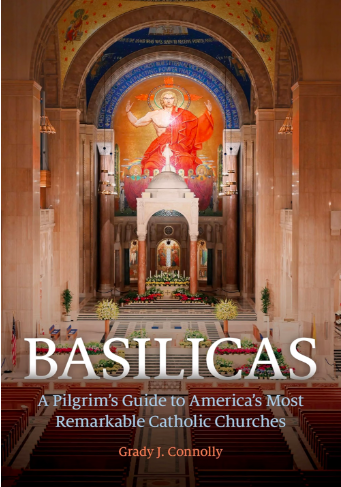 Churches are tangible testaments to the transcendent realities of faith. For the believer, they are portals that offer glimpses of the history of salvation and glimmers of the paradise to come. Basilicas are churches par excellence. The bestowal of the title of “basilica” upon a church can be likened to a site being placed on the National Register of Historic Places by the U.S. Department of the Interior. It is a papal honor denoting a particularly noteworthy place with an implicit encouragement to visit it. “A church is declared a basilica,” the author explains, “because it is a unique place of grace and is significant as a religious site or for its role in the history of the people of God in that area” (xix). In short, basilicas are special sites considered by the Catholic Church to be treasures of heritage and holiness.
The author undertook a piecemeal pilgrimage across all ninety-four basilicas in the United States as well as the four principal basilicas located in Rome. This book is a travelogue that vicariously takes the reader along to these sacred sites. It is organized by alphabetical order of the state in which the basilicas are located, from Alabama to Wisconsin. Each entry contains: key data about location, architectural style, and major feast day; a vibrant photo of both the exterior and interior; some concise historical insights; a short personal reflection from the author’s diary during his visit; and a blank space that allows travelers to jot down the date they visited and record some personal impressions.
The author has successfully compiled an accessible introduction to these extraordinary churches. Each basilica is brimming with artisanal creativity, distinctive cultural heritage, and spiritual fecundity, yet collectively these basilicas tell a larger story of the flowering of the Catholic faith in the United States. It is fitting that this book has debuted as the United States celebrates its semiquincentennial because it promotes reflection on how the seeds of the faith were planted by the blood, sweat, and tears of faith-filled forebears and how they have blossomed into something beautiful as the nation has developed. Moreover, the publication of this book amidst political tensions and divisive ideologies offers a timely antidote to the antipathy. As Gregory Wolfe explains in Beauty Will Save the World: “Great art sneaks past our shallow prejudices and brittle opinions to remind us of the complexity and mystery of human existence.” Engaging the magnificent art and architecture found at basilicas, as well as their rich history, can help present-day people rise above partisan battlelines and defensive postures. These churches can become not merely museums but field hospitals where lives intersect, healing happens, and the resolve to unite with God and neighbor is renewed.
The vast scope of the undertaking necessarily limits the length of the historical sketches and architectural explanations. Nevertheless, each brief entry shares some insights to whet the appetite for further personal exploration. One lacuna is the omission of basilicas located in the U.S. territories of Puerto Rico (i.e., the Basilica of Our Lady of Monserrat of Hormigueros and the Cathedral Basilica of Saint John the Baptist) and Guam (i.e., Dulce Nombre de Maria Cathedral Basilica). While this book was not intended as an academic treatise, some footnotes at the close of the introduction or a select bibliography at the end of the book might have been beneficial. For readers interested in a scholarly treatment of the concept of basilicas, the erudite Basilicas: Historical and Canonical Development by Gabriel Chow Hoi-Yan would pair well with this travelogue. These minor points, however, do not detract from the overall value of this work.
This compendium of basilicas in the United States is a commendable achievement that awakens awe and invites each reader to embark on a transformative pilgrimage of their own. Many individuals, families, or groups will benefit from this book by using it as a guidebook for planning a memorable pilgrimage. Others, who may be limited in mobility, will benefit from the vivid photographs that transport them to these sacred sites in their mind’s eye. The book can facilitate an “armchair pilgrimage.” Still others will benefit from the subtle evangelizing power of the beauty contained within the book. The ancient Roman architect Vitruvius asserted that all architectural projects must be solid, useful, and beautiful. Not only do those qualities describe the basilicas detailed in this book, they also apply to the book itself.
Christopher Siuzdak is Book Review Editor for Homiletic & Pastoral Review.
Insane for the Light – Ronald Rolheiser, O.M.I.
Insane for the Light: A Spirituality for Our Wisdom Years. By Rev. Ronald Rolheiser, O.M.I. New York, NY: Image Books, 2025. 224 pages.
Reviewed by Mark C. McCann.
 The house at the end of my wife’s parents’ driveway still looks the same from the street. It is the same front walk, the same rooms where children once played, where a mother prepared meals and a father sat and read his paper. Inside, however, the old order is now slowly dissolving. My mother-in-law, once the quiet strength of her family, no longer walks and can no longer meet her husband or children in the ways she once did; dementia has carried her into a deepening silence and a diminished form that requires almost total care. My father-in-law, the man who for decades ordered the world around him, now moves through those same rooms with a mixture of fierce devotion and growing helplessness, still trying to protect the home and the bride he has loved for more than sixty years. Around them, their adult children grow weary, stretching themselves between their own lives and the unrelenting needs of the parents who raised them.
It was into this house — into this particular season of diminishment, exhaustion, and stubborn love — that Ronald Rolheiser’s Insane for the Light: A Spirituality for Our Wisdom Years arrived, less like a book to be reviewed, and more like a lantern held up to a darkening path. Rolheiser’s beautiful work for me has been the same kind of blessing that Jacob received — one that comes in the midst of a deep emotional wrestling match with the Almighty, as I make sense of the chaos of learning to cope with this new chapter in our family story.
Themes Lived Out
Insane for the Light (2025) is the third in a spiritual trilogy, 25 years in the making. His earlier books, The Holy Longing (1997 — focusing on the younger years and “getting one’s life together”) and Sacred Fire (2014 — focusing on the generative/adult years and “giving one’s life away” through family, work, and service) are given their spiritual conclusion in this work that now addresses the “wisdom years” and the “mellowing of souls” as we learn “to give our deaths away” to those we love who remain after we are gone.
Rolheiser’s core claim in this volume is that, in the latter years of our lives, we now transition from achievement and control to fruitfulness and surrender as we encounter a “holy passivity” and our final days lead to a metanoia — a “higher mind” that seeks to mirror the Savior and the gift of love to the world in his death. He draws beautifully from St. John of the Cross and his dark night of the senses (getting one’s life together), proficiency (giving one’s life away), and the dark night of the spirit (giving one’s death away), as well as from Henri Nouwen’s deep spirituality on passivity, and a number of cross-cultural illustrations, the chief of which is the Hindu sannyasin/forest-dweller/holy beggar stages of life. All of these images help to frame Rolheiser’s spirituality of aging as a participation in the Passion (“passivity”) of Christ as he surrenders to death in his sacrificial offering to the Father and offers his gift of life to the world.
In our situation, all three stages of life are living themselves out before my eyes. I see my young adult children, discovering who they are and who they are meant to be as they form their careers, embark on marriage and family, take hold of the beauty of life, and seek to leave their mark on the world. For my wife, her siblings, and myself, we are still in the midst of our adult generativity, living with the results of our ups and downs, learning to make sense of the lives we have lived and the achievements we have made. My mother-in-law is dealing with her own dark night of the spirit, and my father-in-law is struggling with moving from control to surrender, as the very reality around him is being shaped by forces beyond his control.
In struggling to make sense of this changing landscape, Rolheiser’s book has offered its quiet, steady light to guide our steps. It would be easy to give in to our frustrations, to let the bitterness and resentments that could build from the physical and emotional exhaustion overwhelm us, and to allow helplessness and hopelessness to rule the day. Yet these are stages we must all pass through as we learn to yield our perspective to the greater inner reality taking place around us and within us.
The Essence of Insane for the Light Lived Out
Rolheiser structures the book as a progressive journey. He begins by mapping the seasons of a life onto the framework of St. John of the Cross, then moves into the hard interior work of aging — the stripping of control, the dark night of the spirit, the unexpected generativity of passivity. From there he leads the reader toward the image of the beggar’s hut: the place of radical simplicity where one learns, finally, to give one’s death away as a blessing. The closing pages return to John of the Cross, restating the whole movement in contemporary language so that the ancient map feels newly urgent.
There is so much woven within these pages that speaks to our family situation with a clarity that is undeniable. But the reality is, the transformation will unfold in its own way in each of our souls. It will take time, and the slow work of struggle and grace, to recognize that my mother-in-law’s quiet presence and growing dependence are already bearing fruit — teaching us the true cost of love, the meaning of patience, and what finally matters in the end.
My father-in-law must struggle with and surrender to the changes that must inevitably arrive, facing the daily deaths that come knocking at the door of his heart as he continues to care for the woman with whom he has shared his life for over sixty-six years. Yet I have already seen blessings of beauty and generative transformation taking place in him. I have watched him play songs from their wedding day and gently dance with his bride as she sits in her wheelchair and smiles at him. I have seen them together on the couch in the evening, watching familiar reruns, his hand finding hers, the two of them stealing kisses in the soft light of the television. In those moments his love has not diminished; it has grown more tender, more deliberate, and more enduring. And I know that tomorrow he will rise again to the same caregiving and the same uncertainty, still carrying a quiet passion for the woman who stole his heart all those years ago.
Passivity and Passion, Metanoia and Movement
Rolheiser names seven interior movements that mark the passage into the wisdom years: from resentment to gratitude, bitterness to forgiveness, imagination to faith, wishful optimism to hope, sophistication to childlikeness, control to surrender, and achievement to fruitfulness. In the house at the end of our driveway, two of these movements are felt more urgently. The long habit of control is being slowly, painfully relinquished as my father-in-law faces forces he can no longer command. And the old measures of achievement — usefulness, competence, the ability to fix what is broken — are giving way to a quieter question: what kind of spirit will remain when the journey and the doing are finished?
This is the transformation required if a new light is to shine. We must grieve old wounds and, in thankfulness, receive the life of Christ that heals and restores. We release old grudges, asking for and offering forgiveness, until gratitude and love begin to take their place. We surrender our preferred images of God and of how life should have unfolded, so that we may be held in the pure presence of the One who loves us. Our individual stories are drawn into a larger story, and we learn a second naïveté—not mere innocence, but a holy dependence and openness. This is not resignation, but a yielding that echoes the Savior’s words, “Into your hands I commend my spirit.” In the end, our achievements will fade away; what will endure is the character we have formed and the beauty we will leave behind for those who remain.
All of us have certainly received holy wounds that feel like battle scars. And yet, each day, when we wake and prepare to walk this path once again, we can feel the love of Christ and receive it with gratitude. The old images of how things were — and perhaps, how we had hoped they would always be — are being reshaped by the light of love that is emerging out of this dark night. Though we struggle at times with one another, the bitterness and brokenness will not win the day. Emerging from the frustration and fatigue, the chaos and confusion, is a unity of purpose and a determination to find our way — together, through the cross and the tomb, to the resurrection on the other side.
We find strength in the midst of helplessness, joy in our perseverance through the trial, and an inner song that sings of a vision of heavenly vistas to come. We join with the Savior as we go to the cross in our passivity — our passion — helpless patients in need of the Great Physician of our souls, who will give meaning, and help these two wonderful parents to bear fruit that will endure for the generations to come, long after God has called them home.
A Guiding Light
One of the central images that runs through the book and points the reader toward the cross is the forest dweller/holy beggar that Rolheiser borrows from Hinduism. The aging one leaves the everyday world to enter the wilderness, embracing a simple life, giving up control and power, so that he may become a wise and holy beggar, a marginalized, impoverished, holy old fool. For all of us, however, there is a danger of allowing the struggles of life and the desire to hold onto it to turn us into pathetic and sad old fools, or angry and bitter old fools. But as we surrender to the truth that we are in the care of the God who loves us enough to lead us through poverty to wisdom, we become the ones who leave a lasting godly impression upon the world, one that brings laughter and smiles and fond remembrances at our funerals when the prayers have all been said.
Though the struggles in the immediate are real, exhausting, and sometimes seemingly insurmountable, I have confidence in the character of my mother-in-law who is making her way to Calvary quietly in her wheelchair, and the fortitude of my father-in-law who is turning his home into the beggar’s hut, as he, with fear and trembling, continues to walk the path to the altar with his bride, no matter where that path may lead in the days to come. I know that my wife’s family, the grandchildren, and I will work through the trials and continue to serve until the gratitude fills our hearts and we see the blessings God is bestowing upon us through Mom and Dad. And in the end, there will be life in death, blessings from brokenness, and renewal for our restless and broken hearts.
I have touched on only a small portion of the wealth of insight that flows from Rolheiser’s book. In truth, it was a challenging and blessed read, one that was well worth the hours spent in solitude and prayer as I poured over the pages and allowed its wisdom to break my own heart with love for my family. It is not a checklist, a map, or a prophecy of things to come. As I stated earlier, it is a light to hold up to the reality of our lives, lives that sooner or later must come face to face with the blessings that will come for those who are insane for the light.
Mark C. McCann is an author and ministry consultant with more than 30 years’ experience in ministry to children, youth, and families, having worked in schools, diocesan offices, and Christian radio. He currently lives in Connecticut with his wife and three children.
The Pastor as Gardener – Matthew Erickson
Erickson, Matthew. The Pastor as Gardener: A Renewed Vision for Ministry. Grand Rapids, MI: William B. Eerdmans Publishing Company, 2026. 224 pages.
Reviewed by Christopher Ewing.
 In The Pastor as Gardener, Matthew Erickson proposes a return to the ancient image of the pastor as one who cultivates, nurtures, and patiently tends the spiritual lives of those entrusted to his care. Drawing upon Scripture, personal experience, and the writings of contemporary Protestant theologians, Erickson presents what the publisher describes as a restorative vision of pastoral ministry. The result is a thoughtful and occasionally encouraging reflection on the challenges of Christian leadership. Yet, from a Catholic perspective, the book raises an important question: Is this genuinely a renewed vision of ministry, or simply a familiar metaphor offered without the theological foundations necessary to sustain it?
Erickson, senior pastor of Eastbrook Church in Milwaukee, organizes his thesis using nine chapters addressing pastoral identity, biblical imagery, cultural challenges, spiritual formation, ministerial practice, and hope. Beginning with the Garden of Eden and Mary Magdalene’s encounter with the risen Christ, whom she initially mistakes for a gardener (Jn 20:15), he develops the analogy between cultivating the earth and fostering Christian discipleship. His central observation is straightforward: a gardener cannot force a plant to grow and a pastor cannot manufacture spiritual maturity. Both must labor faithfully, prepare the environment, and trust that growth ultimately belongs to God.
There is considerable truth and a long history of this analogy. Erickson challenges contemporary tendencies to evaluate ministry through numerical growth, organizational performance, or immediate results. His emphasis on patience, humility, and perseverance provides a useful corrective to managerial approaches that risk reducing pastoral effectiveness to measurable outcomes. His discussion of hope was of particular value as it distinguishes Christian perseverance from mere optimism. The book’s accessible prose, biblical references, and practical reflections also make it suitable for individual meditation or discussion among ministers.
Nevertheless, the book’s principal limitation is its appeal to novelty. Although Erickson describes his work as recovering a neglected image rather than inventing one, the gardener metaphor is hardly unfamiliar within Catholic Christianity. Its theological significance extends well beyond a comparison between cultivating plants and nurturing congregations. St. Augustine, commenting on Mary’s encounter with the risen Christ, understood Jesus as the divine gardener sowing faith within the human heart (Tractates on the Gospel of John, 121). St. Gregory the Great similarly interpreted Christ’s appearance as a gardener in relation to his cultivation of virtue. These interpretations reflect a longstanding understanding of spiritual growth rooted in grace, conversion, and participation in the life of Christ.
Consequently, what Erickson presents as a renewed pastoral imagination often appears to the Catholic reader as an incomplete recovery of an established Christian tradition. The metaphor is sound, but its theological development remains comparatively narrow.
This limitation becomes particularly apparent when considering the nature of pastoral authority. Catholic priesthood cannot be adequately understood through the language of cultivation, accompaniment, and encouragement alone. By virtue of Holy Orders and apostolic succession, the priest participates in Christ’s ministry of teaching, sanctifying, and governing. He does not merely prepare an environment in which spiritual growth might occur. Acting in persona Christi Capitis, he administers the sacraments through which Christ communicates grace to his people. The Eucharist and sacrament of reconciliation, for example, are not simply instruments of pastoral encouragement but privileged encounters with the saving action of Christ.
This distinction does not diminish the genuine contributions of Protestant ministers to Christian formation. Rather, it reveals the limitations of applying a predominantly Protestant account of ministry to Catholic priesthood without addressing its sacramental and ecclesiological dimensions. A Catholic pastor certainly cultivates the spiritual life of his parish, but he does so through a ministry that cannot be reduced to preaching, spiritual direction, or the cultivation of favorable conditions for growth.
A related theological imprecision appears in Winn Collier’s foreword, which encourages ministers to take up their “rudimentary tools,” identifying Scripture, prayer, and faith. The language is evocative, but it invites a certain reductionism. Faith, properly understood, is a theological virtue infused by God, not simply an implement available for accomplishing ministerial objectives. Similarly, Sacred Scripture cannot be separated from the apostolic Tradition through which the Church has received, preserved, and interpreted the deposit of faith. For Catholic readers, these distinctions are not incidental. They concern the very nature of the Church and the means through which Christ continues his saving work.
The book also suffers from a degree of repetition. Discussions of cultural challenges, pastoral formation, spiritual disciplines, and ecclesial environments frequently return to the same essential propositions: cultivate attentiveness, remain patient, nurture spiritual growth, and trust God with the harvest. These are worthwhile principles, but the gardening analogy does not always provide sufficient additional insight to justify its repeated application. The practical guidance is sensible, although rarely surprising.
Ultimately, The Pastor as Gardener is neither a poor book nor an especially consequential contribution to pastoral theology. Its greatest strength is its reminder that Christian ministry requires humility, perseverance, and a willingness to labor without immediate evidence of success. These are enduring virtues, particularly in an age increasingly preoccupied with efficiency and institutional performance.
For Protestant ministers seeking encouragement amid pastoral fatigue, Erickson’s reflections may prove helpful. For Catholic priests and deacons, however, the book offers relatively little that is not already present, and more fully developed, within the Church’s spiritual and sacramental tradition. The pastor is indeed a gardener, but the richness of that image emerges most clearly when understood within the Church’s apostolic mission and the supernatural economy of grace. Without these foundations, the metaphor remains appealing but ultimately insufficient as a renewed vision for ministry.
Christopher Ewing, Ph.D., is a professor of psychology and leadership and an author whose work examines virtue, vocation, and human flourishing within the Christian tradition.
Discerning Stirrings – Rev. Francis V. Tiso
Discerning Stirrings: A Personal Experience of Catholic Spirituality. By Rev. Francis V. Tiso. St. Louis, MO: En Route Books, 2026. 411 pages.
Reviewed by Andrew Likoudis.
 Discerning Stirrings diagnoses the spiritual condition of a Church that has lost contact with much of its own contemplative tradition, and traces the politicization of contemporary Catholicism in part to three centuries of neglect and suppression of apophatic prayer. The gloomy pietism, fearful scrupulosity, devotional clutter, and saturation of religious imagery that mark so much contemporary Catholic life are, for Fr. Francis Tiso, symptoms of a deeper problem. Sanctity has become a Pelagian project of defensive self-preservation rather than self-gift. Tiso describes the souls produced by this mentality as “God’s frozen people,” and many Catholics sincerely seeking holiness will recognize themselves in the portrait.
Tiso announces at the outset that he will address the culture wars surrounding Catholic identity insofar as they touch the spiritual life. He writes as a spiritual director who has fielded inquiries from Catholics distressed by the ideological polarization that has come to characterize ministry. His extended rebuttal of the campaigns against Centering Prayer shows what this warfare looks like in practice. Methods of wordless prayer have been treated as disloyalty to the traditional faith. Yet when stillness is demonized, agitation can be all that remains.
Tiso’s central illustration is a line from St. John of the Cross’s Dark Night that he argues has been mistranslated for centuries. The correct rendering, he maintains, is He kept my heart intact for Himself alone, not I kept my heart intact for Him alone. A difference of a couple of words, and the implications are nuclear. If I preserve my heart, sanctity becomes my achievement, and my self-preservation something I can offer God as proof of my fidelity. If He keeps it intact, however, even through my failures, holiness is first something received. The elaborate apparatus of self-monitoring that has come to substitute for the contemplative life can then be dismantled. Indeed, it must be, if we are to become vulnerable and childlike before God.
This will unsettle readers whose spiritual lives depend on constant self-scrutiny. Tiso does not discard the examination of conscience. He places it at the beginning of the spiritual journey, as part of the ascetical purification that prepares the soul for contemplative intimacy with God. The danger is remaining there. He describes souls who devote enormous effort to uprooting their sins and almost none to cultivating virtue. Examination of conscience can become an examination of memory that reinforces self-justification or keeps the scrupulous soul in a state of permanent probation.
The rigorist saint who emerges from this misunderstanding may possess virtues that are formally correct but emptied of love. Tiso calls his good deeds “acts of violence” and writes that “a chill wind enters every room in which they act.” Such a person has made sanctity his own project rather than a cooperation with God’s grace. Every encounter becomes another opportunity to measure his progress, with other people serving as points of comparison. The rigorist’s judgment of others is therefore not incidental to his attempt at sanctity but structurally required by it.
What gives Tiso’s portrait its sting is that he locates the problem in a theological error rather than merely in bad character. The rigorist’s error is Pelagian. He believes he can improve himself through his own efforts and, having done so, that God owes him something. Tiso calls the products of this error “rigid little moral robots” who cause more harm than good, saints who are impossible to live with, whose actions amount to a constant barrage of judgments and who make virtue look like a vice. The mercy held out against all of it is that the heart was never ours to keep intact in the first place.
Tiso’s prescription is a ressourcement, a recovery of what has been neglected in the Christian spiritual tradition. He calls for recollection to be taught again at every level of formation, arguing that much contemporary Catholic prayer suffers from the absence of the basic stillness and attention that make deeper prayer possible. The post-Vatican II reformers wanted Catholics to move from saying prayers to prayer itself, in the deeper sense of finding God in all things, and Tiso thinks they were right to want this. But many understood the distinction to mean that the prayers themselves were the problem. Without recollection, the movement from prayers to prayer cannot succeed. Nor can virtuous activity substitute for communion with God.
Tiso also urges a renewed engagement with Eastern contemplative traditions, taking inspiration from the ancient Church of the East, which encountered Buddhism and Daoism along the Silk Road and developed a sophisticated theology without surrendering its Christian identity. Like Henri de Lubac, who once called Buddhism “the greatest human achievement” outside Christianity, Tiso approaches these encounters with confidence in the universality of Christ and without fear of what the Spirit has been doing among the nations. His interest is not in eschewing traditional Christianity but in recovering a Catholic openness that has too often been mistaken for indifference to doctrine.
Tiso spent years as associate director of the USCCB Secretariat for Ecumenical and Interreligious Affairs, and that experience informs his treatment of both the spiritual and ecclesial questions raised throughout the book. He also ends where a book on prayer ought to end, with practical exercises in recollection and contemplation that ordinary Catholics can undertake. These are offered without elitism or the suggestion that contemplative prayer belongs to a spiritually privileged few.
Discerning Stirrings deserves a wide Catholic readership, particularly among those responsible for spiritual formation. Tiso’s criticism is severe at times, but it arises from a serious concern for souls who have mistaken vigilance for holiness and self-preservation for fidelity. His argument is ultimately a hopeful one. The Christian life requires asceticism, examination of conscience, and the struggle against sin, but these must lead us beyond ourselves. The point is not to produce a flawless account of our own sanctity, but to surrender ourselves to the God who alone can make us holy.
Andrew Likoudis is President of the Likoudis Legacy Foundation and author of To His Face: Indefectibility & the Problem of Dissent (En Route Books, 2026).
 About Book Reviews

Speak Your Mind