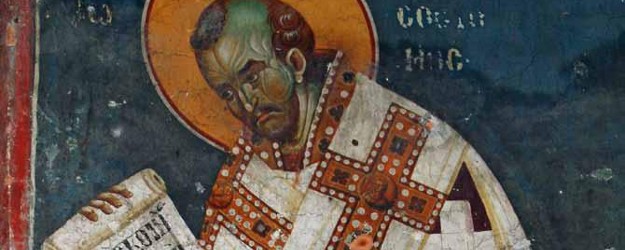
Along the dusty banks of the Orontes, in a city where merchants’ voices collided with imperial decrees and parish quarrels, the Antiochene masters learned to read Scripture under pressure. Not the pressure of modern ideology, but the older kind: real congregations, real crises, real grief, real sin — and a Word that had to be preached without becoming either a charm or a corpse. For John Chrysostom1 and the teachers who shaped his world, the Bible was not a vapor floating above history. It had weight. It had the grain of human speech and the dust of human time.
That instinct is easy to lose in the West today. Our arguments about Scripture tend to force the text into two opposite postures — and both distort it.
On one side, modern fundamentalism often treats the Bible like a flattened instruction manual: “safe” because it has been made rigid, protected from complexity, and pressed into proof-texts for the day’s anxieties. On the other side, a posture of pure academic suspicion can reduce Scripture to a mere artifact — valuable as ancient literature, perhaps, yet functionally detached from divine address and ecclesial proclamation. Antioch offers a third way: an incarnational realism that takes the text’s human concreteness seriously without sliding into literalism, and that seeks spiritual vision without escaping the words.
Quick Reference Table
Antioch vs. Modern Fundamentalism (at a glance)
| Feature | Antiochene “Literal” Reading | Modern Fundamentalist “Literalism” |
| Nature of the text | Incarnational: divine Word clothed in human grammar, genre, history | Dictation-leaning: human authorship minimized; “flat” surface treated as final |
| Historical context | Doorway into meaning; “dust and earth” matter | Often treated as threat; context seen as dilution |
| Literary genre | The text’s rules of engagement (poetry as poetry, satire as satire) | Tendency to treat diverse genres as one “plain narrative” |
| Goal | Theoria through the text: vision that rises through it toward Christ | Proof-texting: freezing lines to “win” a doctrinal or cultural argument |
| Pastoral posture | Patient listening; spiritual formation | Defensive certainty; anxiety-driven control |
This essay argues that Antioch’s literal discipline is not a retreat from theology but a protection of it. The text’s grammar, genre, and history are the Scripture’s “flesh and bone” — the concrete medium God chose for His speech. And for preaching today, that incarnational realism is not an academic luxury; it is pastoral medicine.
I. Incarnational Hermeneutic: Scripture’s Humanity as a Theological Guardrail
Catholic theology is stubbornly incarnational: God does not save by bypassing the human. Vatican II describes Scripture’s “marvelous condescension” (synkatabasis): divine truth comes to us in truly human language, adapted to our condition.2 If the Word truly became flesh in Mary’s womb — real blood, real nerves — then the written Word also comes clothed in grammar, genre, culture, and history. Scripture is not less holy because it is human; it is holy in a way that includes the human.
This principle protects preaching from a subtle but common mistake: treating the text’s particularity as a nuisance. We leap to “application” so quickly that the passage becomes a trampoline rather than a landscape. We preach the conclusion we already wanted, and the reading becomes mere prelude.
Antioch blocks that move by insisting that the passage in its own terms is not a speed bump on the way to “spiritual meaning.” Theoria — contemplative vision — does not bypass the words; it rises through them. Benedict XVI makes the same point in modern idiom: the spiritual sense is real, but it must remain disciplined by the text itself; otherwise interpretation becomes unmoored and arbitrary.3 The Catechism is equally direct: the literal sense is foundational, and the spiritual senses do not replace it.4
The opposite mistake is just as damaging: treating historical-literary attention as an end in itself — accurate, perhaps, but theologically mute. The Pontifical Biblical Commission emphasizes that exegesis must seek the literal sense with maximum accuracy and proper attention to genre; yet Catholic interpretation is ordered to the Church’s living faith.5 The preacher is not a museum curator. He is a witness called to let the text address the Church.
Antioch’s incarnational realism therefore holds together two goods that the modern scene often separates:
- a disciplined respect for the text’s human body (language, genre, history), and
- a confidence that God speaks through that body (not despite it).
This is how Scripture becomes preachable again — not because we “simplify” it, but because we stop treating its humanity as a problem.
II. Literal Sense, Genre, and Theoria: What Antioch Meant (and What It Didn’t)
The phrase “Antioch versus Alexandria” is often used as shorthand — one side “literal,” the other “allegorical.” In reality, the patristic landscape is more textured, and later labels can compress living practices into tidy categories.6 A brief honesty clause is still worth stating: Antiochene exegesis, like any school, had blind spots and later controversies; the point here is not nostalgia, but a recoverable pastoral discipline.
1) Literal is not literalist
Modern fundamentalism frequently collapses “literal” into a blunt surface reading: if the words appear to say X, then X must be asserted in the narrowest way, and any nuance is treated as surrender. Antioch treated “literal” as a discipline: What kind of text is this? Who is speaking? To whom? In what situation? What is the text doing?
That discipline is especially important for preaching, because Scripture’s genres are not decorative. They are moral cues. A lament is not a policy memo. Satire is not a lab report. Poetry is not stenography. To ignore genre is not to “honor the Bible”; it is to misread it.
2) Genre is theology in miniature
In practice, genre is where the text’s concreteness becomes pastoral. Once you say out loud, “This is a lament,” you give your congregation permission to hear a wounded voice without turning it into a command. Once you say, “This is prophetic satire,” you give permission to be unsettled rather than defensive. Once you say, “This is wisdom poetry,” you give permission for imagery to work on the imagination instead of being forced into literalistic prose.
The Pontifical Biblical Commission underlines this point: defining the literal sense includes attention to literary forms and genres.7 Antioch would say: genre is not a barrier to God; it is one of God’s chosen instruments. For preachers, this kind of genre-attentiveness is not ornamental: it is how the text’s poetic and narrative craft carries meaning into the ear and imagination.8
3) Theoria: not escape, but deepened sight
Antioch’s goal was not to keep interpretation “flat,” but to keep it accountable. Theoria is not a flight over the words; it is vision gained by entering them. It is what happens when the preacher stays long enough in the text’s body that its spiritual pressure becomes audible.
Patristic exegesis was never mere technique; it helped form Christian culture by shaping what believers could notice, desire, and confess when they heard Scripture.9
This is also where a Catholic “guardrail” helps: spiritual reading must remain tethered to the literal, and it must remain within the Church’s rule of faith.10 The tradition’s spiritual senses are not an escape hatch from the literal, but a disciplined deepening within the Church’s rule of faith.11 Otherwise, spiritual readings become uncorrectable inventions — and the preacher, rather than the text, becomes the main authority in the room.
III. The Flesh and Bone in Practice: Two Case Studies for Preachers
Some texts function as stress-tests: they reveal our instinct to either defend Scripture in the wrong way or dismiss it in the wrong way. Psalm 137 and Jonah are especially useful, because both are routinely hijacked by modern debates — one by moral scandal, the other by scientific mockery. Antioch teaches us to refuse both traps by attending to what the text is, what it is doing, and what human reality it carries.
1) Psalm 137: The Truth of the Wounded Heart
“By the rivers of Babylon — there we sat and wept . . .” The Psalm begins with exile: memory, humiliation, the ache of displacement. And then it turns — suddenly and violently — toward a line that shocks modern readers: “Blessed shall he be who takes your little ones and dashes them against the rock” (Ps 137:9).
Two predictable errors follow.
Error one (defensive literalism): feeling forced to justify the morality of the act, as if the Psalm were issuing a divine command. The preacher becomes the text’s lawyer, and the congregation senses the strain: the Psalm is being treated as something it never claimed to be.
Error two (dismissive suspicion): treating the line as an embarrassing relic — “primitive,” “tribal,” therefore not genuinely useful for Christian proclamation. The preacher becomes the text’s undertaker. The congregation is left with a Bible that cannot bear the weight of human suffering.
The Antiochene move is different: locate the emotion before evaluating the morality.
Psalm 137 is a lament from exile. Its truth is not “God endorses violence.” Its truth is that trauma produces a heat in the soul that can become monstrous. The Psalm tells the truth about what humiliation can awaken in the imagination.
That truth is pastorally costly to preach because it asks us to stop pretending. But it is also pastorally liberating. Once you honor the Psalm’s flesh and bone, theoria becomes possible: vengeance here functions as a counterfeit liturgy — an attempt to regain control, to restore moral symmetry by imagining an answering violence. The spiritual insight is not that violence is good. The insight is that wounded hearts will seek salvation in false forms.
Why would Scripture preserve such a line? One reason is precisely to put it into prayer — into God’s presence — where it can be judged, purified, contradicted, and healed. Lament becomes a form of spiritual containment: it keeps what is toxic from spilling into action, and places it under the slow authority of God’s mercy.
A preacher can say, carefully but clearly:
- God does not require you to sanitize your interior life to be heard.
- Bringing vengeful fantasy into prayer is not the same as blessing it in life.
- The Psalm gives language for the wounded without granting permission for cruelty.
Sample homily line:
“This Psalm does not teach us to commit violence. It refuses to lie about what violence awakens in us — and it brings that darkness into God’s light so that it can be healed rather than enacted.”
For priests serving communities marked by war memory, family betrayal, displacement, or long humiliation, Psalm 137 becomes not a scandal to evade but a doorway to truth — precisely because it is so unvarnished.
2) Jonah: Beyond the Anatomy of the Fish
Jonah is often reduced to biology: could a man survive inside a “great fish”? The fundamentalist fights for the “fact,” the skeptic laughs at the “myth.” Both miss the simpler and more demanding question: what is the narrative doing to the hearer?
Jonah is compact, ironic, and unsettling. The prophet is not heroic. He is the anti-prophet — the man who would rather flee than preach mercy, and who would rather die than see enemies spared. The most pastorally decisive reality in Jonah is not zoology but resentment. It is psychologically credible. Jonah is the kind of believer who calls his anger “principle.” He wants a God who is correct more than a God who is generous.
Read Jonah this way and the fish scene changes. The “great fish” functions as severe mercy: a forced pause, a strange sanctuary, a reset of direction. Whether one frames it as miracle, symbol, or both, the pressure point is not zoology; it is conversion. Jonah is the mirror Scripture holds up when we prefer our moral certainty to God’s wideness of mercy.
That is exactly why Jonah remains so useful in the pulpit. It exposes a temptation that can appear in very religious forms: the desire for a God whose mercy stays inside the borders of our tribe.
So the preacher can ask, without theatrics:
- Who is my Nineveh — the group I instinctively do not want God to bless?
- Where do I dress resentment in theological language?
- Where do I treat mercy as weakness rather than as God’s strength?
Jonah ends not with closure but with God’s question hanging over the reader. That is pastoral strategy: Scripture is not always trying to resolve us; sometimes it is trying to keep us exposed to grace.
Sample homily line:
“Jonah is not mainly a debate about what a fish can swallow; it is a revelation of what a resentful heart cannot swallow — God’s mercy for those we fear or hate.”
IV. Five Rules for a Flesh-and-Bone Homily (Antioch for Busy Pastors)
Antioch is not merely an academic “method.” It is a set of habits that can be practiced on Saturday night with a lectionary and a tired heart. These five rules translate Antioch’s realism into pulpit work.
1) Name the genre out loud — and let it govern the hearing
Start with one sentence: “This is a lament,” “This is narrative,” “This is prophetic satire,” “This is wisdom poetry.” Genre sets the rules of engagement. The PBC explicitly notes that defining the literal sense includes attention to literary forms and genres.12
Sample line:
“Psalm 137 is a lament, not a legislative text. It is prayer from the wound.”
2) Give the coordinates (who / to whom / where / why) in fifteen seconds
Offer a quick map: speaker, audience, moment, wound. This turns “floating quotes” into a lived scene.
Sample line:
“These words rise from exile — people mocked by captors, trying to remember Zion without being torn apart.”
3) Practice emotional archaeology before moral evaluation
Identify the dominant human emotion — fear, shame, longing, rage — before you rush to tidy it. Many pastoral failures come from preaching around the text’s emotion.
Sample line:
“Before we correct this Psalm, we have to hear it: it is what grief sounds like when it is cornered.”
4) Don’t crush the Old Testament to get to Jesus
Fast typology can become disrespect. Let the passage be itself before moving to fulfillment. Catholic tradition does not require haste; it requires unity. Benedict XVI warns against interpretations that either flatten Scripture into rigid literalism or sever it from the horizon of faith.13
Sample line:
“We will not rush past Israel’s exile. We will sit beside it — and only then learn how Christ carries exile in His own body.”
5) Land incarnationally: one embodied practice, not five abstractions
End with one concrete act that fits the text’s reality. Incarnational reading must land incarnationally.
Sample line:
“This week, name one resentment you have baptized as ‘principle.’ Bring it to prayer, and ask God for the freedom to want mercy more than victory.”
Conclusion: The Pulse of the Word
Antioch’s gift is not a slogan but a posture: God speaks in a way that truly enters human speech. When preaching forgets that, Scripture becomes either a weapon or an exhibit. When preaching remembers it, Scripture becomes a place of encounter: a Word sturdy enough to bear the heat of exile and sharp enough to expose resentment — yet merciful enough to heal both.
A Final Glance: Theoria vs. Literalism
- Starting posture: Theoria enters the text to see Christ through it; literalism uses the text to secure a conclusion before it speaks.
- Treatment of the literal sense: Theoria treats grammar, genre, and history as the roadbed of meaning; literalism turns the surface into a lock — flat, final, and anxiety-proof.
- What it does with difficulty: Theoria names the human reality honestly and lets grace judge and heal it; literalism defends, sanitizes, or weaponizes the difficulty.
- Pastoral fruit: Theoria forms patience, repentance, and mercy; literalism tends toward defensive certainty and polarization.
- The homiletic question: Theoria asks, “What is God doing to us through this text?” Literalism asks, “Which verse proves what I already think?”
The preacher’s task, then, is not to protect the Bible from its humanity or to explain the Bible out of divine address. It is to honor the text’s flesh and bone until the living God speaks — and does not leave us unchanged. For as Antioch reminds us, God’s Word always speaks with flesh and bone.
- John Chrysostom, Homilies on the Statues, Homily 1 (any standard English translation/edition). ↩
- Second Vatican Council, Dei Verbum (Dogmatic Constitution on Divine Revelation), §13 (on God’s “condescension” in human language). ↩
- Benedict XVI, Verbum Domini (Post-Synodal Apostolic Exhortation, 2010), §§34–35 (on the relation of literal and spiritual senses; interpretation in faith). ↩
- Catechism of the Catholic Church, §§115–119 (esp. §116 on the literal sense and the spiritual senses). ↩
- Pontifical Biblical Commission, The Interpretation of the Bible in the Church (1993), I.A (on defining the literal sense; attention to literary genres). ↩
- Robert Louis Wilken, The Spirit of Early Christian Thought: Seeking the Face of God (New Haven: Yale University Press, 2003), esp. on patristic habits of reading and the limits of later “school” labels. ↩
- Pontifical Biblical Commission, The Interpretation of the Bible in the Church. ↩
- Robert Alter, The Art of Biblical Poetry (New York: Basic Books, 1985). ↩
- Frances M. Young, Biblical Exegesis and the Formation of Christian Culture (Cambridge: Cambridge University Press, 1997), on exegesis as a formative practice shaping Christian culture. ↩
- Benedict XVI, Verbum Domini, §35–35; Catechism §115–119. ↩
- Henri de Lubac, Medieval Exegesis: The Four Senses of Scripture, Vol. 1 (Grand Rapids: Eerdmans, 1998). ↩
- Pontifical Biblical Commission, The Interpretation of the Bible in the Church. ↩
- Benedict XVI, Verbum Domini, §34–35. ↩
 About Ersun Augustinus Kayra
Speak Your Mind