
Preaching from the Cross: Paul’s Theology of Proclamation. By Frank J. Matera. Reviewed by Rev. Vien V. Nguyen, SCJ. (skip to review)
On the Dignity of Society: Catholic Social Teaching and Natural Law. By F. Russell Hittinger, ed. by Scott Roniger. Reviewed by Rev. Ryan Connors. (skip to review)
Thomas Aquinas and the Eucharist. Ed. by Michael Dauphinais, Andrew Hofer, and Roger W. Nutt. Reviewed by Nicholas Nogueira. (skip to review)
One Disciple at a Time: How to Lead Others to Dynamic, Engaged, Life-Changing Faith. By Fritz Everett. Reviewed by Matthew B. Rose. (skip to review)
Great Books for Good Men: Reflections on Literature and Manhood. By Joseph Pearce. Reviewed by K.E. Colombini. (skip to review)
Preaching from the Cross – Frank J. Matera
Matera, Frank J. Preaching from the Cross: Paul’s Theology of Proclamation. Grand Rapids, MI: Baker Academic, 2025. 144 pages.
Reviewed by Fr. Vien V. Nguyen, SCJ.
 “Does preaching matter?” “Is preaching important?” and “Does it have the power to change and transform the hearts and minds of those who hear the Word?” — These are some of the questions that have led Frank J. Matera, a Roman Catholic priest and prominent biblical scholar best known for his Pauline scholarship, to ponder why he preaches, what he should preach, and how he should preach. In his search for answers, Matera turns to the apostle Paul, drawing from the Pauline corpus and the Acts of the Apostles to understand the why, what, and how of Paul’s proclamation of Christ crucified and risen from the dead. In this study, Matera seeks to understand Paul’s theology of preaching and its implications for preaching today.
Why did Paul preach? He was sent and commissioned to preach the Gospel. His preaching was not of his own initiative but the result of his call to be an apostle born out of his personal encounter with Christ. This call instilled in him a sense of mission and obligation to preach the Gospel. He insisted that the Gospel he preached was not of human origin but of divine origin. What did Paul preach? The death and resurrection of Christ was the content of Paul’s proclamation. To the Jews, Christ is the Son of God, the Messiah, and the fulfillment of God’s promises to Israel. To the Gentiles, Paul preached about God’s new creation, inaugurated through Christ’s resurrection, and humanity’s longing to know God. The Gospel is the story of God’s saving grace for everyone who believes and calls on the Lord’s name (9). How did Paul preach? God’s power is revealed through weakness, and the cross is the ultimate revelation of that power. Paul did not preach with rhetorical eloquence but with a cruciform life and reliance on the Spirit.
Matera also considers how Paul described his ministry of the Word within God’s salvation plan. Paul’s preaching is the ministry of a new covenant, empowered by the Spirit of the living God. It entails lifting the veil so that those who hear the Word can see the glory of God in Christ and be transformed by it, proclaiming God’s work of reconciliation through Christ and calling others to be reconciled to God, and continually being drawn into Christ’s life-giving work.
Having explored these questions, Matera presents seven theses on Pauline preaching with implications for contemporary preaching. Pauline preaching, he asserts, proclaims Christ Jesus, in whom we find the image, wisdom, and knowledge of God. It is empowered by the Spirit of the living God. It proclaims God’s saving grace and calls people to live by the Spirit. It also builds up the Church and proclaims the Paschal Mystery. These theses underscore the profound importance of why we preach, what we should preach, and how we are to proclaim the Gospel.
In the concluding chapter, Matera returns to the question that he posed at the beginning: “Does preaching matter?” “Of course, it matters,” he answers. It matters because we are sent and commissioned to proclaim a message that is not our own. It matters because our preaching has the power to create a transformative encounter between the Word and its audience (13). It matters because our preaching has the power to transform lives through the working of the Spirit. Our preaching thus demands a deep understanding of Christ’s Paschal Mystery, an intimacy with the Word of God, and fidelity to the church’s tradition. Matera writes: “Our preaching is no longer an act of rhetoric but a proclamation born of an intimate union with Christ crucified that empowers us to speak about a mystery we cannot comprehend but in which we already participate because we preach from the cross rather than from ourselves” (120).
This thin but significant volume, written in an accessible style, is Matera’s study intended for those involved in preaching ministry. It explores Paul’s theology of preaching, which can be summarized as follows: “The preacher is sent. The message is proclaimed. What is proclaimed is believed. Those who believe call on the name of the Lord and are saved” (6). As the title of the book suggests, the Gospel that must be proclaimed originates from the cross, despite its scandalous and foolish nature, with the crucified Christ. In a cultural context that prizes showy rhetoric and performative superiority, contemporary preachers are too encouraged to ground their proclamation in the weakness and shame of the cross, knowing that it is through such cruciform witness that the power of God is manifested.
The book is a valuable contribution to our understanding of Paul’s theology of preaching, as few studies specifically address the topic (xi). Readers will appreciate Matera’s lucid articulation of Paul’s theology of preaching, emphasizing that ministers of the Word cannot commission themselves. They do not preach their own message but proclaim one entrusted to them by another, namely Christ and the Church, through baptism and/or ordination, so that others may hear and believe (7). Thus comes the call to preach faithfully and with integrity for the sake of the Gospel and the Church. Ministers of the Word are to serve the Word rather than presume mastery over it (68). They are to live within God’s new creation, embodying the crucified Christ in their lives and internalizing the inestimable importance and weighty responsibility of preaching the Gospel of Christ’s death and resurrection.
Rev. Vien V. Nguyen, SCJ, is provincial superior of the Priests of the Sacred Heart (Dehonians or SCJs) in the United States. Holding a doctorate in Sacred Scripture from the Jesuit School of Theology of Santa Clara University, Fr. Vien was an assistant professor of Sacred Scripture at Sacred Heart Seminary and School of Theology in Hales Corners, Wisconsin, before his election to provincial leadership in 2022.
On the Dignity of Society – F. Russell Hittinger
Hittinger, F. Russell. On the Dignity of Society: Catholic Social Teaching and Natural Law, edited by Scott Roniger. Washington, DC: The Catholic University of America Press, 2024. xxx + 421 pages.
Reviewed by Rev. Ryan Connors.
 Russell Hittinger takes his place as the most significant English-speaking commentator on Catholic Social Thought in the post-conciliar period. With his latest, On the Dignity of Society: Catholic Social Teaching and Natural Law, readers are privileged to enjoy the most philosophically rich and historically grounded reflection on Catholic Social Teaching yet available.
Fourteen chapters unfold in three sections. Essays on “Catholic Social Teaching,” “Natural Law,” and “First Truths” make up this rich text. Scott Roniger’s editing merits the gratitude of scholars in the field. His introduction helpfully divides Professor Hittinger’s work into three periods. The first period encompasses his initial work on the natural law which produced A Critique of the New Natural Law Theory (Notre Dame, IN: University of Notre Dame Press, 1988) and The First Grace: Rediscovering the Natural Law in a Post-Christian World (Wilmington, DE: ISI Books, 2002). The former text remains the standard point of reflection on the natural law debates of the latter portion of the last century. Hittinger stands in line with Thomists who eschew any account of the natural law apart from its metaphysical foundations.
According to Roniger, during his second period of scholarly activity Hittinger concentrated his efforts on the Church’s social teaching articulated during the modern period. During his third scholarly output principally of the last decade, Hittinger has continued his focus on social thought while offering an increased “engagement with the historical development of Catholic social teaching” (xvi).
In the first set of chapters of On the Dignity of Society Hittinger engages with the dynamics of Catholic social teaching through the centuries. He is especially attentive to the contribution of Pope Leo XIII (1878-1903). Hittinger explains: “Leo’s chief legacy is to have prompted the papal magisterium to think, and to think at levels deeper than diplomacy and public policy” (161). The essay “Two Thomisms, Two Modernisms” stands as the now standard account of the way in which Popes Leo XIII and Pius X approached the modern world. Hittinger praises Leo’s positive engagement with — as opposed to merely disciplinary condemnation of — modern society.
Roniger explains that Hittinger’s “articulation of the nature and dignity of society” is his “most important philosophical achievement . . . that sets him apart from scholars working in the tradition of Catholic social teaching” (xviii). Indeed, students of Hittinger recognize that only those who understand correctly to what the term “society” refers will be able to grasp the riches of the Church’s teaching. Members of societies, properly so-called, share common ends. Married couples, for example, are members of a society (indeed a necessary society) in a way that those involved in other temporal partnerships are not.
Hittinger explains that marriage, Church, and polity are the three necessary societies (98). How the three interact — and what limits exist on the political society — remains an essential question for Catholic Social Thought. In the modern and contemporary periods, these debates often played out in the educational fields. For example, theorists have debated the extent to which the state can override the wishes of parents and to what extent (if at all) the state may impede the Church’s educational apostolate.
The second set of chapters treats various aspects of the natural law. Hittinger engages the thought of the French political philosopher Yves Simon (1903-1961) as well as that of Popes John XXIII, John Paul II, and Benedict XVI. It is in this context that he offers a timely defense of Dignitatis humanae, the 1965 Declaration on Religious Liberty of the Second Vatican Council. He does so interestingly by clarifying what matters the document treats and about what matters the document remains silent. For example, in no case does the Declaration assert that irreligious acts are perfective of the human person.
The final set of chapters offers more properly theological and even Christological reflections on social matters such as the Kingship of Christ and St. Benedict of Nursia’s contribution to the Dark Ages.
Hittinger’s genius — and the reason he is much beloved by his students — is that he is uniquely grounded in both philosophy and history. Rare is the scholar who is equally comfortable discussing the philosophical foundations of a magisterial formulation and the historical circumstances which gave rise to the pronouncement. Readers of On the Dignity of Society are treated to a tour de force on modern Catholic engagement with political life. Readers benefit from Hittinger’s recollection of the teachings of Alexander VI, Benedict XIV, and others more rarely treated in accounts of social doctrine. As one representative example, Hittinger explains the challenges created for the Church in the late eighteenth century:
Catholic sovereigns were deemed to be junior apostles, receiving privileges to govern much of the temporal estates and life within their realms. The French Revolution’s Civil Constitution of the Clergy (1790) unilaterally overturned the common law of political Christendom. Church governance was handed over not to the mischievous but familiar Catholic ruling families but instead was given to the nation. The clergy became civil servants elected by democratic vote. This model spread to the former colonies, particularly in Latin America. Rights once belonging to the Church had been transferred to kings, and now to the nation. The state was no longer governed by anointed laity but by a new doctrine of laicism (32).
For decades to come scholars of Catholic Social Thought and Christian engagement with public life more generally will flourish in their work to the extent they engage the essays of this collection. Russ Hittinger stands as the great example of Catholic scholarship on social questions in the United States in the post-conciliar period. We are grateful to him and recognize the likes of him we will not see again soon.
Rev. Ryan Connors is a priest of the Diocese of Providence and Rector of the Seminary of Our Lady of Providence (Rhode Island). He is the author of Rethinking Cooperation with Evil: A Virtue-Based Approach (Washington, DC: The Catholic University of America Press, 2023); Moral Theology: An Introduction (Cape Girardeau, MO: ECT Press, 2025); and co-author with J. Brian Benestad of Church, State, and Society: An Introduction to Catholic Social Doctrine, Second Edition (Washington, DC, The Catholic University of America Press, 2025).
Thomas Aquinas and the Eucharist – Michael Dauphinais etc., eds.
Dauphinais, Michael, Andrew Hofer, and Roger W. Nutt, eds. Thomas Aquinas and the Eucharist. Washington, DC: The Catholic University Press, 2025. 360 Pages
Reviewed by Nicholas Nogueira.
 Thomas Aquinas and the Eucharist presents a sustained theological retrieval of Aquinas’s Eucharistic doctrine as a response to contemporary doctrinal confusion, catechetical weakness, and metaphysical misunderstanding surrounding the Real Presence. The book is a sustained theological retrieval of Aquinas’s Eucharistic doctrine meant to address a very real problem in contemporary Catholic life: doctrinal confusion, weak catechesis, and (more deeply) a widespread loss of the metaphysical grammar needed to even think clearly about transubstantiation. The editors frame the project in light of the U.S. Catholic Eucharistic Revival, but their argument isn’t simply sociological (“people don’t believe anymore”) or merely pastoral (“we need better programs”). Rather, they insist the crisis is fundamentally theological: we have forgotten how Scripture, doctrine, and metaphysics actually hang together, and that loss inevitably produces Eucharistic minimalism — often in the form of reducing Christ’s presence to symbol, psychology, or communal meaning.
One of the strengths of the book is that it refuses to treat Aquinas like a detached medieval technician who “added Aristotle to the Bible.” Instead, the essays show that Aquinas’s Eucharistic teaching is inseparable from Scripture, patristic exegesis, Christology, soteriology, ecclesiology, and metaphysics (in other words, the whole package). The book begins where it should: salvation history and typology. It argues that Old Testament realities — manna, sacrifice, covenant meals, and divine presence — are not random “illustrations,” but divinely instituted types that find their fulfillment in the Eucharist. And to be fair, some readers hear “typology” and think it’s just allegory with extra steps; however, this book is different. The authors present typology as a disciplined theological mode of reading Scripture that Aquinas inherits and systematizes, so that Eucharistic doctrine appears not as a late scholastic invention but as the culmination of God’s own pedagogy with Israel.
This biblical grounding becomes especially clear in the essays on Aquinas’s exegesis of Jesus’s words and the Pauline corpus (particularly 1 Corinthians). A key point here is how Aquinas understands Paul’s language of “spiritual food” and “spiritual drink.” The book argues that “spiritual” in a Jewish eschatological framework does not mean “imaginary” or “merely inward,” but rather transformation by the Holy Spirit. So the Eucharist is not “spiritual” because it is less real; it is spiritual because it is truly nourishing and truly transformative by divine action. And from that vantage point, transubstantiation arises organically as a claim about reality, not religious sentiment.
The book also does something that a lot of modern Eucharistic writing overlook at times: it situates the Eucharist inside the internal coherence of Christian doctrine. Aquinas is shown to treat the Eucharist not as an isolated sacramental puzzle (“how can Christ be present?”) but as something structurally linked to the Incarnation, the Paschal Mystery, Trinitarian theology, and the unity of the Church. The logic is fairly direct: Eucharistic realism presupposes Christological realism; and when you destabilize the Eucharist, you eventually destabilize the rest. Not only does Eucharistic error create downstream doctrinal confusion, but Eucharistic clarity strengthens the coherence of faith as a whole. In that sense, the book argues (correctly, in my humble opinion) that Eucharistic doctrine is not a secondary add-on — it is central.
Where the book becomes especially helpful — particularly for apologetics and catechesis—is in its careful handling of Aquinas’s metaphysics, especially the distinction between substance and accidents and the mode of Christ’s presence. Against modern assumptions that equate “real” with “empirically detectable,” the essays explain Aquinas’s claim that Christ is present by substance rather than by local, spatial extension. The host retains its sensible accidents (appearance, taste, quantity), while Christ’s whole body is truly present without being divided, resized, or spatially confined. Aquinas’s account of dimensional quantity is used to clarify a point that people often miss: Christ’s bodily dimensions remain properly realized in heaven, not “shrunk down” inside the host, which avoids the caricature that Catholics are claiming Christ is simultaneously large and small in the same respect. The Eucharist, then, is not a physical relocation of Christ’s body, but a sacramental mode of presence proper to divine action.
The authors also take direct aim at modern philosophical and scientific objections — especially those rooted in empiricism, Cartesian dualism, and materialist assumptions that reduce reality to what can be measured. And again, to be fair, some people try to “help” the doctrine by appealing to modern physics or to things like DNA analysis. But the book argues, rather persuasively, that these moves misunderstand both the nature of sacramental presence and the limits of empirical inquiry. You cannot simply solve a metaphysical question by importing laboratory categories into it. The volume calls instead for what it describes as a kind of metaphysical asceticism: a disciplined refusal to collapse being into appearance. Aquinas’s metaphysics, on this telling, is not an outdated system that modernity has refuted; it is a coherent account of reality that can resist scientism without rejecting science.
Finally, the book addresses contemporary Catholic confusion about the Real Presence in a very direct way, including references to sociological data showing widespread erosion of belief. The deeper theological diagnosis is where the critique sharpens: certain modern “accommodations” (especially transignification and transfinalization) functionally abandon Aquinas’s account of substance and reduce the Eucharistic change to meaning or purpose. The authors argue that this is not only intellectually unstable but pastorally disastrous, because it leaves ordinary believers with no coherent account of what the Church is actually claiming. In contrast, Aquinas’s doctrine of transubstantiation is presented as biblically grounded, metaphysically coherent, and pastorally necessary. The book’s closing argument is simple but demanding: renewed Eucharistic belief will require more than a devotional revival; it will require doctrinal clarity and metaphysical formation. And on that score, Aquinas is not optional — he’s a guide we actually need.
Nicholas Nogueira, M.A, is a theology teacher at La Salle Academy in Providence, Rhode Island.
One Disciple at a Time – Everett Fritz
Fritz, Everett. One Disciple at a Time: How to Lead Others to Dynamic, Engaged, Life-Changing Faith. Notre Dame, IN: Ave Maria Press, 2022. 128 pages.
Reviewed by Matthew B. Rose.
 At the Ascension, Christ bestowed on all Christians the vocation of evangelization, to “make disciples of all nations” (Matt. 28:19). The temptation of many Catholics is to shift this responsibility to pastors in parishes, who might then present to their flock a large-scale ministry program, with the intention of evangelizing as many people as possible. This “Sermon on the Mount mentality,” to use author Everett Fritz’s phraseology, misplaces the emphasis of ministry on the number of hearers, rather than the depth of the message. “The message is prioritized over the method,” Fritz writes in his One Disciple at a Time (p. xiii). Fritz’s alternative to such large-scale preaching is an individualistic encounter between the evangelist and one other person. Drawing upon the model he has found effective for youth ministry (as explained in his earlier work, The Art of Forming Young Disciples), Fritz stresses that individual or small-group discipleship will effectively share the Gospel in ways mass evangelization efforts fall short.
One Disciple at a Time presents several stages or moments in this path of individual evangelization in each of the main chapters of the book. The first, and perhaps most important, of these is the connection between the evangelist and the disciple he is reaching. This first step is not one of condemnation or correction. It is not one of mere accompaniment. It is, as Fritz notes, discipleship, contrasted with the Catholic Pharisee’s approach towards religious education: “He is happy to recite Church teaching and tell the sinner what they are doing is wrong, casting judgment and condemnation on the sinner” (p. 9).
Discipleship involves, as chapter two’s subtitle notes, “a personal invitation” from the evangelizing Catholic. Personal invitations stand in contrast to broad-reaching presentations, parish missions, and general catechesis, which do not reach religious seekers (Fritz notes, “in all my years of ministry, I have only once seen a parish mission that packed a church with people” [p. 13]). Personal encounters and religious experiences draw people to experiences of Christ; dry, broad-reaching lectures, presentations, and one-size-fits-all catechetical programs instead drive away participants from parish life (p. 33). Personal spiritual experiences and witnesses provide an arena for God to work in the lives of seekers and provide an experience of metanoia (this crucial moment of encounter forms the topical basis for chapter four).
The earlier chapters of One Disciple at a Time lay out the “how to” of personal evangelization. The later portion of the book turns the focus on the evangelist himself. Chapter Five stresses the importance of prayer in the life of the evangelist; as Fritz notes, “Saints form other saints. It’s that simple” (p. 56). The saints anchor their lives to Christ; all Church ministries must be similarly Christocentric. Contemporary Catholic ministers should “find the courage to step out of the boat,” as St. Peter did (the theme of Chapter Six in the book), challenging themselves and others to grow in relationship with Christ. No human experience is more challenging than suffering, and thus it is essential that the Catholic evangelist seeks hope in the face of suffering. This experience of suffering must be bathed in love, for as Fritz reflects, “A Christian without love is nothing” (86).
Such is a summary of the main points of One Disciple at a Time. Everett Fritz elaborates many profound and important points in the book. I agree with the core point of the book: true evangelization works most efficiently when it is direct and personal, rather than corporate. However, some details in the book gave me pause, particularly in light of my own ministry as a high school theology teacher. These might be more personal concerns, ones likely unshared with the main audience of Fritz’s book (those involved in parish and diocesan ministries) but I felt I should include my reservations, for completion’s sake.
For example, Fritz holds that catechetical instruction need not occur in high school:
I firmly believe that after age thirteen, formal classroom instruction on the faith needs to be replaced with a format that allows for dialogue. Critical thinking fully develops by age thirteen, and teens begin to ask questions and challenge the lessons that they were taught as children. Engaging in critical thinking and answering the tough questions is part of the process of forming a disciple. (36)
This approach will work well with well-catechized students, and perhaps this is the regular experience Fritz has with teens in the context of his ministry. However, at least in my experience, many high school students, even those coming from Catholic grade schools, suffer from notable lacunae in their faith formation, ranging from flaws in their sacramental preparation to the inability to locate and interpret a Bible passage. Among upper level students, Fritz’s model for high school theology should work, but most younger students are not there yet. Perhaps the solution is to provide more time, opportunity, and resources for pre-high school catechesis, which then makes room for the dialogue-centric method central to individual disciple-making, both in the teen years and beyond.
Ultimately, Everett Fritz’s One Disciple at a Time provides a powerful reminder of our vocation to evangelize, to be Christ to others: not to vast crowds, but to individual souls we meet. We become that point of encounter between the shepherd and the sheep. Most profoundly, in leading these sheep to Christ, we must draw near to the Shepherd ourselves, a move that can only be for our benefit.
Matthew B. Rose received his BA (History and English) and MA (Systematic Theology) from Christendom College and currently teaches Religion and History at Bishop O’Connell High School in Arlington, Virginia.
Great Books for Good Men – Joseph Pearce
Pearce, Joseph. Great Books for Good Men: Reflections on Literature and Manhood. San Francisco, CA: Ignatius Press, 2025. 153 pages.
Reviewed by K.E. Colombini.
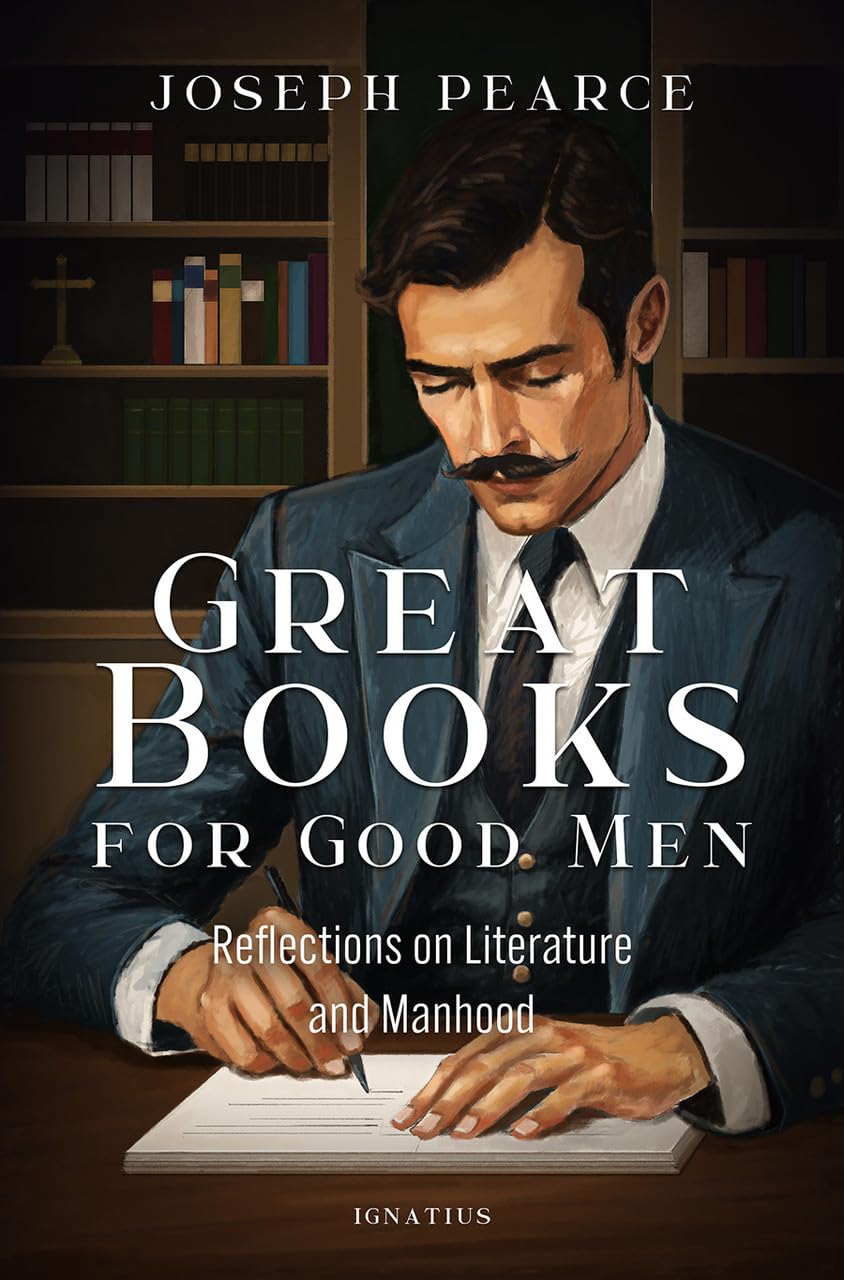 This short book began as a collection of 48 brief reflections originally written for Exodus 90, a 90-day period of prayer and asceticism designed to give men the true freedom they need to become better Catholics and men. We can be grateful that it has been made available to everyone. By way of structure, it was written in four sections — reflections on 12 great poems, reflections on 12 works of literature, and then 12 essays each on G.K. Chesterton and the catholicity of Middle-earth, the world of The Lord of the Rings.
Given its structure, intent and content, this book can be a valuable resource for priests in particular. In fact, the very first offering is a reflection on the General Prologue of Chaucer’s Canterbury Tales, and its description of the various characters in the tales. Pearce focuses on the character of the Parson, and titles this section, “What Makes a Good and Holy Priest?” He writes: “Chaucer seems to be telling us that chastity is necessary for charity. If we will not control our carnal appetites, we will be controlled by them. In order to live a life of charity, like the poor Parson, we need to lay down our lives for others. We cannot do this if we are not willing to control our passions and desires.” A little deeper into the book, Pearce dips into Alessandro Manzoni’s The Betrothed and its portrayal of priests both good and bad. Federico Borromeo, cousin of St. Charles Borromeo, is offered as an example of the former, who served as archbishop of Milan after his cousin and “also followed in his kinsman’s saintly footsteps.” When it comes to poems, Pearce also provides meditations on poems from some of the greatest poet-priests, such as Gerard Manley Hopkins (“God’s Grandeur”), Robert Southwell (“Upon the Image of Death”), and John Henry Newman (“The Sign of the Cross”).
In addition to providing examples of holy priesthood in literature, the volume offers great homiletic fodder, for the study of literature can and should be an important part of one’s pastoral life. Pope Francis reflected on this in a 2024 letter to seminarians. “How can we speak to the hearts of men and women if we ignore, set aside or fail to appreciate the ‘stories’ by which they sought to express and lay bare the drama of their lived experience in novels and poems?” The pope concludes: “Literature helps readers to topple the idols of a self-referential, falsely self-sufficient and statically conventional language that at times also risks polluting our ecclesial discourse, imprisoning the freedom of the Word. The literary word is a word that sets language in motion, liberates and purifies it. Ultimately, it opens that word to even greater expressive and expansive vistas. It opens our human words to welcome the Word that is already present in human speech, not when it sees itself as knowledge that is already full, definitive and complete, but when it becomes a listening and expectation of the One who comes to make all things new.”
Men today, especially in a world of hot social media takes and otherwise fragmented communications, need to embrace the great lessons of classical literature, Pearce easily argues, and we can be grateful (as is Pearce) that he was able to share these brief studies with a broader audience via Ignatius Press. He ends with a reflection on Tolkien and the meaning of life. Tolkien’s words resonate for us all: “Out of the darkness of my life, so much frustrated, I put before you the one great thing to love on earth: the Blessed Sacrament. . . . There you will find romance, glory, honour, fidelity, and the true way of all your loves on earth, and more than that: Death. By the divine paradox, that which ends life, and demands the surrender of all, and yet by the taste — or foretaste — of which alone can what you seek in your earthly relationships (love, faithfulness, joy) be maintained, or take on that complexion of reality, of eternal endurance, which every man’s heart desires.”
K.E. Colombini writes from St. Louis. In addition to HPR, his work has been seen in First Things, Crisis Magazine, Front Porch Republic, National Catholic Register and elsewhere.
 About Book Reviews
Speak Your Mind