
A Quest for the Historical Christ: Scientia Christi and the Modern Study of Jesus. By Rev. Anthony Giambrone, O.P. Reviewed by Rev. Ignatius John Schweitzer, O.P. (skip to review)
The Intentional Household: Living as if People Matter. By John Cuddeback. Reviewed by K.E. Colombini. (skip to review)
Turning Points: How Thirteen Remarkable Men and Women Heard God’s Call and Responded to It. By Russell Shaw. Reviewed by S.E. Greydanus. (skip to review)
Traddyland: Memoir of a Radical Traditional Catholic. By Louis Massett. Reviewed by Andrew Likoudis. (skip to review)
Unraveling Gender: The Battle Over Sexual Difference. By John Grabowski. Reviewed by Rev. Van Khanh Tran. (skip to review)
A Quest for the Historical Christ – Fr. Anthony Giambrone, OP
Giambrone, Anthony. A Quest for the Historical Christ: Scientia Christi and the Modern Study of Jesus. Washington, DC: Catholic University Press, 2022. 448 pages.
Reviewed by Fr. Ignatius John Schweitzer, OP.
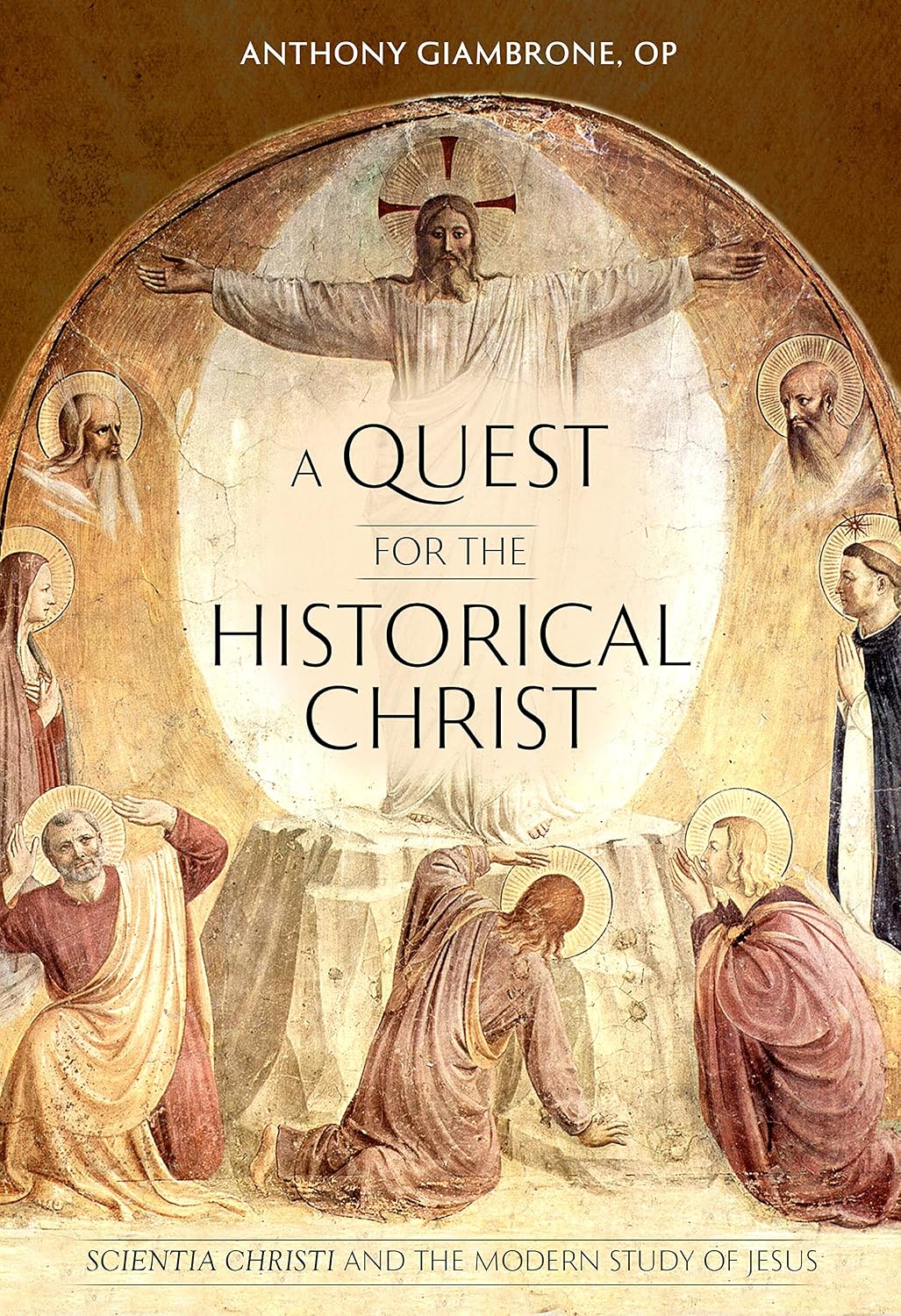 Finally, at last, the divide between a serious historical-critical biblical scholarship and a full-fledged Catholic systematic theology is being bridged! Fr. Anthony Giambrone, OP, of course, is not the first to go in this direction of mending what has been torn apart in the academic fields of Scripture and theology, but he accomplishes this feat with exceptional skill, brilliance, and gifts of grace. I can think of no one as skilled in both disciplines. A professor at the famed Ecole Biblique in Jerusalem and trained in the best of the historical-critical research of our age, he is a well-respected scholar in that world of technical research reflected by his numerous articles in this specialized field of research. And yet he also brings to his work, a keen and deep theological vision, cultivated through his very extensive learning and reading of works in theology and philosophy. His Dominican theological training is never sidelined and it is common to find him working in an idea from the theology of St. Thomas Aquinas seamlessly into his exegetical work with Scripture. And he is also very much in touch with ressourcement theologians and commonly brings in, at key moments, a penetrating thought from the likes of Hans Urs von Balthasar or Pope Benedict XVI.
For those who may have, out of disappointment, set aside either the modern discipline of Scripture or systematic theology, you might give it another chance through Giambrone’s deep, insightful, eloquent, and frankly entertaining prose, with a deep spirituality underneath it all. He opens for us more of the mystery of Jesus through the Scriptures, the Christological councils, and the best of two thousand years of Catholic theology. Moreover, he does this in a way that often feels like spiritual reading. Whatever tenor he adopts at a given moment, it is nourishment for the soul. There are more than common-place helps and challenges in this book for the specialized Scripture scholar and systematic theologian alike, and for the rest of us.
A Key Take-Away from the Book
In this book A Quest for the Historical Christ: Scientia Christi and the Modern Study of Jesus, Giambrone looks at the study of Jesus over the past few centuries, both in a positive and critical way, while drawing on the Church’s councils and Catholic theology. Fr. Anthony likens his seeking the face of Jesus in this book to that of Pope Benedict XVI’s search in his 3-volume Jesus of Nazareth. Giambrone’s title shows he is departing ways from the quest for the historical Jesus and finds the Jesus of history to be precisely the Jesus of faith, the same Christ treasured, pondered, and loved by the Church for 20 centuries. His two main theological interests in the book are reading Scripture with an ecclesial lens in light of the Council of Chalcedon (and the 3rd Council of Constantinople) and re-engaging the theological conversation about Jesus’ human knowledge during his life on earth. In Jesus’ own self-portrayal through his words in the Gospel, we see that he understands his own identity and Messianic mission in terms of the Sacred Scriptures. Jesus describes himself and his mission in terms of the Scriptures he read and prayed with, recognizing himself within the Sacred Page even as he intuitively already knew it. On the road to Emmaus, then, Jesus hands over this Christological reading of the Old Testament to the Church, which sees Jesus in all the writings of Torah, the prophets, and Psalms, in order to read the Scriptures in the same way towards a living encounter with Jesus (Lk 24:27, 44).
In this regard, the Catechism of the Catholic Church #112, quoting St. Thomas Aquinas, notes that the phrase “heart of Christ” can refer to the Scriptures. How is it that we can enter more deeply into the heart and mind of Christ (1 Cor 2:16)? Well, through meditating on the Word of God. Since the Scriptures were so completely in the human mind and heart of Jesus (and indeed as the divine Word, he is the ultimate source of the Scriptures), our meditating and praying with the Word of God helps make our hearts like the heart of Jesus. We come to see reality, the events of life, and other people as he would; and so we come to love them as he would. For instance, a key access point into the human consciousness of Jesus, which may at first seem entirely closed to us, is the Psalter which he prayed so deeply. I have found part III of Fr. Anthony’s book so helpful here in my own spirituality of the Word and trying to enter more deeply into the interiority of Jesus’ heart — into similar attitudes, perspectives, and purposes. And for us who already pray the Scriptures and the Liturgy of the Hours regularly, this book can help us to more deliberately and explicitly enter deeply into the theological depths of what we are already doing in prayer and lectio divina.
In my enthusiasm, I have gotten ahead of myself, in jumping ahead to what I found to be the greatest spiritual fruit of the book. The book is a collection of essays arranged into three main parts. This allows one to shop around and read what looks most engaging among these essays. With his manifestly broad scope of reading all types of books, Giambrone engages contemporary authors in a way that is humble, appreciative, and open to learning. However, he does so in a way that is critical where needed and brings light (and not just heat) to long-standing debates. While doing all this, he writes with charm, quick wit, and good humor.
Modern Historical Studies on Jesus and the New Testament
“Part I. Historical Foundations” looks at the history of modern historical criticism and its search for Jesus, using its modern methods. Giambrone is able to perceive and evaluate the philosophical and theological assumptions underlying much of modern historical criticism over the past 4 centuries, from atheistic to Protestant assumptions. He is conversant with contemporary authors from all backgrounds and is unabashedly Catholic in his very nuanced and fair engagement with them. Unlike the first couple generations of Catholic historical-critical scholars, Fr. Anthony feels no need to prove himself among a Protestant guild of scholars by silencing his own Catholic faith. Can the real Jesus be perceived without faith anyways? And if we are Catholic, can we really look deeply at reality and at Jesus without our Catholic faith affecting us? Key to this first part of the book is a whole essay on Dei Verbum 19 and the Second Vatican Council’s teaching on the historicity of the Gospels. Here Giambrone distances himself from interpretations of “rupture” or a totally new approach as applied here. He finds, rather, in the teaching of Vatican II on the historicity of the Gospels, a “continuity” with the preceding tradition. He notes how contemporary trends of biblical scholarship also support this. Important to part I is the theme of eyewitnesses and understanding the Gospel of Luke’s accent on history.
“Part II. Theological Perspectives” builds on recent literature that makes the case for the early Christology of the first Christians (and New Testament) as being not a low but a high Christology. In these early decades, there is, of course, not the same precision of the later language developed through the councils, but we can clearly see in the New Testament a theological grappling with the mystery of Jesus as true God and true man and receiving the worship that belongs to God alone. Fr. Anthony builds here and elsewhere on some good and groundbreaking scholarship of Protestants like Richard Bauckham, Larry Hurtado, Dale Allison, and N.T. Wright while also showing that their skittishness towards the language of the Church councils actually hurts their case and hinders a proper reading of Scripture. Giambrone also reclaims the rightful place of Greek philosophy in understanding Jesus, like the Church councils did, and the Greek influence even on Sacred Scripture itself.
Reading and Praying the Scriptures Like Jesus Did
“Part III. Jesus and Scriptures” is a masterful handling of the many issues involved in theologically thinking through Jesus’s human knowledge. It should be noted from the beginning that St. Thomas Aquinas observes that if Jesus had only divine knowledge, his human intellect would be completely empty. Put differently, if we think only of Jesus’ divine knowledge or do not give enough emphasis to Jesus’ human knowledge, we are not in accord with Chalcedon orthodoxy, which also highlights a true human nature in Jesus. The divine Son has a human intellect and soul and lived a true human life among us. Hence there is a significant place in theology to ponder Jesus’ human knowledge. Indeed our love for his sacred humanity and human heart will make us interested in this. For St. Thomas, Jesus’ human knowledge falls under three categories: beatific vision, infused knowledge, and acquired knowledge. In these essays, Giambrone zeros in on thinking more about Jesus’ infused prophetic knowledge. He is saving a treatment of Jesus’ beatific vision for hopefully another whole volume of its own for that gigantic theological topic. We wait on the edges of our seat for that! But we are grateful for his opening up Jesus’ infused knowledge in this volume since there is a connection here to Jesus’ mind and heart as we too, to a lesser degree, receive infused lights and inspired judgments in our own reading of Scripture as we read anointed with Jesus’ own Spirit.
For accessing Jesus’ infused knowledge, Giambrone suggests that the best starting point is to start with the Gospels themselves and to let Scripture and divine Revelation be our guide. This seems like an obvious starting point but sometimes treatment of this theological question has started with some a priori idea of a perfection of knowledge. Rather, starting with Scripture itself, and with St. Cyril of Alexandria and others on his side, Fr. Anthony is able to build a nuanced and persuasive account that upholds a high Christology of Jesus’ perfection in the face of words of Jesus like, “But concerning that day or that hour, no one knows, not even the angels in heaven, nor the Son, but only the Father” (Mk 13:32). Theologians throughout the centuries have written much on this question. And if it perks your interest, you have over 100 pages in this book on it, not only dealing with this specific troublesome verse, but building up from Scripture a nuanced and rich account of Jesus’ human knowledge and his messianic consciousness in terms of what we know about his reading of the Old Testament through his own words and actions. Jesus is the fulfillment of the Old Testament and recognizes in its pages his own identity and mission, as the Jewish Messiah, and through Israel with a mission reaching out to the whole world and indeed every time and place with the salvation of God. Here, Fr. Anthony capitalizes on the rich Greek term for “reading,” which also means “recognition” (ana-gnorisis, cf. Lk 4:16). Whatever other ways Jesus exercises an infused prophetic knowledge, one came in his reading of the Scriptures and being able to judge and interpret them aright in their deepest sense, pertaining to himself and his work of saving the world. He had this infused prophetic gift to the highest degree in his reading of the Scriptures. Moreover, his infused prophetic knowledge of future events, primarily the destruction of the Temple and his culminating Cross and Resurrection, are also framed by Jesus himself in terms of his understanding of Scripture. Jesus recognizes, in his reading of the Scriptures, himself as the ultimate “beloved son, Israel.” This is reflected, in part, in his favored titles, like “Son of Man.” Moreover, Jesus sees himself at the center of God’s plan for humanity’s salvation, especially through “the servant of the Lord” texts of Isaiah. From this center point of identity and mission, Fr. Anthony extends out and weaves a rich account of various Old Testament texts and themes as taken up in Jesus’ own teaching through his rabbinical exegesis and as the Son in Spirit-anointed dialogue with the Father (in a key way) through the Scriptures. We see Scripture and this divine dialogue shine out brightly from his sacred humanity in scenes like his Baptism and Transfiguration, which invite us into a like luminosity of the Word: “You are my beloved Son” (Lk 3:22). “Listen to him!” (Lk 9:35)
While we certainly recognize the infinite distance between our reading of Scripture and the God-man’s own reading, part III of the book can help us to appreciate the place of a spirituality of the Word of God in our own lives. It is part of what is involved in our shared humanity with Jesus. For, the human words and accompanying sentiments in his human mind and heart are part of his sacred humanity. And being members of his Body, and branches on the Vine, we have an interior access to Jesus’ interiority, however much through a mirror darkly. We are to read Sacred Scripture in the same Holy Spirit in which it was written (cf. Dei Verbum 12). Whatever the differences, we are to learn from Jesus and follow after him as a disciple learning how to read and live the Scriptures from our rabbi or teacher with his very Spirit he has breathed upon us. Giambrone’s penetrating account of the Old Testament in the life of Jesus helps us to do just this with the help of the historical context and expectations of 1st century Judaism and the world Jesus inhabited.
In a way, this book invites us into a spiritual exercise of knowing (and loving) the Sacred Heart of Jesus more deeply and in a more biblical and theological way than we probably have before. As a result, through the Scriptures, we can be drawn more intimately into the very interiority of Jesus’ own mind and heart, in attunement with the Word, as the living Word of God also beckons, through the Spirit, to our own particular identities, lives, and vocations as Christians. As Jesus continues to read, to exegete, and to pray the Scriptures with and in us, a Holy Spirit anointed reading of the Word can draw us to live more deeply our own particular identity and mission as a son or daughter of God in Jesus Christ. Giambrone opens this mystery further for us. In the end, this lively book can help us to understand Jesus more deeply through the Scriptures, Tradition, and the Church as we continue our own journey to Emmaus (“the Hot Springs”) with Jesus enlightening our eyes and heart to know more deeply the mystery of both him and the unfolding of God’s plan in our lives as he walks steadily with us to strengthen us.
Fr. Ignatius Schweitzer is a Dominican priest of the St. Joseph (Eastern) U.S. Province. He is a professor and director of spiritual formation at St. Joseph’s Seminary in Dunwoodie, and the provincial promoter of the lay Dominicans.
The Intentional Household – John Cuddeback
Cuddeback, John. The Intentional Household: Living as if People Matter. San Francisco, CA: Ignatius Press, 2026. 167 pages.
Reviewed by K.E. Colombini.
 A 2018 Atlantic essay, subsequently shared multiple times over the past eight years by the magazine on its social media platforms, asks a question in its title: “Why Does the School Day End Two Hours Before the Workday?” People (including this author) routinely comment by flipping the script: Why does the workday end two hours after the school day?
This is a fair question, with a benefit beyond the economic. It would not only save many families money they would otherwise spend on after-school care, but it would give families more time together.
The memory of this essay and the reaction to it came to mind as I read Dr. John Cuddeback’s excellent little book, The Intentional Household: Living as if People Matter. Another similar memory was the Covid-19 lockdown of 2020, when many people, myself included, found ourselves working from home and enjoying it, as if it were a more natural situation. As I wrote shortly afterward: “As I think about the experience, there is something about all of us being at home that is not only transcendentally true, good, and beautiful, but also warm, comfortable, and inviting. It’s a feeling I wish we all could have, and enjoy.”
Both parents being present at home as much as possible is an important element of Cuddeback’s recommendations, and research during the pandemic showed not only that far more American “knowledge workers” could work from home full-time (over a third), but that they are more productive when doing so. All the more, it provides children an idea of the work their parents are doing and helps them learn important lessons that will help them as adults.
To Cuddeback, the value also lies in whether the work the parents do is something that can be shared more deeply. The author, a philosophy professor at Christendom College, attempts to live it out at home in rural Virginia, where the family even raises and slaughters pigs together.
You can capture more of his thoughts on a similarly named podcast he produces with his wife, Sofia. Here are the eight principles that Cuddeback sets forth in his book:
- Make household-making a priority.
- Take responsibility for life in your home.
- Make good work in and of the home the context for mutual belonging and living responsibly together.
- Enact real leisure as the heart of life in the home.
- Channel technology to the good of the household.
- When possible, ground the life of the household in the permanent commitment, love, and friendship of spouses.
- When possible, give focus and completion to the household by raising children toward maturity and happiness.
- Make the life and final years of the aging integral to life in the home.
It is hard to argue with any of these principles, and Cuddeback’s subtitle is properly reminiscent of E.F. Schumacher’s landmark 1973 book, Small is Beautiful: Economics as if People Mattered, and rightly so, for both would argue that economics should serve people and that often a smaller approach is better for workers than an industrial-size behemoth that serves far-flung shareholders. This system of economics centered on the worker and the home, often referred to as distributism, provides a moral alternative to the excesses of socialism and its focus on control, and free-market capitalism that is focused on profit.
Cuddeback’s approach is a glimpse of the way life once was, and perhaps the way life really should be. The challenges we face in today’s world are many, from a workplace with demands contrary to family life to entertainment — not true leisure, he would point out — that distracts us from each other.
And how do we get from here to there? Baby steps, perhaps, as much as we can. We can’t all have our own rural Catholic homesteads, but we can garden. We can give up entertainment for reading, prayer, and contemplation, alone and together. We can focus more on the other generations — whether it is the children or grandchildren, or our parents and grandparents.
The real beauty of the Cuddeback plan lies especially in this stress on serving and learning from others — experiencing the curiosity of young children and the wisdom of those approaching their last days. In his conclusion, the author puts it this way: “To care for our parents and our children is who we are; this is essential to being truly human.”
K.E. Colombini writes from St. Louis. In addition to HPR, his work has been seen in First Things, Crisis Magazine, Front Porch Republic, National Catholic Register and elsewhere.
Turning Points – Russell Shaw
Shaw, Russell. Turning Points: How Thirteen Remarkable Men and Women Heard God’s Call and Responded to It. San Francisco: Ignatius Press, 2025. 145 pages.
Reviewed by S.E. Greydanus.
 Discernment has become a subject of such great interest, especially among young adults but among Catholics more broadly as well, that it has generated a mini-culture of its own. Countless faithful struggling with life choices wonder “what God is asking of me” and how they might be sure.
Russell Shaw’s book offers no answers per se, but what it does offer suggests hope that God makes His call clear. These thirteen concise biographies of well-known holy souls — mostly canonized saints, but including one Servant of God, one who has no cause open at this time, and one non-Catholic — each focus on some major turning point, a decisive event that reshaped their lives.
There is no implication that their futures were somehow predetermined, either before or after these events; each of these men and women freely chose to respond to God’s call. The common misconception that my life may be ruined if I make one mistake in “discerning” is, if anything, countered by these examples. Augustine finally gave in to grace after fighting it for years; C.S. Lewis describes his past self as “the most dejected and reluctant convert in all England” (116); Benedict Joseph Labre made half a dozen unsuccessful attempts to enter monastic communities before accepting his extraordinary vocation as a perpetual pilgrim.
Even if our own lives involve no such dramatic changes or moments of revelation, each of us has a unique calling from God and experiences times when faithfulness to Him turns our lives upside down—or perhaps, rather, right-side up. In speaking of answering these divine calls, Shaw makes the much-needed point that everyone has a vocation, not only those who find their place in Holy Orders or a religious order: “Every Christian receives a call to one of these [personal vocation], and each call is uniquely his own; and turning points generally occur in the context of personal vocations, although, if God so chooses, the turning point in someone’s life may be the discernment of his personal vocation” (10). In fact, not only does the finding of one’s vocation apply to laity, it belongs to them in a particular way, on the authority of no less than St. John Paul II:
Declaring the “fundamental objective” of lay formation to be “an ever-clearer discovery of one’s vocation and the ever-greater willingness to live it so as to fulfill one’s mission,” John Paul says that “from eternity God has thought of us and has loved us as unique individuals.” But the specifics of one’s personal vocation are disclosed in “a gradual process . . . one that happens day by day.” (10–11, quoting Christifideles Laici)
Nor does this counsel apply only to the young: “Adolescence and young adulthood are particularly sensitive periods for vocational discernment, yet the Lord calls ‘at every hour of life’” (11).
The universal nature of the Lord’s call is demonstrated here in the variety of profiles. In addition to the six priests and two Carmelite nuns, we have a highly unusual layman (St. Benedict Joseph Labre), a layman who eventually married (C.S. Lewis), a husband and father (St. Thomas More), and two remarkable single laywomen (Servant of God Dorothy Day and Caryll Houselander). Some have obvious points of conversion, like St. Paul or St. John Henry Newman. Others, like St. Thérèse of Lisieux, Pope St. Paul VI, or St. Josemaria Escrivá, show that the “turning” may be to a new form or degree of service.
The biographies are brief but substantial, covering the essence of each figure’s life and message. Each one concludes with points of practical application, considering what we can learn from St. Paul’s holy boldness, St. Ignatius of Loyola’s reforming fidelity, or St. Thérèse’s unpretentious wisdom. Relevant quotes from outside sources, including Church documents and contemporary authors, help to draw connections between the saints’ lives and worlds and our own.
Presented in chronological order, these narratives also offer an outline of historical overview, noting what was happening in the Church and the world of each one’s time and how he or she was an instrument of grace in that setting. In that light, however, a gap appears: The chapters skip from St. Augustine to St. Thomas More, leaving a thousand years of Christianity untouched.
One could also point to some other omissions. The inclusion of more women might have strengthened the work; four out of thirteen is a clear minority (especially given that St. Teresa of Ávila gets only an afterword of barely three pages), and a female reader who reaches the sixth chapter without seeing a woman’s name may wonder when one is going to appear. Then, too, the list is rather heavily European; without in any way detracting from European saints, it’s worth remembering that we can also benefit from learning about less-known holy figures from elsewhere.
Notwithstanding the above, Turning Points is a fine reflection on how God works in human lives and in the world, considered through the lens of thirteen souls who allowed Him to do so. It will be of particular interest for lovers of saints’ biographies; even those familiar with the men and women it profiles can benefit from these fresh perspectives and reflections. It may well benefit anyone looking for models and companions on this winding journey of the Christian life.
S.E. Greydanus is a freelance writer/editor, a lay Dominican, and managing editor of Homiletic & Pastoral Review.
Traddyland – Louis Massett
Massett, Louis. Traddyland: Memoir of a Radical Traditional Catholic. Lou Ben Syr, 2026. 500 pages.
Reviewed by Andrew Likoudis.
 Lou Massett’s Traddyland is a candid and penetrating memoir of one man’s journey out of the SSPX, and precisely the kind of testimony the Church needs at this moment. On July 1 of this year, at Écône, Switzerland, the Society of St. Pius X consecrated four bishops without pontifical mandate, deliberately repeating the egregious act of 1988, despite the Holy See’s warning that such an act would constitute a break from communion and result in excommunication. Once again, the Society appealed to a supposed state of necessity, without any objective standard by which that necessity could be established apart from its own judgment, and claimed that open defiance of the Roman Pontiff could somehow amount to fidelity to the Church he governs. The theological problems with this position have been addressed many times, from Pastor Aeternus through Ecclesia Dei and into the present pontificate. Authors including Andrew Mioni and former SSPX priest Gary Campbell have argued against the Society’s claims. What Massett gives us is something theological arguments alone cannot: an account of what this ideology can do to people formed by it, and what it cost him personally.
Massett was born in 1973 into a large working-class family in Syracuse, New York. His father turned to the SSPX after becoming scandalized by the upheaval that followed the Council. Yet the story Massett tells is, in many ways, another chapter in the same crisis of authority. The early chapters begin with a warm Catholic childhood and gradually become colder and darker as the Society’s outlook comes to dominate more and more of family life.
At thirteen, Massett was sent to St. Mary’s Academy in St. Marys, Kansas, the Society’s flagship community in the United States. He was in eighth grade when the 1988 consecrations took place. One of the most revealing scenes comes in the months beforehand. A brother teaching his class explained that schism was a sin against charity and against the unity of Christ’s Body, and that being Catholic meant accepting the pope’s governance even when one believed the pope was wrong. Within months, the community had embraced the very act that its own catechesis had condemned.
Massett later returned home for a school break and found that his family had changed in his absence. An austere new pastor had taken over the parish. Within a year, his parents had gotten rid of the cable television, the radio was disappearing, and rock music and movies were forbidden. The family Rosary became a nightly requirement, followed by his father’s homilies about Fatima and the supposedly suppressed Third Secret. When Massett went to confession, the priest once told him to kneel on his fingers as penance. At dinner, grievances against the Magisterium became a regular subject, along with accusations of doctrinal capitulation, modernism, and the corruption of the postconciliar popes and the Second Vatican Council.
The cumulative effect is more disturbing than any individual episode. When the authority of the living Magisterium is rejected, something else inevitably takes its place. Sometimes it is simply the private judgment of the individual. In the SSPX world Massett describes, it becomes a whole system of ideas that can explain away virtually any contradiction from outside evidence because the Society itself has already decided what the Church really means.
The consequences could be devastating. When Massett’s sister sought advice about a husband who had begun beating her, the priest whom the family had been taught to regard as the final authority on difficult questions told her to stay, asking what a few beatings mattered when the salvation of her husband and son was at stake. She stayed and continued to suffer the abuse. At St. Mary’s, Massett describes a culture of hazing and shunning, including a vendetta against him as a teenager after he spoke to the press. Decades later, when Kansas investigators opened an inquiry into allegations of abuse involving that rector and other priests, Society officials urged the faithful not to cooperate without lawyers.
This is what happens when a community begins to regard itself as a fortress surrounded by enemies. The Church’s authority becomes suspect, outside scrutiny becomes persecution, and even the duty to protect the vulnerable can become secondary to defending the institution.
Massett’s story also raises an uncomfortable question for the traditionalist claim of a continuing emergency: if private judgment can override Peter, who gets to decide when the emergency is over? His father’s story provides one answer. He began by rejecting a council and eventually, in old age, circulated a sedevacantist manifesto to his family, denying that there was a pope at all. That development is not difficult to understand once the underlying principle has been accepted. If one’s own judgment can determine when the pope has ceased to govern the Church legitimately, there is no obvious point at which that judgment has to stop.
Against all of this, one of the most moving figures in the book is Massett’s sister Joan. Chronically ill and raising young children, she worshiped in an ordinary parish without making the hierarchy the center of her religious life. She spoke about Christ mostly in the language of praise. Massett admits that he once dismissed her holiness as naïveté. Yet her quiet faith steadied him for years. He is perhaps hardest on himself when he recognizes that he had professed the faith with absolute certainty while possessing very little of its charity.
The book has its flaws. A late excursus connecting figures from Massett’s Kansas years with the militia movements of the 1990s will interest some readers but wanders from the book’s central subject, although Massett is admirably careful to distinguish his own claims from what he cannot establish. The prose could also use a firmer copyedit in a second printing. Neither problem seriously diminishes the book.
For readers of this journal, Traddyland is most valuable as a pastoral book. Priests will encounter the children of this world in diocesan Latin Mass communities, in families divided over the SSPX, and in the confessional. Massett shows what it means to grow up inside that world: how a fortress mentality can take root in childhood, how love for the sacred can become entangled with fear and suspicion, and how difficult it can be to find one’s way back.
His final chapters recount his return to full communion and the peace he finds there. That peace is not presented as an intellectual surrender or as the abandonment of everything he once loved about Catholic tradition. It is a return to the Church herself.
At a time when many Catholics remain reluctant to criticize traditionalism because of a general reluctance to have “enemies to the right,” Massett has done something much more useful than settle another argument on the internet. He has told the story of what these ideas can do when they become the atmosphere in which a child grows up. Traddyland deserves to be read by clergy, scholars, and lay Catholics who love the Church’s heritage but refuse to see it turned against her. For pastors trying to help people find their way home, it may prove an especially valuable book.
Andrew Likoudis is Editor-in-Chief, The Kydones Review, a journal of ecumenical and interreligious studies, as well as digital editor of Where Peter Is.
Unraveling Gender – John Grabowski
Grabowski, John. Unraveling Gender: The Battle Over Sexual Difference. Gastonia, NC: TAN Books, 2022. 200 pages.
Reviewed by Rev. Van Khanh Tran.
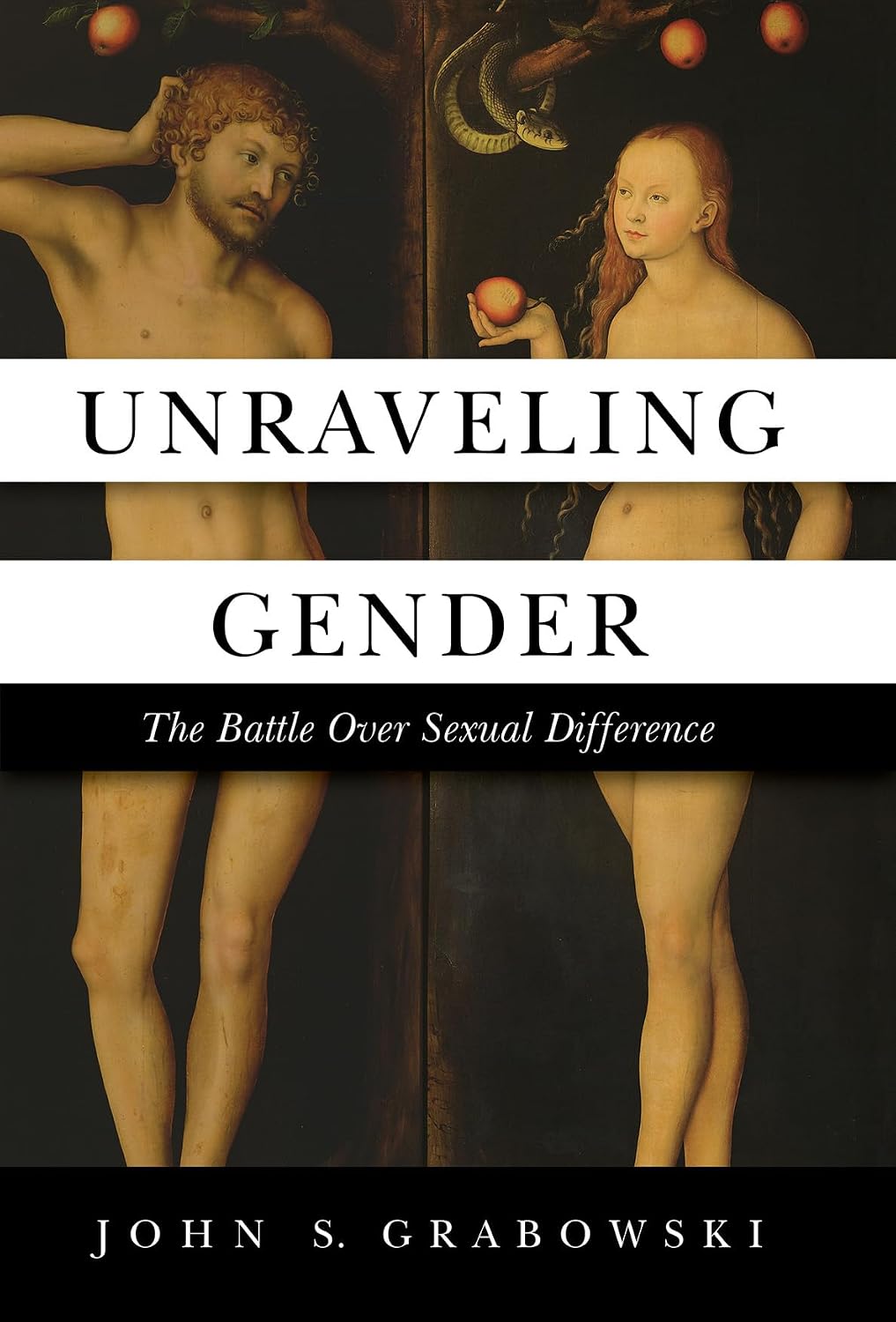 In Unraveling Gender: The Battle over Sexual Difference, John Grabowski of The Catholic University of America revisits a theme that has long accompanied his scholarly work: the question of sexual difference within the Catholic tradition. However, rather than simply restating the concept of sexual difference, a key theme in his earlier writings, Grabowski turns his attention to the rise of gender ideology, which he presents as one of the most pressing questions of the modern world. He approaches this issue by examining what he calls “the unraveling of a coherent and shared understanding of sexual difference in the wider culture,” and then he attempts to “demystify a complex and often confusing topic in the light of both reason and faith” (10). To accomplish this task, Grabowski structures the book in three main movements: first, an examination of the present situation of gender ideology (chapters 1–2); second, an analysis of its causes and consequences (chapters 3–5); and finally, a proposal of possible responses (chapters 6–7).
In chapters 1–2, Grabowski begins by warning about the rapid expansion of gender ideology, which he argues has quietly taken root and begun to exert a profound influence on many areas of contemporary life, including medicine, education, and everyday social practices. According to Grabowski, gender ideology proposes a radical view, suggesting that human identity itself is “nonsense” or has no “clear referent” (13). This ideology ultimately undermines the understanding of the human person as male and female. It stands in contrast to Christian anthropology, which affirms that the human person is created in the image of God, that the body possesses inherent goodness, and that marriage and the family are central to human flourishing.
More specifically, with respect to sexual identity, it is no longer understood as a gift from God. Instead, it is constructed by “social role” and “choice of the individual” and is therefore subject to “change over time” (24). Grabowski argues that this shift has generated unprecedented confusion regarding the human body and personal identity. He points, for instance, to the proliferation of gender categories, sometimes enumerated in the dozens or even hundreds, which he believes contributes to ambiguity and internal conflict within the individual. Beyond its theoretical claims, Grabowski contends that gender ideology has produced serious consequences in different dimensions. In medicine, what he describes as misguided medical practices risk harming both the physical and psychological well-being of patients, particularly in cases related to gender dysphoria. In schools, attempts to create gender-neutral environments often reject traditional markers such as “blue” and “pink.” Grabowski argues that these efforts may paradoxically increase doubt and confusion and contribute to the “growth of rapid onset gender dysphoria among adolescents and young people” (45). Ironically, in civil society, the “distortion of language promoted by gender ideology” includes redefining traditional words, enforcing “new language orthodoxy,” and limiting how individuals can express themselves without fear of social censure. As a result, this creates “cancel culture” and “a form of intellectual fascism” in the liberal and democratic United States (46–52). For Grabowski, these developments reveal a deeper cultural crisis in which the body is no longer viewed as the visible expression of the human person but merely as a surface upon which individuals project a self-constructed identity.
In chapters 3–5, Grabowski explores the philosophical and historical roots of gender ideology. Philosophically, he traces it to existentialist thought, including Sartre’s rejection of an inherent human nature and Beauvoir’s claim that “one is not born but becomes a woman” (66). These imply that the body, sex, and gender are not given but chosen within individual conscience and social context (66–70). Grabowski also links gender ideology to Marx and Engels’ revolutionary ideas, which sought social equality “by suppressing women’s distinctive fertility via large-scale contraception and abortion” (73). The result, according to the author, is a conception of human identity detached from nature, existence, and truth, relying solely on revolutionary self-construction, like “broken cisterns, poisoned wells,” incapable of sustaining truth, and producing emptiness and isolation (76–8).
Grabowski also examines the impact of three historical revolutions. The Industrial Revolution fundamentally subordinated members to economic imperatives. While the Sexual Revolution creates a “destructive subculture” (87), the reproductive advancements of the Technological Revolution deliver “self-harm” through the “use of aggressive medical and surgical techniques,” “contraceptive dependence,” and the manufacturing of a “pornography epidemic” (97). At their core, these revolutions deny human nature and God. They turn the body into a “blank slate” for self-construction, strip sexual difference of its purpose without fertility as an anchor, and treat reproductive acts as technical problems rather than gifts. These changes contribute to gender confusion and the rejection of the male-female binary (100–1).
Grabowski traces a heretical lineage back to early New Testament times, including Gnosticism, which saw “the body not just inferior to the soul . . . but actually evil and incapable of redemption” (112). This heresy undervalues the goodness of creation and treats the body as something to be overcome. While subtle, it persists into modern and postmodern thought, which rejects a God-given human nature and absolute truths about the body and sex. Consequently, Gnosticism distorts the idea of salvation by seeking it through human effort and technology. Moreover, this “false and destructive view” is a “frankenscience” that not only harms the body but cannot wholly erase gender information (119–120).
In chapters 6–7, Grabowski proposes a theological response to gender ideology, emphasizing sexual difference as a God-given gift and advocating a spiritual struggle against error through truth, charity, and pastoral care. As a gift, sexual difference enables men and women to complement each other in body, soul, and personal vocation. According to the author, the error of gender ideology is treating difference as an abstract “something” rather than engaging with “someone” (153). Drawing on Aristotle, Grabowski notes that every person, including intersex individuals, possesses both actuality and potentiality. Present physical or mental disabilities do not diminish one’s potential for full human flourishing. The struggle against secular gender ideology, as outlined in chapter 7, should not be waged with violence but on a spiritual level, through “humility, self-sacrifice, and perseverance” (170). The opponents in this struggle are ideas and errors, not LGBTQ persons or supporters of gender ideology. The goal is to overcome evil and falsehood with love. God calls for faithfulness and directs efforts toward truth and orthodoxy rather than political labels such as “liberal” or “conservative” (176). Church moral teaching is not a weapon against those inside or outside the Church but “an invitation to mercy and life” (179). Not all individuals experience gender-related disorders; pastoral engagement involves “encountering, listening to, accompanying, and befriending” those affected by gender ideology (180).
Unraveling Gender is an integrative and innovative work that makes significant contributions to the field. Beyond its success in challenging the alienation between the Magisterium and theologians in moral theology since the 1960s, the book presents a compelling argument that the inseparable connection between Scripture and the Magisterium provides a thorough understanding of gender ideology. Scriptural narratives are not cited merely to supplement the author’s views on gender ideology; rather, the author uses them to unmask disguises such as a “Babel effect” that rejects limited human nature (59), or the “broken cisterns” in Jer 2:13, which image atheistic humanisms that are incapable of containing “the waters of life-giving truth” (76–7).
Furthermore, official papal documents demonstrate that concern about gender ideology lies at the core of Church teaching. Grabowski conducts a critical reading of these texts, recognizing that while older documents could not foresee every development of gender ideology, they still provide insights into how it has influenced Christian anthropology throughout history. I agree with Grabowski’s theological reflections, grounded in charity and mercy, which offer a balanced approach that leans neither strictly liberal nor conservative. They seek the truth and serve as a bridge between the past, present, and future.
However, regarding the consequences of gender ideology, such as “sexual selection” or the abolition of the gender binary, Grabowski primarily explains them from a theological perspective attributed to “a fallen world” or “a damaged one” (126–7). While this line of reasoning is quite persuasive, the discussion could be further strengthened by incorporating biological evidence, such as the role of testosterone in prenatal development, which supports the binary chromosomal distinction and may be convincing even to those who adhere to a strict scientific worldview.
Overall, the book is accessible and valuable to a wide audience. Theologians, scholars, and graduate students gain a comprehensive account of gender ideology. Educators, mentors, and pastoral guides can use it as a resource for instruction and formation. Parents and young adults preparing for marriage may apply these insights to foster a healthy family life grounded in faith and moral integrity. Even individuals experiencing gender dysphoria might find the book offers meaningful guidance and answers to the challenges they face.
Reverend Van Khanh Tran, a priest of the Diocese of Xuan Loc (Vietnam), is pursuing graduate studies in moral theology at The Catholic University of America in Washington, D.C.
 About Book Reviews
Speak Your Mind