Priests are leaving active ministry in their middle years, and we have not reckoned with why. This essay offers a partial answer from an unlikely source: the developmental psychology of Maria Montessori, which treats every crisis not as a malfunction but as an engine of growth. Read through that lens, the priest’s midlife is a passage rather than a breakdown — the birth pangs of a new strength and a transition into a deeper articulation of fatherhood — written into the human person in a way analogous to birth and adolescence. The Church has done well in developing the tools to accompany the first years of priesthood with mentorship, study, and deliberate care. She has left the “second birth” of midlife largely unattended. I write to bring the phenomenon to light, to argue that it belongs to God’s plan for the priest and not to its frustration, and to ask my brother priests and especially our bishops to pray for priests at this stage of life and to midwife a passage we have so far asked our men to make alone.
In the past several years, I have become aware of a pattern I can no longer ignore. Priests I knew in seminary, priests I have served beside, men whose vocations seemed settled and fruitful, have left active ministry — and they have left, with striking regularity, somewhere between their fifteenth and twenty-fifth year of priesthood. Each man’s story is his own, and I make no assumptions or assertions about any individual. Furthermore, the pattern surely has more than one cause. A crisis of loneliness runs through the contemporary priesthood, and an increasingly administrative model of ministry isolates priests from their people, from one another, and from their bishops. But I have come to believe that something else is also at work, something older than any of our current problems and stranger than we usually allow ourselves to say: these men are leaving at the hour of the midlife crisis, and neither they nor those responsible for them were prepared for what that hour would ask.
The data we have are suggestive but incomplete. The Center for Applied Research in the Apostolate counted 59,192 priests in the United States in 1970 and just over 35,000 fifty years later.1 Dean Hoge’s 2002 study estimated that 10 to 12 percent of newly ordained priests resign within their first five years, and that study prompted a generation of attention to the newly ordained — mentoring programs, convocations, and the deliberate care of the “first five years.”2 The Catholic Project’s national studies of 2022 and 2025 have given us a sobering picture of burnout and loneliness across the presbyterate: about 40 percent of younger priests report loneliness. Only about half of diocesan priests display confidence in their bishops.3 No one, so far as I can tell, has systematically studied the men who leave at mid-life. The research, like our formation, is focused on the beginning of priestly life and falls silent precisely where the danger may be greatest. That silence is itself part of the diagnosis.
I write as a priest of seventeen years. I also write as someone trained in Maria Montessori’s educational theory — an unusual pairing, perhaps, but one that has given me a lens for this problem that I have not found anywhere else. Montessori spent her life studying how human beings grow, and the heart of what she found can be stated in a single claim: development does not advance smoothly. It proceeds through crises. And a crisis, in her account, is the opposite of a malfunction. It is the engine of transformation itself.
The Constructive Rhythm of Life
Dr. Montessori begins her consideration of constructive crises at birth.4 Birth is the first crisis of human life and the most violent. The child loses everything he has ever known — warmth, enclosure, darkness, effortless nourishment, the muffled safety of his mother’s body — and he loses it all at once, without consent and without explanation. Yet no one calls birth a tragedy. The losses of birth are the price of an incomparably larger life: light, breath, faces, the world. Montessori asked us to take that pattern seriously as the pattern of all development.5
It repeats at weaning. The child loses the breast, the most intimate consolation he has, and gains the family table — which is to say, he gains society, conversation, a place among persons.6 It repeats again around age six, when the child of the absorbent mind dies, so to speak, and a new creature appears: the reasoning child, hungry for justice, for facts, for the universe. Montessori organized these observations into her four planes of development — birth to six, six to twelve, twelve to eighteen, eighteen to twenty-four — and she insisted that the planes are not stages on a smooth incline but distinct moments in life, each having its own powers, its own needs, and its own work.7 The passage between planes is turbulent. The onset of adolescence she described as nothing less than a second birth: the child dies, and a “social newborn” appears, fragile and new, needing protection and meaningful work just as urgently as the infant did.8 Her followers came to call this whole vision the constructive rhythm of life.9
The crisis announces itself as loss — of powers, of certainties, of a whole way of being that had worked until now. The crisis, however, is meant to be generative. If it is well prepared and accompanied, it can foster new capacities. If not, the crisis will lead to significant setbacks. A passage attempted without preparation, a guide, or a prepared environment can arrest development or deform it. Montessori built her entire pedagogy on this. The adult’s task is to prepare the environment for the crisis before it arrives. The crises cannot be prevented because they are written into the pattern of human development. The question is how we will prepare for them.
Montessori’s map stops at twenty-four. But nothing in her logic stops there. If development truly proceeds by deaths and births, by the periodic collapse of one form of life so that a larger one can emerge, then we should expect the rhythm to continue into adulthood — and we should be able to predict roughly where the next great passage falls.
The Crisis at Noon
We can. The psychoanalyst Elliott Jaques, studying the lives of creative artists, noticed that, around the age of thirty-seven, their work either transformed, deepened, or collapsed; his 1965 paper gave the phenomenon its now-famous name: the midlife crisis.10 I have witnessed this pattern as well, noticing that many people take on their life’s work around this age. Mother Teresa was 36 when she left her convent to start the Missionaries of Charity. Dr. Montessori herself began working with children around age 37. I can say that I entered the classroom at thirty-seven, as well. A brief survey of those who discovered a “call within a call” shows that it is common to come at this age. I propose that the midlife crisis begins around halfway through the “seventy years, or eighty for those who are strong,” and lasts roughly a decade. That means, broadly, the crisis lasts from 35 at the earliest to about 50 at the latest.
Carl Jung had seen it earlier and given it another image: the noon of life. “We cannot live the afternoon of life according to the programme of life’s morning,” he wrote, “for what was great in the morning will be little at evening, and what in the morning was true will at evening have become a lie.”11 Erik Erikson placed the struggle he called generativity versus stagnation at mid-life — the choice between turning outward to support the next generation or turning inward upon oneself.12 Daniel Levinson’s interview studies located a predictable “midlife transition” in the early forties, as reliably present in ordinary men as in artists.13 And the economists have now confirmed what the psychologists suspected: across nations and cultures, self-reported well-being follows a U-shaped curve over the life course, reaching its lowest point at about age forty-seven.14 These names all circle an experience. At midlife, a man turns and looks back. He takes stock — the literature calls it the life review — weighing what he has built against what he meant to build, and against the years he has left. Some of what he once thought possible he sets aside for good; some he finally takes up for the first time. The reckoning is not morbid. It is how a person decides what the rest of their life is for.
The most useful recent account of why comes from Arthur C. Brooks. Drawing on the research of Raymond Cattell, Brooks distinguishes two kinds of intelligence that govern a working life. Fluid intelligence — the raw power to solve novel problems, innovate, hold many thoughts at once, work fast and long — peaks early and begins declining through the late thirties and forties. Crystallized intelligence — the ability to draw on a lifetime’s accumulated knowledge, synthesize, distinguish patterns, and teach — rises through the fifties and sixties and holds steady into old age.15 The person in midlife is not imagining the decline. What he cannot see from inside the fall is that a second curve is rising beneath him, built of different powers and suited to different work. Brooks names the trap “the striver’s curse.” The more a man’s identity is fused with the achievements of his first curve, the harder he clings to it as it falls, the more he medicates the decline — with workaholism, success-addiction, whatever numbs — and the longer he delays the jump to the curve that would save him.16 And yet decline is only half the story. For most men, these are the peak years of life, above all in love and work, in the capacity to give oneself away and to be received. A man comes into the fullness of his crystallized powers in the very hour his fluid ones begin to fail. The losing curve is real, but it is not the whole story. A man at fifty is in many ways more himself than he has ever been.
Set Brooks’s two curves beside Montessori’s planes, and the resemblance is exact. A form of life with its own powers reaches its limit. The powers wane. The waning feels like death, and in a sense, it is one. But the death is the labor pains of a new set of powers — if the passage is made. Midlife, on this reading, is the fifth plane’s birth crisis. It belongs to the same constructive rhythm as birth, weaning, the change of teeth, and the storm of adolescence. It is not evidence that something has gone wrong with a man. It is evidence that something in him is trying to be born.
The Priest at Noon
Every man faces this passage. I want to argue that the priest faces it with particular intensity and particular danger — and that we have done almost nothing to prepare him for it.
For the person living in the world, outward signs that midlife is approaching are evident. A father watches his children leave home; his body of work changes shape around him, whether he wills it or not. For a priest, however, midlife arrives without outward markers. A priest can be doing at fifty-two exactly what he was doing at thirty-eight: the same Masses, the same meetings, the same cycle of feasts. The interior earthquake has no exterior architecture to express it. Therefore, it goes unnamed.
A priest often comes to this moment on the heels of the excitement of the early years. There are many “successes” for the young priest — building, preaching, energetic ministry, attracting people back to a practice of the faith. An increasingly administrative model of ministry sharpens this further, measuring a pastor by metrics any executive would recognize. When the fluid intelligence begins its appointed decline, a priest may not conclude that his powers are changing kind. He concludes that he is failing — at the one identity he has, the identity so total that even his name has been absorbed into it. The striver’s curse falls heaviest on the man everyone calls Father.
And midlife does something particular to one’s wounds. The structures of seminary and the adrenaline of the first assignments can hold a man’s unresolved history at bay for twenty years — the wounds he carried into formation and, we must add, some wounds formation itself inflicted. At forty-six, the holding pattern fails. What was deferred at the age of twenty-five returns with interest, and it returns to a man who is often alone in a way he has never been before: the rectory empty, the presbyterate thinned and scattered, friendships long since downgraded to collegiality.
The desert monks called it the noonday devil — the demon of acedia who, Evagrius warned, attacks when the sun seems to stand still, making the day interminable, making the cell unbearable, whispering to the monk that the life he chose is a dead end and that meaning lies somewhere else, anywhere else.17 The tradition read noonday both literally and figuratively. In the middle of the day, the monk loses the will to remain attentive in prayer and seeks other activities. In a midlife priest, however, acedia rarely looks like laziness. It looks like a full calendar and an empty tabernacle of the heart. The priest stays active, but begins to skimp on prayer and healthy leisure. Some men leave without leaving. Others self-medicate: an over-attachment to hobbies, turning to the bottle, escaping into a screen, perhaps for some, even an affair. Others just leave. The departures that prompted this essay are, I suspect, the visible fraction of a much larger crisis that mostly stays hidden.
John Paul II saw this clearly. Pastores Dabo Vobis insists that ongoing formation is a duty also for priests of middle age, who face dangers proper to their years: an “exaggerated activism,” a routine exercise of ministry, and the subdued presumption of a man who believes his tested experience now needs no one’s help.18 The American bishops’ Basic Plan for the Ongoing Formation of Priests goes further, naming “priests in midlife” as a distinct formational moment deserving the same intentional care we give the newly ordained.19 The documents are sound. Their implementation, most priests would tell you, is thin to nonexistent. We have built a formation culture that attends the first birth of a priest and leaves him to manage the second alone.
I turned forty-six this year, and I write none of this from a safe distance. The flatness, the strange grief over powers I did not know I had been counting on, the temptation to mistake the end of one way of being a priest for the end of priesthood itself — I have felt these in my own life, in the middle of a presbyterate where I have watched better men than I conclude that the only way through this hour was out the door. I have known the pain of confronting old wounds in dark hours without the experience of a community that is there for me at that moment. I am grateful for an apostolate with a strong built-in community. It has sustained me deeply, and for this I am grateful. Not all are so fortunate.
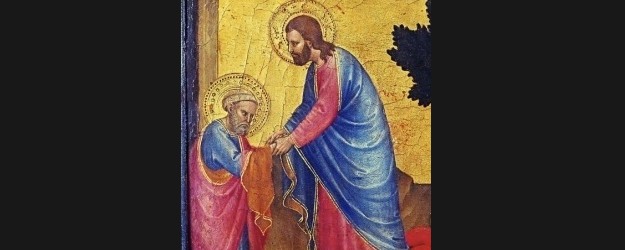
On the shore of Galilee, the risen Christ says to Peter: “When you were young, you girded yourself and walked where you would; but when you are old, you will stretch out your hands, and another will gird you and carry you where you do not wish to go” (John 21:18). We rightly hear the prophecy of martyrdom. But listen to whom it is spoken: a man in the middle of his life, in the wreckage of his worst failure, beside a charcoal fire built to heal the memory of another one. The verse describes the whole arc of a vocation as a passage from self-girding to being girded — from the morning’s strength to the afternoon’s surrender. And only after describing that passage does Christ say, for the second time in Peter’s life, “Follow me.” The call comes twice. The second call comes at noon.
The Passage in God’s Plan
Here, the Montessori perspective can be helpful. If crises are an aspect of the constructive rhythm of human development, then the midlife crisis is a passage appointed by God. God, who ordained that humans be born, are weaned, learn to walk, lose their teeth, widen their social sphere, and eventually leave home, also ordained a mid-life transition. The failure is a feature, not a bug. Fluid intelligence declines so that a man will stop building his own kingdom and become capable of begetting sons in the Kingdom of Heaven.
We can see the pattern of a midlife transition in many biblical scenes. Moses meets the burning bush at the far end of a forty-year plateau in Midian, his ambitions long hidden. Elijah — the closest thing the Old Testament offers to a portrait of ministerial burnout — collapses under the broom tree at the height of his career and asks to die; God’s response is not a rebuke but a meal, a sleep, another meal, a soft word, and a new commission whose centerpiece is generativity: go anoint your successor, mentor Elisha, hand on the mantle (1 Kings 19). And Nicodemus, a senior man, a ruler of the Pharisees, comes to Jesus by night and asks the question every man at noon asks in some form: “How can a man be born when he is old?” (John 3:4). I want to be theologically clear that Our Lord is speaking of the second birth of Baptism. Nevertheless, the supernatural is analogous to the natural. Jesus takes the question with complete seriousness: second birth is the design, the thing a man must undergo to see the kingdom.
The psalmist gives these passages a sort of name. “They go from strength to strength, till each appears before God in Zion” (Psalm 84:7) — the verse from which Brooks took his title, sung by pilgrims who grow physically wearier with every step toward Jerusalem and yet are said to gain strength as they go, because the strength is changing kind beneath them. That is the promise hidden inside the midlife crisis. The first strength will not be given back. There is a second strength, and the road to it passes through the valley of Baca, the valley of weeping, which the same psalm says the pilgrims turn into a place of springs.
For the priest, the second strength corresponds to something we know all priests strive for: spiritual fatherhood. After the transition, the priest earns the title of Father that he was given at his ordination. A presbyterate that loses its men at midlife is not simply losing workers; it is losing men – aborting its fathers at the moment of their birth.
Making the Turn Well
If the crisis is a birth, the practical question is the midwife’s: what does this passage need to go well? Brooks’s counsel to strivers translates into priestly idiom with almost embarrassing ease.
Jump to the second curve on purpose. Brooks’s central counsel is to shift one’s weight deliberately and early from innovation to instruction — from being the engine to forming engineers.20 For a priest, this implies actively seeking the work of transmission: mentoring seminarians, teaching, providing spiritual direction, writing, and handing on what he has learned in twenty years of ministry. A pastor in his fifties pouring himself into the young priest across the deanery is not winding down. He is doing the precise work his stage of life exists for, and he will find that it is the work that makes men in the second half happy.
Brooks observes that the satisfaction of the second half comes less from adding than from chipping away — Michelangelo’s image of David already standing within the marble, waiting to be revealed by removal.21 The mid-career priest’s instinct, panicked by decline, is to add: more programs, more committees, more proof. The crisis asks him to do the opposite. Let some things go to discover what only you can do — and what only you can do, it turns out, was never the administration. It is to celebrate, to absolve, to bless, to suffer with, to pray. A priest who prunes his life back to its sacramental core at fifty is being carved.
Break the success addiction at its root. For a priest, the striver’s curse has a theological name: he has begun to believe that he is made holy by his ministry. A man must rediscover that he was a son before he was ever “Father.” The Institute for Priestly Formation promotes a helpful rubric: “living on the RIM of life” — Relationship, Identity, Mission. The heart easily comes to believe that our identity is generated by what we do; RIM insists on the reverse order, that our identity is rooted first in our relationship with the Father, and that mission flows from there. The Eternal Father’s delight in the priest preceded his ordination. To find one’s identity in beloved sonship is the true corrective to the striver’s curse. The concrete means are ancient: the daily holy hour, the annual retreat, a regular confessor and spiritual director. Time wasted with God is the only solvent for an identity fused to performance.
Convert deal friends into real friends. Brooks distinguishes the “deal friends” of a working life — useful, pleasant, bound to us by function — from the “real friends” who would remain if every function disappeared.22 A priest’s life can be filled to the brim with deal friends: parishioners, staff, brother priests, and colleagues at meetings. Loneliness in midlife is the discovery that few of them are real. The remedies are unglamorous but real: priest fraternities that meet monthly and actually speak honestly, friendships maintained across diocesan lines, therapy without shame, the courage to be known by someone. No man makes this passage alone. That is simply how births work.
Let the Church midwife the passage. The remaining counsel goes to bishops and those responsible for ongoing formation. I believe we need to treat midlife in a way analogous to the excellent care the Church provides for priests during their first five years. The Basic Plan already calls for it; the task is to implement it. If our programs for the ongoing formation of priests presume a midlife crisis, no priest will approach this moment in life unawares. The expectation takes the teeth out of it. A sabbatical or extended retreat could be presented as a standard midlife provision rather than an emergency measure. Vicars for clergy could be trained to recognize the signs of acedia. And let assignments honor the curve: the man of fifty-five may no longer be the diocese’s best builder, and may be on the verge of becoming its best formator. Perhaps the bishop could connect personally with each priest approaching this moment, or appoint another priest to take on this role. The greatest danger of this passage is to undergo it unseen.
Any such accompaniment must maintain the distinction between the internal and external forums. The bishop governs in the external forum; the hardest work of this passage is done in the internal forum, which the bishop cannot enter and must not try to. He can arrange the conditions — the assignment, the sabbatical, the stated expectation, the warm word at the right moment — but he cannot direct a man’s conscience, and he ought not be his own priests’ confessor or spiritual director.23 The most important midwifery he can therefore offer only at one remove: by insisting that every priest have a confessor and a director, by making such accompaniment ordinary rather than a sign that something has gone wrong, and by protecting the freedom in which alone a man opens his interior life.
And the passage remains, finally, the priest’s own to make. No program will make the turn for him. The care of his soul, his mind, and his body is a stewardship he cannot hand to the chancery or to anyone else. The Church can warn him, accompany him, and free him for the work. She cannot do the work in his place.
The Hour of the Second Call
Dante began the Commedia with the most famous line ever written about this passage: “Midway upon the journey of our life I found myself within a dark wood, for the straight way was lost.”24 We quote the dark wood and forget the rest of the poem, which is that the wood has a road through it, that the road goes down before it goes up, and that it ends in vision. The mid-career crisis of a priest is a dark wood with a road through it. Montessori would tell us the wood is on the map. The Gospel tells us who waits on the far side of it: the same Lord who stood on the shore at daybreak and called a failed, middle-aged fisherman to feed his sheep — and then, knowing everything the years would take from him and give to him, said it again: Follow me.
The priests whom we are losing at “the noontime of life” are not failing in their vocations. They are arriving at the second birth of their vocation without the accompaniment they so sorely need. If we can all learn to attend that birth with the same care we lavish on the beginnings of the priesthood, we will discover what every Montessori guide already knows: a crisis can be an opportunity to improve. May God help us turn this moment in the priest’s life into a new flourishing.
- Center for Applied Research in the Apostolate (CARA), “Frequently Requested Church Statistics,” Georgetown University. CARA reports 59,192 priests in the United States in 1970 and 35,513 in 2020. ↩
- Dean R. Hoge, The First Five Years of the Priesthood: A Study of Newly Ordained Catholic Priests (Collegeville, MN: Liturgical Press, 2002). ↩
- The Catholic Project, National Study of Catholic Priests (Washington, DC: The Catholic University of America, 2022), and the 2025 follow-up study, Morale, Leadership, and Pastoral Priorities: Highlights from the 2025 National Study of Catholic Priests (2025). The follow-up found that 40 percent of priests ordained after 2000 reported experiencing loneliness, compared with 27 percent of those ordained between 1980 and 1999 and 15 percent of those ordained before 1980; 52 percent of diocesan priests expressed confidence in their own bishop. ↩
- See Silvana Quattrocchi Montanaro, Understanding the Human Being: The Importance of the First Three Years of Life (Mountain View, CA: Nienhuis Montessori, 1991). Dr. Montanaro developed the treatment of developmental crises that remains standard in AMI formation. ↩
- Maria Montessori, The Absorbent Mind, trans. Claude A. Claremont (New York: Holt, Rinehart and Winston, 1967), esp. chaps. 3–7 on birth and the successive conquests of independence. ↩
- Montanaro, Understanding the Human Being, on the crises of the first three years of life. ↩
- Maria Montessori, “The Four Planes of Education,” lecture, 1938/1939, ed. Mario M. Montessori (Amsterdam: Association Montessori Internationale). ↩
- Maria Montessori, From Childhood to Adolescence (1948; repr., Amsterdam: Montessori-Pierson, 2007), on adolescence as a new birth and the adolescent as a “social newborn.” ↩
- E. M. Standing, Maria Montessori: Her Life and Work (1957; repr., New York: Plume, 1998), on the “constructive rhythm of life.” ↩
- Elliott Jaques, “Death and the Mid-Life Crisis,” International Journal of Psychoanalysis 46 (1965): 502–14. ↩
- C. G. Jung, “The Stages of Life,” in The Structure and Dynamics of the Psyche, vol. 8 of The Collected Works of C. G. Jung, trans. R. F. C. Hull (Princeton: Princeton University Press, 1969), ¶784. ↩
- Erik H. Erikson, Childhood and Society (New York: Norton, 1950), chap. 7. ↩
- Daniel J. Levinson, The Seasons of a Man’s Life (New York: Knopf, 1978). ↩
- David G. Blanchflower, “Is Happiness U-shaped Everywhere? Age and Subjective Well-being in 145 Countries,” Journal of Population Economics 34 (2021): 575–624. ↩
- Arthur C. Brooks, From Strength to Strength: Finding Success, Happiness, and Deep Purpose in the Second Half of Life (New York: Portfolio, 2022), chaps. 1–2; cf. Raymond B. Cattell, Abilities: Their Structure, Growth, and Action (Boston: Houghton Mifflin, 1971). ↩
- Brooks, From Strength to Strength, chap. 1 (“striver’s curse”) and chap. 3 on success addiction. ↩
- Evagrius Ponticus, Praktikos 12; see Jean-Charles Nault, OSB, The Noonday Devil: Acedia, the Unnamed Evil of Our Times (San Francisco: Ignatius Press, 2015); cf. Ps 91:6. ↩
- John Paul II, post-synodal apostolic exhortation Pastores Dabo Vobis (March 25, 1992), §77. ↩
- United States Conference of Catholic Bishops, The Basic Plan for the Ongoing Formation of Priests (Washington, DC: USCCB, 2001), section on priests in midlife. ↩
- Brooks, From Strength to Strength, chap. 2. ↩
- Brooks, From Strength to Strength, chap. 4. ↩
- Brooks, From Strength to Strength, chap. 6. ↩
- The Code of Canon Law keeps the internal and external forum carefully apart and bars those who govern in the latter from binding the former: confessors and spiritual directors are to give no opinion when superiors decide on a candidate’s admission to orders (can. 240 §2), and those charged with governance are not to hear the sacramental confessions of their subjects (can. 985). The same principle underlies the longstanding counsel that a bishop not serve as the habitual confessor or spiritual director of his own priests. ↩
- Dante Alighieri, Inferno, canto I, lines 1–3. ↩
 About Fr. Nick Schneider
This is a very thoughtful and helpful essay, Father. Thank you.
An excellent reflection and call to action – thank you.
To the web master/powers-that-be: reading this on my phone (with the browser correctly configured – I double checked!) was super unpleasant due to the page insisting on displaying as if on a desktop computer (now text reflow, adjusted font size, etc). I **really** want to share this with other clergy (priests and bishops!), but the difficulty in simply reading the text is going to be a significant deterrent! Please find a solution that enables mobile friendly (and mobile-detecting) display.
This article brought together many different sources to support the thesis the priest in midlife needs help. I particularly enjoyed the Maria Montessori’s subsequent “map,” the call to formators to help young men prepare for this event, and the call to priests to take personal responsibility. Bishop Thomas Olmsted began a program in our diocese, Jesu Caritas, and priests remain in small groups with each other, fostering deep friendships. (Our diocese is Wichita, KS.) The author’s ending is beautiful and compelling.