
The Diaconate Revisited: Questions and Developments Since Vatican II. By Marc B. Caron. Reviewed by Rev. Ryan Connors. (skip to review)
Autonomy, Consciousness, and Personhood: A Primer for the Public Dialogue on Abortion. By Stephen Bunjo. Reviewed by Rev. Peter M.J. Stravinskas. (skip to review)
Your Faith Has Saved You: Homilies for Liturgical Year A, Sundays, Solemnities, and Some Feasts. By Fr. John P. Cush. Reviewed by Rev. Denis Nakkeeran. (skip to review)
The Two Jerusalems: My Conversion from the Messianic Movement to the Catholic Church. By Matthew Wiseman. Reviewed by Rev. Lucas LaRoche. (skip to review)
Archbishop Fulton J. Sheen: Convert Maker. By Cheryl C.D. Hughes. Reviewed by Matthew H. O’Donnell. (skip to review)
The Diaconate Revisited – Marc B. Caron
Caron, Marc B. The Diaconate Revisited: Questions and Developments Since Vatican II. Washington, DC: The Catholic University of America Press, 2026. 215 + xviii pages.
Reviewed by Rev. Ryan Connors.
 Recent years have witnessed considerable ecclesial discussion about what could be described as tangential issues related to the diaconate. Both in commissions established by the Holy See and in the public realm discussion has centered on the possibility of revision of settled Catholic teaching that only men can be ordained validly as deacons. For its part the Catechism of the Catholic Church teaches: “Only a baptized man (vir) validly receives sacred ordination” (CCC, no. 577, citing CIC, can. 1024).
In a similar, also tangential fashion, the Church has witnessed considerable recent discussion about the obligation of clerics — including deacons who will not be ordained as priests — to live perfect continence. Again, the 1983 Code of Canon Law requires: “Clerics are obliged to observe perfect and perpetual continence for the sake of the kingdom of heaven” (CIC, can. 277 §1).
With The Diaconate Revisited: Questions and Developments Since Vatican II Monsignor Marc Caron has returned discussion about the diaconate to its proper theological place. What is the diaconate and what does the Church teach regarding its specific character and grace? With a substantive foreword by the indefatigable Matthew Levering, this book will be welcome reading for anyone interested in this aspect of the divine constitution of the Church.
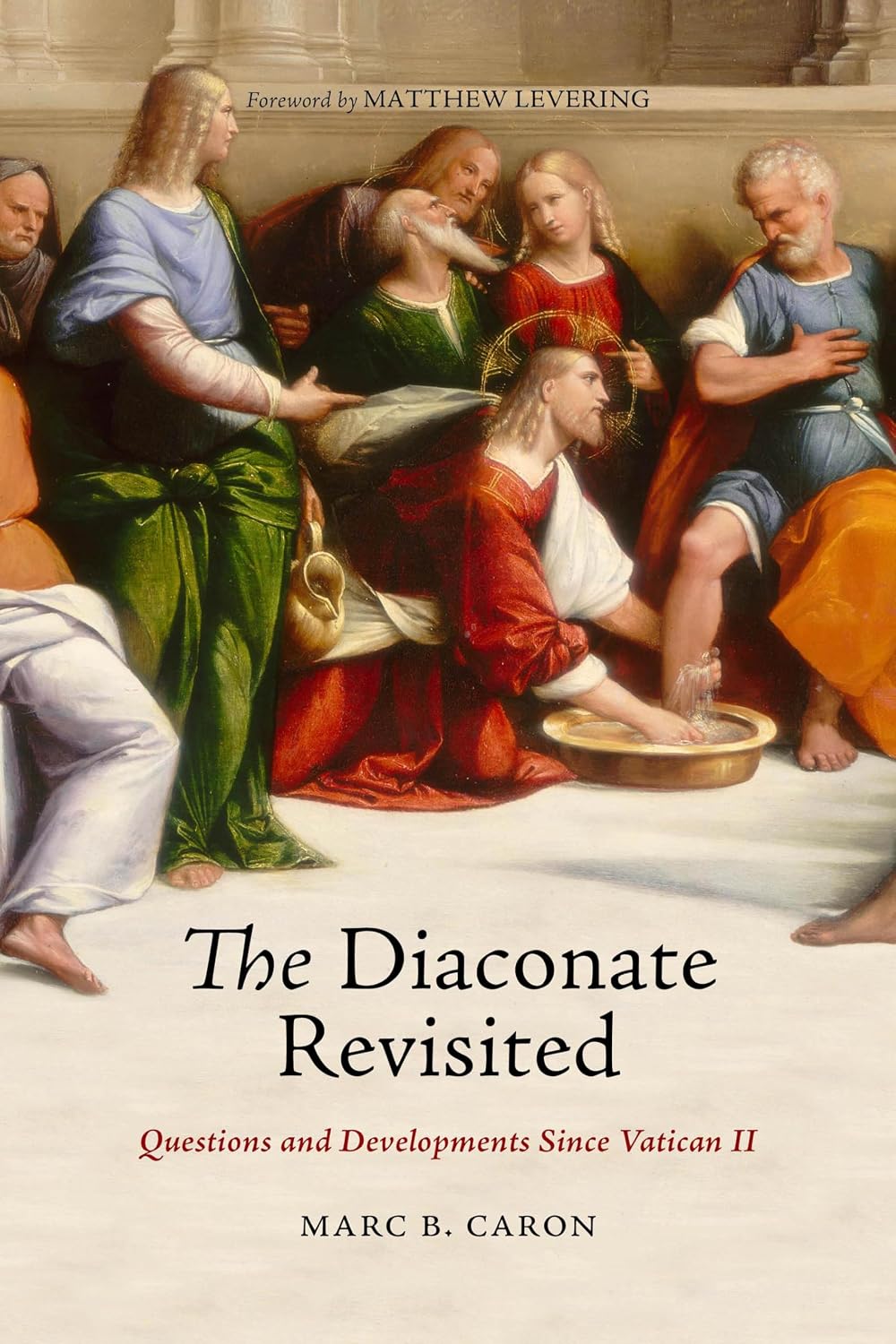
In this well-researched tome, Caron emphasizes that the one sacrament of Holy Orders involves two dimensions, sacerdotal and ministerial. He prefers to render the terms in Latin: sacerdotium and ministerium. He explains that the bishop enjoys the fullness of both aspects — priestly and ministerial — whereas the presbyter possesses each dimension but to a degree more limited than that of the bishop. The book’s cover offers an image of Christ the servant (CCC, no. 1570) washing the feet of the apostles. As Caron explains: “The Last Supper is not only sacerdotal in nature; it is also ministerial or diaconal” (85).
Unlike the bishop and presbyter, the deacon is ordained not unto the priesthood but unto ministry (see Lumen gentium, no. 29). Caron offers an extended history of the use of this phrase and prefers its rendering as “non ad sacerdotium sed ad ministerium episcopi” (36). That is, the deacon shares in the bishop’s service, either by being sent by the bishop to serve, or, perhaps more precisely, sharing in the bishop’s own diaconal or ministerial witness.
The 1964 Dogmatic Constitution on the Church, Lumen gentium (paragraph 29), called for the restoration of the so-called permanent diaconate. In many parts of the world it is fair to say this restoration has unfolded not without difficulty. The process of formation often has proven challenging. The Church has had to make clear that such formation is not in anticipation of deacons entering sacramental ministry in a way not established by the divine constitution of the Church (On this matter, see from the Congregation for the Doctrine of the Faith, the 2005 Note on the Minister of the Sacrament of the Anointing of the Sick.)
Through five dense but eminently readable chapters Caron chronicles the history of Catholic reflection on the diaconate. The scholastics explained the diaconate — and other degrees of orders — as a participation in the sacrament of the priesthood. Since Vatican II (and really prior to that), Catholic thought has distinguished the three degrees of Holy Orders, bishop, presbyter, and deacon, and emphasized that the bishop enjoys the fullness of this sacrament with the presbyter and deacon sharing in his episcopal fullness in unique ways.
An important clarification came with the 2009 Motu Proprio Omnium in mentem of Pope Benedict XVI. He modified the 1983 Code of Canon of Canon Law to read: “Those who are constituted in the order of the episcopate or the presbyterate receive the mission and capacity to act in the person of Christ the Head, whereas deacons are empowered to serve the People of God in the ministries of the liturgy, the word and charity” (CIC, can. 1009 § 3).
In light of this clarification, Caron explains that while deacons may exercise at the diaconal level each of the triple munera — teaching, sanctifying, and governing — it is not essential that they do so simultaneously for each of them (136). Deacons may exercise the role of teaching and preaching, but it is not essential to their office. In terms of governance, the deacon does not share in the headship of bishops and priests. Nonetheless, he may be delegated to govern not in his own name but as delegate of the bishop (138).
Caron is careful to distinguish authentic teaching regarding the diaconate from what has been dogmatically defined. He explains: “[t]he sacramental nature of diaconal ordination is part of the authentic magisterium and demands religious submission of the intellect and will, though not the assent of faith” (81). Nonetheless, he esteems the importance of the diaconate for the Church’s life and insists that “the diaconate, no less than the presbyterate itself, can be considered as a gift to the Church from Christ” (92).
Msgr. Caron has rendered a considerable service to the Church with this excellent resource. The Diaconate Revisited will stand as the standard point of reference for Catholic theology on the diaconate. It complements and completes the work of W. Shawn McKnight, Understanding the Diaconate: Historical, Theological, and Sociological Foundations (Washington, DC: The Catholic University of America Press, 2018). No diaconate formation program can do without this now-essential reading. Deacons, seminary professors, and others who seek to understand better this aspect of Catholic faith owe a debt of gratitude to Msgr. Caron for this important work.
Rev. Ryan Connors is a priest of the Diocese of Providence and Rector of Our Lady of Providence Seminary (Providence, Rhode Island). He is the author of many publications including Rethinking Cooperation with Evil: A Virtue-Based Approach (Washington, DC: The Catholic University of America Press, 2023); Moral Theology: An Introduction (Cape Girardeau, MO: ECT Press, 2025); and Confirmation (Cape Girardeau, MO: ECT Press, forthcoming).
Autonomy, Consciousness, and Personhood – Stephen Bujno
Bujno, Stephen. Autonomy, Consciousness, and Personhood: A Primer for the Public Dialogue on Abortion. Eugene, OR: Wipf & Stock, 2026. 326 pages.
Reviewed by Rev. Peter M.J. Stravinskas.
 The sides in the abortion debate are fixed. One is pro-life, and the other is pro-choice. These labels have hardened into identities, and the identities have become the argument. Yet neither label names what it argues toward. Pro-life reasons from biological life to a conclusion about personhood, but life is not what the argument is actually about. Pro-choice reasons from bodily autonomy to a conclusion about personhood, but autonomy is not what the argument is ultimately about. Both sides reason from something adjacent to the real question, and both arrive at their conclusions without ever engaging it directly. That is Stephen Bujno’s diagnosis in Autonomy, Consciousness, and Personhood, and it is why he calls his book a primer. Before the argument can be properly held and respectfully engaged, it requires reorienting.
Bujno’s reorientation is to concede the importance of each side’s preferred value, as autonomy is an important bioethical concern, and of course, so too is biological life. The problem is when those are presented as the foundational premise from which the moral value of the unborn is inferred. Bujno contends that the real major premise is personhood, and with it the question of moral value. Some abortion advocates concede the personhood of the unborn but argue that its moral value is not equivalent to the mother’s. That is the terrain the reoriented conversation must cover. Neither biological life nor autonomy can settle it alone.
If this reorientation does not sound original, the book will surprise the reader with its claim that it is the “sides” which are the problem with making that move. One side tries to bring the other closer to their position, either fertilization or some point near viability and birth. Proving when the heartbeat begins is not a pro-life win, any more than proving the absence of consciousness in the early embryo is a pro-choice win. The ebbing and flowing is exhausting, and each side ultimately hopes the other will accept concessions that do not rationally fit their position.
If it is not contested that autonomy matters or that the biological life of the unborn matters — because they do — then what is contested is who and how personhood is determined, and whether that person has moral value equal or less than the mother. Until the public conversation engages that question, Bujno argues, the impasse will hold. That is not a compromise seeking common ground, but a rational claim about where the argument actually is.
The book’s structure follows the reorientation with Chapter One describing the impasse. Chapter Two treats the foundations of dialogue and the elements of a good argument, including a section on syllogistic logic that any reader will find genuinely useful. Chapters Three through Five treat various positions on personhood for consideration. Bujno then frames a foundational axiom—either some living humans are persons or all living humans are persons — and argues that this is the necessary fulcrum for the whole conversation. If “all,” autonomy is constrained by the moral value of the unborn. If “some,” then who decides, and by what criterion? Chapter Six then turns to consciousness, the marker most commonly invoked in secular arguments for restricting personhood.
Bujno’s treatment here will be of particular interest to pastors and chaplains. He shows that consciousness-based accounts of personhood, taken consistently, have implications well beyond abortion. If personhood requires developed consciousness, then the comatose patient, the person in a minimally conscious state, and the newborn all have their standing placed in jeopardy by the same logic. Whole brain death, which Bujno treats carefully in its own right, is drawn into the same conversation.
Chapter Seven engages contemporary arguments in detail. Chapter Eight offers questions for further consideration, such as artificial wombs and embryo research tethered to IVF. What is offered may at first glance sound science-fictional, but the present research is presented and explained. Throughout, Bujno maintains a distinction from the classical tradition: the disinterested reasoner is committed to the question and open to where the argument leads, while the indifferent reasoner has no stake in it at all. His book is written for and from the former.
Two features of the book deserve particular mention for a pastoral readership. First, the treatment of philosophical anthropology in chapters four and five complements what Gaudium et spes and Evangelium vitae present theologically. A priest or deacon reading these chapters will find the natural-law substrate of the Church’s teaching articulated in terms accessible to interlocutors who do not yet share its theological premises. Second, Bujno’s chapter on the foundations of dialogue is a genuine catechetical tool. Any parish adult education group, OCIA setting, or clergy formation program addressing contested moral questions could use it profitably.
The book is not a rallying document. It is a slow, careful, deliberately dispassionate treatment of a subject where the sides are ordinarily dug in. That is precisely why it belongs on the shelves of parish libraries, seminaries, and hospital chaplaincy offices. In an ecclesial culture where the pro-life witness has sometimes been reduced to slogan and performance, Bujno’s book is a useful corrective, asking the harder question. It will require effort of the reader, but offers more in return for the effort.
Rev. Peter M.J. Stravinskas, Ph.D., S.T.D., founded The Catholic Answer in 1987 and The Catholic Response in 2004, as well as the Priestly Society of Saint John Henry Cardinal Newman, a clerical association of the faithful, committed to Catholic education, liturgical renewal and the new evangelization. Father Stravinskas is also the President of the Catholic Education Foundation, an organization, which serves as a resource for heightening the Catholic identity of Catholic schools.
Your Faith Has Saved You – Fr. John P. Cush
Cush, John P. Your Faith Has Saved You: Homilies for Liturgical Year A, Sundays, Solemnities, and Some Feasts. St. Louis, MO: En Route, 2025. 329 pages.
Reviewed by Rev. Denis Nakkeeran.
 In the logical follow-up to his book published last year, Fr. John Cush presents another beautifully reflective collection of homilies for the Year A cycle of liturgical readings. In Your Faith Has Saved You: Homilies for Liturgical Year A, Sundays, Solemnities, and Some Feasts, Cush offers good models and examples for homilists, while himself also offering his preaching as the fruit of his own prayer and contemplation.
In Year A, the majority of the Gospel readings come from the Gospel according to Matthew. Cush thus introduces his work by offering the reader an exposition on what grounds Matthew’s Gospel account. As Cush himself says, “At the heart of the Gospel according to Saint Matthew is a burning question — posed first by Jesus Himself, and still reverberating in every homily, every proclamation of the Word, and every heart that listens with faith: ‘But who do you say that I am?’ (Mt 16:15). Peter’s response — ‘You are the Christ, the Son of the living God’ (Mt 16:16) — forms the cornerstone of the Matthean Gospel and the foundation of apostolic preaching” (p. 1).
Cush offers in his introductory notes the key Christological and broader theological themes that are presented in Matthew’s Gospel, from which the homilist can draw. He ensures that the homilist sees the practice of preaching from the texts of this Gospel account not as a simple exposition of nice ideas or merely calls to external action, but rather as the presentation of Jesus Christ, much like how Matthew himself seeks to preach Jesus Christ. As Cush summarizes, “The task of the homilist, then, is not first to moralize or entertain, but to open the Scriptures and reveal Christ, as He opened His mouth and taught them (Mt 5:2)” (p. 4).
As with his previous publication, one of the greatest strengths of this book is the presence of a number of different kinds of resources. Cush can masterfully find inspiration in the many works and media throughout history that have both drawn upon the Gospel and seek to portray something about the Gospel. This inspiration is communicated well and helps to concretize some of the more abstract elements of Scripture for the modern Christian, helping to expose people to a more complete understanding of what Scripture seeks to communicate.
In his homily for the Solemnity of the Epiphany, Cush is able to portray well the meaning of this solemn celebration. While in the modern world, this day does not get much attention, Cush shows why this occasion is worthy of great solemnity. As he indicates, “Christmas is the mystery of the Word made flesh, but Epiphany is the mystery of the Word revealed to the world. It is the universal expansion of the Incarnation — Christ is not only the Messiah of Israel but the Savior of all peoples. The Church Fathers often referred to this day as the “theophany” — the revelation of God’s glory to the Gentiles” (p. 51). There is a profound truth that is revealed in Matthew’s Gospel as the events of the Epiphany are recounted. Our faith is more securely grounded as we come to know this revelation, which can only happen when it is encountered and preached for others to encounter. As he continues, “This liturgical feast is more than a historical commemoration. It is a proclamation of the Church’s missionary identity” (p. 52). From experience in parish work, this is a point that can often be ignored — that the Church has a mission that goes beyond charitable works. Preaching must serve this greater mission. Cush demonstrates well how a homily can help to serve in the continued mission of the Church to proclaim Jesus Christ and all that He teaches to the world.
Through personal stories, a variety of scholarly and non-scholarly sources, and his own prayer, Cush is able to offer a unique set of homilies that demonstrates his own voice that is able to preach the Gospel well. Similarly to his homilies for the readings of Year C, Cush is not seeking to write a “how-to” on homilies or to simply offer best practices. The goal of this book is to preach well and to serve as an exemplary resource for others to preach well.
In this latest collection of homilies, Fr. Cush once again offers rich and compelling reflections on the Gospel of Matthew throughout the liturgical year. With the same warmth, pastoral insight, and unique storytelling that characterized his previous work, he invites readers to encounter Jesus Christ in a way that is both deeply human and profoundly transformative. Each homily draws the reader more deeply into the mysteries of the faith while demonstrating the enduring importance of the Gospel for Christian life today. This volume will be a welcome resource for anyone seeking to know Christ more intimately, and it will be especially appreciated by committed disciples and those who desire to deepen and enrich their own preaching.
Rev. Denis Nakkeeran is a diocesan priest of the Archdiocese of Boston. He holds an S.T.L. in Moral Theology from the Pontifical University of St. Thomas Aquinas (Angelicum) in Rome and serves as a professor and formator at St. John’s Seminary in Boston.
The Two Jerusalems – Matthew Wiseman
Wiseman, Matthew. The Two Jerusalems: My Conversion from the Messianic Movement to the Catholic Church. San Francisco: Ignatius Press, 2024. 210 pages.
Reviewed by Rev. Lucas LaRoche.
 The conflict between the State of Israel and Palestine, which has received more coverage in recent years, has caused — in the present reviewer’s experience — a proliferation in Protestants who become infatuated with the idea of Messianic Judaism. It does seem to be a natural move: Those Christians who believe that the State of Israel remains the true Israel of God, when it is threatened, double-down on their devotion to it.
Dr. Wiseman’s The Two Jerusalems, then, provides an interesting resource for those curious about the internal dynamics of the movement, including a real observation and critique that the attempt to Judaize mainstream Protestantism seems to be based on the impulse to add Tradition to a movement otherwise lacking it. Written as a biography, Dr. Wiseman uses his own family’s theological wanderings over the course of his lifetime to expound and explain many of the nuances and attractions that seem to draw contemporary men and women towards a more Judaizing bend. Beginning with the evangelicalism of his childhood, Dr. Wiseman shows how his own family moved to the Messianic Movement — in a variety of its different shades — before he himself became an Anglican for a short period and ultimately joined the Catholic Church.
As far as the book stands as a biography, it is not uninteresting. Although Dr. Wiseman never uses the word himself, he does fill the role of a “searcher” that one frequently encounters in a variety of Church settings: one who was raised in a particular Church or communion and migrated through several others before finding a home. Dr. Wiseman’s own erudition and clarity allow him to describe what this process was like, over the course of decades, and his own natural intellectualism allows him to provide steady and clear-sighted critiques to those streams of thought that he encounters on his journey.
The real value of the book, one may observe, though, is that of a synthetic presentation of Messianic Judaism or the Messianic Movement more broadly. While many Catholics are familiar with and able to understand and respond to common tropes from Protestants, Orthodox Christians, and other well-established Christian communions, members of the Messianic Movement prove difficult to dialogue with, in part because of the lack of internal structure that led Dr. Wiseman out of the movement. Nonetheless, with the majority of Dr. Wiseman’s book being spent on his time as a member of the Messianic Movement, he provides an integrated account of what life within that movement looks like, which allows the reader to begin to understand and appreciate the unique characteristics of the movement, and understand why some individuals might be drawn to it.
At times, the function of the book as a primer in the Messianic Movement — at least for the present reviewer — seemed to overshadow the biography, or vice versa, but it remains an engaging book through which one is able to learn something of contemporary impulses in the religious landscape through Dr. Wiseman’s own life and story.
Rev. Lucas LaRoche, S.T.L., is a priest of the Diocese of Worcester. He received his S.T.L. in Patristic Theology and the History of Theology from the Pontifical Gregorian University. He currently serves as pastor of Sacred Heart Parish (Webster, Massachusetts) and associate archivist of the Diocese of Worcester.
Archbishop Fulton J. Sheen: Convert Maker – Cheryl C.D. Hughes
Hughes, Cheryl C.D. Archbishop Fulton J. Sheen: Convert Maker. San Francisco, CA: Ignatius Press, 2024. 261 pages.
Reviewed by Matthew H. O’Donnell.
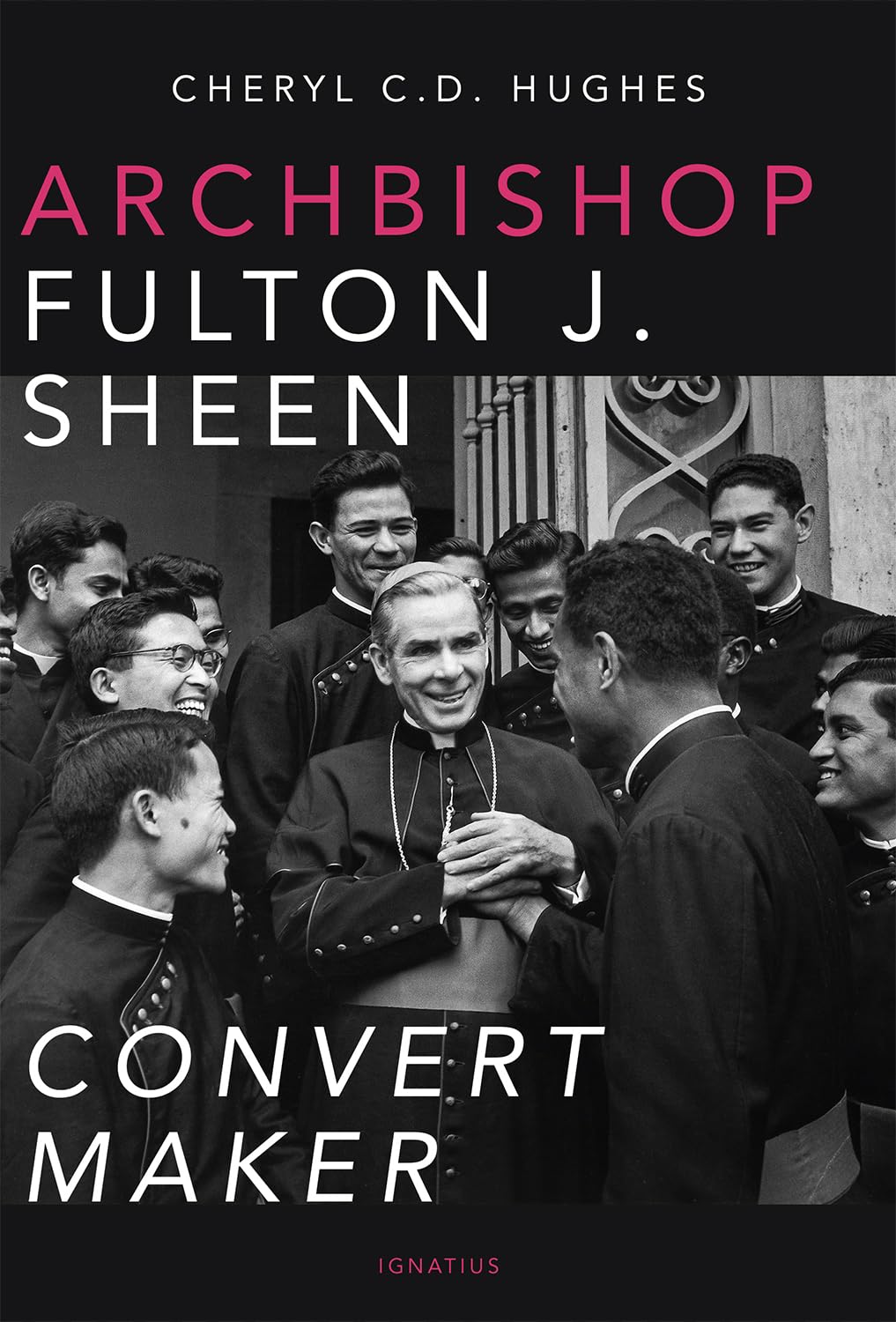 When I was a young seminarian, Bishop Fulton J. Sheen seemed to be a larger-than-life figure. Now, as a full-fledged adult, I read that he was 5’7” tall and 137 pounds. His small frame was due to his contracting tuberculosis as a child. His later clerical regalia filled out his slender frame for his eventual presence on television. He was graced with a mystical experience during his early seminary years that he described as an “Illumination of soul. Light suffused intellect.” The result was an overwhelming conviction of the certitude of faith, which reconfirmed his vocation to the priesthood. In his early 20s he began the practice of a daily Holy Hour before the Blessed Sacrament, a devotion he kept for the rest of his life. He found the presence of the Blessed Lord to be an inspirational environment for prayer, crafting homilies, and writing 66 books — longhand! No matter what his living arrangements were, he always included space for a private chapel. In his final residence, he carpeted the floor of the second room in blue, in honor of the Blessed Mother, under whose mantle he would find solace.
Not long after the ink dried on his double master’s degrees from the Catholic University of Louvain (Belgium), Sheen pursued doctoral studies in Rome, though the degree was conferred at Louvain. After a grueling six-hour oral exam, he was awarded the very highest distinction. Soon the scholar’s accolades made Dr. Sheen the sought-after professor. In 1926, he joined the faculty of the Catholic University of America just one year after the publication of his dissertation, a position he would hold for 25 years. Stepping out from behind the student’s desk to the front of the seminar room, he practiced the approach and methods of his beloved professors at Louvain: (1) Always keep current: know what the modern world is thinking; read its poetry, its literature; observe the architecture and its art; hear its music and theater; and then plunge deeply into St. Thomas and the wisdom of the ancients, and you will be able to refute its errors. (2) Most importantly, tear up your lecture notes annually.
Speaking engagements led him to hosting the weekly radio show, The Catholic Hour. Though Catholic in name, Bishop Sheen’s intentions were ecumenical. He spoke to Catholics, non-Catholics, Protestants, Jews, and those with no faith. His worldwide evangelization efforts were just starting to develop when he became National Director of the American Society of the Propagation of the Faith. His selfless fundraising for the missions shaped the character of his vocation, so much so that the world’s poor began to be known as “Sheen’s poor.” In fact, his zeal for the poor led him to make a special arrangement with the IRS to forward his income (tax free) from speaking engagements, books, pamphlets, radio, and eventually television broadcasts directly to the poor and the missions.
That brings us to the subtitle of the book: “Convert Maker.” Hughes uses her doctorate in historical theology to highlight a selection of converts to Catholicism for whom Bishop Sheen “opened the door of the Church.” For instance: Clare Boothe Luce — writer, congresswoman, ambassador; Bella Dodd — teacher, lawyer, Communist organizer; Louis Budenz — journalist, Communist organizer; Heywood Broun — journalist, writer; Elizabeth Bentley — communist agent, spy; Ada “Bricktop” Smith — entertainer, saloonkeeper, Fritz Kreisler — violinist, composer, conductor; and Virginia Mayo — Hollywood actress round out the case studies that Hughes examines. In all of them Bishop Sheen shares a similar starting place, finding people where they are. Bishop Sheen’s vast knowledge of world philosophies made him “the right man, at the right time, with the right message.” During a visit to the United States, Nikita Khrushchev purportedly said to Bishop Sheen, “I have heard of you . . . you know more about Marx than I do!” As Hughes writes in the secondary dedication page, “God is the God of the Second Chance.” These lost sheep are in various degrees of distance from God. Many have left the Church. Some never belonged at all. The “shepherd’s” voice, via a radio microphone, then a television camera, sounds out calling them home. Hughes writes, “A convert’s entire life is a prologue to conversion, not one event but a series of events.” Bishop Sheen’s three rules for working with those who come for instruction in the faith are: “Kindness, Kindness, Kindness.”
Going into Vatican II, Sheen considered himself as a centrist who wanted both fidelity to historic and biblical teaching, while at the same time rectifying social justice. A surprise for me in this book was the post-Vatican II Bishop Fulton J. Sheen. He became Ordinary Bishop of Rochester. Upon arrival he tried to rebuild the Rochester seminary in a day, bringing in faculty from Europe, homiletics professors who were Protestant, a Marxist philosophy professor, and a rabbi scripture scholar. Then he wanted to close a church and make it housing for the homeless. He took the aggiornamento in what is often his modus operandi-full speed ahead. He wanted to make Rochester a “microcosm” of the post-Vatican II Church. This appointment was his first role as a pastor. “He had many skills,” Hughes writes, “but administration was not one of them.” His critics held that he just tried to do too much too fast.
The focus of the last decade of his life was the holiness of priests and the humbling of himself. In the end, Bishop Sheen had his regrets: fine clothes, Cadillacs (he received a new one every year from a local dealer), love of clerical titles and privileges. At 83 years old, he underwent open heart surgery. In recovery from his hospital bed he said, “We must preach Christ, and Him crucified.” He called his state in the hospital bed “the horizontal apostolate — to keep looking up at heaven.”
Pope John Paul II gave Bishop Sheen his best epitaph: “He had written and spoken well of the Lord Jesus, and he was a loyal son of the Church.”
Some 42,000 converts later, Bishop Sheen remarked, “God does the convert making, I just open the door.” Allow me to close with Bishop Sheen’s classic valediction, “God Love You!”
Matthew O’Donnell is a graduate of Saint Ignatius High School in Cleveland and John Carroll University. He and his wife, Leah, are parishioners of Saint Mary Parish in Chardon, Ohio.
 About Book Reviews
Speak Your Mind