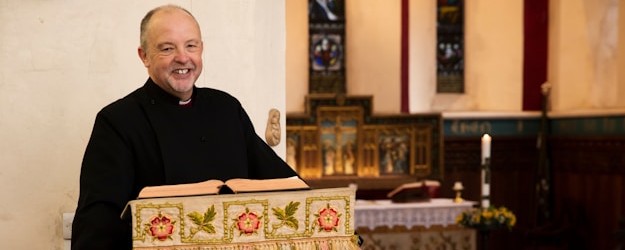
I have a confession: I have never heard a homily from the pulpit which I remember the next day.
Now, granted, my memory is not great, so part of the fault is with me. But I don’t think I’m unique. Part of the problem might be that preaching is only one of the many pastoral pieces a seminarian may be introduced to while in formation, similar to how many physicians have only a rudimentary introduction to topics such as nutrition and mental health while in medical school. This is compounded by the fact that it might be a “weak leg” for priests who, like triathletes, find that they are stronger in some areas (swimming and running, for example) versus others (like cycling). Additionally, like pews in a church, some Catholics believe that preaching from the pulpit falls in the realm of “Protestant strengths,” since Protestant Christians have the Bible, preaching, and the community as the primary cornerstone of their faith sans sacraments, magisterial teaching, and ecclesiastical authority.
Some of our good shepherds do, however, know the importance of communicating a message to their flock in that scant quarter-hour once a week (the only time many priests have an opportunity to do so to those who actually attend Sunday Mass). Those who do not attend Mass on Sundays but who may be curious about the Catholic faith may stumble upon these homilies on YouTube or channels like Sensus Fidelium and find forceful, meaty teaching about the Faith from bold priests using the New Media as a form of reaching out to the lost and ignorant.
The ability of a priest to touch a soul from the pulpit, through the power of the Holy Spirit, should not be underestimated. “I shouted,” the great St. John Vianney recalled to his congregants, who were disappointingly scant upon his arrival in the village of Ars but who grew to overflowing near the end of his life, “because you were deaf.”1
Communications is an art, not a science. Practically speaking, it requires clarity and form, but also a certain deftness and sensitivity to things like tone, timing, and reading the audience, just as a seed needs ample sunlight, water, and good soil to sprout and flourish. In terms of preaching, a priest must also be ignited by the flame of faith and the grace of the Holy Spirit to have any effect. But these gifts are generously given to any priestly soul who asks sincerely for them in prayer. A pastor who may not be naturally gifted in this art as a charism can more than make up for it in his personal prayer life and asking for these gifts in trusting faith and for the benefit of the souls entrusted to him.
Speaking from my experience as a simple layman in the pews, I believe there are five important practical considerations for a homily to go from “forgettable” to having the capacity to make the deaf hear.
Cut to the Heart
In the Scriptures, St. Peter cuts his audience “to the heart” through his bold and Spirit-inspired preaching (Acts 2:27). He pricks their conscience, awakens them from their slumber, and forces them to recognize the guilt we all carry for Christ’s death on the cross.
For the parish priest, it is safe to assume that 80-90% of your congregation is most likely spiritually asleep at the wheel on any given Sunday. It is a strong temptation to be conservative and play it safe when it comes to the subjects one chooses to preach about related to the Gospel readings. It is unfortunate that the most powerful force for bringing a man back from the dead — the love of God — has become like white noise for the comfortable median in the way it is typically communicated in many homilies. “It is better that you were hot or cold,” as our Lord admonishes (Rev 3:16). Ironically, the safe homilies are often the most forgettable, while hard teachings communicated with the fervent love of the priest multiplies them like loaves in the wilderness. People in the pews are starving for bread — not the jagged crusts of partisan polemics garnered for a social media following or to intentionally alienate people, but rather the bread of spiritual substance which will satisfy their hunger.
The priest must not be afraid and should seize the opportunity to raze the complacent foundation of sleepy hearts to rebuild on a strong foundation.
The Elevator “Pitch”
Anyone in business or sales knows that the “elevator pitch” — that ten to fifteen seconds which closing a deal depends on — is vitally important. It needs to be honed so that when the time comes, and the heart of the congregant has been rent in two, the delivering of the message drops like a seed in a quickly closing furrow. Missing this opportunity means the seed falls on the surface to be nipped up by the birds of distraction, or it springs up and withers, as our Lord recalls in the Parable of the Sower, because it has no root.
It doesn’t have to be kitschy, but it should be memorable, a “take away” that if a congregant recalls nothing else from the rest of the words in your homily, they will remember that one line or two. Which brings me to the next point.
Brevity Over Flowers
Although I did not agree with much of the off-the-cuff remarks of the Holy Father during the Francis pontificate, I did think that his “no more than ten minutes” homily advice had a sound core. Attention spans in the tech era we live in today are woefully short. Virtually no one is reading novels like War and Peace while memes and pithy soundbites are legion.
Therefore, a homily should be akin to a poem — every word counts and needs to carry its own luggage. If it is not serving the purpose of springing life into the heart of a dead man, it should be cut out. There is also no need for animated semantics; if the message is sound and of the Spirit, you can accentuate the words without drawing attention to you as the speaker-priest. Brevity helps you draw the focus from “eyes on you” and your words, to an interior recollection of the congregant on the state of their own souls.
There is also value in pauses and the uncomfortable “white space” that should punctuate important points. For example, if you have shocked your sleepy congregant to attention with the conscience-rending kernel of Truth (“Your idle words have earned you a seat in Hell.”) and your pitch finds its way into a fertile furrow in the soul (“You are going to die.”), let the sobering void of a few seconds of silence settle in like a pawl. Every impulse in you will be to move on to the next, more cheery point, quickly, but resist this temptation. Punctuate with the power of silence, even if only for a few seconds, to sic the Hound of Heaven on their conscience. Which leads to the next point.
The Haunting
“Christ came to comfort the afflicted, and afflict the comfortable,” as the saying goes. In John 6, we see Jesus taking a wagered risk that his “hard teachings” (which many there could not accept) would also retain a remnant of those who hungered for the Bread of Life. And it does. Just as Peter cut to the heart the crowd in Acts 2 with his preaching, it is because he recalled his own heart being torn in two by the shame of his denial of Jesus.
We should find comfort in the words of Christ but also be haunted by them. The parish priest who wishes his congregants to rise, take up their mat, and walk must be willing to send them out of the church not with a trinket or token of affirmation, but with a haunting. For a man ensconced in sin, or a woman armed with a magazine clip of gossip, should not be able to shake the nagging feeling that their life must change as their head hits the pillow at night, for “death and life are in the power of the tongue” (Prov 18:21).
“What Shall We Do Now?”
From a practical perspective, every homily should end with an action item. There is nothing worse than someone delivering a sobering or crushing message with no recourse on the part of the receiver to do anything about it.
But we do have recourse — to metanoia and a hope for redemption, no matter what state we are in in our walk with the Lord. After his bold proclamation, St. Peter follows up the inquiry “What shall we do now?” with “Repent and be baptized” (Acts 2:38). It may be as simple as “Confessions are this day and this time, and I hope to see you there,” to an encouragement like “Be not afraid! (in embracing a particular cross or leaving a particular sin behind).” Even very practical points like how to take a beating (for the faith) for those who are putting their jobs or reputations on the line by following Christ in his hard teachings are not inappropriate.
Think of the homilies we as lay men and women need this way — if you had ten minutes with your spouse, the love of your life, and you knew it would be the last time you would ever speak with them, what would you say? Would you talk about the weather or news or the local sports team? Would you spend half an hour dancing around the things that needed to be said for healing? Or would you tell them you loved them in a way that removed any shred of doubt that you meant it with all your heart?
Those who are asleep at the wheel will eventually crash their proverbial cars. As a parish priest, you have a quarter hour once a week to set the precedent for your ministry and awaken them from their flaccid worldly stupor. “For by your words you will be justified, and by your words you will be condemned” (Mt 12:37). Will you waste words, play it safe and ride out your time with forgettable homilies while here on earth? Or will you resurrect the dead in your pews, by the power of the Holy Spirit, by lobbing the meaty mustard seed of the Gospel in the fissures of the heart with the limited time they are with you? The hungry in the pews need bread . . . though man does not live on bread alone. The words of Christ — and those who speak as his representatives in persona Christi — are spirit and life which hold in them the power to raise a man from the dead.
- Abbe Francis Trochu, ‘The Curé D’Ars according to the Acts of the Process of Canonization” 1927, Chapter 5, The Conversion of Ars. ↩
 About Rob Marco
Dear Rob,
Enjoyed your article. I hope it is fruitful.
Sincerely,
Tom Showerman