
Growing into God: The Fathers of the Church on Christian Maturity. By John Gavin, S.J. Reviewed by Fr. Joseph Briody. (skip to review)
Plato and Christian Personalism. By D.T. Sheffler. Reviewed by Fr. M. Ross Romero, S.J. (skip to review)
Diary of a Young Jesuit: All This Beauty Blooming. By Barry Martinson, S.J. Reviewed by Christopher Siuzdak. (skip to review)
Growing in Virtue, One Vice at a Time: With a Crabby Mystic. By Mary L. Hill, FSP. Reviewed by Daniel Simon. (skip to review)
Alight with Hidden Glory. By Erik Varden. Reviewed by Christopher Siuzdak. (skip to review)
Growing into God – John Gavin, S.J.
Gavin, John, S.J. Growing into God: The Fathers of the Church on Christian Maturity. Washington D.C.: Catholic University of America Press, 2025. 206 pages.
Reviewed by Fr. Joseph Briody.
 In Growing into God, Fr. John Gavin masterfully traces the path of Christian maturation, a sure path because it has been lived and described by the Fathers. Along the way, we meet well-known Fathers. We also meet lesser-known Fathers and Mothers: Mark the Monk, who saw Christian life as the unfolding of baptismal grace; and Saint Macrina the Younger (sister of Gregory of Nyssa) who always carried the Psalter.
Fr. Gavin shows how the wisdom of the Church Fathers is ever ancient, ever new. I used this book on retreat recently to great benefit. Impressive in its treatment of human nature, the living Tradition, and the marvelous workings of grace, the well-organized chapters gradually unfold, beckoning the reader toward deeper maturity in Christ.
The book is divided into three parts: The Pillars of Maturation, The Means of Maturation, and The Expressions of Maturity. There are eleven chapters, a forward by Dr. Angela Franks, several tables, and an appendix.
We face a crisis of immaturity — to which this book offers a response. Having turned from God and lost our way, we have nothing to grow into. The author is clear that while humility and honesty are important on our part, Christian maturity is a divine gift. Only when Christ abides in us will we bear much fruit.
The author chooses the term maturity because the idea of maturation offers an approach appealing to our times. He shows how powerfully the Fathers of the Church speak to this theme for us. The book “constructs a mosaic of maturity” from the writings of the Fathers.
Christian maturation is the opposite of demonic infantilism and its culture tantrums. Growing into God presents “a dazzling picture of a wondrous figure: the saint, the mature Christian, transformed by union with the Father, the Son, and the Holy Spirit.” (5) The book inspires the Christian to return to the sources — Scripture and the Fathers — and to recover the desire to “to grow into God.” The Second Vatican Council appealed for such a return to the sources. Growing into God is a remarkable example of how this call can be heeded in the spiritual life — overflowing into all of life.
Christ shows us what the mature human being is like: He reveals to us the deified man. (13) Through Baptism, Christ restores to us the freedom to unite ourselves to God and live according to the Father’s will. (16) Christian maturation means moving “from divine image to divine likeness.” What does this mean? We are already God’s image (Gen 1:26). The task of our Christian life is to grow into God’s likeness through grace and conversion. Image includes relationship, capacity, possibility, and dignity. Likeness involves the living-out of this image: it is fullness, perfection, and maturation. (18) Christianity is the “likeness to God” possible for humanity (St. Basil of Caesarea). (27)
Living the virtues is vital because the virtuous person becomes more human and more divine. (32) This is why the saints are “the most vivid persons of history” (37), a statement setting the context for reflection on “Vocation and Commitment” (Chapter 3). The setting is the universal call to holiness and the call to “follow the poor Christ, the humble and cross-bearing Christ” in order to share His glory” (Lumen Gentium, 41). (42) Wrapping up the first three chapters, the question is posed: why is it that so few Christians want to “grow up”? Subsequent chapters respond to this.
Chapter Four, “Satan’s Tantrum,” is gripping. Gavin’s artful use of patristic language and imagery stops the reader in his tracks. The fall of the angels is “elected immaturity,” that is, “the deliberate rejection of maturation in Christ.” It was “a pathetic, yet deadly, refusal to accept the gift of growing in the divine likeness.” This infantile, demonic delirium seeks “to make human beings like [the demons] themselves.” (56) This refusal to mature in divine likeness leads to self-destruction. (58) Communion becomes rivalry: “to be” is “to be in competition.” Since the demons no longer look to the Source that gives them form, they are amorphous. For the Desert Fathers and Mothers, they take on hideous forms. However, they have no real power in the world and are dispelled by prayer and fasting. (60, 62)
There is an interesting section on the vices that feed parasitically on human integrity. The sadness of walking away from a clearly given and already embraced vocation is expressed. “The barrage of demonic discouragement” falsely suggests that the path to maturity can be found elsewhere: “that one should walk away from vocation in favor of an . . . undefined future.” (66) Does this insight shine some light on the unprecedented numbers of men who left the priesthood in the late sixties and early seventies? Maybe. It may also help us understand today’s reluctance to embrace vocation as lifelong commitment.
Part Two presents “The Means of Maturation” and deals with the Scriptures, the Mysteries (the Liturgy, mystagogy, catechesis), and asceticism. We don’t often think of ascetism as leading to maturity, yet it is essential and leads to transformation. Prayer heals the mind and contemplation leads us into the heart of the Trinity.
Part Three deals with “Expressions of Maturity” in terms of Witness, Teacher, Servant and Fool. Christian maturity requires the confession of faith. The mature disciple will teach others, witness to others, and be a servant for others. We are already all these things through Baptism. Refusal to serve one’s neighbor leads to “spiritual infantilization.” (152) Immaturity often becomes clear in times of trial — an opportunity also to grow in Christian maturity. Good deeds are the best burial garment! (157)
Chapter 11, “The Fool,” is the shortest chapter and perhaps the most enigmatic for us “moderns.” What’s clear is that we don’t have to follow the example of Symeon the Holy Fool and do things perceived as crazy! Our sincere and authentic following of the poor, humble, cross-bearing, and glorious Christ will already shock many and “shake the world to its core.” (167)
The book draws to a close with a fine conclusion. Much of what we see in the world are “tantrums from ideological infants.” Fr. Gavin diagnoses the contemporary crisis regarding ideology, vocation, fidelity, meaning, direction, hope, and love.
It is remarkable how fresh and powerful the words of the Fathers are as we meet them anew in this book. The masterful use of the Fathers delivers an appealing call to the holiness that is timeless. It’s an attractive invitation to Christian maturity. When Christians grow in divine likeness, the whole world benefits. The “normal” that Christianity offers is a Person, “Jesus Christ, who gives form through a relationship of love.” (174) If you’re looking for a book to take on retreat, this is it!
Rev. Joseph Briody S.S.L., S.T.D. is Professor of Sacred Scripture and Coordinator of Spiritual Formation at Saint John’s Seminary in Brighton (Massachusetts).
Plato and Christian Personalism – D.T. Sheffler
Sheffler, D.T. Plato and Christian Personalism. Steubenville, OH: Hildebrand Press, 2025. 165 pages.
Reviewed by Fr. M. Ross Romero, S.J.
 In Plato and Christian Personalism, D.T. Sheffler argues that Plato’s dialogues are more compatible with Christian personalism — understood broadly — than has previously been acknowledged by key figures in that movement. The book has two principal aims: (1) to identify the major themes of Christian personalism and explain how the movement has approached Plato’s philosophy; and (2) to “sift through” what the author identifies as “largely relevant passages in the dialogues” in order to determine the degree to which these passages cohere with, or deviate from, Christian personalism as the author represents it. Since the trajectory of personalist thought regarding Plato has not treated him as a fellow traveler, the book counsels a reconsideration of this relationship, viewing Plato’s positions — especially on the soul — as a helpful propaedeutic for personalist thought. The author’s conclusion is succinctly expressed on the final page: “Should we think of Plato, then, as a personalist before personalism? Hardly. Should we rather think of personalism as the natural and logical development of Plato? Most definitely” (p. 158).
The argument unfolds over five chapters. Chapter 1 situates the problem in relation to Étienne Gilson’s claim that Plato lacks an adequate account of the person distinct from nature, a position developed, in varying ways, by Wojtyła, Ratzinger, Zizioulas, and C.J. de Vogel. Of these, only de Vogel, through her emphasis on personality, finds in Plato and the pre-Socratics an adequate basis. In response, Sheffler reframes the debate by setting out the central commitments of personalism — person as a category of being, consciousness, self-knowledge, interiority, agency, identity, unrepeatability, incommunicability, dignity, and imago Dei — and asks whether Plato’s account of the soul may be rendered continuous with them. The claim, cautiously advanced, is that it can.
Chapters 2–4 identify “anchor points” through a synthetic reading of major dialogues (including Phaedo, Gorgias, Laws, Alcibiades I, Republic, Phaedrus, Timaeus), deliberately setting aside both developmentalist and dramatic approaches, as well as readings that privilege the integrity of individual dialogues. Instead, the author groups Platonic material on the soul into three domains. Chapter 2 treats mythoi, especially accounts of the soul’s cosmic journey, as disclosing its relation to eternal being. Chapter 3 turns to images of the soul that illuminate its internal structure and complicate standard anti-body interpretations by exhibiting both psychic and somatic dimensions. Chapter 4 considers passages concerning the soul’s assimilation to the Forms, presenting a logos of immortality in which noesis suggests a mode of theosis, approaching, though not identical with, personalization. Questions of analogy and participation emerge, alongside an implicit defense of philosophy as a way of life — nous in motion. Lastly, Chapter 5 returns to mythos in order to consider the individual soul in its cosmic and unique expression. Taken together, these analyses suggest a conception of the soul that is at once cosmically oriented and internally structured yet not fully articulated in personalist terms.
The author has performed a valuable service in bringing Plato and Christian personalism into sustained conversation. The author is at his strongest in his readings of Hildebrand and in his exposition of Hildebrand’s affinity for Platonism (see especially pp. 116–127). In many respects, the central contribution of the volume is that it renders it possible to read Hildebrand as a Platonist without thereby dismissing Plato as anti-personalist. Yet this strength also invites further reflection. To what extent might the author’s reconstruction of Plato be enriched by a more explicit attentiveness to phenomenology? Although the language of “looks” and “showings” may not appeal to all readers, such an approach could prove fruitful. It might allow for a more coherent organization of what the middle three chapters reveal about Plato’s account of the soul. One limitation of the present method is that, by treating the dialogues collectively as “largely relevant passages,” something of the attentiveness to the carefully constructed wholes written under the name of Plato becomes obscured. Would a more explicit phenomenological orientation clarify how dimensions of the soul are given, rather than merely assembled? However, far from detracting from the value of this volume, these questions only serve to open further avenues for better companionship between Plato and Christian personalism.
The volume will be especially of interest to those who have a familiarity and interest in Plato, but the most valuable contribution regards personalism since, for many preachers, the precise meaning of the term can be illusive. The opening chapter provides a helpful summary of personalism and the key Catholic figures whose views fall under this term. Engagement with volumes of this kind will expand the homiletic imagination of the preacher.
Rev. M. Ross Romero, S.J., Ph.D., teaches at Kenrick-Glennon Seminary in St. Louis (Missouri).
Diary of a Young Jesuit – Barry Martinson, S.J
Martinson, S.J., Barry. Diary of a Young Jesuit: All This Beauty Blooming. San Francisco, CA: Ignatius Press, 2025. 294 pages.
Reviewed by Christopher Siuzdak.
 This book is a compilation of personal journal entries from the first six years of formation in the religious congregation commonly known as the Jesuits around the time of the Second Vatican Council and the landmark Thirty-First General Congregation of the Society of Jesus in the 1960s. A number of recently published autobiographies by Jesuit priests contain a short segment reflecting retrospectively on the novitiate (“boot camp”) and subsequent stages of training, but this book offers more of a play-by-play of life in the Jesuit novitiate, juniorate, and philosophy studies. The very manner in which Martinson chronicles and reflects upon daily happenings in his personal diary helps the reader cultivate the kind of attentiveness that allows one to perceive God’s presence “hidden in plain sight.” The reader is introduced indirectly to a method of reviewing one’s activities so as to increase self-understanding and awareness of Divine Providence’s functioning. This published diary does more than merely convey the historical content of a given lifeworld; it indirectly engages the reader in a conversation about spiritual life and growing in discipleship.
The work’s subtitle, “All This Beauty Blooming,” captures something essential about the themes therein. The phrase, drawn from a poem by Gerard Manley Hopkins, points toward Martinson’s central insight: grace appears in often overlooked and unexpected places. As the author reflected one day during his juniorate: “There is so much beauty blooming everywhere, if I just look for it” (157). It shines through in studying and passing exams that were “like a foretaste of the Last Judgement” (274), tiring manual labor such as picking grapes in vineyards or canning apricots, conversing with mentors, weaving a web of friendships, praying using various methods, listening to the celestial cantillations of choirs or singing until hoarse at a celebration, encountering those experiencing poverty or marginalization, conquering new challenges, and developing one’s talents. The pursuit of holiness, in Martinson’s telling, is not primarily dramatic or extraordinary; rather, it grows quietly through fidelity to prayer, openness to friendship, generous service, and attentive gratitude for the beauty God scatters throughout everyday life.
The diary begins the summer following high school graduation when Martinson was on the cusp of entering the Jesuit novitiate. His sense of being called to priestly ministry, however, began to germinate much earlier. He began thinking about the priesthood at the tender age of third grade. He had attended Catholic schools, including a high school conducted by the Augustinians, and “had been around priests a lot” (23). In the wake of his father’s passing, Martinson began thinking more about otherworldly realities. “And since priests seemed to be a link between heaven and earth, I was naturally drawn to them” (27). He noticed in some of his teachers a great love for God, an intangible aura of holiness that he found magnetic. During philosophy studies, Martinson jotted down in his diary: “I see my Jesuit vocation as the freedom to love all people. On campus, I am around many students whose lives appear apathetic and empty. By contrast, those of us at the Mount [Jesuit community near Gonzaga University] have an opportunity to lead free and full lives, focusing on the needs of others rather than ourselves” (223–224). Readers encounter the genuine voice of a young man captivated by the possibility of giving everything to Christ and the joy of being increasingly conformed to the pattern of Christ’s life.
This book is recommended, first and foremost, for those discerning religious vows, especially but not exclusively with the Jesuits. Although numerous elements of the formation experience have evolved since those times, the undergirding impulse of seeking sanctity and the overarching themes of formation for ministry remain the same perennially. It is a spiritual book, but also potentially useful for historians of American religion and history buffs in general. Historians lust for diaries that reveal day-to-day happenings and contemporaneous interpretations. This is precisely that. It is not merely a memoir reflecting with the benefit of hindsight on the course one’s life has taken; rather, it has a certain freshness by capturing what was running through the mind of a young Jesuit. A drawback of this book is that friction and frustrations appear largely absent. It is understandable that Martinson was brimming with youthful enthusiasm and perhaps his natural disposition or level of cheerfulness places him perennially on “the sunrise side of the mountain,” but even Saint Ignatius himself wrote about sorrows, tears, and desolations. It would have been interesting to see how Martinson worked through difficulties in his Jesuit training. More exploration of doubt, frustration, or interior conflict could have added additional complexity and emotional depth. All in all, Martinson’s personal diary teaches the important lesson that achieving the heights of holiness involves being “down to earth” and finding divine action amid the seemingly pedestrian parts of life. By sharing his experience, Martinson invites others to enter into a life of greater attunement to God, which is a solid foundation for a life rich in meaning and fulfilment.
Christopher Siuzdak is Book Review Editor for the Homiletic & Pastoral Review.
Growing in Virtue, One Vice at a Time – Mary L. Hill, FSP
Hill, Mary L., FSP. Growing in Virtue, One Vice at a Time: With a Crabby Mystic. Boston: Pauline Books and Media, 2024. 214 pages.
Reviewed by Dan Simon.
 “My grace is enough for you, for my power is made perfect in your weakness” (2 Cor 12:9); “Let all your faculties — mind, will, and heart — rejoice and seek to find fulfillment in a virtuous life.” (p.166) This is surely a noble calling and one the “serious Catholic” may likely find appealing. Of course, an immediate response may also be “a little help here” as anyone who has tried to live out the universal call to holiness can attest. In Growing in Virtue, One Vice at a Time, Sr. Hill helps to answer this call in her conversational and engaging style. She utilizes what one might consider a Jedi mind trick of spiritual direction, addressing those vices that we all have, but rather than be dismayed, to use them as a springboard for growth in their related virtues.
The book is structured with a chapter devoted to each virtue and two opposing vices associated with each. In the section on cardinal virtues, for example, fortitude is discussed within the context of the opposing extremes of cowardice and rashness. Christian virtues are handled similarly with humility as being situated between pride and obsequiousness. Likewise with the theological virtues, faith lies between the extremes of disbelief and fanaticism. The chapters are short, allowing one to either move briskly through the book or more slowly, meditating on each. I did both, often going back to reflect on a particular chapter. Sr. Hill’s disarming style and wit makes the text deceptively simple in its delivery. Simple in that it is straightforward and direct but deceptive in that it is packed with subtle insights and theological depth, and is highly practical to our daily lives. Sr. Hill’s book rewards contemplation.
The book is likely to be enjoyed by someone interested in a fresh and encouraging way to strive toward or to guide others toward growth in virtue. Pastors, religious, spiritual directors, and lay Catholics will find this to be an engrossing and informative read. It can be pointedly direct at times but also consoling and is completely free of a dour critical tone or theological jargon. This is not to suggest it lacks theological depth. Whether or not St. Thomas Aquinas is a direct source, the framework Sr. Hill employs is recognizably Thomistic. Her pairing of virtue and vice implicitly states what St. Thomas Aquinas says explicitly, that a virtue can best be understood against the vice it overcomes. Anyone who has taken a Theology 101 course will recognize the connection to Aquinas’s teaching that virtues and vices are habits, not just behaviors but dispositions of the soul that incline one toward certain acts. Growing in Virtue is effective in part because it suggests specific applications of this theological approach while being deeply understanding of the challenges we face: “We still find ourselves in an ongoing struggle. It’s actually more than a struggle: it’s more of a tug-of-war between the virtues and the vices. We make some progress, and then a pull of vice throws off our balance. We have to struggle harder to gain the upper hand.” (p. 165)
The text contains a generous use of scriptural citations and Sr. Hill handles related sources unobtrusively throughout the text with a notes section at the end (which is in fact a who’s who of interesting sources to follow up on). Although Sr. Hill describes herself as the “crabby mystic,” there is nothing in the text that comes across as curmudgeonly. It is just the opposite. Sr. Hill’s fourth book challenges one to strive for the virtuous life through an optimistic, encouraging, entertaining and thoughtful approach. Growing in Virtue, One Vice at a Time is a valuable resource for lay or religious leaders involved in parish ministry, spiritual direction, or formation programs as well as the generally interested reader.
Daniel Simon is currently in formation for the permanent diaconate for the Diocese of Rockville Centre.
Alight with Hidden Glory – Erik Varden
Varden, Erik. Alight with Hidden Glory. London: Bloomsbury Continuum, 2026. 120 pages.
Reviewed by Christopher Siuzdak.
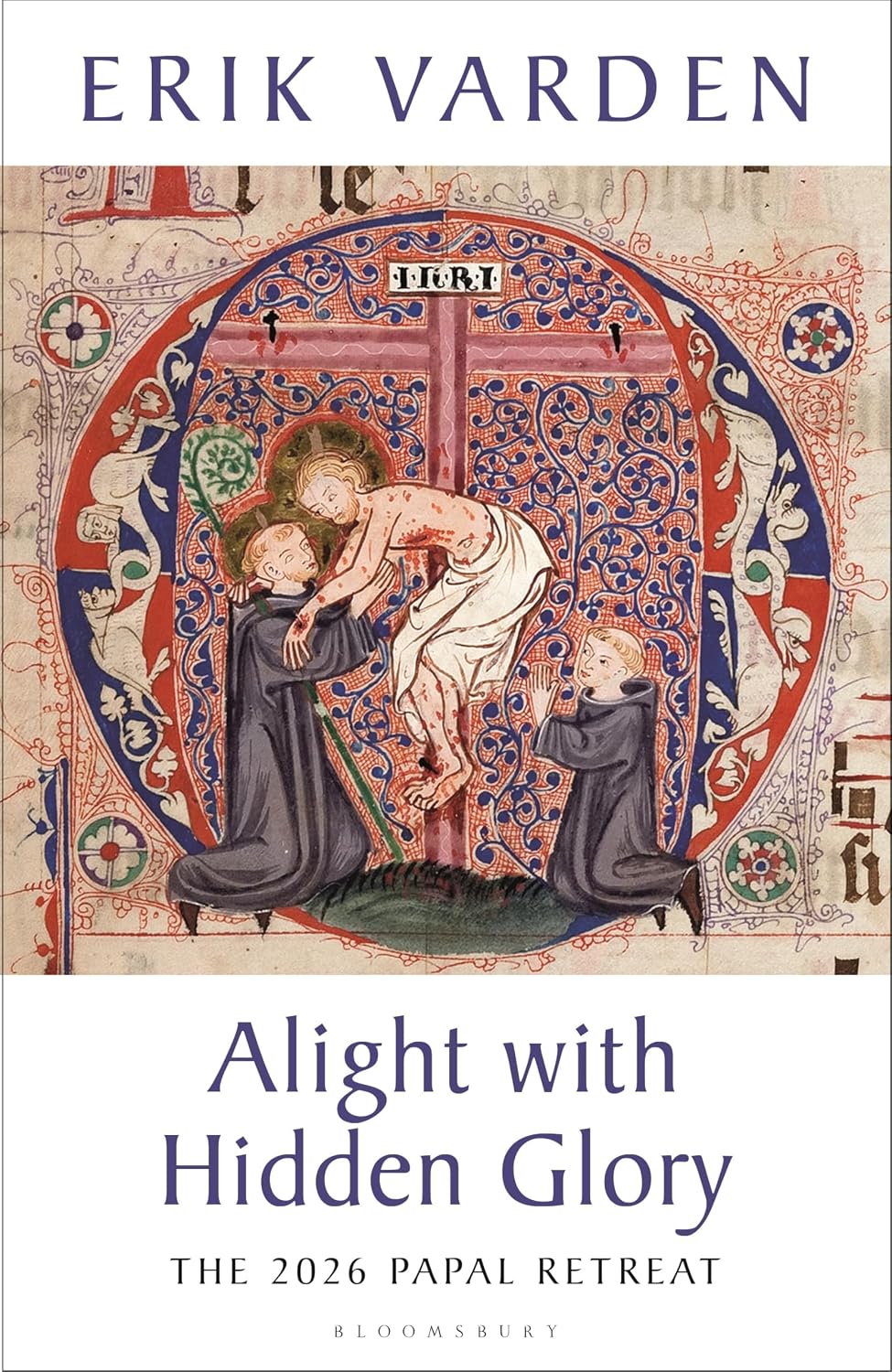 In the first year of his pontificate, Pope Leo XIV invited Erik Varden, who is a Trappist monk and Norwegian bishop, to preach the Lenten retreat in which the Holy Father participated together with his collaborators in the Roman Curia. This book offers readers a proverbial front seat in the Vatican’s Pauline Chapel for a series of spiritual reflections, allowing each reader to proceed prayerfully at his or her own pace through eleven thought-provoking segments. Perhaps unsurprising for a Trappist monk who formerly served as the Abbot of Mount Saint Bernard Abbey, Varden draws upon the writings and life of Saint Bernard of Clairvaux throughout the reflections. Interestingly, Saint Bernard dispatched advice to one of his spiritual sons in the Cistercian community who became Pope Eugene III. Many golden nuggets of Saint Bernard’s wise counsel remain relevant to this day — for all the faithful, not only those charged with leadership.
In a historical age and office marked by relentless activity and constant distraction, Varden — echoing Saint Bernard — calls for a healthy diet of rest, silence, and self-pruning. “Wisdom presupposes a degree of leisure. What is more, the commandment of charity extends to oneself: ‘If a man is no use to himself, to whom is he useful?’ ‘So remember,’ Bernard adds felicitously, ‘I do not say always or even often, but sometimes remember to restore yourself to yourself” (94, italics original). In short, leisure is not so much an escape from responsibilities as it is a precondition for discharging one’s duties well and perceiving God’s action in the midst of one’s responsibilities. Leisure is not antithetical to sacrificial outpouring; rather, it is part of the paschal dynamic.
Along the way, Varden endeavors to read the signs of the times in light of the Gospel and offers some sociocultural observations. He worries about the cooptation of religion and the overstretching of the concept of freedom for political purposes. “Young men in particular interpret Christ’s words belligerently as part of a search for fugitive ‘manliness,’” he opines (6). “The hijacking of Christian language and signs for secondary purposes,” he adds, “should be vigorously challenged” (6). Commenting on the despairing lyrics of a popular singer, he notes than many youths feel a sense of woundedness and hopelessness. “On the one hand, people readily display acquired, inherited or imagined wounds as a badge of identity” (106). “On the other hand, there is a tendency to airbrush wounds out of existence” (106). In these phenomena, Varden sees a silver lining: many people are searching for more beyond superficialities, superfluities, and sentimentalities. Their disquieted hearts are yearning for something more substantive and solid. The cross of Christ, which reveals the non-finality of wounds, offers an answer.
The paradoxical truths of Christianity have much enlightenment to offer at the individual and communal levels. Varden reflects: “[O]nly when supernaturally illumined will our nature reveal its perfect form. Only then will the delightfulness of which earthly life is capable be apparent. Only then will the glory hidden within us and about us shine forth, teaching us what we and others can become […]” (89). Integrating the horizontal and vertical dimensions of life reveals the truth that the deepest realities often remain hidden beneath appearances: glory is found within tribulation, strength beneath weakness, holiness amidst temptations, joy in sacrifice, freedom in self-donation, resurrection following passion, and greatness within humility. In this sense, Varden exhorts the retreatants to become supernatural realists and, in so doing, to become agents of renewal.
This book makes for good spiritual reading for clergy and religious, seminarians and novices, as well as the faithful at large. Such a spiritual text rewards slow reading punctuated by introspection and prayer rather than rushed completion. This Cistercian-flavored retreat is a valuable aid in the arduous journey of continuing conversion.
Christopher Siuzdak is Book Review Editor for the Homiletic & Pastoral Review.
 About Book Reviews
Speak Your Mind