For July 5, July 12, July 19, and July 26
Fourteenth Sunday in Ordinary Time – July 5, 2026
Readings: Zechariah 9:9–10 • Psalm 145:1–2, 8–9, 10–11, 13–14 • Romans 8:9, 11–13 • Matthew 11:25–30
bible.usccb.org/bible/readings/070526.cfm
Isn’t it wonderful that today’s Gospel helps us go on contemplating the Sacred Heart of Jesus? Traditionally, June is when we Catholics intensify our devotions to the Sacred Heart, especially because the liturgical Solemnity of the Sacred Heart almost always happens in June (this year, it fell on Friday, June 12). But today’s Gospel is July’s surprise opening into overtime: “Take my yoke upon you and learn from me,” says Our Lord, “for I am meek and humble of heart; and you will find rest for yourselves.”
Not only do we learn from Jesus himself what kind of heart he has — a meek and humble one — we also learn that his Sacred Heart teaches us how to find rest for ourselves. And that, too, is a great piece of news at a time of year when kids are on summer vacation, and maybe you’ve also managed to take a long Fourth of July weekend off to wind down and rest.
Resting isn’t as easy as it sounds. Some of our struggle to rest can safely be blamed on other people: noisy neighbors, nosy relatives, nasty bugs — you name it! But most of our struggle to rest stems from ourselves: our own restlessness, our workaholism, our bad habits. Our eyes, ears, hearts, and minds dart from one thing to another — restless. All those bad habits we’ve built up during the year can’t be shaken off overnight. And so, we fear we might waste the little vacation time we’ve got because we’re sadly unable to rest.
But the good news, brothers and sisters, is that Our Lord tells us exactly how to rest. Let me repeat the words once more: “Take my yoke upon you and learn from me, for I am meek and humble of heart; and you will find rest for yourselves.” Jesus invites us to center on him, to focus on him. Not to escape the chores and duties of our daily lives but to refocus our love for all creatures in a love that is centered on the Creator — and more specifically, on his Sacred Heart. Now, the human heart is like a bullseye: small, red, smack in the middle of the human chest. It’s literally a focal point: a point where we can focus our attention and let the Lord rekindle in us the fire of His Love. If we’re on fire for the Lord — whether it’s a roaring fire or a quiet, steady blaze — we suddenly find we get more energy and more clarity to love other creatures: our neighbors, our relatives, our spouses, even ourselves. The Sacred Heart of Jesus is a called a “devotion” because it gets us on fire more quickly for God. The Sacred Heart is like one of those firelighters some folks throw on the barbecue to get it going. (I know everyone has their own way of firing up the grill — just bear with me!) The heart is an image everyone can understand: by focusing our minds and our imaginations on the Heart of Jesus, meek and humble, on fire for us all and for his heavenly Father, we can rekindle our faith, our hope, and our love. And by some wonderful grace, we will find that we are also more able to find true rest.
Jesus knows how tired we sometimes are. He Himself sometimes was exhausted. He gets us. That is why he invites us to come and unburden ourselves on Him: “Come to me, all you who labor and are burdened, and I will give you rest.” You don’t have to have some fancy college degree to get how good the Lord is with us: in fact, Jesus praises his Father for the exact opposite thing. “I give praise to you, Father, Lord of heaven and earth, for although you have hidden these things from the wise and the learned you have revealed them to little ones.”
So, as we take some time off this summer, let us entrust all our worries and concerns to Our Lord. Let us bring all that to the fire in Christ’s Heart. Let Christ both burn away our waste and fill us with good food for body and soul. Let His Sacred Heart give us rest. In the beautiful words of the response to this Sunday’s psalm: “I will praise your name for ever, my king and my God.” Praising the Sacred Heart of Jesus and His most Holy Name makes us truly happy and gives us true rest. Amen.
Fifteenth Sunday in Ordinary Time – July 12, 2026
Readings: Isaiah 55:10–11 • Psalm 65:10, 11, 12–13, 14 • Romans 8:18–23 • Matthew 13:1–23
bible.usccb.org/bible/readings/071226.cfm
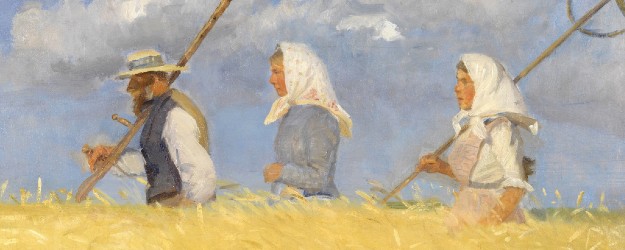
It’s great we get to hear today’s Gospel in the season where a lot of harvesting is happening all over our nation. Fresh summer produce is being churned out in the fields; fresh summer fruit is growing in orchards and gardens; and wheat is being harvested in many places over the summer months. Although we often associate our harvest festivals with autumnal colors and Thanksgiving, there is already a lot to be thankful for at this time of year, in July.
And we too, as we pause for some well-deserved rest, or at least try and wind down from our usual chores, might want to consider being thankful for the many graces God has sent our way this year. In fact, for us Catholics, as much as we like celebrating “capital-T Thanksgiving” in November with all its trimmings, “small-t thanksgiving” — giving thanks to God through Christ — is something we ought to do every day. Some of us, for instance, take part in daily Mass: the Eucharist is indeed a great thanksgiving for God’s many gifts to us, especially Christ’s redeeming life, death, and rising. Others among us have the beautiful custom, at dawn or dusk, to bring to mind all the gifts God gave us over the last 24 hours: the gift of life, the gift of health, the gift of our family and friends, the gift of food on our table, and so on. It is key to a good human life to be thankful. Sometimes, we focus too much on what is wrong with our country or with our lives. Of course, it is good to be a realist and to be aware of our own sins and failures. But we can only look at them as God wants us to if we first and foremost acknowledge how many graces God showers on us daily. Thanksgiving should always precede the confession of sins.
Now, what are the last words of the parable of the Sower we just heard? “But some seed fell on rich soil, and produced fruit, a hundred or sixty or thirtyfold.” This is my point: Jesus brings his disciples’ attention — and our own attention too — to the wonderful abundance of God’s love and grace. The gift of God’s Word, for one, is amazingly fruitful. That’s what Jesus teaches us this Sunday. God as Creator and Savior just overflows with graces He wants to send to each and every one of us. Since Christ is the Word of God Himself, every gift Christ gives us is like a special word of love he whispers in our ear. The seed’s overabundant fruit when it fall on “rich soil” — “a hundred or sixty or thirtyfold” — testifies to the power of God’s Love for all creatures. You know that symbol they often use for Thanksgiving cards — the cornucopia? It’s an ancient symbol, a horn-shaped basket overflowing with all sorts of fruit and vegetables. Well, the cornucopia reminds us of the awesome overabundance of God’s Love for us.
But that means two things for us. First, we have to make sure we offer some “rich soil,” so that the words of divine Love can land in us and bear proper fruit. We have to get rid of the brambles and rocks and ward off the greedy birds. We have to water the soil and make sure the right amount of sunlight hits it. Now, we can do this by being attentive to God’s words, whether it’s the Scripture we pray with, or God’s practical gifts to us as real signs of his love — God’s efficient love-language to us. We can also prepare the rich soil by making sure we reject our bad habits and confess our sins to a priest in the sacrament of reconciliation. Tear up those thorns, and chase away those angry birds, brothers and sisters! Make sure that your soil is rich, so God’s gifts to you can bear plenty of fruit.
And a second thing: make sure you give thanks to the Lord daily for the abundance of his gifts to you. Make your way to church and stop for prayer. Or pause for prayer in the quiet of your home. Or pray in your car as you go to work or return home. And make sure you’re very concrete when you thank God daily for his many gifts. As St. Teresa of Avila famously said: “It’s one grace to receive a gift from God: it’s a second grace to be aware of that gift; and it’s a third grace to thank the Lord for it.”
Now is the right time for the harvest. Now is the right time to thank God for his efficient word and for the abundant fruit it bears in our lives. Amen.
Sixteenth Sunday in Ordinary Time – July 19, 2026
Readings: Wisdom 12:13, 16–19 • Psalm 86:5–6, 9–10, 15–16 • Romans 8:26–27 • Matthew 13:24–43
bible.usccb.org/bible/readings/071926.cfm
Like last Sunday, today’s Gospel continues with parables taken from the agricultural world, a world that was familiar to Jesus, his disciples, and the women and men who gravitated around them and listened to what Jesus had to say about our relationship to God. It’s not easy for us to understand what our relationship to God really is — and it wasn’t much easier for folks back then, in Jesus’s day and age. That’s why he picked practical images from ordinary life when he spoke to the people in parables. They were familiar with the issue of weeds in a garden or in a field. Most of them would have had access to some kind of property and would have experienced the constant pain it is to have to rip out plants that are not good for you and grow in the middle of your crops. In a worst-case scenario, the weeds that grow alongside a crop like wheat might even be poisonous. You’d have to be extra careful to take those plants out because their leaves or seeds might taint your good crop of wheat. But in some cases, you couldn’t rip them out before the harvest, either because these weeds were too clingy, or because they were too stealthy. So, a good farmer or fieldhand would do what Jesus says in today’s Gospel: they would let the whole thing grow together, weeds and wheat together, and only separate them when the harvest had come.
Well, Jesus decided that that agricultural reality was an apt image to help people understand why the Church is full of sinners alongside good people, and God doesn’t strike down the sinners. Maybe that’s a scandal for us. We might be tempted to want a Church that only holds pure people. But the thing is, brothers and sisters, if the Church only had pure people, sinless people, then it would only have had one human person: Our Blessed Mother, Mary Most Holy, the Immaculate Conception. The rest of us — and this should not be news to us, folks, but it’s good to remember from time to time — are all sinners, who are in dire need of God’s grace. The line between the weeds and the wheat doesn’t divide neatly between good Catholics and bad Catholics: that line goes down the middle of our hearts. Listen to these wonderfully beautiful words from Vatican II’s document on the Church, Lumen Gentium: “While Christ, holy, innocent and undefiled, knew nothing of sin, but came to expiate only the sins of the people, the Church, embracing in its bosom sinners, at the same time holy and always in need of being purified, always follows the way of penance and renewal.” That’s us, brothers and sisters! We are sinners who seek God’s grace and forgiveness, and that is truly a wonderful path to walk together.
First and foremost, therefore, we must truly trust in and firmly believe in God’s mercy. Today’s first reading brought home that point, as it addresses God directly: “But though you are master of might, you judge with clemency, and with much lenience you govern us; for power, whenever you will, attends you. And you taught your people, by these deeds, that those who are just must be kind; and you gave your children good ground for hope that you would permit repentance for their sins.”
In Christ Jesus, God has given us the definitive hope that we are permitted repentance for our sins. If we avail ourselves of the Church’s sacramental life — from baptism to the Eucharist to confession — we can count on God’s great mercy and forgiveness. Although we often sin against God’s love, we can always, always fly to him for comfort and confession. He wants the wheat in our lives to grow strong and bear much fruit and produce an abundant harvest. And so, God trusts us to make bundles of our weeds — bundles of our sins — and bring them to him for a great bonfire. A lot of us are familiar with campfires this time of year, or celebratory bonfires. Well, we can do the same thing spiritually: as we pause this summer and give thanks to God for his many gifts over the year, we can also present him with the less appealing parts of our lives and let him burn away our sins. Yes: “Lord, you are good and forgiving, abounding in kindness to all who call upon you.” Amen.
Seventeenth Sunday in Ordinary Time – July 26, 2026
Readings: 1 Kings 3:5, 7–12 • Psalm 119:57, 72, 76–77, 127–128, 129–130 • Romans 8:28–30 • Matthew 13:44–52
bible.usccb.org/bible/readings/072626.cfm
Conventional wisdom has given us the well-known proverb: “Don’t put all your eggs in one basket.” Meaning: Beware! Don’t stake all you got on just one thing. If you have ever invested any money, your financial advisor probably told you the same thing: invest in a diversified portfolio. “Don’t put all your eggs in one basket.”
But this Sunday’s Gospel flies straight into the face of conventional wisdom: “The kingdom of heaven is like a merchant searching for fine pearls. When he finds a pearl of great price, he goes and sells all that he has and buys it.” This pearl merchant first goes out “searching for fine pearls” in the plural — intending to find enough to make a pearl necklace, or bracelet, or at least a pair of earrings. He’s looking for enough pearls to string, so that if one breaks or goes bad or missing or whatever, he’s not lost his whole investment. But then this pearl merchant goes crazy — or at least, he gets very confident. “When he finds a pearl of great price, he goes and sells all that he has and buys it.”
Now, generally, Jesus tells us parables to throw us off. Contrary to what a lot of people believe, parables are not little moral stories. For instance, nobody should think that not sharing your lamp-oil with other bridesmaids is the height of charity. Nobody should think that letting ninety-nine sheep on their own to go off and find one that got lost in the brambles is good farming practice. And nobody should think that investing all your assets in one big pearl is a financially sound decision. What Jesus is trying to do with the parables, instead, is to shake us up, to change how we imagine God, and how we imagine He will come and save us. God is unconditionally invested in each and everyone of us. He loves all his children. Each of one us is a pearl of infinite value to Him. God sent his only-begotten Son to lead a human life and lose that life for us. That is totally insane! It is not prudent; it doesn’t even respect the basic natural law of all living beings — self-preservation. That’s how crazy God’s love is for each of us.
That is what Jesus, in the parables, is telling his disciples along the ages. And in return, what God hopes, what Christ hopes, what the Holy Spirit hopes, is that we will somehow reciprocate their love. They hope that divine love for each and every one of us will not remain unrequited. That we too will invest all we have on God, that we will “put all our chips” on His mercy and grace.
Now, I hope that all of us know some male or female religious: some monks, or nuns, or religious sisters or brothers — someone who has taken vows of poverty, chastity, and obedience. In the midst of our Church, God calls some women and men to give up everything for God, to lead a common life, a life that, in a way, makes no sense by the world’s economic and social standards. Somebody like Mother Teresa. Or Saint Francis of Assisi. Or the Little Flower. These women and men are signs among us of God’s invitation to purchase the pearl of great price. Not everyone, of course, is called to such a life. Most people are called to the family life, where you need sound financial decisions and economic prudence. But the family life too requires that you put a lot of chips on just one person — your spouse. Of course, when you’re married, you still have your own relatives, and couples often found a family of their own, with children and grandchildren. But the high-risk, high-stake love you find in marriage is also a sign of how we are all invited to trust deeply and uniquely in God and his saving plan for us.
So, brothers and sisters, if you feel that you are putting your trust in something that is taking you away from God and away from those you should love more dearly, pause and think. Try and imagine what are the pearls of great price life has offered you. I can guarantee you that the Gospel is one of them. We can take comfort, therefore, in the beautiful words of today’s responsorial Psalm: O Lord, “let your kindness comfort me according to your promise to your servants.” Amen.
 About Fr. Nicolas C. Steeves, SJ
The Field in the Parable of the Weeds does not represent the Church. It represents the whole world. Thus the parable isn’t about the internal state of the Church; it is about the trials of the Church in the world. The message isn’t “Don’t worry about all the sin in the Church”; it’s “The sin in the world won’t overcome the Church.” It would be a welcome change to see some of these systematic theologians pay more attention to what the Scriptural text actually says.
G. Poulin,
There can be more than one valid interpretation of a Scriptural passage. Father has one, and you have another. Neither is contrary to the Church’s teaching or requires forcing or distorting of the passage in question; so both are acceptable.
There are also right and wrong ways of interpreting Scriptural passages. Not all interpretations are correct. And treating the weeds of the parable as if they were members of the Kingdom is incorrect, as Jesus himself says that they are not. They are members of an entirely different kingdom.
Funnily enough I have to preach on this tomorrow. The application cuts both ways as you say. CCC 827 puts it as plain as day.