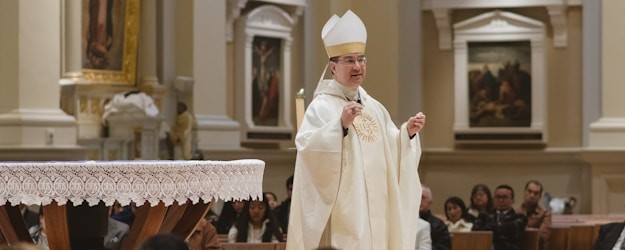
Retirement of Bishops and Popes
Question: Why do Bishops have to resign at the age of 75? Why doesn’t the Pope have to resign at 75?
Answer: The requirement that bishops submit their resignation at the age of seventy-five is a discipline of the Catholic Church rooted in canon law and shaped by pastoral and theological considerations. According to the 1983 Code of Canon Law, a diocesan bishop who has completed his seventy-fifth year “is requested to present his resignation from office to the Supreme Pontiff, who will make provision after he has examined all the circumstances” (CIC, can. 401 §1). The same requirement applies to auxiliary bishops (CIC, can. 411). In practice, this means that upon reaching seventy-five, a bishop must formally offer his resignation to the Pope, who then decides whether to accept it immediately, to defer acceptance, or in certain cases to ask the bishop to remain longer.
Theologically and pastorally, this norm reflects the Church’s understanding of episcopal ministry. A bishop’s office is not a personal possession but a service entrusted to him by Christ through the Church. Retirement underscores that the office belongs to Christ and His people, not to the individual bishop. At the same time, the responsibilities of leading a diocese are considerable, requiring energy, clarity of judgment, and the ability to engage closely with clergy and laity. A fixed retirement age acknowledges the natural limitations that come with age and ensures that dioceses are shepherded by pastors capable of fully exercising their ministry. It also provides opportunities for renewal and the introduction of new leadership for the good of the local Church.
Historically, the expectation of episcopal retirement is relatively recent. For much of Church history, bishops served until death unless they resigned because of illness or were transferred. It was Pope Paul VI, in his 1966 motu proprio Ecclesiae Sanctae, who first established the expectation that bishops should present their resignation upon turning seventy-five. This provision was later codified in the 1983 Code of Canon Law, giving it universal application.
It is important to note, however, that bishops are required only to submit their resignation; the decision of when to accept it rests with the Pope. In some cases, bishops continue beyond the age of seventy-five if circumstances warrant, while in others the Holy Father may accept a resignation promptly or even request earlier retirement due to health or other pastoral reasons.
A striking contrast exists with regard to the papacy. Unlike diocesan bishops, the Bishop of Rome is not bound by a mandatory retirement age. Canon law does not set an age limit for popes, since the papacy is a unique office in the Church, serving as the visible source of unity and supreme authority. Traditionally, popes served until death, and this remains the norm. However, modern history shows that a pope may freely resign if he judges himself unable to continue. Pope Benedict XVI’s resignation in 2013, at the age of eighty-five, demonstrated this possibility in practice and set a precedent in contemporary memory, though such resignations remain exceedingly rare. Thus, while bishops are expected to retire at seventy-five, the pope retains the freedom to discern whether to remain in office until death or to resign voluntarily.
In sum, the requirement that bishops offer their resignation at seventy-five reflects the Church’s desire to balance continuity with pastoral effectiveness. It honors the long years of service of a bishop while recognizing human limitations, and it ensures that the episcopal office remains a ministry of service for the good of the people of God, rather than a lifetime entitlement. At the same time, the papacy stands apart as a unique office, where no mandatory retirement exists, but where voluntary resignation is possible out of humility and concern for the Church’s welfare.
“Speculative Theology”: What and Why?
Question Two: Could you explain what a speculative theologian is and their function in the Church?
Answer: In Catholic theology, “speculative theology” means theology understood mainly as a way of coming to true understanding of God and divine revelation (the “knowledge” side), rather than mainly as a defense or foundation, or mainly as moral instruction. Scholastic “speculative” sciences are attractive for their own sake because their end is “sheer knowledge,” not production of an action or work. In theology, that “knowledge end” means deep understanding of revealed mysteries. Let’s go back to the first question of the Summa theologiae. Sacra doctrina is theology as a whole sacred science based on supernatural Revelation, meant to become a deeper, organized understanding of the faith (not just a rough outline). Speculative theology is one major mode/emphasis inside that whole sacred science: it stresses contemplative, theoretical understanding.
Speculative theology differs from dogmatic theology because dogmatic theology is specifically the part of theology that treats the theoretical truths of faith. Moral theology treats practical truths; apologetics/fundamental theology is treated separately as an introduction/foundation. Dogmatic theology names a subject-area/discipline (theoretical doctrines of faith), while speculative theology names a knowing/understanding emphasis. My own “specialization” as a theologian is dogmatic and fundamental theology.
Speculative theology differs from fundamental theology in as much as fundamental theology focuses on revelation and its credibility — especially how reason can have a rational place for revelation, whose ultimate foundation lies not in reason’s own demands but in revelation itself. Thus, we can say fundamental theology is more like the “foundation/threshold” work; speculative (and dogmatic) theology is more like the deep interior understanding of revealed dogma. I like to say dogmatic theology is the “What?” of theology; fundamental theology is the “Why?” of theology; moral theology is the “How?” of theology; but all theology is all about the “Who?” namely God, who himself is the subject and end of this sacred science.
Speculative theology is part of scholastic theology. Since scholastic theology treats theology as a science and also insists that “speculative” work aims at understanding for its own sake, speculative theology fits naturally within the scholastic approach. Speculative theology is not contextual theology. In much contemporary “contextual” theology, the driving principle often becomes experience as the measure of truth-claims from revelation, leading to a contest between experience and divine revelation as the first principle. Speculative theology, by contrast, treats divine revelation as the proper foundation that reason receives and understands.
Ultimately, speculative theology is theology’s theoretical, contemplative understanding of revealed truth; dogmatic theology is the branch that studies the faith’s theoretical doctrines; fundamental theology lays the reason-based credibility foundation for revelation; and contextual approaches differ by often making experience the controlling starting-point rather than revelation.
 About Rev. John P. Cush, STD
Recent Comments