Before offering a liturgical synopsis of Revelation, it may be helpful for the reader to move through two “Reading Guide” sections: (i) General points in reading Scripture, and (ii) General points to remember in reading the book of Revelation. The substantive section of this exposition nevertheless stands independent of these “general points.”
General points to remember in reading Holy Scripture
First — The Scriptures come to us across a long span of history, and an entire span of historical experiences that are strange to contemporary people. Thus, try to read them in their own terms, not in our contemporary terms. Nevertheless, they will have a contemporaneity because the nature of man has not changed, although the worldviews of persons and societies have changed.
Second — Recognize that we are confronted with a variety of literary genres, and often different literary genres will jostle one another; that is, do not impute neat and consistent blocks of text. For example, in a single verse of Exodus 14:21 we have a “strong East wind” driving back the Red Sea, and the waters divided on the “right and the left”: the first may be a historical memory, the second may be a saga dramatization. However, whatever the literary form, its bedrock is an encounter and memory of Exodus that was/is formative for the Israelites, and for the Church.
Third — Recognize that scholarly views will not all agree, and some scholarly views will push one way of reading, and another scholarly view a different way of reading. That is, if you refer to secondary sources, try to discern where the secondary writer is “coming from.” In approaching Scriptural texts themselves, we approach them in their canonical status as Sacred Scripture, while nevertheless recognizing that the texts may present different voices: for example, King Solomon was wise, and King Solomon was far from wise. That is, from a “revelatory” position the “revelation” may be the fickleness and folly of the human actors, while nevertheless encountering this human narrative under Divine Providence — a revelatory Divine Providence that moves to its dénouement in the reconciling work of God in Christ. It is this “Christological perspective” as led by the Holy Spirit in the Church that leads us toward authentic and dynamic reading of God’s action as present in the canonical Scriptural inheritance of the Church of God.
Fourthly — Recognize that the Scriptures are cultural books: that is, they are human and societal products as well as “divine” products. As such, there may be present elements that are not necessarily revelatory (or not necessarily directly revelatory). For example (as already mentioned), sometimes the “revelation” is the nature of human folly or simply a then-contemporary understanding, such as the “flat earth” worldview. Nevertheless, such recognitions need to be situated in the encompassing understanding such as found in the Vatican II Constitution, De Verbum, where on this perspective we read, “The interpreter must investigate what meaning the sacred writer intended to express and actually expressed in particular circumstances by using contemporary literary forms in accordance with the situation of his own time and culture” (DV, n. 12, emphasis added).
Fifthly — Thus, the most important thing is to come to the Scriptures “bringing as little ‘baggage’ as possible” and trying to hear strange language and trying to hear within that strange language (and with worldviews and cultural perspectives) what under God one needs to hear and to learn: that is, allowing the Scriptures to speak God’s word to us, rather than reading “our word” and projecting “our thinking.” One indeed needs to read with a critical eye, but only in a process that leads to reading with a listening heart.
Sixthly — Our Scriptural reading may be comforting, may be contemplative, but with both of these will always be confronting: confronting because the word (Word) of Scripture is to be lived, not just “heard.”
Seventhly — The living of the sacred text calls for valor and sustained application by us readers, but both these only with a bedrock of Come Holy Spirit! Because a truly Christ-like life at bedrock is a fruit of the Holy Spirit: an authentic Christian life manifests the fruits of the Holy Spirit and it is God-working-with-us that brings these fruits to fruition: brings our life as a life of grace.
Eighthly — In dealing with secondary authors (that is, interpreters of the sacred texts), try always, pray always, to discern what is not of grace, but what is of “man” (“male and female he created them”), because “religious” people may try to present “piety” as godliness, when it may be “me!” “my doing!”: discern this, so that the counterfeit is recognized, and the authentic fruits of the Spirit are cultivated. This requires humility — God, give me a discerning heart as I search for truth and authenticity; my righteousness, Yes, but my righteousness under Your Righteousness. We have ultimately to be God-referenced, not us-referenced. Where our self-reference is an under-God reference, it becomes genuine and not contrived, as manifested in the fruits of the Spirit.
St. Ephraim the Syrian: “Your Word, O Lord, has many shades of meaning, just as those who study it have many different points of understanding . . . He who comes into contact with some share of its treasure should not think that the only thing contained in the Word is what he himself has found . . . If when your thirst is quenched the fountain [of the Word] also is dried up, your victory will bode evil for you” (Diatessaron, 1:18–19).
Introducing a synoptic architectural view of the book
The book Revelation presents many interpretative challenges that are not addressed in this article. Instead, we present an “architectural” perspective on the book under the banner of “Liturgical Cosmology”: that is, a structured worldview that has a liturgical focus. In this perspective I “bookend” that opening chapter of the Bible (Genesis 1) with the closing chapter of the Bible (Revelation 22), each of which closes with the Holy Day (the first, a Sabbath, and the last, being a Sunday). Discerning this interpretative structure began for me when reading Genesis 2:2 and noticing, “By the sixth day God had finished the work [ἔργα] he had been doing; and so on the seventh day he rested from all his work [ἔργον, LXX].” And I thought, in reading back to Genesis 1, this is a liturgical text: we are dealing with a Sabbath, and when we deal with a High Sabbath, we are dealing with the celebration of an Octave, Sabbath to Sabbath (Genesis 1:1–2:2).
With that thought, my mind moved to something that stuck with me in the closing sequence of the last book of the New Testament, Revelation 21:10–22:5 that which the Church interprets as the “New Jerusalem” (Revelation 21:10) descending from heaven and the worship [λατρευβσουσίν] of God and the Lamb as seen by the addressed disciples. This evoked for me Romans 12:2, where I have an understanding that our “work of God” is worship that Paul names λατρείαν. This led me to wondering whether this “bookending” of the Bible (OT + NT) was a high Holy Day, a high Sabbath — and whether the structure of Revelation was an Octave: a sequence of 8-day revelatory events Sabbath to Sabbath (for us, Sunday to Sunday), each beginning and ending with a vision of heaven that may be interpreted liturgically.
A close reading verified my thought, where the “first day” in ecclesial terms is a Sunday (Rev 1:10): I was in the Spirit on the Lord’s day. There then follow seven “Sundays”: Rev 4:1, 8:1, 11:15, 14:14, 16:17, 18:20, and 21:1, each an “eighth day.” That is, the OT opens with a liturgical cycle leading to Sabbath worship that may be read as a programmatic text that presents a liturgical theology cosmology. Similarly, the NT closes in a like manner, with a dénouement in a Christological liturgical theology cosmology.
There was no scriptural NT canonical order of the Bible at the time that the book Revelation was written. Yet the Bible opens with worship, and the Bible closes with worship — the “New heaven and the new earth” (Revelation 21:1) — which again supports a reading of the architecture of the book as a liturgical theology cosmology (and history / prophesy). We need to be reminded that our word cosmos derives from the Greek κόσμος, which means “order,” “created order.” That is, from the opening to the closing of our canonical Scriptures we have a bookending of a created order and a consummation of a created order — an order that centers on the worship of the Creator, Redeemer, Sanctifier.
Such a reading of Revelation takes us into a divine cosmology and a divine temporality — which, of course, is not “temporal” in our sense of “time,” because God is outside time. Nevertheless, the Scripture presents witnesses of the entry of God into our temporality: thus, “The grace of the Lord Jesus be with all” (Revelation 22:21), often rendered as “all the saints” (the ecclesial readers / hearers). That closing text is a now, where the Kingdom of Heaven is “in heaven” and “on earth” in the Communion of the Holy Church of God. Amen!
Having posited an “octave” liturgical structure of the Revelation text, we now turn to specifying those 8 days across 8 weeks.
The weeks / days that give shape to the Revelation text
- Prologue and the Letters: The “scene” is He who is coming (1:7): The author is in the Spirit on the Lord’s Day, Sunday (1:10: the 1st Week). This gives the tenor of the book as presenting pneumatic and prophetic and liturgical literary genres. It should be noticed that the 1st week in the liturgical architecture of the book Revelation presents seven letters to the seven churches in Asia (Rev 1:11): Ephesus (2:1), Smyrna (2:8), Pergamum (2:12), Thyatira (2:18), Sardis (3:1), Philadelphia (3:7) and Laodicea (3:14).
2nd Week. 1. The scene again is a door open in heaven [οὐρανῷ] with a vision of what is to take place after this (4:1). Holy, holy, holy, is the Lord God Almighty (Rev. 4:8b).
- Monday (6:1) the breaking of the [first of the] seven seals: exposition of the reign of Christus Victor.
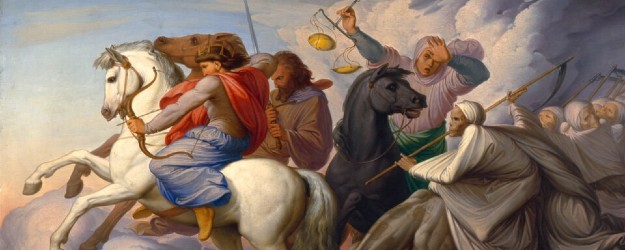
- Tuesday (6:3) the breaking of the second seal: the red horse (the color of slaying, blood).
- Wednesday (6:5) the breaking of the third seal: the black horse with scales of justice.
- Thursday (6:7) the breaking of the fourth seal: the deathly pale horse.
- Friday (6:9) the breaking of the fifth seal: the cry of the martyrs [μαρτυρίαν]: the call for waiting!
- Saturday (6:12) the breaking of the sixth seal: the Great Day of wrath [ὀργῆς] of the Lamb: the victory does not consist in achieving power, but in being found worthy to wield it. Chapter 7:1–17 represents an interval expositing the reign of God and the vindication of those who remained faithful. Note the liturgical text at 7:12: Amen! Blessing and glory and wisdom and thanksgiving and honor and power and might be to our God for ever and ever!
3rd Week. 1. Sunday [and an eighth day] the breaking of the seventh seal (8:1): When the Lamb opened the seventh seal, there was silence in heaven . . . (Rev. 8:1a):
Silence in heaven and the prayers of the saints, and note the location, earth [gē: the root of the word geology] (verse 5) and the forthcoming great signs.
- Monday (8:6) the first trumpet: readiness to blow: sign of hail and fire.
- Tuesday (8:8) the second trumpet: sign of a great mountain burning.
- Wednesday (8:10) the third trumpet: sign of the falling of a great star, Wormwood.
- Thursday (8:12) the fourth trumpet: angel announces further anticipation of the torments.
- Friday (9:1) the fifth trumpet: the unlocking of the abyss and the fate of those not having the seal of God on their foreheads.
- Saturday (9:13) the sixth trumpet: the hour, the day, the month, the year: plagues upon those who refused to abandon idolatry; and the exposition of the angel with a small scroll (10:1) and the time of waiting is over and the seventh angel announces fulfilment of the mysteries of God [μυστήριον τοῦ θεοῦ], the gospel [εὐηγγέλισεν] (10:7), followed by the deliverance of the small scroll to [John] with the agony of the proclamation of the Gospel to the nations (10:8–11). There follow the witnesses [μαρτυρίαν], with the “world” going its way and the vindication of the martyrs (11:1–13). (Understand “world” not firstly in terms of God’s creation, but in terms of that which is not-God-referenced.)
4th Week. 1. Sunday [and an eighth day] (11:15) the seventh trumpet: When the seventh angel blew his trumpet, and there were loud voices in heaven, saying, The kingdom of the world has become the kingdom of our Lord and of his Christ, and he shall reign for ever and ever:
the [heavenly] worshiping activity of the Church brings crisis to the world.
- Monday (12:1) the [1st] great sign: woman in heaven in labor: birth pangs of the Church.
- Tuesday (12:3) the second sign: the dragon and the woman and her flight to the desert [e[rhmon], a place prepared for her by God for a determined period.
- Wednesday (12:18) the third sign: the emergence of the beast for a determinate time: allusion to Rome and to the cult of the Emperor worship — with a reference to heaven and those who are there “entented” [σκηνὴν] [in Latin, tabernacled].(13:6)1 in LXX [tabernaculum in Latin] before the construction of the Solomonic temple).] and the maraudings of the first Beast (13:7–10).
- Thursday (13:11) the fourth sign: the second Beast, his parodying the Holy Spirit and the totalitarianism of his pernicious reign.
- Friday (14:1) the fifth sign: the day of Calvary and the vision of those who have followed the Lamb.
- Saturday (14:6) the sixth sign: the angelic announcing of the gospel eternal [εὐαγγέλιον αἰώνιον]2 and of the fall of Babylon [Imperial Rome], and the call for constancy in faith and perseverance, and the angelic cry, Blessed are they who die in the Lord! . . . their work[s] follow them [that is, into the heavenly realm] (14:13) leading into the Sunday.
5th Week. 1. Sunday [and an eighth day] (14:14, 20): And Lo, a white cloud, and seated on the cloud, one like a Son of Man, with a golden crown on his head, and a sharp sickle in his hand (Rev. 14:14): the seventh sign that is conflated with the first vision: the harvest at the end of an era, and the wrath of God. The harvest is the prelude to the heavenly liturgical singing of the hymn of Moses and of the Lamb (15:3f). This triumph / vindication heralds the seven last plagues (15:7).
- Monday (16:2) the [1st] plague: evil sores on those who had the brand of the Beast.
- Tuesday (16:3) the second plague: blood of dead men and death in the sea.
- Wednesday (16:4) the third plague: rivers and fountains of blood; (16:5) the vindication of the witnesses of Christ and the cry from the altar, Yes, Lord God Almighty, just and true are your judgements (16:7).
- Thursday (16:8) the fourth plague: fire and heat on the unrepentant.
- Friday (16:10) the fifth plague: pain and sores on the unrepentant with the whole empire of the Beast plunged into darkness.
- Saturday (16:12) the sixth plague: the Armageddon in the East (the empires outside the reach of Imperial Rome), and anticipation of the blessedness of those who persevere in the faith.
6th Week. 1. Sunday [and an eighth day] (16:17): And a great voice came out of the temple, from the throne, saying, It is done! The seventh plague: the final punishment / destruction of the great Babylon and the cursing of God by men [ἄνθρωποι]. This is the context from which the cry of the angel is heard, “It is done!” γέγονεν. We encounter some conflation of a diurnal structuring of the text with that Sunday triumph extending into an amplification in chapter 17 that traces the demise of Babylon.
- Monday (17:2-7) the seven sights: the image of the Woman drunk with the blood of saints [ἐκ τοῦ αἵματος τῶν ἁγίων] (17:6).
- Tuesday (17:8) the second sight: The ambivalence of the beast that was and is not [ἦν καὶ οὐκ ἔστιν, and not is], and the call for wisdom to comprehend these contradictions.
- Wednesday (17:10) the third sight: the defeat of the Kings and victory of the Lamb (in which defeat the faithful share).
- Thursday (17:15) the fourth sight: the crushing of the Woman (the Prostitute) and the end of her debauchery.
- Friday (18:1) the fifth sight: Babylon has fallen! (partly a conflation with the fourth sight).
- Saturday (18:4) the sixth sight: the call of my people [ὁ λαός μου] to go out of her (a conflation of the Beast and the Woman); and the mourning of the corrupt world and the blood of the saints (18:9–24).
7th Week. 1. Sunday [and an eighth day] (anticipated in 18:20 and extended in 19:1–10): Rejoice over [the great city], O heaven, O saints and apostles and prophets, for God has given judgment for you against her! (Rev. 18:20). The seventh sight: the heavenly celebration of the saints, apostles and prophets of God’s judgement over the throwing down of wickedness [the Woman] — conflated with the Songs of Victory and the liturgical worship of the twenty-four elders and a great multitude crying to God: Amen, Alleluia! (19:3, 6). The marriage of the Lamb and the Bride (19:7–10).
- Monday (19:11) the 1st of the seven destructions: The Faithful and True seated thereupon and wearing a cloak soaked in blood of the Word of God and who executes the fierce anger of God.
- Tuesday (19:17) the second destruction: the feast of carrion birds.
- Wednesday (19:19) the third destruction: the fiery lake of burning sulphur.
- Thursday (20:1) the fourth destruction: the chaining and the shutting of the Abyss.
- Friday (20:4) the fifth destruction: this is really a Consummatum est (John 19:30, τετέλεσται) — the Last Word of Jesus at his Crucifixion: “Death [Destruction] is swallowed up in Victory!” 1 Corinthian 15:54).
There follows (20:2–10) a long intermediary [a millennium] ending again in the lake of sulphur fire that may be read as the sixth destruction.
- Saturday (20:11) the seventh destruction: the final judgement and the burning lake of the second death of judgement.
8th Week. 1. Sunday [and an eighth day] (21:1): Then I saw a new heaven and a new earth . . . (Rev 21:1) The New Heaven and Earth: God is with His People, those who proved themselves victorious (21:7). There is then a reprise of the seven angels leading to a perspective of the New Jerusalem, wherein there is nothing unclean or false (21:27), followed (22:1) with the showing of the River of Life.
(22:3–15) Testimony of the truth of the book and the proclamation of its truth. There is the terrible text (22:11) prophesying wickedness in the Church — perhaps read as the “World,” but I think the Church as the grave referent, or perhaps both referents). (A prevalent ambiguity that is markedly present in the Pauline epistles and is gravely encountered across ecclesial history.)
(22:16–21) Labeled as an Epilogue with the Spirit and the Bride saying, Come! The ban on tempering with the word of the book as written (22:18). The “Last Words” (22:20b), Amen, Come Lord Jesus! [Ἀμήν, ἔρχου κύριε Ἰησοῦ]: a Coming that joins a new heaven and a new earth.
Closing remarks
We thus see the pneumatic and programmatic structure of the book Revelation, beginning on a 1st Sunday and ending on an 8th Sunday, an Octave, where every Sunday is located in “heaven” — but understanding “heaven” as both here-and-now (on earth and in temporality) and outside temporality and our spatiality (the realm of God: Father, Son, and Holy Spirit). The force of my reading is that we are to live at once in both temporality and in a-temporality and, as such, we find a continuity in the present life and the life of consummation (“heaven”). This is true for all the faithful, not just a select class of the faithful disciples of Christ.
- I interpret this as a prolepsis; that is, an anticipatory of heaven and remembering that any reference to the “tent” carries resonance from John 1:14 which is “entented among us” (remember that the ark was housed in a tent [skēnē, σκηνή ↩
- Note: where two letter g occur in Greek, it is pronounced ng. ↩
 About Fr. Paul Anthony McGavin
Thank you for these great sources and inspirations. God bless you
Dear Father Paul, I pray to thank you for these very profound and extenuated meditations of the glory of this most wondrous and mysterious text. You must have placed, may I assume, a great many years of contemplation to develop such beauty, complexity, liturgical order, and depth.
If I may, I am attempting to complete a book which tries to probe the fuller meaning and structure of the entire divine plan, from the fall all the way to the New Creation inclusive. It calls into it the near totoailty of major Scriiptures and theology and spirituallity, but definitely exhausts the Apocalypse, too.
If I may as well, share, as briefly as I can, in my humble attempt to look at the greater plan, I effectively see a great octave of the supreme ages of the world, seen first, through the lense of the datys of creation in the beginning of Scripture, secondly, in the mysterious delineation of the beast kings in Apocalypse 17 at the end of Scripture, and finally, but astoundingly, in the pregancy narratives of the Jotyful Mtysteries details of the conglomerate pregancies of Elizabeth and Mary. Oh, and also music.
Let me keep it short to show what I mean, because it is very very long in the associated writings in my hopefully forthcoming texts.
It is a little long none the less, so I will have to break it into chunks for the comments
PART I
THE DAYS OF CREATION CAN IMAGE THE GREATER AGES OF THE WORLDS RECREATION, OR REDEMPTION, PER TRADITION
As you know, God created the world in six days of labor, rested allegorically on the seventh, and rose from the dead on the eighth.
AUGUSTINE AND METHODIUS: ARE THE TOTAL AGES 7 OR 8?
Long story short, both Augustine and St Methodus of Olympus delineate five ages to the old law, from adam to Christ. Both see the sixth as the Church in some sense. Augustine, suggests in main conjecture, that the seventh is eternnitty, not the eighth on account of our common catholic view of amill.
Methodius on other hand speaks of a “millennium of rest” in the seventh, and then the eigthth is Eternity.
In my book, I argue that Methodius is closer to the truth, if we demote his possibly heretical chilaism with a little allegory or symbolism: Rather than the seventh night being the great apostasy and the seventh day the seccond coming, the seventh night, which BTW would be our current time, is the dark nigth of the soul for the Church, the minor apostasy, after which, if a minor chastisememnt must come, will come the glorious triummph of the Immaculate Heart for the reunion of Christians and a great era of spiritual and temporal peace, a true seventh day sabbath for THIS side of the end of time.
THEN, the eighth darkness of the days of creation, or, I should have said, the eightth “evening”, is the great apostasy, persecution, conversion of Jews, tribulation, and then at indeterminate time, the Second Coming, the resurrection of all men, like Chrisrt rose on the eighth day, the Public Judement and then the utltimate eighth “light,” or “morning”, the eternal sabbath that will never end in the New Creation.
THE DAYS OF CREATION ALTERNATE BETWEEN FIRST DARKNESS THEN L IGHT, A PICTURE OF THE EVOLVING DIVINE PLAN
In this view, I should have indicated. Like the days of creation, which each have two parts, an evening and morning, they can symblize a great period of spiritual darkness in God’s plan, followed by a great Redemption relative to the People of God, a monring, or light.
Salvation history is then an alternation Between a greater phase of spiritual darkness Followed by a greater phase of spiritual light or redemption . From Augustin, the agese of the world for the OT are delineated first by the first two great partriarches, Noah and Abraham:
From on the catechsis of the Uninstrructed: Five ages of the world have passed. There has entered the sixth.
PART II
AUGUSTINES QUOTE ON THE FIVE AGESS OF OLD, THEN THE SIXTH AS CHURCH
I will quote here from a part of my book so I don’t have to retype it:
Five ages of the world, accordingly, having been now completed (there has entered the sixth). Of these ages the first is from the beginning of the human race, that is, from Adam, who was the first man that was made, down to Noah, who constructed the ark at the time of the Flood. Then the second extends from that period on to Abraham, who was called the father indeed of all nations which should follow the example of his faith, but who at the same time in the way of natural descent from his own flesh was the father of the destined people of the Jews; which people, previous to the entrance of the Gentiles into the Christian faith, was the one people among all the nations of all lands that worshipped the one true God: from which people also Christ the Savior was decreed to come according to the flesh. For these turning-points of those two ages occupy an eminent place in the ancient books.
On the other hand, those of the other three ages are also declared in the Gospel, where the descent of the Lord Jesus Christ according to the flesh is likewise mentioned. For the third age extends from Abraham on to David the king; the fourth from David on to that captivity whereby the people of God passed over into Babylonia; and the fifth from that transmigration down to the advent of our Lord Jesus Christ.
With His coming the sixth age has entered on its process; so that now the spiritual grace, which in previous times was known to a few patriarchs and prophets, may be made manifest to all nations; to the intent that no man should worship God but freely, fondly desiring of Him not the visible rewards of His services and the happiness of this present life, but that eternal life alone in which he is to enjoy God Himself: in order that in this sixth age the mind of man may be renewed after the image of God, even as on the sixth day man was made after the image of God.1
Dear Scott, My article gives a “liturgical topography” whereby we may interpret what you term the “divine plan”. It is, however, an “overview” perspective, and does not move to an attempt at detailed definitiveness across the span of Sacred Scriptures, or of history, or of Patristic literatures. That is, it gives a “perspective” that leads us to an overview, but does not lead us to the kind of close specificaiton that you seek across a wider field. I would be outside my field of competence to comment on your postings; but the important thing when we refer to “liturgy” is that it is worship, and worship encounters mystery: the mystery of the Holy Trinity and of divine action. We can have certain insights, but our lived “liturgical” action and responses remain encounters with what is beyond our close specification and delineation of structure. I do not feel that I can move further than what I have depicted as a persepctive in reading the wonderous book, Revelation. God lead you kindly. Blessings: Father McGavin
PART II
AUGUSTINES QUOTE ON THE FIVE AGESS OF OLD, THEN THES SIXTH AS CHURCH
I will quote here from a part of my book so I don’t have to retype it:
Five ages of the world, accordingly, having been now completed (there has entered the sixth). Of these ages the first is from the beginning of the human race, that is, from Adam, who was the first man that was made, down to Noah, who constructed the ark at the time of the Flood. Then the second extends from that period on to Abraham, who was called the father indeed of all nations which should follow the example of his faith, but who at the same time in the way of natural descent from his own flesh was the father of the destined people of the Jews; which people, previous to the entrance of the Gentiles into the Christian faith, was the one people among all the nations of all lands that worshipped the one true God: from which people also Christ the Savior was decreed to come according to the flesh. For these turning-points of those two ages occupy an eminent place in the ancient books.
On the other hand, those of the other three ages are also declared in the Gospel, where the descent of the Lord Jesus Christ according to the flesh is likewise mentioned. For the third age extends from Abraham on to David the king; the fourth from David on to that captivity whereby the people of God passed over into Babylonia; and the fifth from that transmigration down to the advent of our Lord Jesus Christ.
With His coming the sixth age has entered on its process; so that now the spiritual grace, which in previous times was known to a few patriarchs and prophets, may be made manifest to all nations; to the intent that no man should worship God but freely, fondly desiring of Him not the visible rewards of His services and the happiness of this present life, but that eternal life alone in which he is to enjoy God Himself: in order that in this sixth age the mind of man may be renewed after the image of God, even as on the sixth day man was made after the image of God.1
PART III
THE ALTERNATING PHASES OF DARKNESS AND LIGHT FULLY GEL WITH AUGUSTINE’S DELINEATIO OF THE AGES
The text perfectly provides what we are looking for. That is, Augustine is equating the sixth age of human history, or the church, with the six day of creation, where just as God created man on the 6th allegorical day so, in the sixth figurative age of humanity, God recreates man in his likeness and image by bringing the gentiles into the church, the supernatural light of the Gospel, which remakes human beings from darkness into light. Let us apply it. Simply notice that, first, St. Augustine delineates five epochs for the OT, and this is the same number as our five sets of darkness and light traversed above. Similarly, if we look closer, the partitioning points of St. Augustine’s rendition are precisely the points of light in our analysis, leaving the greater history between his same points of light as the points of darkness in our discourse. Just follow it:
Firstly, the lights:
• Adam: Original Justice is light.
• Noah: the Flood is light.
• Abraham: the confounding of tongues and formation of the Hebrew People are light.
• David: the formation of the holy kingdom after the Exodus is light.
• Captivity: the Captivity, though great suffering for the Jewish People, is still light, since by it, God softened the hearts of His wayward People and brought them to repentance [the restoration to holy land and rebuilding of the Temple fits here as well.]
• The Christ: need we say more about the light of the First Coming of Our Lord and Savior, Jesus!
Secondly, the phases of darkness in between:
• Between Adam and Noah: the darkness of the fall and wickedness of Noah’s day.
• Between Noah and Abraham: the darkness of the great sin of Babel, blasphemous materialistic perversity.
• Between Abraham and David: the darkness of the Egyptian Enslavement.
• Between David and the Captivity: the darkness of the great sin of the Jews prior to the exile.
• Between the Captivity and First Coming of Jesus: the darkness of the Maccabeean struggle, including Old Testament antichrist figure, Antiochus.
Profoundly as well, again, at the end of our citation, Augustine brings us into the days of creation himself, the same allegorical days we mentioned and traversed: St. Augustine points out that the sixth age, the Church, is the age in which man is remade in mind and heart through the Gospel, even as God made man in his image and likeness on the sixth day.
For now, this ends the quote which I hope was helpful.
Now, I argue that the sixth day is when there is still light as the Church labors against sin, iniqtuiy and false doctrinal attacks to spread the Gospel. Only when the greater spiritual assault on the Church is completely dark, has the sun set on the sixth morning or light, and we enter the minor godless of our day, the seventh darkness.
PART IV
THE SIXTH AGE OF LABOR OF THE CHURCH, WHEN DOES IT END? WHERE ARE WE?
This is true, as follows: the primary spiritual attackes on the church since pagan rome have followed the fivve great sources of Catholic truth from top to bottom:
Here is a fully accurate rendering of the sources of truth of the Church, as not merely three but five, like the toes of the human foot:
1. The Trinity and Incarnation
2. The Supreme Apostolic Successor [the Pope]
3. The General Apostolic Succession and Oral Tradition
4. The Written Tradition [Scripture]
5. Reason
THE SIXTH DAY OF THE CHURCH’S LABOR TO WORK OUT THE SPIRITUAL GOSPEL FOLLOWS AN INCREDIBLE RIGOROUS STRUCTURE!
These five sources form a pyramid of truth: as ou ascend the pyramid of sources above , the truth increases but the evidence for reliability decreases, and down the pyramid, vice versa. So height of the pyramid side indicates degree of truth of the source by itslef, but width indicates degree of evidence for the source as legitimiate. The historical journey of doctrine in the Church bears this out completely!
1. After Pagan Rome, the majority of the primary heresies afflicting the Church until the Schism were mainly attacking God in His special nature as Triune and Incarnate: Arianism, Monophysitism, Monothelytism, Nestorianism, Apollinarism, Pneumatomachianism, Tritheism, and so forth. Too, Islam culminated these: it totally denied the Trinity and Incarnation and, if that were not enough, went on to suggest a revelation beyond Jesus, the Quran, which Arianism, while also denying the Trinity and Incarnation, did not. Too, even the Iconoclastic heresy is an affront to the Incarnate God, since, it involves the interpretation of the First Commandment which is to have no other gods before him, sacred images, and the reality that images of the saints, because of the presence of deifying sanctifying grace, are images of Christ, an Incarnational mystery.
2. Then, the next great attack was clearly the Great Schism of the East, which assaulted Peter, the supreme apostolic successor, just underneath God.
3. As for the next great attack, really, in the Middle Ages, Albigensianism or Catharism were minor compared to what was the clear continuing trajectory of the opposition to the Church, the moral fall of the clergy in the late Middle Ages, paving the way for the great assault, the Protestant Rebellion; and lo and behold, the ultimate thing that all Protestants have in common is in contesting the general Bishops and Sacred Tradition, which are just beneath Peter, the supreme Apostolic Successor.
4. It just keeps going: the Protestants’ confounding of the Scriptures only served to make humanity doubt the veracity of the Bible itself and, in fact, all Divine Revelation, which gave rise to a general climate of solo-ratio, or faith in Reason alone, the natural digression from the Protestants’ counterpart rallying-cry, sola-scriptura (Enlightenment, French Revolution, Masonry, and so forth).
5. Finally, in the 20th century, even Reason dies, and we have total apostasy, as in atheism in the East [which is irrational since it denies God, who can be known from Reason alone, Vatican I] and relativism and materialism in the West [which is irrational since it denies objective truth].
PART V
THERE IS STILL LIGHT IN THE SIXTH DAY UNTIL THERE IS NO MORE LIGHT, ONLY DARKNESS: ATHEISM AND RELATIVISM ARE COMPLETE DARKNESS, EASTERN EURO AND WESTERN EURO CIVS NOW IN THE DARK!
Hence, in all but the fifth phase, anti-Reason, some light is present. Let us analyze it.
1. To begin, the heresies against God’s special nature still leave much light: all but Islam still have Scripture and Tradition in some respects, and even Islam is supernatural light: a Judaeo-Christian shell and belief in the necessity of revelation and divine assistance.
2. Schism Ditto. The Orthodox are practically Catholic, like a bright sun with a little cloud to the side, the rejection of Peter and the Filioque.
3. Protestantism is bringing in rain and sadness but still much supernatural light: most of Scripture and two sacraments, Baptism and Marriage. Protestants, for all the rhetoric they may spout at us, are not devil’s children; they are God’s children and just misguided.
4. Even, too, in the Enlightenment and the general age characterized merely by natural light, Reason, it is like a dim twilight: deists and rationalists still hold to a Creator and some sense of natural law, usually. And even when Reason later became diverted away from supernaturally dead religion and towards merely this world, still, Reason directed toward science, math, psychology and economics is aimed at truths and things that concern a reflection of the divine, for the created order and its laws and relationships were made by God and so imprint the divine wisdom. Hence, man’s pursuit of the truths of chemistry, and biology, and geology, and economic theory, and the maths, and the psychological order, and so forth, are already approaching God.
5. Hence, only when man, in the 20th century, sheds Reason in diabolical horror with atheism in the East and relativism in the West, was there no longer any of the divine sources of truth left, no light left in the sky, sparing the nightly luminaries.
WHAT LIES AHEAD IS A POSSIBLE MINOR TRIUBLATION, THE AGE OF THE IMMACULATE HEART AND PEACE, THEN THE GREAT APOSTASY AND END
Now, most mystics approved and approved end time prophecies indicate that although much of the former Christedom world is in darkness, ti is NOT tne end of the world. Rather, we expect a MINOR tribulation, after which we will see the renuion of Christians a glroious era of Our Lady’s Immaculate Heart and Peace.
Only after this does the greater apostasy arise, the Antichrist ,the terrible persecution, conversion of Jews, and tribulation occur, within which at an “unknown hour”, the Christ reutnrs to resurrect all humanty, as he arose on the eighth light of the days of the creation.
PART VI
FINALLY, DISCUSSION OF THE OCTAVE OF GOD’S DIVINE PLAN: DAY ONE OF NOAH AND DAY EIGHT OF THE SECOND COMING MIRROR ONE ANOTHER, THE OCTAVE OF HUMAN HISTORY
The octave then follows as Chrisrt’s and Peter’s words both. As it was in the days of Noah, so shall it be in the days of the Son of Man.
That is, both days one and eight are similar in spiritual nature, but only separted by seven great phases .
In day One, the whole world is almost totally wocked, sparing a renmant, Noah and His family. God destoryes this world by water, an apocalptic baptism, and begins the renwal or remaking of humanity through the stages of redemption.
In day eight, the near totality of the world is wicked, with only a remannt of good Catholic Gentiles, and the Jews who convert enmasse, which is still small. This time, God destoryes the world by baptizing with FIRE, and ENDING the world with the ULTIMATE COMPLETIO Of the redemption of the world, the resurrection beyond the eschaton , the New Creation that shall never end.
PART VII
THE BEAST KINGS ALSO BEAR IT OUT:
Supplementary info: in apocalypse 17, 9-11, a delineation of the kings of the beast is given. St Hippolytus of Rome says they could be ages. In this case, they fit perfectly with our analysis:
“And they [the heads of the beast] are also kings. FIVE have fallen. ONE is, the OTHER has yet to come, and the beast which was and is not and will be again, even he is the EIGHTH, and is OF the seven, and goes into perdition.”
In short, the beast as a whole carries with and unto it the entire fallen nature as incarnated in great ages of human history, from the fall all the way to the great apostasy, hence, the eighth is “of the seven”.
Five have fallen is self evident: as our analysis show above, five great phases of sin precede the firrst comjing of Christ.
ONE is. The church is six, and in St Johns time of writing, PAGAN ROME is clearly the reinging age.
The other has not yet come: the SEVENTH, our modern age, the dark night of the soul, the minor godless age. The eighth, the great apostasy and very end.
Note, the beast WAS and IS NOT and will be AGAIN. In day one, the falle nature WAS, since it was the prevailing force of human history at that time: God, prior to the Flood, had not, as of then, yet entered human history substantially to curb the wickedness of Noah’s day. And humanit was not listening, able to repent. Hence, the fall WAS.
But the Flood, the redemptio of the world was underway, and so the fallen nauure starts to take a back seat to God’s plan to renew humanity, little by little, in stages, mainly puctuated stages of the worlds resistance to his grace. As in, per Apoc 13, a head of the beast is wounded or slain, then it comes back to life, and so froth. A phase of sin arises, then God slays it by a great act of redemption around the associated People of God, then sin comes back, is slain, etc. Hence, this redemptive process marks the situation of “the beast is NOT”.
Too, all the more in St Johns day, the Gospel is beginning to destroy the fallen nature, at least in part, by the Churchs progressive conversio of many parts of the world.
But finally in the great apostasy, after first, the coming possible tribulatint hat will show terribly the world’s need of the church in all its facets, and then, sconedly, an age of peawce of Our Lady that will show that if they would but stop resisting grace, and cooperated with the Church, faith and science can be reconcled and there can be peace, the world is simply without excuse, totallyl wicked and incurable, and totally culpable, as above. Hence, at the end, like before the Flood, the fall is back and back to stay, incurable but with full culpability of the entire plan of redemptin. Hencee, the beast is AGAIN.
And because the phaes are one and eight, it too, like the days of creation is an OCTAVE of darkness.
ART VIII
THE WAY OF THE SAINT FOR THE PEOPLES OF GOD
A final word: WHY the phases are these?
In my view, eawch people of God, both the Jews, then the church, walk the historical spiritual path of the way of the saint:
purgativve, illuminative, untive.
Hence, the darknesses:
3. egypt, dark night of sense
4. intermediate apostasy from old law: dark night of the soul
5. martyrdom, maccabees, antiochus iv epiph, antichrist figure for jews
6. pagan rome, dark night of the sense
7. intermediate apostasy of our modnern day: dark night of the soul
8. martyrdom: great apostasy, nt antichrist,
PART IX
THE FIRST TWO AGES AND THE LIES OF THE FALL
what about the first two ages before the jewish way of saint?
For now, mustr say, there are two great reasons we exist, and if we flip them, we two great lies of fall:
1. to know and love God in this life. Knowing God is faith ,and loving God is repentance, or baptismal disposition
2. to be happy with God forever in heaven in the next life. In next life, we will have spiritual marriage to God.
The two great lies of the fall are then:
1. anti-baptismal dispositio: no faith, no repentace. This was Noah’s day, the world had not faith in the flood warning ,they scoffed and no repentace, they were wicked: so God baptized the world in the flood
2. Materialism or anti-marital dispostion apocalyptically: a world that does want the heavenly and spiritual marriage to God in the NEXT life, but just a figurative fornication with the things of this world and THIS life as the ultimate fulfillment. Rejection of otherowordly MARRIAGE to the CreaTOR in NEXT life, in ex change for worldly FORICATION with the CreaTION in the THIS life, again, materialism, living for the brute created of goods here below instead of the unfathomable spiritual goods up above.
In the second case, the blasphemous towe of babel, humanity’s pursuit of a wordly grandeur as their ultmatte end to glorify themselves in place of God was apocalytpic anti-marrriage, and it was broken by confounding of tongues and calling of one underdog of holiness, the spiritual Marriage between the father of heaven and Abraham and his belove Hebrew people.
Hence, before the last six ages of the ways of the saints above, the first two ages afflict effectively all of humanity with the scourges of the two great lies of the fall, each chastised with an appropriate counter redemption.
1. Anti-Baptism: light: Flood
2. Anti-Marrage Materialsim of Babel; Light, marriage to Abraham, a small nation of holiness.
I know it is a lot, but hope you might have liked this other perspective of a singular but great octave of the whole DivinePlan. Thank you so much if you have this far!
God bless!