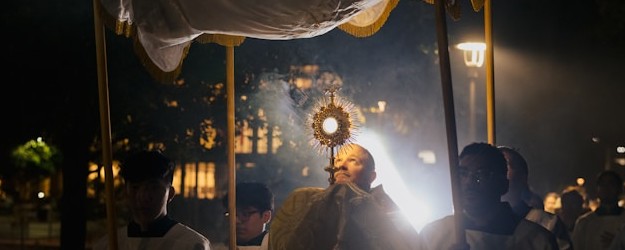
Introduction – The Silence Before the Mystery
During the Church’s infancy, when the faithful gathered in the catacombs, they came not for a symbol or a story, but rather for the living Christ who had promised, “My flesh is true food and my blood is true drink” (John 6:55). Two millennia later, many still profess this truth while struggling to feel its weight. As most devout Catholics stand before the tabernacle, they still risk forgetting that before us rests the same Lord who spoke from Sinai and hung on the Cross. The renewal of Eucharistic faith begins not with argument but with awe.
Historical Glimpses of Reverence
From the earliest centuries, the Church expressed belief in the Real Presence through bodily reverence. Saint Cyril of Jerusalem instructed the newly baptized to form their hands “as a throne to receive the King.”1 Tertullian warned that the Eucharist was not to be received “except from the hand of the minister.” When persecution ended and churches filled, ritual caution deepened devotion: genuflections, fasting, confession before Communion. These were not gestures of distance but of desire — human ways of acknowledging divine nearness.
In the Latin West the custom of receiving on the tongue arose gradually, not from suspicion of the laity but from the instinct that sacred things invite sacred posture. Medieval theologians saw this development as an act of love: what the hand had once held, now the tongue received directly, signifying that the Word himself fed his people. Saint Thomas Aquinas taught that “out of reverence for this Sacrament, nothing touches it except what is consecrated.”2 The Church’s bodily disciplines were never arbitrary rules; they were catecheses in motion, training hearts to adore.
The Body Given for Us
The Eucharist is not an idea but a body, and bodies speak a grammar of presence. In Christ’s command “Take and eat” the verbs are earthy and intimate. When the Word became flesh, the infinite consented to be handled; when the bread becomes the Word, the finite must learn to handle with awe. To forget this grammar is to risk turning mystery into routine.
Saint Paul warns the Corinthians that “anyone who eats and drinks without discerning the body eats and drinks judgment upon himself” (1 Cor 11:29). Reverence safeguards discernment. It reminds the believer that Communion is both invitation and warning, mercy and majesty. Our gestures at the altar — kneeling, bowing, receiving with care — are confessions of faith more eloquent than words.
Eating the Scroll
In Ezekiel’s vision, the prophet is commanded to eat a scroll filled with the words of God; in his mouth it becomes sweet as honey (Ezek 3:1–3). That image prefigures the Eucharist, where the Word is not merely read but consumed. To “eat the scroll” is to internalize revelation until it shapes thought and desire. In Holy Communion, the Christian becomes a living commentary on Scripture. Saint Augustine expressed the paradox simply: “Believe, and you have eaten.”3
Yet this act of holy eating stands in shocking contrast to the Levitical prohibition against consuming blood (Lev 17:10-14). For Israel, blood belonged to God alone, the sign of life that was never to be profaned. Christ fulfills the law by offering his own blood, not as violation but as invitation. He gives what was once forbidden so that humanity may share the very life of God. The scandal of his command — “Unless you eat the flesh of the Son of Man and drink his blood, you have no life in you” (John 6:53) — is the measure of its gift.
The Posture of Faith
Reverence is faith made visible. Kneeling, fasting, silence after Communion — these are the liturgy’s body language. They are not nostalgia but necessity, especially in an age that prizes convenience over contemplation. The gestures of the saints were never about personal taste but theological truth: the Eucharist is God’s descent, not our invention.
The Church reminds us in Memoriale Domini that “the method of distributing holy communion must convey the greatest reverence possible.”4 Whether the faithful receive in the hand or on the tongue, standing or kneeling, the essential question is interior: Do I approach as one who believes this is God? Saint John Chrysostom warned that “when you see the Lord immolated and the priest standing at the sacrifice . . . say to yourself: This blood has purged heaven.”5 Every communicant stands where Isaiah stood, before the altar of burning coals.
Forgetting and Remembering
Modern culture excels at production but suffers from amnesia. We forget not only doctrine but wonder itself. The Eucharist confronts this forgetfulness by commanding remembrance: “Do this in memory of me.” To remember in the biblical sense is not mental recall but participation — entering again into the saving event. Each Mass gathers the centuries into a single hour; Calvary is not repeated but made present.
The saints remind us that such remembering begins in repentance. Saint Francis of Assisi wept whenever he saw a priest carrying the pyx, crying, “My God is carried in so humble a manner!” Saint Thérèse of Lisieux called every Communion “a new incarnation.” Their tears and simplicity are antidotes to indifference. They show that Eucharistic faith matures when gratitude outweighs habit.
The Call to Recover Awe
If reverence has dimmed, it is not because faith has changed but because familiarity has dulled astonishment. The remedy is neither polemic nor nostalgia but renewed contemplation of the mystery itself. To recover awe is to allow grace to retrain the senses — to hear the silence after “Behold the Lamb of God” as a summons, to see the elevation as a cue not for eye-rolling but for adoration.
Pope Benedict XVI wrote that “the attitude of humble adoration must be reawakened.”6 That awakening begins wherever believers rediscover the link between gesture and belief. When a child genuflects, when a priest purifies the chalice slowly, when a parish pauses in silence after Communion — these are small liturgies of love that rebuild the Church from within.
Conclusion – Receiving the Word Anew
The Word made flesh still waits to be received with trembling joy. In every generation the Church must learn again how to approach the burning bush without shoes. Reverence is not restraint but readiness — the poised heart that knows heaven has stooped low. When we extend our hands or open our mouths, we echo the Virgin’s fiat: “Let it be done unto me.” At that moment, the Christian becomes what he beholds. To receive the Eucharist worthily is to remember who we are: creatures addressed by God, loved into communion, summoned to kneel before the mystery that feeds the world.
- Cyril of Jerusalem, Mystagogical Catecheses, V, 21. ↩
- Thomas Aquinas, Summa Theologiae, III, q. 82, a. 3. ↩
- Augustine, Tractates on the Gospel of John, 26. ↩
- Memoriale Domini (Instruction on the Manner of Administering Holy Communion), Congregation for Divine Worship, May 29, 1969. ↩
- John Chrysostom, Homilies on 1 Corinthians, 24. ↩
- Benedict XVI, Sacramentum Caritatis, 65. ↩
 About Nicholas Nogueira
A beautiful portrayal of the essence of Eucharistic reverence and a call to live it.
I especially love the line, “Modern culture excels at production but suffers from amnesia” and “Reverence is faith made visible.”
Thank you for writing this!
Sister, I loved the “Reverence” comment too. I have written, so far, over 4440 Glimpses of the Eucharistic Face.
Reception is an act of Hope.
Reception expresses my deep helplessness.
Reception says, “I believe.”
We can just go on and on. He is infinite in His giving.
God bless. Please pray for my love of Mother’s Son to grow to the level they desire for me. GK
Amen, amen to sister Mary Catherine’s quote…how beautiful and true!!!
Nicholas,
Thank you for calling to our attention Eucharistic Reverence. Reverence is so important, especially in a culture that does not reverence creation, even life itself. Each human act can communicate reverence, which requires silence, deliberate attention to the greatest miracle on earth in every celebration of the Eucharist.
One thing I wish was changed, and two, I wish would be brought back. The Sign of Peace. At the start of Consecration to the giving out of Communion, is the most solemn part of the Mass. While all our attention and devotion should be focused toward the Altar, we’re distracted by the request to give the sign of peace to our neighbors.With all the kissing, hand shaking, and waving, it completely takes that away. Why can’t the decon announce that at the beginning of Mass, just before the Procession?
What should be brought back, kneeling at a Communion Rail and receiving on the tongue. To me, that’s how we should present ourselves to the majesty of our Lord.
I agree totally! My husband and I refuse to shake hands. We bow our heads and fold our hands. We fervently pray for peace for everyone but silently to Our Jesus who is physically present. In my opinion, this is such a disrespectful dis play and a total misunderstanding of the true prescience of Our Lord. We have asked numerous priests over the years to at least, put a kneeler down for those who wish to kneel to receive and have been met with denial over and over again. I truly wonder how many people at Mass really believe they are receiving Jesus’ the very same Jesus who walked this earth and died on the cross for ys. From the display and lack of reverence I’ve observed, very few truly even give it a second thought. How very sad.
Margaret, spot on. We bow our heads a little and close our eyes at this time. We reflect on what just occurred on the Sacrificial Altar. Keep working on the kneelers. We are approaching the Divine Presence and begging for His entrance to the soul. Best if we are prostrate.
Ann, good eye. At this part of the Mass, Jesus and the In Persona Christi priest have just immolated themselves on the Sacrificial Altar in the work for my salvation. Have the sign of peace before Mass. Teach the people about the immolation of the two principals. Help the parishioners new know what is transpiring. Attend Mass in the eternal now, on Calvary, next to the Blessed Mother.
During my years of attending Mass at St. Mary’s Cathedral (Sundays and weekdays) from 1969 until today, I have seen the consecrated Host taken by hand and put in pockets, left on church benches, broken in crumbs in the hymnal box, shattered in pieces on the seat of pews. I have seen the Holy Eucharist crumbled in children’s hands, taken away unconsumed by strangers in the crowd–to who knows where. It disturbs me deeply, seeing this sin of desecration against the Body of Jesus Christ, with no measures put in place to end these horrific sacrileges. Neither have I seen public reparation to atone for desecrations of the Eucharist at our Cathedral. Nor have I seen any effort to educate parishioners about the Real Presence of Jesus in the Eucharistic. And so the desecrations continue, perpetrated by the careless, the uninstructed, the unbelieving, and doubtless by the malicious.
It has always been my understanding that to desecrate or facilitate the desecration of the Sacred Host is a horrific sin worthy of eternal punishment. “This is the Bread that came down from Heaven.” John 6:58.
Would it not be possible to have a day of atonement set aside each year to make public reparation for the many assaults against the Body of Christ? If that is not possible, I feel strongly that Holy Communion should be received on the tongue by all, with no exceptions, as was practiced in the Church from ancient times . It would eliminate for good this rampant horror in our Churches.
Nicholas Nogueira, be sure to thank the Blessed Mother for giving you the love of her Divine, Crucified, Eucharistic Son. All the needs of the soul and the body are found in the Divine Eucharistic Face of the Crucifed Christ. It is, I am.
Our Eucharistic Goal, and soon I pray: I am who I am, because the Divine, Eucharistic, Crucified Christ is who He is.
Let us fall in love with Mother and Her Son. God bless