“It is vital, then, that you preserve your traditions without attenuating them, for the sake perhaps of practicality or convenience, lest they be corrupted by the mentality of consumerism and utilitarianism.” (Pope Leo XIV, Address to Participants in the Jubilee of Oriental Churches, May 14, 2025)
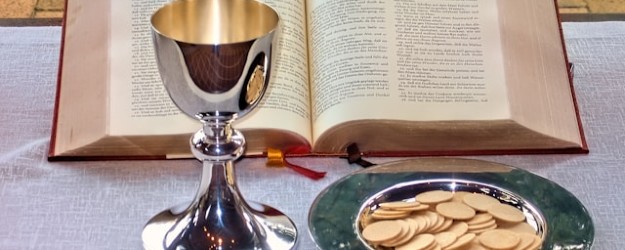
“Practicality or convenience” . . . Shall we add “fear” to Pope Leo’s admonition? I am thinking, specifically, of the currently dominant practice of distributing Holy Communion in the Catholic Church under a single species, the host. Though my focus is on the Church in the United States, it is worth acknowledging that in other parts of the world, the chalice also is not used except on certain holy days such as Holy Thursday and Corpus Christi. Mind you, I am not referring to the Church’s dogma of the nature of the Eucharist, but to its distribution.
A dogma of the Catholic Church is that reception of the Holy Eucharist either in the form of the Host or in the form of the Precious Blood provides the recipient the whole Christ, Body, Blood, Soul, and Divinity. The dogma was officially declared at the Council of Trent, the sessions of which lasted a total of eighteen years (1545–63) in the wake of the Protestant Revolt. But the practice or “discipline” concerning distribution of the Holy Eucharist is not dogma; rather, it is part of the Church’s authority in carrying out its duties for the faithful. The discipline has changed over the millennia. It is likely that most Catholics are not aware that for the first twelve hundred years of Christianity, it was the accepted practice to receive under both species or elements, and not just the Host alone. The Catholic Encyclopedia describes the practice as follows:
It may be stated as a general fact, that down to the twelfth century, in the West as well as in the East, public Communion in the churches was ordinarily administered and received under both kinds. That such was the practice in Apostolic times is implied in I Cor., xi, 28, nor does the abbreviated reference to the “breaking of bread” in the Acts of the Apostles (ii, 46) prove anything to the contrary. The witnesses to the same effect for . . . subsequent ages are too numerous, and the fact itself too clearly beyond dispute, to require that the evidence should be cited here.
While there were exceptions made, e.g., in bringing communion to the sick, or for children, the widespread practice was to imitate Christ’s command to eat and to drink. Yet even then both species were taken to others: Justin Martyr writes about deacons taking to the homes of those who are absent a portion of “the eucharized bread and wine and water.” (First Apology 65, ANF 1:185)
During the late Middle Ages the discipline gradually changed to one of using only the host in the distribution of the Eucharist. Around the year 1400 some Catholics objected, saying that reception under both species was necessary to receive Christ fully. That was declared a heresy by the Church and, within 200 years, in its earnest defense of the Catholic faith, the Council of Trent stated: “Not only, therefore, is Communion under both kinds not obligatory on the faithful, but the chalice is strictly forbidden by ecclesiastical law to any but the celebrating priest.” (emphasis added) This was intended to reinforce the church’s dogma on the nature of the Eucharist.
The dogma that either species provides the entire Christ is based on a combination of ideas: a) Biologically, it is nearly impossible to separate flesh from blood since the two elements shed cells between them. Thomas Aquinas called this their hypostatic union or concomitance. b) After his resurrection Christ was and is whole and divine, body and blood, undivided. The Council of Trent (Session XXI, c, iii) put it succinctly:
By reason of the hypostatic union and of the indivisibility of His glorified humanity, Christ is really present and is received whole and entire, body and blood, soul and Divinity, under either species alone; nor, as regards the fruits of the sacrament, is the communicant under one kind deprived of any grace necessary for salvation.
Thus, it is said that receiving under both species has only symbolic value and is not necessary to receive all of Jesus.
Left out of the bishops’ consideration at Trent was acknowledgment that Jesus Christ, of course, was and is aware of all this and yet He explicitly chose to use both elements in establishing the sacrament. He said so not only to the Apostles at the Last Supper but also directly to the crowd who had followed him:
Truly, truly, I say to you, unless you eat the flesh of the Son of man and drink his blood, you have no life in you; he who eats my flesh and drinks my blood has eternal life, and I will raise him up at the last day. For my flesh is food indeed, and my blood is drink indeed. He who eats my flesh and drinks my blood abides in me, and I in him. (John 6:53–56)
With respect to these words, the Ignatius Study Bible notes the long-standing position of the Church that “Jesus is speaking literally and sacramentally,” not metaphorically. Literally, that is, eating and drinking.
What did Jesus intend with respect to the Holy Eucharist? Though He is fully present under either consecrated bread or consecrated wine, Jesus never said anything like “Take and eat this bread which is my body and blood.” He specifically separated the components of the Eucharist. Further, after Jesus’ Ascension, the Apostles distributed the Eucharist to the laity under both species, a practice understood by Church Fathers as appropriate, one that continued for over a thousand years.
Yet, seemingly as an attempt to justify Trent’s prohibition of receipt of the Precious Blood, the authors of the Catholic Encyclopedia argue that what Jesus commanded to be done, reflected in the words of consecration at every mass, is not “divinely determined.” Consider their reasoning:
Were one to insist that Christ’s action in administering Holy Communion under both kinds to the Apostles at the Last Supper was intended to lay down a law for all future recipients, he should for the same reason insist that several other temporary and accidental circumstances connected with the first celebration of the Eucharist (v.g. the preceding paschal rites, the use of unleavened bread, the taking of the Sacred Species by the recipients themselves) were likewise intended to be obligatory for all future celebrations.
We see here that these writers view the actions and words of Jesus in establishing the Eucharist as being equivalent to “other temporary and accidental circumstances.” I am not aware of any theologian who would view “Take and eat . . . take and drink” as equivalent to temporary circumstances. With respect to the Precious Blood, the Ignatius Study Bible states:
“The consumption of blood — always forbidden under the Old Covenant (Lev. 17:11–12) — is now enjoined in the New, since it communicates Christ’s divine life to the believer.” St. Paul refers to communion under both species for the faithful in Corinth: “For as often as you eat this bread and drink the chalice, you proclaim the Lord’s death until he comes.” (1 Cor. 11:26)
Some have argued that when He established the Eucharist with the twelve Apostles, he meant it only for them and for future priests and bishops. That doesn’t make sense since each Apostle and their successors act in persona Christi in saying the words of consecration for those in their care, parishioners who would be and are lay people. The “matter” of each Church sacrament, for example, requiring the use of water for baptism, is biblically based. Such should also be the case for communion, i.e., Christ specifically used both bread and wine, and chose to distribute them after the blessing.
With the passage of some 400 years of prohibiting distribution of the Precious Blood to the laity, Church documents issued by the Second Vatican Council allowed limited distribution via the chalice. In the U.S., diocesan heads have authority to determine and declare communion distribution policy. Starting in the 1980s, many began providing for distribution of the Precious Blood.
One of the widely-used communion antiphons at Mass states: “When we eat this bread and drink this cup, we proclaim your death, O Lord, until you come again.” And the contemporary communion hymn, Eat This Bread, one of several such hymns, conveys the same idea:
Eat this bread, drink this cup, come to me and never be hungry.
Eat this bread, drink this cup, trust in me and you will not thirst.
The two-species practice grew steadily for fifty years until its wholesale, abrupt end due to the impact of the Covid China flu. Recent studies by the Center for the Applied Research in the Apostolate (CARA) of parish surveys on post-pandemic liturgical adaptations note that many U.S. dioceses suspended the distribution of the Precious Blood during the COVID-19 pandemic due to concerns about viral transmission via a shared chalice. Even after the federal health emergency ended in May 2023, however, there has been a reluctance to return to sharing the chalice. CARA’s data indicate that some parishes have not restored the chalice, citing residual fears among parishioners about hygiene or diocesan policies leaving the decision to individual pastors. (A similar fear seems to inhibit many from shaking hands during the kiss of peace at Mass.) A 2024 survey by the Federation of Diocesan Liturgical Commissions found that only 50 of 99 responding U.S. archdioceses and dioceses had universally restored the chalice, with 47 leaving it to each pastor’s discretion. Yet those same communion hymns and antiphon continue to be used at Masses even though communicants do not have the opportunity to “drink this cup.”
Even in parishes in which communion under both species is permitted, some pastors find it difficult to recruit Extraordinary Ministers of Holy Communion who are willing to offer the Precious Blood. Simply put, many Ministers do not want to drink from the chalice at the end of communion time if there is Precious Blood remaining. Here we have it: fear. Fear of each other. Fear of the invisible. I am not aware of any reported case of someone becoming infected with a virus as a result of receipt of the Precious Blood from the chalice. These and other roadblocks call for creativity on the part of church leaders to develop alternatives. The sharing of the chalice is not the sole method.
In fact, there are several ways that both species can be distributed. The Eastern Catholic and Eastern Orthodox churches never relinquished the age-old policy of communion under both elements. We should learn from them. There is intinction. There is use of a spoon. The late Pope Francis and current Pope Leo XIV have used intinction at masses in both local Roman parishes and for seminarians.
Objections to these practices rely on three concerns: a) there may be spillage of the Precious Blood; b) hygiene may be compromised by sharing a common chalice; and c) communion lines would move more slowly, thereby adding to the total time for mass. Here is a direct explanation from the Catholic Encyclopedia:
[Consider] the discretionary power of the Church over everything connected with the sacraments that is not Divinely determined — the question of giving or refusing the chalice to the laity becomes purely practical and disciplinary, and is to be decided by a reference to the twofold purpose to be attained, of safeguarding the reverence due to this most August sacrament and of facilitating and encouraging its frequent and fervent reception. Nor can it be doubted that the modern Catholic discipline best secures these ends. The danger of spilling the Precious Blood and of other forms of irreverence; the inconvenience and delay in administering the chalice to large numbers; the difficulty of reservation for Communion outside of Mass; the not unreasonable objection, on hygienic and other grounds, to promiscuous drinking from the same chalice, which of itself alone would act as a strong deterrent to frequent Communion in the case of a great many otherwise well-disposed people; these and similar “weighty and just reasons” . . . are more than sufficient to justify the Church in forbidding it. (https://www.catholic.com/encyclopedia/eucharist)
This explanation of the reasoning used by the bishops at Trent implies that the distribution of the Eucharist as Christ did is viewed as a secondary, non-essential aspect: “the question of giving or refusing the chalice to the laity becomes purely practical and disciplinary . . .” Reinforcement of this view comes from many sources today. Some bishops are fearful of possible spillage of the Precious Blood if Extraordinary Ministers of the Sacrament (colloquially but improperly referred to as Eucharistic Ministers) were to begin using intinction. But the General Instruction of the Roman Missal (GIRM) specifies, among many other aspects of Catholic worship, that the Permanent Diaconate, not lay people, are responsible for administering the Precious Blood. In the United States, the guidelines for intinction are as follows:
Holy Communion may be distributed by intinction in the following manner: Each communicant, while holding a Communion-plate under the mouth, approaches the Priest who holds a vessel with the sacred particles, with a minister standing at his side and holding the chalice. The Priest takes a host, intincts it partly in the chalice . . . (https://www.usccb.org/prayer-and-worship/the-mass/norms-for-holy-communion-under-both-kinds, 49)
This may limit the role of Extraordinary Ministers to, perhaps, holding a patent under the chin of each recipient or holding the chalice in the process of assisting the priest or deacon in distributing Holy Communion.
In addition, many priests fear that slower communion lines at Sunday masses would lengthen the total time for mass! It is here that we are reminded of the recent admonition by Pope Leo XIV, cited at the beginning of this essay: let not convenience or utilitarian reasoning dictate the practice of our faith.
In its response to Protestant heresies, Council of Trent fathers thought it prudent to forbid reception of the Precious Blood. The twentieth century’s Vatican Council proclaimed a modest change in the practice. At present, §281 of GIRM states:
Holy Communion has a fuller form as a sign when it takes place under both kinds. For in this form the sign of the Eucharistic banquet is more clearly evident and clearer expression is given to the divine will by which the new and eternal Covenant is ratified in the Blood of the Lord.
Even here, there is an implied hedging, that is, both species provide a “fuller form as a sign.” What about biblical fidelity, wherein Jesus gave both bread and wine, making that the basic form?
Again, from Vatican II, we read: “The sharing in the body and blood of Christ has no other effect than to accomplish our transformation into that which we receive.” (Lumen Gentium Constitution on the Church, para. 26) The bishops of the United States echoed this point in their comprehensive Norms for the Distribution and Reception of Holy Communion under Both Kinds in the Dioceses of the United States of America (usccb.org):
In a preeminent way the eucharistic Liturgy uses the signs of bread and wine in obedience to the Lord’s command and after their transformation gives them to us as the Body and Blood of Christ in the act of communion. It is by taking and sharing the eucharistic bread and chalice — “signs perceptible to the senses” — that we obey the Lord’s command and grow in the likeness of the Lord whose Body and Blood they both signify and contain.
Our bishops remind us that it is in the “taking and sharing” of both the “eucharistic bread and chalice” that “we obey the Lord’s command.” It would seem timely now to carry out that command, not as “preference” or “possibility” but as integral to receipt of communion. Thus, we ask: Shouldn’t Church leaders reconsider the administrative laws and procedures regarding the distribution of communion? Isn’t there a sound basis for mandating distribution under both species? Might it not be prudent for the Vatican to undertake a review of the norms for distribution of communion? It is my hope that such a review would lead the Church to return to the two-element discipline that had been practiced for more than a thousand years since its founding. Not mere accident or minor aspect, communion under both species is what Christ did and, in turn, wanted the Church he established to do. It fulfills the action, it fulfills His command.
 About Frank D. Tinari
“Frank Tinari is a Eucharistic Minister in the Diocese of Paterson, NJ, serving at Holy Family Parish.” NO. Priests and bishops are ordinary ministers of the Eucharist; they have the authority to confect the Body and Blood of Christ. Even I as a deacon am only an ordinary minister of COMMUNION. All others are extraordinary ministers of communion.
Thanks for the wording clarification, Deacon Bill. Henceforth, I will use the proper description. Blessings, Frank
Professor Tinari makes a compelling argument for Communion under both species. From my experience, I find Communion of the consecrated wine imprudent. A large number of Catholics don’t accept the True Presence in the Eucharistic host. I doubt consuming the consecrated wine improves that percentage. I have seen cups not completely consumed by the extraordinary ministers of communion and purification of the sacred vessels left to non-ordained individuals. All this in my opinion promotes non-reverence of the Precious Blood of our Lord. The word sloppy comes to mind. Allow me to say that it has taken me a long time to realize Holy Communion must involve only an ordained minister who stands in the place of Christ feeding us, with reception of the Host only on the tongue, not in the hand (where we feed ourselves), and kneeling, if possible, out of complete reverence for the God of all creation.
Peter, thanks for your post. I, too, share your concern for irreverence of the Eucharist. That calls for greater vigilance in the training of communion ministers. Admittedly, it is more convenient to distribute just the host. But the point of my research in this article is to emphasize that Christ wants us to use both species. At Trent, the bishops did not make a dogmatic error but, rather, a policy error in prohibiting the receipt of the Precious Blood to the laity.
P.S. I also edit a free monthly newsletter, Family & ProLife News Briefs. It is sent via email and thousands read it. If interested, contact me at tinarifr@shu.edu
In our diocese it is usual to distribute communion under both species. I was unaware there are parishes in the US that are distributing only under one kind. The sign value of both is much more effective. So while we receive the complete Jesus no matter the amount or species, the Church recommends distributing under both kinds. Excellent point, Frank.
Deacon Andy, yes, about 40% of dioceses in the U.S. have the option of distributing communion under both species. Many do not. The Church teaches that both species have a “sign” value. I think it’s more basic. Jesus clearly demonstrated that the Eucharist should be distributed under both species. I am working on another article that explores whether dogma can be used to change the way sacraments are administered.
P.S. To receive my monthly newsletter, Family & ProLife News Briefs, just email me at tinarifr@shu.edu Dozens of churches receive and use it, and thousands of the laity read it. It is sent free of charge each month via email.
Thanks Frank for your kind offer.
There’s no doubt the sign value is far greater when offering both blest bread and cup when there are enough trained extraordinary ministers. I’m unsure that it should be a requirement – the Church always errs on the side of grace, mercy, caution and practical considerations. Your next article would be interesting to read.
Grace, peace & blessings.
What a grace it was to read this article on the Solemnity of Corpus Christi.
My sincere admiration and gratitude to the author for presenting such a thoughtful and reverent reflection on a subject that touches the very heart of our Catholic faith — devotion to Jesus Christ in the Holy Eucharist.
Whether one agrees or disagrees with the proposal, anyone seeking to deepen love, reverence, and devotion to Our Lord in the Blessed Sacrament deserves our admiration, respect, and careful consideration. Discussions concerning Holy Communion under both species should be approached not with division, but with charity, humility, and a shared desire to draw souls closer to Christ.
This article invites respectful reflection and meaningful conversation on an important aspect of our Eucharistic tradition, and for that I am grateful. On this beautiful Solemnity of Corpus Christi, may our attention remain fixed on what unites us above all else: our faith in the Real Presence of Jesus Christ — Body, Blood, Soul, and Divinity — truly present in the Most Holy Eucharist.
May every effort to foster deeper Eucharistic faith and devotion bear abundant fruit for the Church and for souls.
— Vincent J. Bove
A big difficulty in administering the Eucharist in both kinds is the removal of altar rails.
Where the faithful are kneeling, it is more possible to administer the Chalice (the Precious Blood) reverently, as the Minister of Holy Communion may firmly hold the chalice by the stem and the Comunicant touching the base of the chalice tip it in order to receive a small amount of the Precious Blood, all the while the Communion Minister retaining a firm grip on the chalice stem, so that there is no excess drinking and no spillage. Also, what needs to be understood is that where the chalice is wiped with the purificator only on the outside, the “form of wine” quality of the Precious Blook means that there is no adherence from lips on ;the inside of the chalice; and, thus, the purification can (and should be or is better to be) confined to the outside of the chalice–in which case one does not have a urificator saturated with wipings of the Precious Blood. (Also, the chalice should NOT be turned, so that the inside of the chalice retains the moister of Precious Blood from the previous administration (administrations): it is a dry inner surface to which saliva or lipstick adheres, not a moist surface.) It is better to have arrangemets where Communicants can receive in “one kind” or in “both kinds” and where both the “Body of Christ” and the “Blood of Christ” are administered only where there are sufficient Ministers of Holy Communion, so that Sacramental Administration is neither too delayed nor irrreverent. The responsibility of Pastors is to ensure that what arrangements are made for the Distribution of Holy Communion are consistent with proper reverence for the “mysteries” of the Real Presence in the Eucharist. Unless both Clergy and People and lay MInisters of the Holy Communion are properly inducated, the essential condition of maintaining due reverence (indeed, adoration) for the “Real Presence” in the Celebration and Distribution of the Holy Eucharist may be compromised. My conviction is that the words of the Institution that we have in Apostolic Traditon from Our Lord should be observed, but that due “observance” requires a practice where the reverence (indeed, the adoration) of the Eucharistic Presence is prudently guarded.
Father McGavin, PhD, DTheol, aged 83 years.