I remember as a child hearing our parish priest preaching about the many studies that show that a supermajority of those who call themselves Catholic do not believe in the True Presence of Christ in the Most Holy Eucharist. All this time later and after eleven years as a priest and seven as a pastor, I am preaching the same statistics that my childhood pastor preached because they have not changed. There are a “Legion” of reasons given for this sad statistic, many of them valid and compelling. There is one reason, however, that is not spoken of enough. Perhaps that is because it makes us priests and bishops look bad. I am reminded of a line from Bishop Robert Barron’s book on the Creed where he gives a list of factors that he believes have led to an intensification of the enormous antipathy toward Christian belief in society. “A third factor — and I am afraid that it falls under the category of ‘we’ve met the enemy and it is us’ — is the dumbing down of the faith that has occurred for over fifty years, at least in the Catholic Church.”1 We have met the enemy, and it is us.
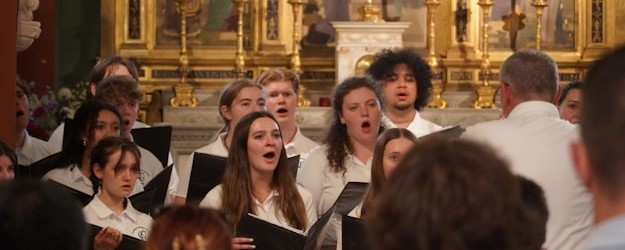
This failure has occurred not only in the classroom and the pulpit but in the choir loft (at least in those few churches that still have choir lofts). For the past five to six decades, almost anything and everything under the sun has been allowed to be sung within the Catholic Liturgy. The Liturgy, in many places, became a venue for performance and individual expression instead of the worship of Almighty God in spirit and truth. There have been few standards applied, and in some places, none. This paper does not seek to address musical styles (although the Church’s Magisterium has spoken to that 2), but the problem of lyrics, particularly with many so-called “Communion Hymns.” In spite of Vatican II decreeing that “The texts intended to be sung must always be in conformity with Catholic doctrine” (Sacrosanctum Concilium, 121), I still hear “hymns” whose lyrics express deficient and, in some cases, outright heretical descriptions of the Most Holy Eucharist. What good does it do to preach the truth from the pulpit, if that truth is then contradicted in the sung word?
It is, sadly, quite common for practicing Catholics, even in Catholic-rich Southern Louisiana, to casually refer to the Body, Blood, Soul, and Divinity of the Lord Jesus Christ as “the bread” or “the wine.” For the past nine years of my priesthood, I have been in parish assignments where the Precious Blood is not distributed to the laity from the chalice. If I had a dollar for every time that someone asked me, “Father, when are we going to start drinking the wine at Mass again?” I could have built a new church. My immediate gut reaction is something like “THAT is why! Because you think it’s wine.” If we pastors and bishops are honest with ourselves, how can we honestly blame these poor souls? They hear the Eucharist referred to in such language weekly in songs sung with at least the implied permission of the pastor. When pastors do try to address the matter with the music coordinator, they don’t have a leg to stand on because these deficient hymns are in Catholic publications that are “published with Ecclesiastical Approbation.” This is a failure that goes all the way to the top.
There has been some attempt at a course correction by the bishops, particularly in the United States, with the publication of a document by the United States Conference of Catholic Bishops Committee on Doctrine in 2020, entitled “Catholic Hymnody at the Service of the Church: An Aid for Evaluating Hymn Lyrics.” I have, however, only heard of one diocese attempting to implement this document and it did not go so well. After a media storm, the Bishop backtracked. I am not surprised. I hate to generalize, but any pastor will tell you that one of the most difficult areas of parish life to shepherd can often be music ministry. It is a field where things can be taken quite personally. It has not helped that for the last fifty years, music ministry has been given much autonomy but not much direction.
Some might ask, “Is this really such a problem?” I answer yes. The truth matters. The words which we speak matter, most especially the words which we speak in our worship of Truth Himself. Lex orandi lex credendi — the law of prayer is the law of belief. The Church loses her credibility when the words that she prays are inconsistent, and sometimes even contradictory, to the faith she professes to believe. The result is parishioners asking when they will get to drink the “wine” again.
The USCCB’s document addressed several categories of deficient hymns. I would like to point out the section on “Deficiencies in the Presentation of Eucharistic Doctrine,” which it says are “by far the most common and the most serious.”3 The document explains that Catholics nurtured on a steady diet of deficient Eucharistic hymns will learn that at Mass is shared bread and wine, even special bread and wine, but not the Body, Blood, Soul, and Divinity of Jesus Christ. The document states:
“Eucharistic doctrine has developed, and depends upon, a high degree of precision of language. For example, Christ is not present ‘in’ bread and wine, but rather the substance of bread and wine ceases to exist as such and Christ is substantially present under the appearance of bread and wine. Hymn lyrics do not have to reproduce technical language, but they should be guided by the customary usage of Scripture and liturgical Tradition. This would mean: language that implies that the elements are still bread and wine after consecration should be avoided; language that implies the bread and wine, still bread and wine, are merely symbols of another reality or person, should be avoided.”
The document goes on to explain that when it comes to the word “bread” in reference to the Eucharist, it should always be used in a way consistent with Sacred Scripture, such as “Bread of Life,” “Bread of Angels,” “Bread Come Down from Heaven.” When it comes to the word “wine,” however, Sacred Scripture never uses that word to describe the Eucharistic elements post-consecration. It always uses “chalice” or “cup,” but never “wine.” The Church, in her Magisterial teachings, has followed the same pattern.
The document then gives several examples of commonly used hymns that are problematic in this regard. They are: “God is Here! As We His People,” “Now in This Banquet,” “All Are Welcome,” and “Let Us Break Bread Together on Our Knees.” These are just examples. It is not meant to be a comprehensive list.
Using the USCCB’s criteria, I will attempt to expand on that list of deficient “Eucharistic” hymns which 1) say or imply that the Eucharist is merely symbol, 2) that it is bread and wine, or 3) the Lutheran belief of consubstantiation — that the Body and Blood exist alongside the bread and wine. What is sung in many Catholic parishes today is not Catholic belief, but Lutheran.
Since several of the hymns I will list express consubstantiation instead of transubstantiation, it would be helpful to clarify what this means. I will allow the late Benedict XVI to explain.
“While the Catholic Church together with the Orthodox Churches teaches the transubstantiation (metousiosis) of bread and wine, Luther rejects this metaphysical formula and affirms consubstantiation instead. In other words: while for Catholics a transformation of the offerings occur, as a result of which they are no longer bread and wine but the Body and Blood of Jesus Christ, for Luther there is no transformation. He insists on the unquestionably real impression that they continue to be bread and wine and are tasted by us as such. But together with the bread and wine (‘in, with, and under’ the offerings) the Lord becomes present, his Body and his Blood. The offerings are not transformed, but to them is added the presence of the Lord.”4
Benedict goes on to explain that belief in transubstantiation or consubstantiation has consequences for the whole of the Christian life.
“Corresponding to the idea that the celebration of the Supper involves no transformation — but that the Body and Blood of Christ, like any other things, are added to the bread and wine — is a concept of the essence of Christian life that certainly constitutes the most profound difference between the Protestant interpretation of being Christian and the tradition of the Catholic faith. It is expressed in the formula simul iustus et peccator [at the same time just and a sinner]: becoming a Christian does not change man but only adds something else to him.
“In the term ‘transubstantiation, the whole emphasis is on the ‘trans’: in the Eucharist a transformation occurs, a transformation that goes to the very depths of being, just as becoming Christian requires of a human person a fundamental change of his being, precisely a conversio.”5
Here now is the list of additional hymns that are found in Catholic hymnals but that, according to the USCCB’s criteria, do not adequately express the Catholic Faith, or in some cases even contradict it.
- Gather Us In. Apart from the fact that this could hardly be considered a hymn of worship as it has us as the only focus and not God, the third verse reads, “Here we will take the wine and the water, here we will take the bread of new birth . . . Give us to drink the wine of compassion, Give us to eat the bread that is you.”
The use of the term “wine” in this way is inconsistent with Scripture and Tradition.
- Bread of Life (Farrell). The fifth verse says, “You are the bread of peace, you are the wine of joy.”
- Bread for the World (Farrell) The refrain reads, “Bread for the world: a world of hunger. Wine for all people: people who thirst.”
Here there is no attempt at consubstantiation or even of symbol. It’s simply bread and wine. No body. No blood.
- One Love Released (Bob Frenzel and Kevin Keil) The first verse reads, “Is not this bread we share, the body of our Lord? Is not the wine we drink, the blood of Christ outpoured?”
This is a clear case of Luther’s consubstantiation. It says that we are drinking wine AND blood.
- The Supper of the Lord (older version). An older version of the refrain is another clear case of consubstantiation, “Precious Body, Precious Blood, here IN bread and wine.” Thankfully, there is a revised version of the refrain which adequately expresses the ACCIDENTS of bread and wine. It reads “Precious Body, Precious Blood, SEEN as bread and wine.”
- The Feast Meant for Everyone (Booth & Hart). The problem lies in the title itself. The Eucharist is not a symbol of hospitality. Holy Communion is not a come one, come all event.
- What Feast of Love (Delores Dufner) “What wine of love is offered here, what crimson drink from heaven . . . the sweetest wine of heaven.”
- In Remembrance of Me (Ragan Courtney) The first words of this hymn are “In remembrance of me, eat this bread. In remembrance of me, drink this wine.” This is simply not Catholic. Yet I have heard it at First Communions, Holy Thursday, and Confirmations. Later the song does get it right, but the damage is already done. In a later verse, it reads in the first person, “Take, eat, and be comforted; drink and remember too, that this is my body and precious blood shed for you.” So, which is it? Is it bread? Is it wine? Is it body or blood? This author clearly thinks it’s both (consubstantiation). Upon a simple google search, I discovered that the author is Baptist and teaches at Baptist seminaries. Why are we singing a hymn on the Eucharist written by a Baptist that expresses a Baptist view of the Lord’s Supper at a Catholic Mass?6
- It’s More Than Wine and Bread (Vince Nims). The title says it all. This is another clear case of consubstantiation instead of transubstantiation. It should say, “It is not wine. It is not bread.” This song says that it remains wine and bread, and the Body and Blood are added.
- To Be Your Bread (David Haas). “To be your bread now, be your wine . . . Give us the bread and wine.”
- Bread of Life (Rory Cooney). “You and I are the bread of life . . . this is our body, this is our blood.” I don’t even know how to respond to that.
It should not mystify us that the supermajority of Catholics do not believe what the Church teaches about the Most Holy Eucharist, because in many places the Church simply hasn’t been teaching it. We’ve been teaching this stuff instead. We have nobody to blame but ourselves. Will we learn from our mistakes or keep repeating the same sad statistics generation after generation?
- Robert Barron, Light from Light: A Theological Reflection on the Nicene Creed (Park Ridge, IL: Word on Fire Academic, 2021), xii. ↩
- See Sancrosanctum Concilium 112–121. ↩
- United States Conference of Catholic Bishops Committee on Doctrine, “Catholic Hymnody at the Service of the Church: An Aid for Evaluating Hymn Lyrics,” September 2020. ↩
- Benedict XVI, What Is Christianity? The Last Writings (San Francisco, CA: Ignatius Press, 2023), 166. ↩
- Benedict XVI, What Is Christianity? 166–67. ↩
- Being written by a non-Catholic does not, per se, exclude a hymn from Catholic use. Most of our classic Christmas carols are written by Protestants, but Protestants who held the same belief in the Incarnation. Protestants and Catholics do not share the same belief when it comes to the Eucharist. ↩
 About Fr. Matthew Cormier
Amazing how few songs in “Glory and Praise” songbook, mention God.
Thank you Father Cormier. I’ve learned so much from you. Love and prayers.
I am blessed to have read this. Although I believe every word that you have written, it is difficult to express these beliefs to anyone without clear and concise language and explanations. As a catechist, I need to read and hear this repeatedly. Without it, I am afraid that in trying to explain, I would inadvertently “dumb” down our beliefs in transubstantiation. It is much easier to explain transubstantiation when contrasting it to consubstantiation or other beliefs. This has given us a unique clarity and defense of which I have never read until today.
Thank you for this article! It would be better if no hymns were sung during Communion than the banal, deficient ones that are so often used. Singing distracts from quietly worshipping Christ before and after receiving Communion. I say do away with it. Perhaps fewer people would leave right after receiving Communion if this were the case.
Most American Lutherans would reject “consubstantiation” as a description of their theology. Instead, they tend to prefer to speak of “sacramental union” of the body and blood of Christ with the bread and wine of the Eucharist. Also, I wonder how many people really know what “consubstantial” means. It is present in the current text of the Nicene Creed, wherein Jesus is referred to as “consubstantial with the Father.”