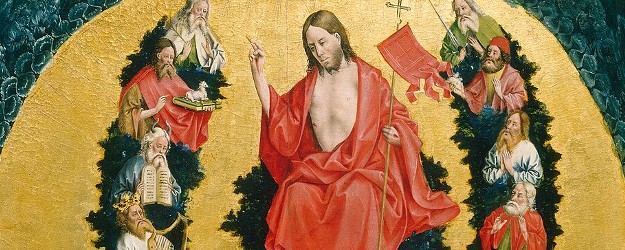
For the Fifth Sunday, Sixth Sunday, and Seventh Sunday of Easter, the Solemnity of the Ascension, Pentecost Sunday, and the Solemnity of the Most Holy Trinity
Fifth Sunday of Easter – May 3, 2026
Readings: Acts 6:1–7 • Psalm 33:1–2, 4–5, 18–19 • 1 Peter 2:4–9 • John 14:1–12
bible.usccb.org/bible/readings/050326.cfm
“Love’s longing is the preparation of the dwelling” (Augustine, Homilies on John 68.3). Saint Augustine speaks these words to his congregation sixteen hundred years ago about the very same Gospel we have just heard. Our Lord Jesus speaks to his apostles at the Last Supper about his moving on: “I am going to prepare a place for you,” he says. No one likes departures. Jesus knows this about us because he has made us and so he says, “Do not let your hearts be troubled . . . I will come back again and take you to myself, so that where I am you also may be.” Thomas wants assurances. He wants to know the way for himself, lest he be forgotten. He says, “Master, we do not know where you are going; how can we know the way?” Jesus responds, “I am the way and the truth and the life.” Philip accepts this assurance and wants to use it as a shortcut, saying, “Show us the Father.” Jesus will allow no shortcut. He knows what he is creating within his apostles because he has first made them. Christ Jesus is generating love. He is stirring great love into the hearts of his apostles by making them yearn for the place he is going and for his return from that place, so they may be with their friend and Lord forever. “Love’s longing is the preparation of the dwelling,” Augustine says.
This is not the first time God has stirred up love in His creatures by means of longing. He does it for His very first humans. God makes the first man and says it is not good for him to be alone. God has blessed everything else He has made — light and dark, sea and land, plants and animals, sun and moon — and called them good. Not so the man alone. “It is not good for the man to be alone,” God says, and proceeds to make everything for the man except what will be a suitable partner (Gen 2:18–20). God presents to the first man all kinds of animals. The man names them. He becomes a scientist, the first zoologist. He is exercising dominion over creation with his mind. This is not enough. None of the creatures prove to be a suitable partner. God knows they will not be. He makes the man feel this. God generates great longing in the man by showing him everything that will not satisfy him. And who knows how long it takes to name all the animals — a day, a year, a century? Long enough that when God does draw the woman from the man’s wounded side, the man can say, with authentic love, a love nurtured by longing, “This one at last.” He clings to her, the two become one flesh, and they rest in the place God has made for them — each other’s arms. Love’s longing prepares the dwelling.
What God does for the first man and woman, He does for Christ and his Church. He draws the Church from the wounded side of his Christ, whom physical death has put into a deep sleep upon the cross. This time, the Church as bride yearns for her groom. She remains while he goes to prepare a place for his disciples. She does not remain static, though, fixed in place. Just like the first man names all the animals God brings to him, the Church brings the name of Jesus Christ to every corner of the earth. The children of Adam and Eve gain names for themselves in heaven, in the heavenly mansions Jesus is preparing for them, when they are baptized. The whole Church yearns for the return of Christ and she lives out this yearning by performing his works of love across the world.
The works of love, the works of the Church’s yearning for her groom’s return in glory, themselves generate more yearning. Philip wants a shortcut but Jesus tells him, “Amen, amen, I say to you, whoever believes in me will do the works that I do, and will do greater ones than these, because I am going to the Father.” The saints have done this. They have healed the sick and raised the dead. They have fed the poor and visited the lonely. They have brought the good news of salvation and built a universal Church. They have given all those whom they have touched the desire to know the Christ who works through them. All want to know Jesus. We want our world to be a suitable partner for his kingdom. He holds off so that every generation may learn, in its own way, that only Christ himself can satisfy us. By his delay, he is bringing our desire to perfection, so that when he does come again, we will want nothing but him. “Our hearts are restless until they rest in you,” Augustine says to God.
What about those of us who die before his return can satisfy us? That is everyone, so far. We can easily say that heaven will satisfy us. This is true but we await the resurrection of the dead. Jesus is coming again to bring us to where he lives. He who remains fully God and fully man — spirit, soul, and body — is coming to transform all that we are — spirit, soul, and body — into what he is. Our own aches and pains are often enough to make us long for the holy sleep of death, but the saints are eager to suffer more, indeed to let God break open their bodies in martyrdom, the way He once opens the side of Adam, the way He once pierces the side of Christ, to make their longed-for conjugal embrace of their spiritual spouse. The longing for Christ generates love enough to die for him. The death of the martyrs has been perhaps the greatest work in making God the Father known, because life has poured out through those saints. If there is a shortcut, here it is. Saint Philip finds it in his lifetime and dies a martyr’s death. That is also the way Saint Thomas himself will take, in India. The many saints who are not martyred nevertheless live like martyrs, breaking themselves open while they feed the hungry, instruct the ignorant, visit those in prison, admonish the sinner, and pray for the living and the dead. We will never meet a saint who is satisfied with their place in this world or with their spiritual advancement before God. They continue to let love’s longing build a mansion for them in their true home, where Christ is, from which he is coming again to take us all to himself.
Sixth Sunday of Easter – May 10, 2026
bible.usccb.org/bible/readings/051026.cfm
Six Sundays into the Easter season, we are still preparing for Pentecost, for our annual celebration of the gift of the Holy Spirit. Easter is longer than Lent. We spend forty days fasting in preparation for Christ’s passion, death, and resurrection. We spend fifty days in celebration. God’s joy will always outdo the sorrows we experience. Our long Easter season is not just a time to represent the joys of eternity, though. It is time for us to take in the reality of the resurrection. We keep hearing from the Last Supper discourse because there is much to take in. The resurrection itself is not a simple fact, a one-off event for which we keep partying. By his rising from the dead, Jesus brings our human nature to perfection. This takes time for us to assimilate. The Holy Spirit is our help. He helps us assimilate this radical new state of affairs. “He remains in you,” Jesus says, “and will be in you.” Jesus breathes the Holy Spirit into his disciples that first Easter evening. He sends the Holy Spirit as fire upon the apostles on Pentecost. He continues to confirm and enrich our understanding of the word we receive in every sacrament, in our prayer, and even in our keeping the commandments. Jesus tells his disciples he will not leave them orphans, and in the same breath with which he promises the Paraclete, he exhorts his disciples to keep the commandments. Keeping the commandments is an act of love on our part. Keeping the commandments seals the presence of the Father, Son, and Holy Spirit in our hearts.
When Jesus tells us he is not leaving us orphans, that he is coming back to us, that he is leaving his Spirit with us, we should understand this is not just about our relationship with him, but about our relationship with the world as well. Our faith in Christ, our hope in the resurrection, the love we show by keeping the commandments and doing the works of mercy, these alienate us from the world that cannot accept Christ or the Holy Spirit. Jesus tells his apostles that the world cannot accept the Spirit of truth because it neither sees nor knows the Holy Spirit. Jesus goes on to say, “In a little while the world will no longer see me, but you will see me, because I live and you will live.” In other words, Jesus is leaving and is taking us with him. We live already in heaven, in some way. We are in the Father just as the Son of God is. This reality, this resurrection reality, this Easter joy, is already ours. Remember when Jesus tells Martha, “I am the resurrection and the life.” The resurrection of Lazarus reveals eternal life already present in the person of Christ Jesus. We who spend so much of our year celebrating Easter do so to reveal to the world that we already have a share in the resurrection. We are orphaned before the world, not God. The world has disinherited us. This emancipation makes us free to live as the Spirit leads, to proclaim the Gospel as the Paraclete guides, to keep the commandments as Christ instructs. We live already in God and as help to assimilate this word, Christ gives himself to us in the Eucharist.
The deep-rooted, long-lasting truths Christ speaks at the Last Supper take time to become the way we think about ourselves and our place before God and the world. Not as orphans does Christ leave us, because he remains in his Eucharist. When we come to receive him in Holy Communion, we hear his words again. Our coming here weekly and even daily, during the Easter season and all throughout the year, make the Eucharist an active enzyme for digesting the difficult words we hear. We are orphans before this world but not before God. We have to live and work alongside those who do not know Christ or the Holy Spirit and remember that God has not left us alone. We live already in heaven but have not yet entered into the Beatific Vision. Our work in this world is to keep the commandments and perform the works of mercy as evidence of the love God has placed within us, His love as a token of the great inheritance that is ours. We are, as Saint Peter says, to “sanctify Christ as Lord in [our] hearts,” always ready to give an explanation for our hope, keeping our conscience clear and maintaining good conduct against the times of trial that inevitably come upon those whom the world cannot recognize. The world does not recognize us because we belong to Christ and the Holy Spirit. Let’s linger in our Easter joy a little longer, confident that though orphaned before the world we live already in possession of our hope, life with God the Father, God the Son, and God the Holy Spirit.
Solemnity of the Ascension – May 14, 2026
Readings: Acts 1:1–11 • Psalm 47:2–3, 6–7, 8–9 • Ephesians 1:17–23 • Matthew 28:16–20
bible.usccb.org/bible/readings/051426-Ascension
On Easter Sunday morning, before the first glorious Mass, before the sung alleluias and pastel dresses, before the sprinkling rite and the baskets of chocolate waiting for me in the rectory, I sat down for some coffee and put on YouTube, where the algorithm, knowing what day it was but not perhaps what joyous emotions I should be feeling, sent me a video of a skeptic. The skeptic was a well-known biblical scholar, a famous doubter of the New Testament’s claims to portray authentically the earliest days of Christianity. I thought I should not watch it, lest I spoil the mood. But the skeptic was sitting down with a non-skeptic, a high-level journalist who wears his Christianity outwardly and unashamedly. So, why not? With some urging by the Holy Spirit, I wanted to see how the conversation went.
The conversation turned on the question of doubt. The skeptic related how even the Gospels and the Acts of the Apostles record the doubt Jesus’s disciples experience after his resurrection from the dead. We hear it ourselves, today: “The eleven disciples went to Galilee, to the mountain to which Jesus had ordered them. When they saw him, they worshiped, but they doubted.” There it is. Matthew records it. For a Gospel meant to convince the world of Jesus Christ, that he is true God and true man raised from the dead, it might not seem prudent to put in the part about his own disciples’ doubt. Mark’s Gospel, too, ends with a series of short episodes in which the disciples doubt Jesus’s resurrection. Doubt is not the last word, though.
The last word on Jesus’s resurrection is not doubt. It is not a philosophical argument about perception, either. Jesus does offer his disciples many proofs, tangible proofs, that he is truly risen, as the Acts of the Apostles records for us. He eats with his disciples. He invites doubting Thomas to put his finger into his wounds. Thomas responds with a great acclamation of faith, “My Lord and my God!” This is not the last word, either. Jesus does not demonstrate the truth of the resurrection as a simple fact, take it or leave it. Before he ascends into heaven, before he takes earthly leave of his disciples, he sends them on mission: “Go, therefore, and make disciples of all nations, baptizing them in the name of the Father, and of the Son, and of the Holy Spirit, teaching them to observe all that I have commanded you. And behold, I am with you always, until the end of the age.”
The resurrection is not a simple fact but a lived reality. In fact, the last word on the resurrection has not yet been spoken. Jesus, the Son of God, will speak that last word when he raises us all from the dead, when we who have lived out his mandate to make disciples of all nations wake up to eternal life. Or, perhaps more accurately, since Jesus is the Word of God, the last word will be spoken by God the Father, when he seals all reality in Christ, when the heavenly Jerusalem descends and Christ takes his bride, the Church, to himself forever.
In the YouTube conversation I watched Easter morning, the non-skeptic countered the skeptic’s claims with some common sense. If a deceased loved one appeared to any of us the way Jesus does to his disciples, would we not doubt? We know what death is. We know what death does. Those who appear to us from beyond the grave come in ephemeral, passing form. This has happened in my family, as it has happened in many families, where a loved one might speak a quick word of consolation to those of us left behind. We are often sure of this experience, but not always. It does not matter, not really. Such an appearance does not make the person any less dead. They are making no claim to be alive in both body and soul. It is a reassurance we do not, strictly speaking, need. We do need the truth of the resurrection. Jesus eats with disciples after the resurrection. He walks about with them the way he did before he died on the cross. One should doubt that, naturally. We are possessed of reason and reason is good. One should hold his intellect above the potential deception of his senses. This is how we survive in a world of dark forests, desert mirages, and demonic trickery. Jesus spends forty days with his disciples after his resurrection in order to give their minds time to assimilate what their senses are telling them. He makes them feel the reality of the resurrection, at every meal, in every shared conversation, and in the repeated promise Jesus makes of the gift of the Holy Spirit.
The event of the resurrection is not over. In the Acts of the Apostles, Jesus says to those gathered for his Ascension, “You will receive power when the Holy Spirit comes upon you, and you will be my witnesses in Jerusalem, throughout Judea and Samaria and to the ends of the earth.” This follows very closely on what Jesus has said about himself at the end of Matthew’s Gospel: “All power in heaven and on earth has been given to me. Go, therefore, and make disciples of all nations.” The power that has raised Jesus from the dead, the power by which the one who is true God and true man lives in perfect unity of divine spirit and human flesh, that same power belongs to those who believe in Christ, who receive the Holy Spirit, who, themselves, will rise from the dead when God speaks his last word.
Doubt, in the meantime, is met with work. We do the work of making Christ Jesus known as risen from the dead and the more we do this work, the more we feel his resurrection power, the grace of God, at work in us. Faith does more than receive a fact. Faith moves mountains and faith in the resurrection of Jesus carries the mountain of humanity upward, from its slumping acceptance of life and death in a fallen world into the celestial Church. Faith is a lifetime’s work and the apostles of Jesus do this work over their lifetime. Matthew and Mark can confidently include notes about the disciples’ doubt because those same disciples are at work decades later, proclaiming the Gospel, performing the works of mercy, and offering their bodies in living sacrifice, certain, without a doubt, that they will rise with Christ Jesus on the last day.
Seventh Sunday of Easter – May 17, 2026
bible.usccb.org/bible/readings/051726-Sunday
What feels most like home? Is it Mom’s cooking, or sitting with Dad on the porch? I have a large extended family, and once or twice a year as many as could of my aunts and uncles and cousins would come together at my grandfather’s house. I often felt the most at home there, watching my father and my uncles share their theories of the world, listening to stories my aunts would tell of when everyone were kids themselves, when my cousins and I made up our own world to inhabit for a week. There were meals, great meals, and a greater sense of family holding my adolescent soul together when things in my immediate family were not going so great.At the Last Supper, Jesus provides a meal, the greatest meal, for his friends. He feeds them with himself. This is the Passover meal, when Jews remember they belong to one very large extended family, the children of Jacob-Israel, the grandchildren of Abraham and Sarah. The family has been through a lot, including a narrow escape from the Egyptians. The hand of death had touched every family except theirs and they had passed through the Red Sea. Jesus’s disciples come together to remember the event that has made the Jewish people what it is. Amid this celebration, with all the warmth of memory and tradition, Jesus does something new. He does something new that should make every one of his disciples feel at home, the way I once did with my aunts and uncles and grandparents: Jesus speaks with his Father.
Our Lord Jesus does more than make his disciples feel at home in God’s presence — he is making a true home for them in the Blessed Trinity. He says to God the Father, “I revealed your name to those whom you gave me out of the world. They belonged to you, and you gave them to me, and they have kept your word. Now they know that everything you gave me is from you.” Jesus reveals the family secrets. He tells the eternal tale. The disciples surrounding him him are God’s children, a gift from Father to Son. The Son is giving them back to the Father, formed for a life of faith. The Holy Spirit will be their ongoing companion and ours, the Church’s help to reach the home Jesus is displaying before the apostles, in the sounds of which home already ring nostalgic in the ears of those at the Last Supper, in the words of Jesus’s High Priestly Prayer. This is what our true home sounds like: “I pray for them. I do not pray for the world but for the ones you have given me, because they are yours, and everything of mine is yours and everything of yours is mine, and I have been glorified in them.” This is the conversation Jesus chooses to have before he gives up his life for them, to make them know they always have a home in God: “And now I will no longer be in the world, but they are in the world, while I am coming to you . . . Now glorify me, Father, with you, with the glory that I had with you before the world began.”
It’s with the confidence we have in a warm and stable home that we venture our way outward in this world, and this is no less true than when we keep confidence in the heaven that awaits us. The apostles leave the Last Supper unsure of Jesus’s words until Pentecost, when the Holy Spirit makes them remember all that Jesus has done among them in light of the eternal home that await them. The Last Supper becomes more than a dim memory, it becomes the institution of the Eucharist, the place where God forms us into a family around a meal, just like He has done for the Jews before us. We hear the old family tales when we read the Scriptures. Father tells his view of the world from the pulpit and we sing the old hymns together. We do as the early Church has done: “All these devoted themselves with one accord to prayer, together with some women, and Mary the mother of Jesus, and his brothers.”
With this confidence we gain here, at the warmth of the Eucharistic table, we venture into the world again. We take Saint Peter’s words to heart: “Rejoice to the extent that you share in the sufferings of Christ, so that when his glory is revealed you may also rejoice exultantly.” We venture faith and risk the works of mercy knowing that should we be bullied for this out there, we have a home with our strong Christ, who has endured all this first and lived, who has risen from the dead.
When we grow up in a home of people who have matched success with warmth and encouragement, we want to emulate those people. Being close to our parents and aunts and uncles makes it easier to work hard and take the risk of investing our time and talent in a life, since we know we can also count on them for advice. This is our life with the saints. This is our life in Christ. They have each of them ventured forth and conquered the world for the Church, all of them at the risk of their life, many of them passing through martyrdom into heavenly glory. Contrariwise, if we do not try to replicate the success of an earlier generation, we begin to feel not at home at the reunion table. Christ does call each generation to follow him, to imitate his ways, to take up our cross daily. Heeding this call makes us worthy of the Eucharistic meal. The Last Supper is the first encouragement for a generation of disciples who will watch their Lord die, who yet hear him speak deep family secrets to God the Father. It becomes our ongoing memory of the event that makes us a family in the Trinity. It is our strength to venture forth and proclaim the Gospel. Let’s leave here and do so, in such a way as to win our return here, and to merit a glorious entry to our eternal home.
Pentecost Sunday – May 24, 2026
bible.usccb.org/bible/readings/052426-Day
It is Pentecost, so we should talk about the weird way in which we give gifts at Christmas. It is always appropriate to talk about Christmas. It is late May, not even “Christmas in July,” and the reality is that everything we do now refers to the Incarnation of Christ. Jesus is God’s gift to us. The Magi, in response to such a gift, step forward, ahead of us, in our stead, and give gifts to God’s gift in return — gold, frankincense, and myrrh. We imitate this by putting wrapped presents under a tree. We love it. We make a list of the things we want and we have no reason to expect our parents to exercise capricious cruelty by denying us the things we want and yet we remain overjoyed when we get the very things we ask for. Something special, something perhaps even spiritual, comes with the gift. For this reason, ancient societies, especially those of the American Indians, are built on mutual gift giving. It builds trust. Visiting dignitaries bring gifts to popes, presidents, and parish priests every day and who knows where they put them all. In their heart, of course. Gift giving is so often an expected part of our life, and yet we act like the world has unfolded for us every time we receive tokens of esteem and affection. In a way, it has. Every gift is a token of love, a sacramental of love, even if just natural love. This works even when practiced falsely, in the form of bribery, because we are made to receive gifts as things which build bonds of unity.The Holy Spirit is often called by the name Gift. The Holy Spirit is the gift of Father and Son to the Church. Jesus has promised this gift repeatedly to his apostles, especially at the Last Supper. He also gives the Holy Spirit repeatedly: on the first Easter Sunday, again fifty days later, at Pentecost, and in every sacrament. Each time, the Church receives the gift of the Holy Spirit as a kiss of divine love. The Church fully expects to receive the Holy Spirit in these first instances and in every sacrament and that expectation does nothing to dampen our affection for the giver. Or, it should not. Children can be bad receivers of gifts, bratty or unappreciative, and so can Christian adults. Saint Thomas is, at first, unappreciative. He is not present when Christ first appears and gives the Holy Spirit for the forgiveness of sins. He wants to have been there, to receive directly from the mouth of Christ the Breath of new creation. The gift of the Holy Spirit is not a one-time offer, though, and indeed the nature of this gift is that it keeps on giving. The apostles come into possession of the Holy Spirit for the forgiveness of sins so that they can give this gift of forgiveness to each other. Fifty days before Christ endows the universal Church with the special gifts of tongues and prophecy, he gives as of first importance the Gift we need to exercise the chief thing he commands of us, to forgive those who trespass against us. He gives the Holy Spirit for the forgiveness of sins. Pentecost is possible only for a Church already united in mutual forgiveness, of a Church at peace. “Peace be with you,” says Christ when he first gives the Holy Spirit. The kiss of mutual love, of God’s peace, from the apostles to us at this altar, comes before the special gifts waiting for us under the tree of the Cross.
We want those particular gifts. We want to feel God’s special power working through us. Tongues, prophecy, teaching, administration — Saint Paul acknowledges all these at work in the Church and says that, whatever the particular gifts God has given us, they flow from and return the same one source. He says, “There are different kinds of spiritual gifts but the same Spirit; there are different forms of service but the same Lord; there are different workings but the same God who produces all of them in everyone.” They serve the one God and the one Church. They all manifest the manifold power of the Body of Christ. Indeed, in the one Holy Spirit are we baptized into one body. The greatest gift God gives to us is unity, because that is how God is in Himself.
We make a Christmas list and are overjoyed when we receive what we want. This Pentecost, let’s make a list of things we want from God. Let’s make it Christmas in May. Let’s put at the top of the list the things God wants to give us: peace at home and abroad, forgiveness, knowledge of Christ, effective works of mercy, joy, hospitality, charity, and chastity to replace our greed and lust, a world in which all Christian virtue flourishes, a place safe for our children and our elderly. Christ gives us the Holy Spirit in every sacrament we receive. Let us extend the kiss of divine peace to our neighbor, and watch God give us the world we want.
Solemnity of the Most Holy Trinity – May 31, 2026
bible.usccb.org/bible/readings/053126.cfm
“Life is a journey, not a destination.” This quotation from the Transcendentalist philosopher Ralph Waldo Emerson has probably graced at least one picture in every high school yearbook for the past sixty years. The irony is that we most often like to quote it in a book that most certainly records life as a series of graded steps toward a destination. High school defines a destination for us, and holds up with its diploma the promise of a future. We learn from our adolescence to shape our lives for the rewards of hard work, to earn a place in this world, to find the finish line in top form.Our Christian life is in many ways similar. We have a goal we call heaven. Baptism and Confirmation are our launching point. The Eucharist sustains us as food for the journey. Confession corrects course. Marriage and Holy Orders arrange our particular journey in a special way and we get a last-minute boost from the Anointing of the Sick, but the goal is the same for man and woman, clergy and laity: eternal life with God.Trinity Sunday is a celebration of our destination. Between Lent and the Easter season, we have spent a third of our year preparing for and celebrating the passion, death, and resurrection of Jesus, and of the gift of the Holy Spirit to the Church on earth. Trinity Sunday, as the first Sunday outside the Easter season, shows us our unearthly goal. We are to live with God — Father, Son, and Holy Spirit — forever. That is life’s destination.That said, we have to recognize God with us all throughout our journey to Him. Moses encounters God in a burning bush on Mount Sinai and God tells him he will return to that very mountain with his chosen people in tow. God, in a pillar of cloud and fire, leads the people on their freedom road out of Egypt. With Mount Sinai ablaze with the presence of God, Moses says, “If I find favor with you, O Lord, do come along in our company.” God has been in their company but the people have sinned. God has already told Moses, “You have seen how I treated the Egyptians and how I bore you up on eagles’ wings and brought you to myself” (Exod 19:4). We today know that we must keep the commandments to get to heaven, and we do not always know that the list of the ten commandments comes to us with a prologue in which God reminds us that He is already with us. The first commandment reads, “I am the LORD your God, who brought you out of the land of Egypt, out of the house of slavery. You shall not have other gods beside me” (Exod 20:2–3). God commands us to do nothing He is not already helping us to achieve by His presence and His grace. He goes before and behind His people in a column of smoke and fire. He clears the way for David to take his throne. He makes a way in the spiritual desert of our souls by the words of His prophets, so that we may receive his Christ in faith. That very same Jesus Christ, God’s own Son, God-with-Us, walks with and ahead of us to open the gates of heaven by his passion, death, resurrection, and ascension. He commands us to follow him, to take up our cross daily and follow him. He sends the Holy Spirit upon us to live in us, to dwell within us, to make us God’s temple on earth. Life before the face of God may be our destination — the Beatific Vision is indeed life’s goal — yet we should see life’s journey with God as already wrapped up in that final, happy state of affairs.God is with us, but that does not make the journey a leisurely one. The Transcendentalists portray everyone as basically good and at their best when left to their own devices. Moses, who deals with the constant bickering of the people, knows better. When he sings his victory song to God after escaping the Egyptians, he says, “The Lord is a warrior; Lord is his name” (Exod 15:3). David the psalmist, taking his cue from this very same song, says, “God, when you went forth before your people, when you marched through the desert, the earth quaked, the heavens poured, before God, the One of Sinai, before God, the God of Israel” (Ps 68:8–9). God is with us to protect us from our spiritual enemies as well as to form us for life with Himself. The journey of this life is one of spiritual warfare, of movement from slavery to sin to freedom for spirit, soul, emotions, and body. God is with us because we need Him. Baptism passes us through the waters that wash away the sins that once cast us out of the garden and which form a wall between us and the empire of sin that Egypt symbolizes. The notion that we are all basically good is the old heresy of Pelagianism. Christ comes to us and the Holy Spirit dwells within us because our life’s journey is a dangerous desert road to the garden of life. When we walk with God, he forms us into the warrior that He is, the fighter He has shown his Messiah to be. If we are to join the ranks of the heavenly host, if we are to endure the brilliant face of God, our life must be a journey of spiritual preparation.What does a life’s journey look like in preparation for the Beatific Vision? We have several formulas for this throughout the Bible, and there is hardly a chapter of the apostles’ high school yearbook that does not describe the Christian’s life journey. Jesus himself gives us the Beatitudes. Paul expresses it in several ways, including what we hear today: “Mend your ways, encourage one another, agree with one another, live in peace, and the God of love and peace will be with you” (2 Cor 13:11). We could simply say: sacraments, prayer, and the works of mercy. The way we train to live forever with our awesome and all-powerful God is to live the way God does within Himself as a Trinity: complete obedience and loving self-surrender, seeking always the good of the other, making one’s life mission to glorify God. This is the way of Christ Jesus, whose earthly mission we have been following for a third of our year, through Lent and Easter. Jesus has given us the beatitudes, Paul has his formulas, and we could also wear as our own the breastplate of Saint Patrick, which amply describes a life’s journey in Christ:
Christ in the heart of every man who thinks of me,
Christ in the mouth of every man who speaks to me,
Christ in the eye of every man that sees me,
Christ in the ear of every man that hears me.
I bind to myself to-day,
The strong power of an invocation of the Trinity,
The faith of the Trinity in Unity
The Creator of the Elements. Amen.
 About Rev. Peter A. Heasley, S.Th.D.
I’m curious to know who these homilies are aimed at. In other words at the average parish or some other grouping?