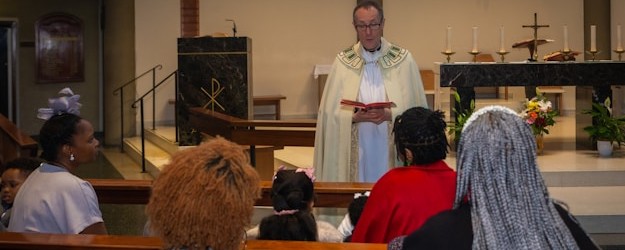
Homily vs. Sermon: Does the Difference Matter?
Question One: According to the liturgy of the Catholic Church, what is the difference between a homily and a sermon?
Answer: The distinction between a homily and a sermon in the Catholic Church may appear subtle, yet it carries significant theological and liturgical weight. While the terms are sometimes used interchangeably in popular speech, Catholic teaching and liturgical law carefully differentiate between them. At its core, the difference lies in the relationship to the liturgy: a homily is an integral part of the Mass or other sacramental celebrations, rooted in Scripture and delivered by an ordained minister, while a sermon is a broader form of religious instruction that may or may not occur within the liturgy. The development of this distinction can be traced from the early Church through the Middle Ages and the Council of Trent, and it was clarified definitively at the Second Vatican Council.
From its beginnings, Christian preaching after the proclamation of Scripture was understood as a homily. The word homilia comes from the Greek, meaning a conversation or exposition, and in the patristic era it referred to the explanation of the Word of God within the liturgy. Church Fathers such as St. Augustine and St. John Chrysostom are remembered for their homiliae, which were direct commentaries on biblical texts proclaimed in the assembly. Thus, in its original form, the homily was always biblical and liturgical in nature.
Over time, however, a second category of preaching developed. By the medieval period, a distinction could be observed between the homilia and the sermo. The homily remained closely tied to the biblical text, but the sermon became a broader category of preaching that could treat doctrinal, moral, or devotional themes. Sermons were often delivered not only during Mass but also at processions, popular devotions, or on special feasts. In the parish setting, a “sermon” on a catechetical subject, such as the Creed or the commandments, was often heard in place of a biblical homily.
The Council of Trent (1545–1563), responding to the Protestant Reformation, placed renewed emphasis on preaching and catechesis. It encouraged sermons at Mass and mandated that pastors instruct the faithful regularly, particularly in basic doctrine. Yet in this period, preaching at Mass was most often a sermon in the broader sense, not a homily in the ancient sense. It might or might not expound the Scripture readings of the day, and instead could focus on doctrinal or moral exhortation.
The decisive shift came with the Second Vatican Council (1962–1965). The Constitution on the Sacred Liturgy, Sacrosanctum Concilium, declared: “By means of the homily the mysteries of the faith and the guiding principles of the Christian life are expounded from the sacred text during the course of the liturgical year. The homily is to be highly esteemed as part of the liturgy itself” (§52). With this statement, the Council recovered the patristic sense of the homily as liturgical preaching that springs directly from Scripture and the celebration of the mysteries. This marked a deliberate move away from identifying the Sunday preaching at Mass as merely a “sermon” in the older catechetical sense.
Post-conciliar legislation cemented this understanding. The General Instruction of the Roman Missal (§65–66) describes the homily as an integral part of the liturgy, obligatory on Sundays and holy days, and reserved to bishops, priests, or deacons. The 1983 Code of Canon Law (can. 767 §1) goes further, declaring: “Among the forms of preaching, the homily is preeminent; it is part of the liturgy itself and is reserved to a priest or deacon.” In addition, modern papal teaching emphasizes its importance: Pope Paul VI in Evangelii Nuntiandi called the homily a privileged means of evangelization, while Pope Francis in Evangelii Gaudium described it as a “dialogue” between God and His people through the preacher’s exposition of the Word.
In light of this development, the contemporary Catholic distinction is clear. The homily is always liturgical, always tied to the Word of God proclaimed, and always delivered by an ordained minister within Mass or other sacramental celebrations. The sermon, on the other hand, is a broader form of preaching, which may be catechetical, doctrinal, or moral in nature, and which can occur inside or outside of liturgy. While sermons remain valuable, particularly in retreats, devotions, and missions, they do not have the same liturgical character as the homily.
Understanding Mass Intentions and Stipends
Question Two: What are Mass stipends? What does getting a Mass intention offered actually mean?
Answer: In the Catholic Church, every celebration of the Eucharist is offered for the glory of God and for the sanctification of the faithful. At the same time, the Church permits each Mass to be offered for a particular intention, which is a specific person or need brought before the Lord in the sacrifice of the altar. This practice reflects the belief that the Eucharist makes present the saving sacrifice of Christ on the Cross, and that uniting one’s prayer to the sacrifice of the Mass is the most powerful form of intercession available to the faithful (CCC §1362–§1367).
A Mass intention is the spiritual purpose for which the priest applies the fruits of the Mass. Such intentions may be for the repose of the soul of someone who has died, for the healing of the sick, for thanksgiving, or for a special grace or need. It is common for the faithful to request Masses on anniversaries of death or for particular occasions, entrusting their loved ones and their intentions to Christ’s sacrifice made present in the Eucharist. While each Mass has infinite value for the Church as a whole, the priest’s application of the Mass to a specific intention expresses the personal and communal character of Catholic prayer (CCC §1371).
Linked to the practice of Mass intentions is the custom of the Mass stipend. A stipend is a monetary offering given when a Mass is requested for a particular intention. It is important to note that this is not a payment for the Mass — sacraments cannot be bought, for this would be the sin of simony (cf. Acts 8:18–20; CIC can. 947). Instead, the stipend is a free-will offering that symbolizes the personal sacrifice of the faithful, joining their gift to the self-offering of Christ, while also providing for the material support of the priest and the life of the Church (CCC §1383).
The practice of Mass stipends has a long history in the life of the Church, particularly in times when priests did not receive a regular salary and relied on such offerings for their sustenance. Today, stipends are regulated by canon law to ensure proper use. Canon 945 affirms the custom, stating that priests are permitted to accept an offering to apply the Mass for a specific intention (CIC can. 945 §1). Canon 948 requires that each stipend received correspond to a separate Mass (CIC can. 948). Canon 952 further specifies that bishops’ conferences are to determine the amount of the offering to be accepted for the celebration and application of a Mass, though the faithful remain free to give more or less according to their ability (CIC can. 952 §1). These safeguards ensure that the practice remains ordered toward prayer and sacrifice, not commerce.
In practice, then, the distinction is clear. The Mass intention is the spiritual reality, the purpose for which the Eucharist is offered. The Mass stipend is the customary material offering that accompanies such a request. Even if no stipend is given, priests may and often do celebrate Masses for intentions freely, since the heart of the practice lies in the spiritual intercession offered through Christ’s sacrifice.
In everyday parish life, it may help to think of a Mass intention as the way we “place someone or something on the altar” during the Eucharist, uniting that intention to Christ’s sacrifice. A Mass stipend is the small offering we make when asking for this intention, both as a sign of our own sacrifice and as support for the priest and parish. The Mass is never “bought” — it is the free gift of Christ to His Church — but by joining our prayer and offering to the Eucharist, we participate more fully in its fruits. Requesting a Mass for a loved one, living or deceased, remains one of the most beautiful and powerful ways to pray for them.
 About Rev. John P. Cush, STD
Recent Comments