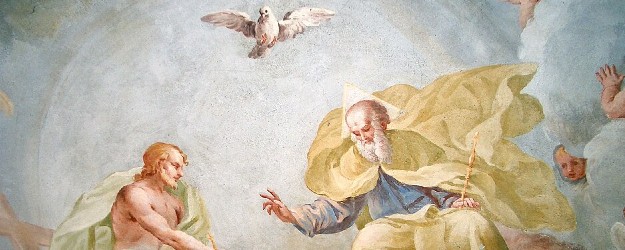
One often hears how priests hesitate and tremble on Trinity Sunday as they confront the necessity of composing a sermon which sounds and expounds the most profound mystery of reality, the infinite God’s interior life which has been revealed to us in and through His only Son, Jesus Christ. No wonder that they stutter and stumble with all the saints as rationality seems to strike against a barrier impermeable to logical reason: God is one and God is three. It is so much more desirable and joyful to praise the mystery, the source of human creation and salvation, then to explain it.
Yet there is an intelligibility within the mystery. Otherwise it would not have been revealed. Catholic faith has been transmitted in words from one generation to the next, from Jesus until today. It is grounded in Scripture, God’s infallible word, which opens up the heart of God. That implies some intelligibility. Indeed, numerous councils of the Church were guided by the Spirit in articulating ever more exactly the mystery of the Three in One. Subtle concepts were hammered out over the Church’s first seven centuries to explain the mystery: one nature in three persons or three persons in one nature. The following reflections, once preached by the author, do not substitute for a course on the Trinity, which he has taught for years, but they may help to help the Trinity Sunday preacher to illuminate to some degree the ultimate meaning of Christian life and salvation.
Here is a possible sermon, then, for Trinity Sunday morning. Some footnotes are added for those who might wish to pursue certain ideas in the sermon:
Today the Church celebrates the greatest mystery of the universe. Indeed it is a mystery greater than the universe. We believe in the Blessed Trinity: the Father is God, the Son is God, and the Holy Spirit is God. Yet we are not polytheists. There is only one God, but there are three persons in God. How are three one and how is one three? That truth is never taught in basic arithmetic.
Of course we realize that God is an infinite mystery whom our finite minds cannot wrap themselves around. How then can we understand the mystery of His interior life? I cannot explain it to you since I am not God, but I know that without this mystery none of the many mysteries of our lives can be understood.
For example, how did we get here? I don’t mean by car or by foot. But how did we humans get to be here on earth? We can trace our lineage back over our parents to grandparents to great-grandparents and so forth until we get to some pre-ape-like creature and then to a reptile, a fish, a mollusk, a membrane, a collection of chemicals, a soggy sliver of earth. And how did the earth get here? How far back do we have to trace that? Each stage is preceded by another stage until we arrive at the Big Bang, the current, almost universally accepted hypothesis in physics whereby somewhere in the proximity of 13 billion, 800 million years ago an initial, infinitesimally miniscule, extremely dense piece of matter-energy exploded into our current universe which is still expanding. That boggles the mind. Our science cannot imagine something coming from nothing; so it imagines something infinitely dense that joins matter and energy even though in scientific physics matter is distinguished from energy, energy being that which relates various particles of matter to each other. Whence arose that initial matter-energy? That is a mystery beyond which science cannot go. Based on scientific principles and method, it is an unanswerable question.1
So we don’t know where we are coming from. Where are we going? Do we study to work to eat to keep alive to pass on life to others? But for what purpose in the future? What is history’s goal? Will the universe end in the Big Crunch or the Big Freeze? That is, when the initial expansive impulse gives out, will gravity pull all the parts of the universe back together for a monstrous crash? Or, according to the laws of thermodynamics, which prescribe ever-increasing entropy in the universe, will energy give out and all heat disappear and leave us out in the cold? And in such a mysterious universe, what is the purpose of my life in the meantime? Especially as it faces death?
Then another mystery: why should I be at all? We certainly know that we did not persuade our parents with a good rational argument to generate us. Our birth depended on their free choice to be married. Do you think that your mother persuaded your father to marry her by a rational argument? Or, vice versa, your father persuaded your mother that way? If the commitment of love depended upon a reasoned argument, then every woman who claimed to be rational would have to love the man who gave the definitive rational argument. That would be a disaster for everyone involved.
We know that love is a gift not bound to abstract rational arguments. Who can ever rationally persuade a person to dedicate his or her whole life to another person? Yet we know that when we encounter the goodness or beauty of another person, we are called to love that person, cost what it may. Friendship is open-ended. In friendship and especially in marriage we have to be prepared to give our lives for the one whom we love. Who of us has the right to demand of another person such a commitment? No human. That is why love is a gift that rejoices the heart. What I cannot argue another person into, what I cannot demand as a right is given to me as a gift.
Who alone can demand such total dedication? Only God, who is Himself Love and who created human beings, male and female, in His image. Why did He create us? Out of Love for love. He wishes to share His love with us for all eternity.2 Why else would a divinity who is omniscient, omnipotent, and eternally blissful, ever create a world which would only give Him trouble? But God is more than rational. He is Love, and love gives itself away for the beloved. That is a mystery, isn’t it? God loves us because He is Love. That means that He did not begin to love when He created our universe. He is in Himself Love. But love involves self-giving. That entails a certain plurality in God. God is not a solitary individual. He shares Himself primordially. The Father gives Himself fully to the Son, and the Son, receiving the Father’s love, returns the gift. In all eternity each empties Himself to be fulfilled by the reciprocal gift of love, who is the Holy Spirit. For love is expansive. Each person is who He is in Himself and in relation. Love’s mystery entails the greatest unity in the greatest diversity.
Just in our limited experience we see how married couples want to be one with each other, body and soul, yet each does not want the other to be dissolved into himself or herself. They want their spouse to be who he or she is, really different, even as they desire the greatest unity. That is a mystery, isn’t it? But it reflects the mystery of God, doesn’t it? And can I ever be who I am without a relation to my parents? Can there be a son without a father or a daughter without a mother? We are who we are in ourselves and in relation to others.
But who believes all this sentimental stuff about love in a world of sin, a world in which our experience is at best ambiguous? We see wars, terrorism, destructive riots, the innocent oppressed, corrupt politicians, slavery, genocide, broken promises in marriage, children maltreated even by members of the clergy, all the political ambition for power with its lying and manipulation of mass media, stealing, covetousness, unbridled passions. Love is a word used to justify sexual exploitation, and all are urged to fulfill themselves. We are so ready to condemn others and so reluctant to confess our own sins. For the selfishness of sin is not just out there but in the depths of my heart, so wounded, so fractured. Is love just a word we use to exploit others, justify ourselves, and cloak our malice?
In this fallen, broken world, who can assure us of love’s reality? No human being who examines his own heart and then looks death in the face, seeing where his life and love end. In a sinful world only God can assure us of love’s reality. In His mercy God not only gave us His teaching through the prophets, but because love is shown principally not in words, but in deeds, indeed in a whole life of deeds, He came among us in a way that we might understand. We sinners could not perceive the infinite God directly. Then in His mercy God the Son assumed the image of God which He had created. As Dante wrote, “The Maker did not scorn to make Himself something He made.”3 He took it upon Himself to refashion that image which our sins had so disfigured, and thereby He demonstrated love’s reality.4 On the cross He showed us the image of man which our sins produced; yet He is more than man. So on Easter Sunday He recreated that man fully in God’s image and proved that Love, God, is truly stronger than sin and death. He emptied Himself out of obedience to the Father and for love of us. Only when you give yourself away can you find yourself and be who you are truly meant to be.5
God’s word is powerful. It creates what it pronounces. When Jesus, the Word of God, speaks a word of love, that word engenders a response of love in human hearts. He knocks on the door of our hearts to see if they are open to admitting Him and then following Him and sharing His life. Of course this response is not primarily our doing. Jesus makes us love Him by overwhelming our hearts. If He gave His life for me, how can I not respond by giving my life for Him? Then I realize the mystery of God’s omnipotence. If God gives all to me, I should give all in return to Him. All the attractions of this finite universe, my life itself, are as nothing compared to my love for Him who loved me first. I can surrender all for Him, because He has all power over my heart. Then His love thoroughly penetrates my heart. I live for Him because He lives in me. As St. Paul wrote, “Now live no longer I, but Christ lives in me” (Gal. 2:20). In other words, I am sharing God’s life of love, and this is a love that lasts for eternity. As in true love I am no longer concerned with myself, but with my beloved, and that is why my heart overflows in joy.6
This sharing of God’s life involves the divinization of the human person loving God. No creature can divinize himself. Our first parents sought to supplant God and failed miserably. Only God can divinize us. That is why, when Jesus in history calls us to follow Him, His Holy Spirit has to be sent into our hearts to enable our proper response, joining us to the divine Son of God. Then we can pray with Jesus, “Abba, Father,” as we are reborn into divine life. Thus we see that the Trinity is not some far-off mystery enveloped in clouds of incense. The one God, the mystery of tri-personal Love, is one nature, one principle of activity since the three free agents, perfectly united in love, act as one, in procuring our salvation. There is the greatest unity in the greatest diversity. Hence the blessed Trinity is a mystery that guides and shapes our ordinary, daily lives of sacrifices and joys. We need only have the eyes of faith to perceive God’s love. This mystery, greater than the whole material universe, allows us to perceive God’s image, however distorted, in our fellow men and especially in our fellow Catholic Christians who share in Christ’s Body and Blood. The Holy Eucharist is the enduring finite sign of infinite Love which Jesus left us in order that we might daily recommit ourselves to Him, going outside of ourselves to digest Him, to let ourselves be nourished by His love, and so to be ever more reformed into the perfect image of God which God intended from the beginning and accomplished in the Incarnation, life, death, and resurrection of His only Son, Jesus Christ, our Lord and Savior.7 Praised be God, Father, Son, and Holy Spirit now and forever. Amen.
- For the basic problems facing philosophy and physics cf. J. McDermott, S.J., “The Mystery of Matter,” Angelicum 87 (2010), 993–1014; “Matter, Modern Science, and God,” Angelicum 88 (2011), 481–508. ↩
- For knowing God in creation and recreation cf. J. McDermott, S.J., “Faith, Reason, and Freedom,” Irish Theological Quarterly 67 (2002), 307–332. ↩
- Dante, Paradiso, Canto 33:5-6: “. . . che ’l suo fattore/ non disdegnò di farsi sua fattura.” ↩
- On the relation of person and nature in Christology cf. J. McDermott, S.J., “On Nature, Freedom, and Person in Aquinas and Beyond,” Nova et Vetera, English edition 9 (2011), 791–824. ↩
- For the meaning of suffering cf. J. McDermott, S.J., “The Christian Meaning of Suffering,” Nova et Vetera (English edition) 20 (2022), 373–402. ↩
- On the meaning of freedom cf. J. McDermott, S.J., “The Mystery of Freedom,” Lateranum 74 (2008), 493–542. ↩
- For the basic structure of revelation cf. J. McDermott, S.J., “The Sacramental Structure of Reality,” Josephinum Journal of Theology 17/1 (2010), 57–79; “The Centrality of the Eucharist,” Antiphon 28/2 (2021), 211–44. ↩
 About Fr. John M. McDermott, SJ
In my book “Beginners Love,” I have explained the mystery of the Trinity by simply stating that since we are made in God’s image and every human being has three things in common, namely:
1. head
2. heart
3. soul
these can equate to Father, Son and Holy Spirit.
And by the way in Genesis when God says “Let us make humankind in our image,” I am surprised to see that some people do not realize that this is simply God speaking in the Royal We.