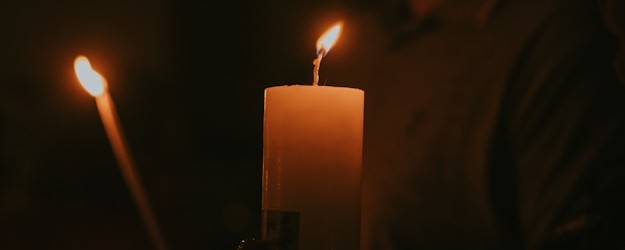
He called me “keeper of the flame.” Assigned as the parish sacristan, I remember receiving guidance from the pastor. Among the instructions was that I should be mindful of the sanctuary candle, seek to keep it burning — transfer the flame to a new candle and do so before the existing candle goes completely out. He explained that the flame is from the Easter candle which, in turn, is from the Easter fire. The intent was (and is) that the flame should be transferred to each new Sanctuary candle — a perpetual light, to burn continuously. The evolution of the Easter candle in our Church can be traced to the second century.
Easter Candle
“The sun is setting, and our earth will soon be mantled in darkness. The Church has provided a torch, which is to spread its light upon us during the whole of this long vigil. It is of unusual size. It stands alone, and is of a pillar-like form. It is the symbol of Christ . . .When lighted we must see in it both the pillar of fire which guided the people of God, and the glory of our Jesus risen from His grave.”1 The Easter candle is a constant reminder of His victory, that He is risen.
By around 150 A.D. Christians were holding a vigil before Easter Sunday that lasted until 3 A.M. (cockcrow) at which time they celebrated Eucharist. The vigil began with a lamp or candle being lit in a ceremony known as the Lucernarium (the lighting of the lamp). This ceremony was conducted year round but was more elaborate on the Easter vigil. Many early Christians believed that Jesus would soon return and likely during this vigil. “At midnight, there was a cry, ‘Behold the bridegroom! Come out and meet Him!’” (Matthew 25:6). From the single large candle lit at the beginning of the vigil, candles held by individual worshipers were in turn lit. People spent the night watching, in prayer, and later, administering baptisms.2
The white pure wax of the Easter candle is regarded as the virgin flesh of Jesus, the wick His soul and the flame His divinity. These candle characteristics are discussed by Father Herbert Thurston (1856–1939): “Hence the clear wax of which the candle was made typified the sacred flesh of Jesus Christ, which He had taken from the most pure substance of His virgin Mother. No wonder the pious thought of the early rubricians went on to recognize in the wick of the candle an image of the human Soul of Christ, without which His sacred flesh was inert and lifeless, and to see in the blessed flame which crowned it a figure of the Divine Personality of the Word, coming down from heaven to give life to the world.”3 In his classic book The Visible Church, Father John Sullivan (1861–1933) includes this simple explanation: “In the candle, the wax, being spotless, represents Christ’s spotless Body. The wick enclosed in the wax is an image of His Soul; and the candle-flame typifies the Divine Nature united to the human in one Divine Person.4 The white color has long signified purity and innocence.
The markings the priest engraves on the revered Easter candle are traced to the early Church, likely in Spain and France when a cross was carved into the wax. The Alpha and Omega markings were added over the centuries and reflective of the sacred scriptures in Revelation chapters 1, 21 and 22: “I am the Alpha and Omega.” The five grains of incense were included to indicate the five wounds of Christ and call to mind the spices the women used when they prepared Jesus’ body for burial. Numerals showing the current year were inscribed around the eighth century and reflect the number of years since the Incarnation.5 By the twelfth century all the current markings had been included.6 The 2011 Roman Missal discusses the markings of the Cross, the Alpha and Omega, and the Date in a way that indicates they are not optional, but says that the grains of incense may be inserted (2011 Roman Missal, Easter Vigil, p. 345).
Service of Light
Lighting an outside fire on the Easter vigil can be traced to St. Patrick in the fifth century. It was custom among the pagans in Ireland to light bonfires near the time of the spring equinox, petitioning their idol gods for good planting and growing seasons. Legend has it that a local king demanded that no fire be set before his bonfire was lit. Patrick defied the king and lit a fire on the eve of Easter, proclaiming and honoring the Resurrection in advance of the king’s fire. The king’s advisors told him to quickly have St. Patrick’s fire put out, claiming the fire would burn forever and “the man who lighted it would be exalted above kings and princes.”7 As Christianity grew in Ireland, so too did the lighting of a fire on the night before the Resurrection and around the eighth century had slowly spread into Europe.
Between the tenth and twelfth century, the practice of lighting a fire outside the church on the Easter vigil became part of the Roman ritual. The flame from the fire was brought into the church where a large candle, the Easter candle, was lit and, by the middle ages, remained on the sanctuary until the Solemnity of the Ascension. It was then removed from the church. In some churches the candle was again lit on Pentecost.8
At first the priest lit and blessed the Easter fire outside the church, then the flame from the fire was brought inside where the Easter candle was already in place. Prepositioning the candle was at least in part because many of the candles were large, a hundred or more pounds, and not easy to move.9 After the flame was brought into the church, it was the deacon (or priest acting as the deacon) who adorned the candle with the markings, praised the risen Christ while singing the ancient hymn, the Exultet (or Exsultet). “But it is worthy of remark that it is the deacon and not the priest — or, in smaller churches, the celebrant as deacon and not as priest — who blesses the Paschal candle, to signify that not to the apostles but to others was entrusted the privilege of preparing the dead body of Our Savior — which the candle not as yet lighted typifies — for the holy sepulcher.”10 This early role of the deacon is explained in more detail by James L. Meagher (1848–1920) in his book The Festal Year, saying that it is an exception that the deacon blesses the Paschal candle rather than the priest or bishop. Meagher says,
“This is the reason [for that exception]: The holy women came to the sepulcher and announced the resurrection of Christ, and as St. Augustine and St. Chrysostom say, it is right for woman, who first sinned, to be the first to tell that sin had been wiped out. Thus, the young deacon, who represents the weaker sex, blesses the paschal candle. While all the other clergy are clothed in violet vestments during the blessing of the fire and of the candle, the deacon alone is in white to honor the holy women who told the Apostles of the resurrection of Our Lord.”11
Today, the Roman Missal clarifies that the priest blesses the Easter fire, marks, then, from the new fire lights and blesses the Paschal candle saying, “May the light of Christ’s rising glory dispel the darkness of our hearts and minds” (RM EV 346). Then the deacon carries the candle into the church with the faithful processing behind him. Carrying the light of Christ, reminiscent of the pillar of fire that the Israelites followed when escaping the Egyptians, the deacon proceeds toward the church sanctuary. He stops three times en route and sings out, “The Light of Christ,” those in procession respond, “Thanks be to God.” The deacon then places the candle in the stand next to the ambo or middle of the sanctuary. He incenses the candle and sings the Exultet (RM, EV 346–347).
The Exultet, written as a hymn of praise, dates from the fourth century, and by the twelfth century was part of the Roman rite.12 The term means to exult, in this instance, rejoice, proclaim and honor the Easter candle as symbolic of the risen Christ.
Following the Old Testament readings during the vigil Liturgy of the Word, the bells are rung, the Alleluia and Gloria sung and, using the flame of the Easter candle, the altar candles are lit, but not the sanctuary candle.13
Liturgy of Baptism
Christians have long administered baptisms during the Easter vigil and the Easter candle plays a central role. It is part of blessing the baptismal waters and lighting the way for the newly baptized. It blesses the baptismal water when it is immersed into the water. “The immersion of the Candle is emblematic of Christ’s descent into the waters of the Jordan, to receive Baptism, and its elevation, of our resurrection, as the effect of the Sacrament, from sin to a life of grace.”14 Candles given to those just baptized are lit from the Easter candle signifying that these new Christians now possess the light of Christ: “The candle, lit from the Easter candle, signifies that Christ has enlightened the neophytes” (Catechism of the Catholic Church, n. 1243).
The Liturgy of the Eucharist follows the baptisms and when Holy Communion is complete, the Blessed Sacrament is returned to the tabernacle and the sanctuary candle lit from the Easter candle. “Because eucharistic reservation has commenced once more, the veil is arranged over the tabernacle, according to custom, and the server lights the lamp(s) near the tabernacle.”15 Now the role of the “keeper of the flame,” the eternal flame, becomes apparent.
Placement and Disposal – Paschal Candle
The Church provides special guidance for this most treasured of all candles, the ever-present reminder of the living Christ. “The paschal candle should be prepared, which for effective symbolism must be made of wax, never be artificial, be renewed each year, be only one in number, and be of sufficiently large size so that it may evoke the truth that Christ is the light of the world. It is blessed with signs and words prescribed in the Missal or by the Conference of Bishops” (1988 circular letter, Paschale Sollemnitatis, Congregation of Divine Worship and Sacraments, n 82).
Traditionally, the Easter candle sits close to the ambo throughout the Easter season but may also be placed near the altar or in the middle of the sanctuary (RM EV, p. 347). It stands regally and prominently in every Catholic Church. For centuries, the candle was extinguished at the end of the Gospel on the Feast of the Ascension commemorating Jesus leaving the apostles, returning to the Father.16 It is still extinguished on that day in the Traditional Latin Mass. In the Ordinary Form of the Mass, the Candle is extinguished at Pentecost: “With Easter time now concluded the paschal candle is extinguished. It is desirable to keep the paschal candle in the baptistery with due honor so it is lit at the celebration of Baptism and the candle of those baptized are lit from it” (RM, Pentecost Mass During the Day, p. 457). The 1988 circular letter Paschale Sollemnitatis, n.99, adds, “After the Easter season, the candle should be kept with honor in the baptistery, so that in the celebration of Baptism, the candles of the baptized may be lit from it. In the celebration of funerals, the paschal candle should be placed near the coffin to indicate that the death of a Christian is his own Passover.”
The U.S. Conference of Catholic Bishops’ Newsletter of April 2014, Vol. L, provides additional instructions on what to do with last year’s Easter candle. It cannot be reused and cannot be thrown away. It can be returned to the supplier (if they agree) to be melted down. Since it is a blessed object, it must be “appropriately disposed of. This could involve burning the candle in a devotional manner (privately as opposed to publicly and liturgically) or even burying the candle in blessed ground.”
Why Year Round?
Why display the Easter Candle year around? Why not put it away after the Easter season and use it only at baptisms and funerals? That answer comes not just from Church directives but, at least in part, from Pope Saint John Paul II (r. 1978–2005). He said: “We are an Easter people, alleluia is our song.” (Angelus, Nov 30, 1986) We carry the hope and joy of the Easter miracle in our hearts throughout our lives, not just at Easter.
The Easter Candle is a permanent and visual reminder of that joy and hope, a reminder of Resurrection Sunday, of His victory over death. (“Where, O death, is your victory? Where, O death, is your sting?”) (1 Cor., 15:55) Each time we come into church we see it setting next to the baptismal font calling to mind that because of our baptism we too will be resurrected. This candle is intended to always remain in its place of honor as the glorious sign of our Risen Savior, that He is alive.
Pointing out the meaning of the Easter Candle, in most parishes, is often limited to one day or period during the liturgical year. Catechetical instructions rarely mention it in any detail. The faithful, we all, will profit from more frequent reflections, discussions, homilies that tell us of the beautiful symbolism, the history associated with this powerful image, this most enduring candle.
- Prosper Dom Gueranger, The Liturgical Year: Passion Time and Holy Week (J. Duffy Dublin, 1867), p. 560. ↩
- James Monti, A Sense of the Sacred (Huntington, IN: Our Sunday Visitor, 2012), p. 458–459. ↩
- Fr. Herbert Thurston, “The Exultet and the Paschal Candle,” The Month, April 1896, p. 510–511. ↩
- Fr. John F. Sullivan, The Visible Church (New York: P. J. Kennedy & Sons, 1920), p. 159. ↩
- Monti, A Sense of the Sacred, p. 471. ↩
- Monti, A Sense of the Sacred, p. 478. ↩
- Fr. William B. Morris, The Life of St Patrick of Ireland (London: Burns and Oates, 1888), p. 179. ↩
- E. G. Cuthbert F. Atchley, The Churchman’s Glossary of Ecclesiastical Terms (London: A. R. Mowbray and Co., 1923), p. 135. ↩
- Fr. A.A. Lambing, The Sacramentals of the Holy Catholic Church (New York: Benziger Bros., 1892), p. 222. ↩
- Lambing, Sacramentals, p. 225. ↩
- Fr. James L. Meagher, The Festal Year, Or, The Origin, History, Ceremonies and Meaning of the Sundays, Seasons, Feasts and Festivals of the Church During the Year, Explained for the People (New York: Russell Bros, 1883), p. 273. ↩
- Monti, A Sense of the Sacred, p. 478. ↩
- Peter J. Elliott, The Ceremonies of the Liturgical Year (San Francisco: Ignatius Press, 2002), n. 285. ↩
- Fr. William J. Berry, Sacramentals of the Holy Catholic Church (London: Thomas Richards and Sons, 1879), p. 126–127. ↩
- Elliott, The Ceremonies of the Liturgical Year, n. 308. ↩
- D. Atwater, ed., A Catholic Dictionary (New York: Macmillan Co.), p. 35. ↩
 About D.D. Emmons
[…] Chuyển ngữ từ: hprweb.com […]