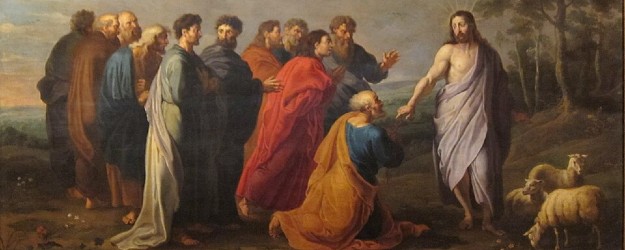
Since its foundation, the Church has grappled with the nature and exercise of hierarchical authority, especially in relation to the Petrine office. Though much has been articulated about apostolic succession and the primacy of Peter, it is a necessary task of the Church to continue to plumb the authentic meaning of authority, especially as it relates to the facilitation of authentic communion, mission, and service in the life of the Church. On May 8, 2025, this perennial task found renewed relevance in light of the recent election of Pope Leo XIV, the first American-born pontiff. His choice of episcopal motto, In Illo uno unum (In the One, We Are One), offers an acute theological statement and reminder about the Church’s vocation to unity in Christ. Reaffirming the Christological underpinning of ecclesial communion, the motto conveys that the unity of the Church is not a mere institutional construct but is grounded in the mystery of Christ Himself. Therefore, in a time marked by division, within the Church, between Christian communities, and across global society, Pope Leo XIV stands as a visible icon of the Church’s mission to be a sacrament of unity in the world and for the world.
Through the scope of the ecumenical movement, which has as its goal the unity of the Body of Christ,1 few questions remain as theologically complex and pastorally significant as the question of papal authority. To address this significant ecumenical endeavor, the joint statement “The Gift of Authority,” by the Anglican-Roman Catholic International Commission (ARCIC), was issued in 1999. Characterizing ARCIC’s hermeneutical key in their statement on authority in the Church, the dialogue highlights 2 Corinthians 1:19–20, which describes the dynamic of God’s “Yes” to humanity and humanity’s “Amen” to God. This dynamic, ultimately found in Christ’s exchange with the Father, fulfilled in His life, death, and resurrection, provides the foundation for understanding ecclesial authority not as a type of domination, but as a gift for the sake of three ends: communion, mission, and service. To further examine the notion of the gift of authority as that which renders communion, mission, and service within the Church, we will consider the biblical foundations of Petrine primacy, its doctrinal development, and the role of authority in the Church through the prism of ARCIC’s 1999 statement.
Scriptural Foundations of the Petrine Office
The Church’s current understanding of the primacy of the chair of Peter stems from an extensive developmental process throughout the Tradition. At its roots are the biblical accounts of the apostle St. Peter, the apostle whom the New Testament references the most. In the Synoptic Gospels alone, Peter is mentioned 114 times, in the Gospel of John 46 times, and in the other books 57 times.2 Especially in the period after the Resurrection of Christ, Peter had taken a position of leadership and authority among the disciples. This is conveyed by the biblical account of Peter as the prime witness of the appearance of the risen Lord (see 1 Corinthians 14:5; Luke 24:35; Mark 16:7; John 21:15).3 Moreover, the place of Peter among the early Christian community is elucidated further by the accounts of the Acts of the Apostles. Some of the pivotal Petrine recordings in the Acts of the Apostles include Peter’s crucial role in the election of Matthias (1:15), speaking in the name of the apostles at the Pentecost account (2:14), and his authoritative position in deciding whether Gentiles may receive Baptism (10:34–48).4 In this way, Peter takes priority of place among the community of disciples during the post-Resurrection period.
The primacy of Peter after the Resurrection of Christ corresponds to an extension of his leadership exercised already during Christ’s three-year ministry. This is most vividly elaborated in the Gospel accounts. First, the Gospel of Luke represents Peter as the “faithful steward” (Luke 12:42), as the model of a missionary (Luke 5:1–11), and as the one whom Christ especially prayed for so that he could “strengthen his brethren” (Luke 22:32–34).5 Next, the Gospel of Matthew illustrates Peter as occupying the first place among the twelve apostles (Matthew 10:2).
Significantly, one of the most important texts to examine regarding the primacy of Peter is found within Matthew 16:16–19. In this passage, the apostle Peter declares Jesus as the Son of God, a revelation he gratuitously receives from the Father. Upon making this declaration, Jesus asserts, “And I tell you, you are Peter, and on this rock I will build my church, and the powers of death shall not prevail against it” (v. 18). Soujeole, in his Introduction to the Mystery of the Church, asserts that “the theme of the stone is a well-known biblical theme”6 which finds an Old Testament reference in Isaiah 28:16: “Behold, I am laying in Zion for a foundation a stone, a tested stone, a precious cornerstone, of a sure foundation.”
It is of merit to consider here that the primal foundation of the Church is always Christ, and only in a “secondary and subordinate way” are the apostles.7 As such, Peter and the Twelve share in the mission of Christ as foundation. In a unique way, however, Peter is commissioned to visibly manifest the first foundation as shepherd and head of the Church. Soujeole asserts,
This equivalence between the whole (the Twelve, the Church) and the one (St. Peter) shows the fundamental structure of the service of unity in the Church. The jurisdiction that the Twelve receive together with St. Peter as one of the members is the same jurisdiction that St. Peter receives as pastor of the whole Church and as head of the college.8
In this manner, the apostle Peter attains preeminence of place among the apostles through Christ Himself. Since Christ is the true rock and head of the Church, when named Petrus, the apostle Peter is given a share in Christ’s own name and a share in Christ’s own authority.9
Finally, this passage, namely, Matthew 16:16–19, emphasizes the conferral of the keys of the kingdom of heaven regarding the authority of binding and loosing. The image of the “keys of the kingdom of God” (v. 19) is diametrically opposed to the image of the “the gates of Hades” (v. 18). In this way, “just as Hades is the kingdom of death, so the kingdom of heaven is that of life,”10 and it is the keys of the kingdom that authorize access to the divine life therein. Peter, then, as steward of the keys to the kingdom of heaven, grants access to participation in the eschatological kingdom to come through the authority given him in Christ.
Furthermore, the depiction of the keys alludes to other passages in Scripture, such as Revelation 1:18 and 3:7 and Isaiah 22:22.11 In the Book of Revelation, it is Christ who holds the authority of the keys of life and death in His hands, “who opens and no one shall shut, who shuts and no one opens” (3:7). This passage also finds an interpretive key in Isaiah 22, where the Lord God places the key of the house of David on the shoulder of Eliakim. In like manner, “Christ gives Peter the key to the kingdom of heaven,” which denotes that Peter is granted oversight of the access to the kingdom. Ultimately, it is Peter, together with Christ, who “shall open, and none shall shut; and [who] shall shut, and none shall open” (Isaiah 22:22). Though the authority to bind and loose is also bestowed upon the other apostles, later in Matthew 18:18, it is clear that Peter’s preeminence among the apostles is established by Christ Himself.
Doctrinal Development of the Primacy of Peter
To determine a justification for the primacy of the Chair of Peter in the Church, one does well to turn toward both a philosophical and theological justification on the matter. Soujeole asserts that, on the philosophical plane, one may look toward the societal principle “reductio ad unum.”12 By way of this philosophical principle, it is argued that a society tends to have one head, or one who is in authority. Likewise, there must also be a theological principle that justifies the primacy of the pope. As such, sacramental theology may be employed to understand a theological justification of papal primacy. Soujeole avers, “The pope is a sign of unity — that is clear to everyone — but what is still more important is the very reality of unity.”13 Hence, the papacy is a visible sign that points to an efficacious reality or cause of unity. When establishing Peter as the rock, Christ extends his role as foundation of the Church to the apostle Peter. To this point, Soujeole considers Yves Congar and the following assertion:
If the general system of the people of God is that of a union of the heavenly and the earthly that is simultaneously the translation of the heavenly in the earthly and the service of the heavenly by the earthly, in short, a system in which the earthly is ‘symbol,’ ‘icon,’ ‘sacrament’ of the heavenly, are we not then authorized to look for an icon, a ‘vice gerens’ of (i.e., one acting in place of) the Shepherd of the one flock in a supreme bishop who is steward and major-domo and therefore claviger [key-holder] of the whole house of God?14
Insofar as the Primacy of the Chair of Peter is considered, the bishop of Rome and the Church of Rome have always and everywhere been considered the sign pointing to the unity of the universal Church. The bishop of Rome, then, acts as a sign and means toward the attainment of unity within the Church. This role in the Church is not attributed to any political cause but is traced and associated with apostolic succession. In this case, “the only reason for the preeminence of the bishop of Rome is the fact that he succeeds St. Peter on the Cathedra of Rome so as to be the rock.”15 Though the dogma of papal primacy was defined dogmatically later in history, the living of the faith, which was only later understood doctrinally, was attested to since the conception of the nascent Church.
Turning toward the eminent dogmatic instantiation of papal primacy, let us consider the First Vatican Council and the Constitution Pastor Aeternus. To better understand the papacy and the authority which follows from it, the Constitution sets forth four chapters as follows: (1) The Emergence of the Pre-eminence of St. Peter among the apostles; (2) The Ongoing Extension of the Primacy of St. Peter through the Roman Pontiff; (3) Substance and Nature of the Primacy of the Bishop of Rome; (4) On the Infallible Teaching Authority of the Roman Pontiff.16 In its first chapter, on the primacy of St. Peter the Apostle, the Constitution affirms that Peter’s primacy over the apostles is a gift granted by Christ.17 Furthermore, this scriptural teaching, which the Constitution asserts, is one which has been held “semper” within the Catholic Church.18 The second chapter, on the transmission of the papacy, affirms that the primacy of the Bishop of Rome is extended to Peter’s successor. This transmission is connected to Peter’s role as rock and shepherd in the Church. As such, “if the primacy of St. Peter was instituted by Christ for the salvation and perpetual good of the Church, it must therefore last as long as the government of the Church lasts.”19
The third chapter, establishing the primacy of jurisdiction, asserts that the pope’s jurisdiction concerns faith and morals as well as the discipline and government of the universal Church.20 Within the Constitution, this sovereignty is defined as ordinaria, immediata, and episcopalis. It is of merit to briefly clarify what is meant by each of these terms. First, ordinaria pertains to the fact that papal authority originates from the office in se. Next, immediate signifies that the pope’s authority may be exercised without intermediaries. In other words, “the pope can exercise anywhere the tria munera Christi directly,”21 that is the teaching, sanctifying, and governing offices of Christ. Lastly, episcopalis pertains to the nature of the pope’s ministry of “overseeing.” In this case, the nature of papal jurisdiction is specifically pastoral. Finally, the fourth chapter, on papal infallibility, asserts that the pope’s authority in teaching is for the sake of equipping the Church in its definitive decisions on matters of faith and morals. As such, the boundaries of papal ex cathedra decisions “extends no further, but no less far, than that of the Church.”22
Furthermore, the Second Vatican Council continued to build upon what had been defined and promulgated in the previous council concerning papal primacy. Found within Lumen Gentium, the Dogmatic Constitution on the Church, in chapter three, is an elucidation of the hierarchical structure of the Church and especially the episcopate. In this way, the Second Vatican Council sought to associate papal primacy and the episcopal college more explicitly. In such a way, “the head and the body are not disconnected, and their mutual relations are indispensable for the life of all.”23 Ultimately, the Bishop of Rome is in relationship with the other bishops as St. Peter was interconnected with the apostles in the early Church. This is further illuminated by Lumen Gentium: “Just as in the Gospel, the Lord so disposing, St. Peter and the other apostles constitute one apostolic college, so in a similar way the Roman Pontiff, the successor of Peter, and the bishops, the successors of the apostles, are joined together.”24
Further, this context for describing papal primacy within the Dogmatic Constitution on the Church relates to the desire to continue to elaborate on the role of the college alongside the successor of Peter. It is worth noting that the episcopate only acts collegially if acting in unison with the head of the college, namely, the Roman Pontiff. In a word, “the college or the body of bishops only has authority if the college is understood in communion with the bishop of Rome . . . as its head.”25 In this way, the episcopal college, together with its head, exercises authority over the universal Church, and this “exercise of power is most clearly revealed in the ecumenical councils.”26
Papal Primacy through the Scope of John Henry Cardinal Newman
To further examine the primacy of the papacy within the context of the ecumenical endeavor of unity, let us turn toward the structure of thought of St. John Henry Newman. Newman, an Anglican convert to Catholicism, developed his own thought on papal primacy, which evolved throughout the years. Though Newman was influenced by the Protestant notions of the papacy and the Antichrist, “Newman dealt with the question (of papal primacy) on a higher intellectual plane . . . primacy came into play with complex considerations involving apostolicity and catholicity.”27 Early in his life, in his work The Via Media of the Anglican Church, one discovers that while Newman did not fully hold on to the notion of the Bishop of Rome as the Antichrist, he also did not accept the notion of papal primacy. In expressing his understanding of the episcopacy and the Bishop of Rome, Newman asserts,
But what there is not the shadow of a reason for saying that they held, what has not the faintest pretensions of being a Catholic truth, is this, that St. Peter or his successors were and are universal Bishops, that they have the whole of Christendom for their own diocese in a way in which other Apostles and Bishops had and have not, that they are Bishops of Bishops in such a sense as belongs to no other Bishop: in a word, that the difference between St. Peter and the Popes after him, and no other Bishop, is not one of mere superiority and degree, but of kind, not of rank, but of class.28
While Newman did not accept the pope’s primacy at this time, he later developed his understanding of primacy to the point that he came to accept it.
Later, in 1835, Newman would eventually reject the notion of the pope as the Antichrist. Moreover, primacy of the Bishop of Rome became a topic which he discussed in his Essay on the Development of Christian Doctrine. In his Essay, Newman touched upon the notion of papal primacy and the development of doctrine over time. McCarren keenly notes that Newman, “in order to confound Anglican complacency with the Rule of Saint Vincent of Lerins, by which quod semper, quod ubique, et quod ab omnibus creditum est was the norm of faith.”29 This describes papal primacy as accepted in faith always and everywhere since the beginning of the ancient Church. In this way, Newman asserts, “In truth, scanty as the Ante-Nicene notices may be of Papal Supremacy, they are both more numerous and more definite than the adducible testimonies in favour of the Real Presence.”30
Though Newman did not establish an extensive and definitive conclusion on the subject of papal primacy, his initial thoughts opened the way for an ecumenical understanding of the matter. Moreover, it seems, that Newman would have “considered the episcopacy a divine ordinance intended for local government, whereas the papacy was destined to care for the unity of the whole ecumenical communion.”31 In the end, already in Newman’s thought were the beginnings of the notions of collegiality and the consultation of the lay faithful, in virtue of the sensus fidelium.
ARCIC: The Gift of Authority
The Anglican–Roman Catholic International Commission (ARCIC), established in 1967 following the historic meeting between Pope Paul VI and Archbishop Michael Ramsey, serves as the official theological dialogue between the Roman Catholic Church and the Anglican Communion. Its mandate is to address theological and ecclesiological differences with the aim of restoring full visible communion between the two traditions. While ARCIC does not define doctrine authoritatively, its documents are theologically rigorous and carry significant ecumenical weight. In its 1999 statement, “The Gift of Authority,” ARCIC turned its attention to one of the most challenging and vital aspects of unity: the nature and exercise of authority in the Church, including the role of the Bishop of Rome. The document offers a shared theological reflection rather than a binding agreement, yet it represents a notable convergence on issues that have historically been points of division in order to foster and enable visible unity amid the real but imperfect communion that exists between the churches.
Both Anglicans and Catholics have understood that “authority rightly exercised is a gift of God to bring reconciliation and peace to humankind.”32 Within the context of “gift,” ARCIC’s statement on authority in the Church is given by God for the sake of the Church and all of its members. This authority is modeled after the ministry of Jesus Christ, and it is in this that the Church exercises its authority. Ultimately, just as Christ the Head of the Body brings unity to His members, “a universal primacy . . . serves the unity of all the local churches.”33
As mentioned above, the hermeneutical key at the core of “The Gift of Authority” is found in God’s “Yes” to humanity and humanity’s “Amen” to God. God’s promise of redemption, fulfilled in Jesus Christ, is his “Yes” to mankind. This continual work of redemption and conversion is enacted by way of the Spirit of God through the Church. God’s “Yes,” then, is for the sake of human flourishing in every respect. Hence, authority founded on the “Yes” of God to all of His promises, is aimed toward “life in all its fullness”34 and promulgating the will of the Father upon the earth. Further, the perfect “Amen” in response to the Father’s “Yes” is given in Jesus Christ. Christ’s obedience to the Father’s will is exemplified by His total self-gift in charity. Jesus’ “Amen,” therefore, sets the paradigm for man’s “Amen” to the Father. All obedience and adherence to authority in the Church surge from Christ’s loving and obedient “Amen,” which rendered salvation and reconciliation for the world.
Through the lens of ARCIC’s “Gift of Authority,” one can deduce a threefold purpose for authority in the Church, namely, communio, missio, and servitium. Though ARCIC’s statements are not binding magisterial teachings, they can offer fruitful theological engagement and suggest possible paths toward mutual understanding, particularly when they echo themes already articulated in the Second Vatican Council and the wider Tradition.
1. Communio
First, let us examine papal authority for the sake of communion. Since authority of the episcope is rooted in Jesus, the ministry of “overseeing” is oriented first toward communion or koinonia, fellowship, among believers. How does authority in the Church, however, generate communion among its members? Primarily, it is by way of authority that the traditions, or “memory” of the Christian community are transmitted and preserved over time.35 As such, without a proper structure of authority, in which there is a unity under one head, the “Tradition [which] is integral to the economy of grace, love, and communion”36 cannot be transmitted. Significantly, ARCIC asserts, “Tradition makes the witness of the apostolic community present in the Church today through its corporate memory.”37 In other words, the unity of the Tradition held and lived out by the members of the Church bears witness to that which has been held and practiced throughout the life of the Church. Authority binds church communities over time and space, giving the possibility to live faithfully to the apostolic Tradition.
2. Missio
Papal primacy is, likewise, for the sake of missio within the Church. In this sense, authority in the Church is not only for the sake of those within the community of its members, but it is also directed to those who are outside of its boundaries. As affirmed by ARCIC, “The authority which Jesus bestowed on his disciples was, above all, the authority for mission, to preach and to heal.”38 Authority, then, is for the sake of disseminating the transformative power of the Gospel to all nations by sending out all the faithful as the Father sent Christ for the sake of redemption and reconciliation. In a word, “authority enables the whole Church to embody the Gospel and become the missionary and prophetic servant of the Lord.”39
3. Servitium
Lastly, the gift of authority in the Church is ordered toward servitium. The role of the Bishop of Rome, as head of the episcope, the collegial body of “overseers,” is not for the sake of sheer obedience. Rather, authority is oriented toward the service of the members of the Body. In this case, if servitium is an end of authority in the Church, there must be a proper relationship between authority and those to whom it serves. As such, ARCIC elucidates, “The jurisdiction of bishops . . . is not arbitrary power given to one person over the freedom of others. Within the working of the sensus fidelium there is a complementary relationship between the bishop and the rest of the community.”40 To discern well the promptings of the Spirit in the Church, and to serve the laity, it is essential that the episcopal head, along with the episcopal body, listen to those whom they serve. It can be said that this is an authentic spirit of synodality lived within the hierarchical structure of the Church.
Conclusion
While theological differences remain, the joint statement “The Gift of Authority,” by ARCIC, marks progress toward mutual understanding and ecclesial reconciliation. The recent election of Pope Leo XIV, and his profoundly providential motto, In Illo uno unum (In the One, we are one), provides a timely sign of the Church’s enduring call to unity. His papacy likewise presents a renewed opportunity to reengage this foundational ecclesiological question in a spirit of charity in the One who unites us all. Though not exhausting the topic or solidifying a definitive conclusion, the ARCIC dialogue, emphasizing God’s “Yes” to humanity and humanity’s “Amen” to God, contextualizes authority as a gift directed toward communion, mission, and service. In a fragmented world, the gift of authority, rightly understood and faithfully exercised may yet become the very means by which the High Priest’s prayer finds its fulfillment: “That they may all be one.” (John 17:21)
- John 17:21 (RSV). “That they may all be one; even as thou, Father, art in me, and I in thee, that they also may be in us, so that the world may believe that thou hast sent me.” ↩
- Benoît-Dominique de la Soujeole, Introduction to the Mystery of the Church (Washington, D.C.: Catholic University of America Press, 2014), 599. ↩
- Miguel María Garijo-Guembe, Communion of the Saints: Foundation, Nature, and Structure of the Church (Collegeville, MN, MN: Liturgical Press, 1994), 66. ↩
- Garijo-Guembe, 67. ↩
- De la Soujeole, 600. ↩
- De la Soujeole, 601. ↩
- De la Soujeole, 601. ↩
- De la Soujeole, 600. ↩
- De la Soujeole, 601. (See also St. Leo the Great, Homily for the Anniversary of his Episcopal Ordination, 4.2–3.) ↩
- Garijo-Guembe, 70. ↩
- Garijo-Guembe, 70. ↩
- Soujeole, 605. ↩
- Soujeole, 605. ↩
- Soujeole, 605. (See Yves Congar, “De la communion des Eglises a une ecclesiologie de l’Eglise universelle,” L’Episcopat et l’Eglise universelle, US 39 (Paris: 1962), 258.) ↩
- Soujeole, 606. ↩
- Garijo-Guembe, 199. ↩
- Soujeole, 609. ↩
- Garijo-Guembe, 199. ↩
- Soujeole, 610. ↩
- Soujeole, 611. ↩
- Soujeole, 611. ↩
- Garijo-Guembe, 202. ↩
- Soujeole, 613. ↩
- Lumen Gentium, 22. http://www.vatican.va/archive/hist_councils/ii_vatican_council/documents/vat-ii_const_19641121_lumen-gentium_en.html. ↩
- Lumen Gentium, 22. ↩
- Garijo-Guembe, 207. ↩
- Gerard H. McCarren, “Newman on Papal Primacy in an Ecumenical Context,” Josephinum Journal of Theology 9, no. 2 (2002), 212. ↩
- McCarren, 213. (See Newman, Via Media, vol. 1, 180–181.) ↩
- McCarren, 215. ↩
- McCarren, 215. See Newman, An Essay on the Development of Christian Doctrine (London: Longmans, Green, and Co., 1878, 1897), 20. ↩
- McCarren, 216. See Misner, Papacy and Development, 80–81. ↩
- Anglican-Roman Catholic International Commission II (ARCIC), “The Gift of Authority,” (Origins 29. May 27, 1999), no. 5. ↩
- ARCIC, “The Gift of Authority,” no. 6. ↩
- ARCIC, “The Gift of Authority,” no. 7. ↩
- ARCIC, nos. 15–18. ↩
- ARCIC, no. 15. ↩
- ARCIC, no. 18. ↩
- ARCIC, no. 32. ↩
- ARCIC, no. 32. ↩
- ARCIC, no. 36. ↩
 About Fr. Matthew Gonzalez
In regard to authority, one of the things that is overlooked or misunderstood is Jesus’ meaning of the word. We see it in MK 2:10, “the Son of Man has authority to forgive sins on earth.” Again in Mk 3:15 and Mt 10:1, He sends them out “gave them authority over unclean spirits to drive them out and to cure every disease and every illness.” This is the authority He ultimately gave to the Church. This form of authority is power rather than an administrative permission. The Church has this authority in the Sacraments, as well as authority of Petrine authority discussed above. Acknowledging this form of authority as in the Sacraments, it becomes the definitive explanation of Ordination. We argue that Christ did not give the Church authority to ordain women. If we replace the word authority with power, the dialogue moves in a different direction. Sacraments are acts that bring about an ontological change. The power of Ordination, as given by Christ, does not affect the ontology of the woman.