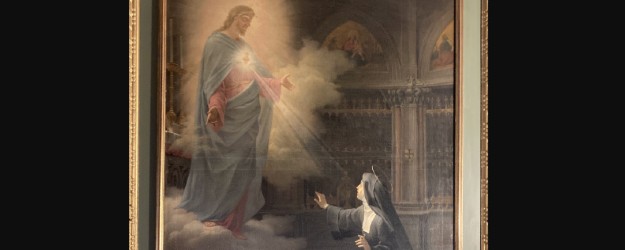
The feast of the Sacred Heart of Jesus was established in 1670 at Rennes in France. The main person behind its establishment was St. John Eudes. Five years later, a religious sister of the Order of the Visitation of Holy Mary at Paray-le-Monial in France, called Margaret Mary Alacoque, reported having four visions of Jesus in which he revealed his heart to her. From these beginnings, this devotion became so widespread that it would become unusual to enter a Catholic church without seeing a statue of Jesus with his Sacred Heart, usually to the side of the sanctuary. As well as this, an easy way to tell if one were in a Catholic home would be to look for a picture of Jesus with his Sacred Heart hanging on a wall.
Today, when we hear of devotion to the Sacred Heart of Jesus, this is the kind of image that may arise in our imaginations.
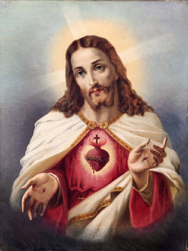
However, I realize that, for many people today, such an image would not attract them to learn about the Sacred Heart of Jesus or consider incorporating such a devotion into their life of prayer and devotion. As well as having an image arise in our imaginations, some thoughts may arise in our minds, thoughts about receiving communion on the First Friday of each month, or making reparation to the Sacred Heart to make amends for those who fail to worthily receive Jesus in the Eucharist or otherwise treat him with coldness or contempt. On the other hand, we may think of the words that Jesus spoke to Margaret Mary at his third appearance to her during the octave in preparation for Corpus Christi:
Behold this Heart, Which has loved men so much, that It has spared nothing, even to exhausting and consuming Itself, in order to testify Its love; and in return I receive from the greater number nothing but ingratitude by reason of their irreverence and sacrileges, and by the coldness and contempt which they show Me in this Sacrament of Love. But what I feel the most keenly is that it is hearts which are consecrated to Me, that treat Me thus. Therefore, I ask of thee that the Friday after the Octave of Corpus Christi be set apart for a special Feast to honour My Heart, by communicating on that day, and making reparation to It by a solemn act, in order to make amends for the indignities which It has received during the time It has been exposed on the altars. I promise thee that my Heart shall expand Itself to shed in abundance the influence of Its divine love upon those who shall thus honour It and cause It to be honoured.1
If such are our thoughts, we may find ourselves saying something like:
Well, this may have been a good and helpful devotion for an earlier age. If we go back to the state of the Church in the second half of the seventeenth century, when the influence of Jansenism was rife, such a devotion may have been valuable. Jansenism, with its discouragement of frequent Communion by arguing that a high degree of perfection was necessary before approaching the sacrament, may have needed an antidote in the form of a devotion that encouraged more frequent reception of communion. Jansenism, with its deeply pessimistic theology that Christ did not die for all people, may have needed as an antidote a spirituality that emphasised the love of Jesus for everyone. Even in the nineteenth century, and the first half of the twentieth, when most believers were not that theologically educated, such a devotion could still be very helpful for grounding the spiritual lives of many Catholics on a firm foundation. However, since the Second Vatican Council, we have put aside such a way of relating to God. We have a more liturgically and eucharistically centered spirituality in the Church. This old devotion does not resonate with contemporary Catholics. It does not resonate with me.
However, is this the case? Has this devotion reached its use-by date? If so, why did Pope Francis recently write an encyclical, Dilexit Nos, on the Human and Divine Love of the Heart of Jesus Christ?2 Why did Pope Leo XIV recently compose and pray a prayer to the Sacred Heart of Jesus?3 Why is Paray-le-Monial, after nearly being forgotten in the 1960s and 70s, now receiving about 200,000 pilgrims each year?4
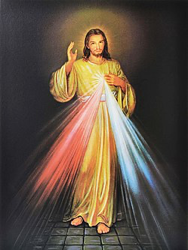
I would like to show you two more images. The first is the most popular Divine Mercy image.
The second is a lesser known one, but it is an image of the original painting of Jesus as Divine Mercy, painted in 1934.
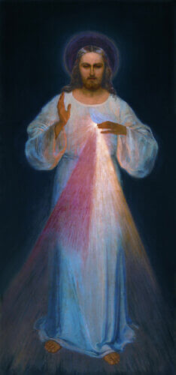
It was concealed after the Soviet occupation of Lithuania and only became widely known after 2005. Devotion to Divine Mercy has become very popular throughout the Church. It includes venerating the Image of The Divine Mercy, celebrating the Feast of Mercy (Divine Mercy Sunday on the second Sunday of Easter), praying the Chaplet of Divine Mercy, keeping the Novena to The Divine Mercy, and praying the Hour of Great Mercy at 3 o’clock in the afternoon. The basis of this devotion is as follows:
Although these means of receiving God’s mercy are new in form, they all proclaim the timeless message of God’s merciful love. They also draw us back to the great Sacrament of Mercy, the Holy Eucharist, where the living Lord, who suffered and died on the Cross and whose Heart was pierced with a lance, pours forth His mercy on all mankind, and grants pardon to all who draw near and honour Him. As Jesus told St. Faustina: “My Heart overflows with great mercy for souls, and especially for poor sinners. . . . It is for them that the Blood and Water flowed from My Heart as from a fount overflowing with mercy. For them I dwell in the tabernacle as King of Mercy.”5
The symbolism of the image is explained in the following way: According to Sr. Faustina, Jesus told her:
The two rays denote Blood and Water. The pale ray stands for the Water which makes souls righteous. The red ray stands for the Blood which is the life of souls. These two rays issued forth from the depths of my tender mercy when my agonized Heart was opened by a lance on the Cross. Happy is the one who will dwell in their shelter, for the just hand of God shall not lay hold of him. By means of this image I shall grant many graces to souls. It is to be a reminder of the demands of my mercy, because even the strongest faith is of no avail without works.6
I think that this devotion is a contemporary version of devotion to the Sacred Heart of Jesus. One thing to note about this devotion is that it does not emphasize “reparation” for “ingratitude . . . irreverence and sacrilege” but rather emphasizes the mercy and forgiveness of Jesus. However, I do not think that we should just summarily dismiss what was revealed to Margaret Mary in the third apparition, because it shows us that Jesus has a truly human heart, like yours and mine, which is wounded by ingratitude and rejection.
I want to show you one more image. It is an icon written by a friend of some friends of mine.
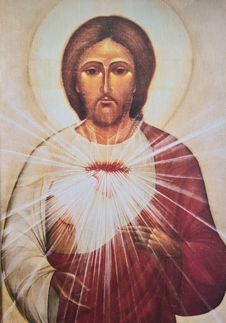
Artist: Suzanne Kent DeBold
I first saw this icon in the home of my friends, in their prayer room, when my wife and I were praying with them one day, and it is the only time that I have ever coveted an icon. I wanted to have a copy, and I managed to get one. When I first saw it, this icon had a great effect on me. I could not concentrate on what we were praying. All I could do was gaze at it. For me, this is a contemporary image of the Sacred Heart of Jesus.
So, are the validity and value of this devotion just a question of finding the right image, and perhaps having one that is more merciful than accusing? I think that both these points have merit, but I also think that there is much more to be understood about this devotion, and why it is, in a way, extraordinary. To discover how extraordinary it is, I think that we need to do two things. One is to get back to the “heart” of the devotion, which is to be found in Margaret Mary’s account of Jesus’ first and second apparitions to her. The other is to recover the authentic biblical understanding of what is meant by the Hebrew term, lēv, and its Greek equivalent, kardia, which mean “heart.” However, I think that we must do the second thing first: recover an authentic biblical understanding if we are to fully appreciate the heart of this devotion.
The first problem we must face is that, this side of the Enlightenment and the Romantic movement, this side of the eighteenth and early nineteenth centuries, we must overcome an understanding of the heart as an “exclusive symbol of feeling and sentiment, over against the ruthless rationality of reason.”7 From Descartes onwards, our understanding of the human person became fragmented, with people like Kant emphasizing the will, Hegel the intellect, and Schleiermacher the emotions. This understanding is typified in Schleiermacher’s position that “understanding, will, and emotion are the three provinces of the human mind, and none can be transmuted into any other.”8 After Jacques Rousseau, the heart stands for nothing more than the emotions. I think that this fragmentation affected the Catholic practice of devotion to the Sacred Heart of Jesus during the nineteenth and twentieth centuries, and that this is reflected in the first image I showed you. It is the emotions of Jesus that are emphasized, and it is meant to appeal to our emotions.
Yet if we turn aside from these philosophers and look at the Sacred Scriptures, we are presented with a very different understanding. The Hebrew word lēv is the most common anthropological term used in the Old Testament. There, it is presented as what unites the psychic and somatic aspects of the human being. Rather than just referring to the emotions, it is used to refer to the whole spectrum of human faculties. It is the place of knowing, faith, willing, and conscience. It is drawn to what seems good and beautiful. It is the seat of the passions, imagination, and memory. It is the place of virtue and purity. It is the place of relationships with other persons. It is the place that God searches and knows, the place of revelation and the refusal of revelation, and the place of God’s indwelling.
Summing up the biblical understanding of the heart, the Theological Dictionary of the New Testament says:
[The] heart is the center of the inner life of man and the source or seat of all the forces and functions of the soul and spirit. . . . [In it] dwell feelings, desires and passions. . . . [It is] the seat of understanding, the source of thought and reflection . . . the seat of the will, the source of resolves . . . supremely the one center in man to which God turns, in which the religious life is rooted, which determines moral conduct.9
In Jesus of Nazareth, Pope Benedict XVI explains this understanding of the “heart” as follows:
“Blessed are the pure in heart, for they shall see God” (Mt 5:8). The organ for seeing God is the heart. The intellect alone is not enough. In order for man to become capable of perceiving God, the energies of his existence have to work in harmony. His will must be pure and so too must the underlying affective dimension of his soul, which gives intelligence and will their direction. Speaking of the heart in this way means precisely that man’s perceptive powers play in concert, which also requires the proper interplay of body and soul, since this is essential for the totality of the creature we call “man.” Man’s fundamental affective disposition actually depends oi just this unity of body and soul and on man’s acceptance of being both body and spirit. This means he places the body under the discipline of the spirit, yet does not isolate intellect or will. Rather, he accepts himself as coming from God, and thereby also acknowledges and lives out the bodiliness of his existence as an enrichment for the spirit. The heart — the wholeness of man — must be pure, interiorly open and free, in order for man to be able to see God.10
This passage reveals that, for Pope Benedict, the heart is not to be identified simply with the emotions or the will. Nor is it to be identified simply with the intellect or the soul. Nor does he identify it simply with the ego, the “I.” Instead, for him, it is the locus of the integration of the intellect, will, passions, and senses. It is the locus of the integration of the body and the soul. One could say that, for Pope Benedict, the human heart is the personal integration, the integration by the person, of all these aspects of their humanity. For him, the heart is “the wholeness of man.” Understanding the “heart” in this way will radically change how we approach the revelation of the Sacred Heart to Margaret Mary and revolutionize how we engage in this devotion. Jesus is a divine person, the Second Person of the Blessed Trinity, who is both fully divine and fully human. This means that the heart of Jesus is a fully human heart. With this understanding of “heart,” including the Sacred Heart of Jesus, in mind, let us now look at the apparitions.
Looking at the first apparition, the first thing to note is when and where it took place; on the feast of St. John the Evangelist and while Margaret Mary was praying before the Blessed Sacrament. At the end of the Prologue of his Gospel, St. John writes: “The only Son, who is in the bosom [kolpos] of the Father, he has made him known.” (Jn 1:18) The next and only other time that John uses this word is at the Last Supper, when he tells us, “One of his disciples, whom Jesus loved, was lying in the bosom [kolpo] of Jesus” (Jn 13:23). John then goes on to say that this disciple, “falling back on the breast [stethos] of Jesus,” asks him who his betrayer will be. Note that he says “breast” not “bosom.” This is because, even before he speaks to Jesus, John is already “in the bosom” of Jesus. This is where all beloved disciples always are. Also, in his Prologue and at the Last Supper, John is telling his readers the same thing that Jesus tells Philip, “The one who has seen me has seen the Father. . . . I am in the Father and the Father in me.” (Jn 14:9–10) If a disciple lies in the bosom of Jesus, as Jesus lies in the bosom of the Father, then the one who knows Jesus also knows all that Jesus knows, including the Father. Such as disciple, in the Holy Spirit, will be able to cry out, “Abba! Father!” (Rom 8:15, Gal 4:6)
The next thing that we must remember is that Margaret Mary experienced her first apparition of Jesus while she was praying before the Blessed Sacrament. Devotion to the Heart of Jesus is intrinsically linked to receiving him in the Eucharist and adoring him in the Blessed Sacrament.
The next thing we should do is look carefully at her account of this first apparition:
I was praying before the Blessed Sacrament, when I felt myself wholly penetrated with that Divine Presence, but to such a degree that I lost all thought of myself and of the place where I was, and abandoned myself to this Divine Spirit, yielding up my heart to the power of His Love. He made me repose for a long time upon His Sacred Breast, where He disclosed to me the marvels of His Love and the inexplicable secrets of His Sacred Heart, which so far He had concealed from me. Then it was that, for the first time, He opened to me His Divine Heart in a manner so real and sensible as to be beyond all doubt, by reason of the effects which this favour produced in me, fearful, as I always am, of deceiving myself in anything that I say of what passes in time. It seems to me that this is what took place.11
The similarity here with the beloved disciple resting on the breast of Jesus, and receiving revelation from him, is inescapable. According to Margaret Mary, Jesus than said to her the following:
My Divine Heart . . . is so inflamed with love for men, and for thee in particular that, being unable any longer to contain within itself the flames of its burning Charity, It must needs spread them abroad by thy means, and manifest Itself to them [mankind] in order to enrich them with the precious treasures I discover to thee, and which contain the graces of sanctification and salvation necessary to withdraw them from the abyss of perdition. I have chosen thee as an abyss of unworthiness and ignorance for the accomplishment of this great design, in order that everything may be done by Me.12
Here the Lord does not begin with any mention of reparation, but only of his burning love for every person, and his desire to make them holy and save them from eternal separation from himself. Margaret Mary continues:
After this He asked me for my heart, which I begged Him to take. He did so and placed it in His own adorable Heart where He showed it to me as a little atom which was being consumed in this great furnace, and withdrawing it thence as a burning flame in the form of a heart, he restored it to the place whence he had taken it.13
This reminds us of the “new heart” that the Lord speaks of to the prophet Ezekiel (cf. Ezek 36:26). However, something more is going on here. God promised to the Israelites that their hearts of stone will be replaced by hearts of flesh. However, Margaret Mary is already a Christian. She already has a transformed heart, a heart wherein there is a real and deep love for the Lord. That is why she is in the chapel adoring the Lord in the Blessed Sacrament. She desires to spend more time with the Lord whom she loves. Nevertheless, Jesus wants to do more in her, so he asks her for her heart. What happens to her during this apparition is that Jesus transforms her heart of flesh into a heart of “fire.” Thus, he says:
See, My well-beloved, I give thee a precious token of My Love, having enclosed within thy side a little spark of Its glowing flames, that It may serve thee for a heart and consume thee to the last moment of thy life; Its ardour will never be exhausted.14
Of the second apparition, we read:
On one occasion, whilst the Blessed Sacrament was exposed, feeling wholly withdrawn within myself by an extraordinary recollection of all my senses and powers, Jesus Christ, my sweet master, presented Himself to me, all resplendent with glory, His Five Wounds shining like so many suns. Flames issued from every part of His Sacred Humanity, especially from his Adorable Bosom, which resembled an open furnace and disclosed to me His most loving and most amiable Heart, which was the living source of these flames. It was then that He made known to me the ineffable marvels of His pure love and showed me to what an excess He had loved men, from whom He received only ingratitude and contempt.15
In her account, this is what Jesus says to her:
I feel this more . . . than all that I suffered during my Passion. If only they would make Me some return for my Love, I should think but little of all I have done for them and would wish, were it possible, to suffer still more. But the sole return they make for all My eagerness to do them good is to reject Me and treat Me with coldness. Do thou at least console Me by supplying for their ingratitude, as far as thou art able.16
It is at this point that we may have some doubts about the value of this devotion, by reducing it to something like: “I must console Jesus because he feels so bad. Despite his love for everyone, so many do not love him in return.”
However, we need to read on. Margaret Mary goes on to say:
On representing to Him my inability, He replied: “Behold, this will supply for all that is wanting to thee.” And at the same time his Divine Heart being opened, there issued from It a flame so ardent that I thought I should be consumed, for I was wholly penetrated with it, and being no longer able to bear it, I besought Him to have pity on my weakness.17
Then Jesus says: “I will be thy strength.” The great paradox here is the love which Jesus asks from us is his own love that he infuses into us. We become “another Jesus.” As St. Elizabeth of the Trinity will pray more than 200 years later:
O my beloved Christ, crucified by love, I wish to be a bride of your Heart; I wish to cover you with glory; I wish to love you . . . even unto death. But I feel my weakness, and I ask you to “clothe me with yourself,” to identify my soul with all the movements of your soul, to overwhelm me, to possess me, to substitute yourself for me that my life may be but a radiance of your life. Come into me as Adorer, as Restorer, as Saviour . . . O consuming Fire, Spirit of Love, “come upon me”, and create in my soul a kind of incarnation of the Word: that I may be another humanity for him in which he can renew his whole Mystery.18
The ultimate aim of this devotion is not just to make reparation to Jesus, or console him, or even to give ourselves in love to him, although these are all part of this devotion. The goal is not just to love the Lord our God with all our heart and soul and mind and strength, and our neighbour as ourselves, although these are part of the goal. Rather, the fulfilment of this devotion is that we “become Jesus,” so that, as him, we can love the Father as he loves the Father, and that we can also fulfil the second great commandment to love our neighbour as we love ourselves. In other words, our goal is the make the words of St. Paul come true: “It is no longer I who live, but Christ who lives in me” (Gal 2:20).
- Margaret Mary Alacoque, The Life of Saint Margaret Mary Alacoque, trans. The Sisters of the Visitation, Roselands, Walmer Kent (Visitation Library, 1930), 106. ↩
- Pope Francis, Dilexit Nos, “On the Human and Divine Love of the Heart of Jesus Christ,” 24 October 2024. https://www.vatican.va/content/francesco/en/encyclicals/documents/20241024-enciclica-dilexit-nos.html. ↩
- Victoria Arrunda, “Pope Leo XIV Releases New Prayer to the Sacred Heart of Jesus – Here’s How to Pray It!” EWTN Great Britain, June 9, 2025. ewtn.co.uk/chpop-pope-leo-xiv-releases-new-prayer-to-the-sacred-heart-of-jesus-heres-how-to-pray-it/. ↩
- “Paray-le-Monial: A Sanctuary at the Heart of Burgundy,” Villes Sanctuaires en France, www.villes-sanctuaires.com/en/villes-sanctuaires/paray-monial. ↩
- “Forms of Devotion,” TheDivineMercy.org, thedivinemercy.org/message/devotions. ↩
- “The Image,” Divine Mercy Australia, www.divinemercy.org.au/devotions/the-image/. ↩
- Beáta Tóth, The Heart has its Reasons: Towards a Theological Anthropology of the Heart (Eugene, OR: Cascade, 2015), 151. ↩
- Joseph Ratzinger, Faith and the Future (San Francisco: Ignatius Press, 2009), 63. ↩
- Friedrich Baumgärtel and Johannes Behm, “καρδια,” in Theological Dictionary of the New Testament 3, edited by Gerhard Kittel. Translated and edited by Geoffrey W. Bromiley, 605–14 (Grand Rapids, MI: Eerdmans, 1965), at 611–12. ↩
- Joseph Ratzinger, Jesus of Nazareth: From the Baptism in the Jordan to the Transfiguration (New York: Doubleday, 2007), 92–93. Italics in original. See also Francis, Dilexit Nos, 3–27. ↩
- Alacoque, The Life of Saint Margaret Mary Alacoque, 67. ↩
- Alacoque, The Life of Saint Margaret Mary Alacoque, 67–68. ↩
- Alacoque, The Life of Saint Margaret Mary Alacoque, 68. ↩
- Alacoque, The Life of Saint Margaret Mary Alacoque, 68. ↩
- Alacoque, The Life of Saint Margaret Mary Alacoque, 69–70. ↩
- Alacoque, The Life of Saint Margaret Mary Alacoque, 70. ↩
- Alacoque, The Life of Saint Margaret Mary Alacoque, 70. ↩
- Elizabeth of the Trinity, The Complete Works, Volume One, trans. Aletheia Kane (Washington, DC: ICS Publications, 1984), 183. ↩
 About Peter McGregor
Speak Your Mind