Predestination: What Does the Church Teach?
Question One: Do Catholics believe in predestination?
Answer: Catholics do indeed believe in predestination, though the Catholic understanding of the term differs markedly from what is often assumed in Calvinist or strictly deterministic contexts. Predestination, in Catholic theology, refers to God’s eternal plan by which He orders human beings to eternal life with Him. The Catechism of the Catholic Church teaches: “To God, all moments of time are present in their immediacy. When therefore He establishes His eternal plan of ‘predestination,’ He includes in it each person’s free response to His grace” (CCC §600). Thus, Catholics affirm predestination, but always in harmony with the reality of human freedom.
A key distinguishing feature of the Catholic position is the rejection of double predestination. The Church condemns the idea that God positively predestines some people to damnation. Both the Council of Trent (1547) and later papal teaching insist that God “does not will anyone to perish” (cf. 2 Pet. 3:9; 1 Tim. 2:4). At the same time, Catholic theology insists on the mystery of cooperation between grace and freedom. God’s grace is primary and necessary, but human free will remains real. Trent’s Decree on Justification declares: “Man’s freedom, though weakened, is not destroyed, and when moved and aided by God, man can freely assent to that movement” (ch. 5).
St. Thomas Aquinas treats predestination extensively in the Summa Theologiae (I, q.23). For Aquinas, predestination is part of God’s providence — His eternal ordering of creatures toward their end (ST I, q.23, a.1). God chooses certain individuals for eternal life, not on the basis of merit, but according to His loving plan (ST I, q.23, a.5). Importantly, predestination includes not only the final end of heaven, but also the means by which one attains it: grace, the sacraments, and perseverance (ST I, q.23, a.5). Aquinas emphasizes that predestination does not negate free will, since God’s causality itself embraces human freedom rather than destroying it.
Within Catholic theology, there are nuanced differences on how this interplay of divine providence and human freedom is best explained. Thomists such as Domingo Bañez and, later, Garrigou-Lagrange emphasize God’s efficacious grace and the notion of “physical premotion,” whereby God’s will infallibly moves the human will without abolishing freedom. Molinists, following the Jesuit Luis de Molina, stress instead God’s “middle knowledge” — His foreknowledge of what free creatures would do in any given circumstance — and hold that predestination includes this foreseen free cooperation. Both schools are permitted, and the Church has never issued a definitive ruling in this internal debate, even after the lengthy Congregatio de Auxiliis (1597–1607).
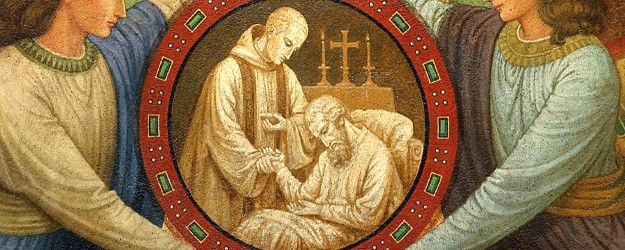
Who Administers Anointing of the Sick and Why?
Question Two: Why can’t deacons perform the sacrament of the anointing of the sick?
Answer: The question of why Roman Catholic deacons cannot perform the sacrament of the Anointing of the Sick touches on the very heart of sacramental theology, particularly the Church’s understanding of Holy Orders, the nature of the sacraments, and the priesthood of Christ. The Catechism of the Catholic Church is explicit on this point: “Only priests (bishops and presbyters) are ministers of the Anointing of the Sick. It is the duty of pastors to instruct the faithful on the benefits of this sacrament” (CCC §1516). This means that the Church restricts the celebration of this sacrament to bishops and priests alone.
The theological reason for this restriction lies in the connection between the Anointing of the Sick and the forgiveness of sins. The sacrament is not merely a prayer for physical healing but carries within it an intrinsic link to absolution. The Letter of James provides the biblical basis: “Is any among you sick? Let him call for the presbyters of the Church, and let them pray over him, anointing him with oil in the name of the Lord; and the prayer of faith will save the sick man, and the Lord will raise him up; and if he has committed sins, he will be forgiven” (Jas 5:14–15). The text is clear that it is the presbyters — the priests — who are summoned for this ministry, not deacons. Since the sacrament involves forgiveness of sins, even in cases where a dying person cannot make a formal confession, it requires the sacramental power of the priest, who alone is configured to Christ the High Priest in this way.
Catholic theology of Holy Orders further clarifies this distinction. The sacrament of Orders has three degrees: deacon, priest, and bishop, and each participates in the priesthood of Christ differently. Deacons are configured to Christ the Servant (Christus Servus). They can baptize, proclaim the Gospel, preach, and witness marriages, but they cannot consecrate the Eucharist, absolve sins, or anoint the sick. Priests, by contrast, are configured to Christ the Head (in persona Christi capitis) and act in His person to consecrate the Eucharist, forgive sins, and administer anointing. Bishops possess the fullness of the priesthood, with the authority to ordain and govern. Deacons, therefore, do not receive the sacerdotal character that grants the authority to absolve and anoint.
The Church’s historical practice confirms this theology. As early as the fifth century, the Council of Orange (441 AD) explicitly declared that deacons may not administer anointing. This prohibition was reaffirmed at the Fourth Lateran Council (1215) and again at the Council of Trent (1551), which taught: “This sacred unction of the sick was instituted by Christ our Lord as truly and properly a sacrament of the New Testament . . . and its proper ministers are the priests of the Church.” Thus, tradition has consistently affirmed that the sacrament is reserved to priests.
This restriction does not diminish the important pastoral role of deacons in caring for the sick. Deacons may visit the ill, bring Holy Communion, proclaim Scripture, and lead prayers for the dying. They may also administer viaticum — the Eucharist given to the dying as spiritual sustenance for the journey to eternal life. In this way, deacons participate in the Church’s ministry of comfort and presence, even if they do not administer this particular sacrament.
 About Rev. John P. Cush, STD
Lay ministers as well as deacons may also visit the sick, proclaim Scripture to them, administer Communion, and pray. This includes those of us who are women.