
The Diaconate and Marriage. By Deacon James Keating. Reviewed by Deacon Dominic Cerrato (skip to review)
Sacred Music: A Preface to Christian Art and Music. By Charles Scribner III. Reviewed by Fr. John J. Conley, S.J. (skip to review)
Lectio Divina with the Spiritual Masters: The Gospel of John with St. Augustine. By Peter A. Heasley. Reviewed by Sr. Maria Veritas Marks, O.P. (skip to review)
Get Married: Why Americans Must Defy the Elites, Forge Strong Families, and Save Civilization. By Brad Wilcox. Reviewed by Fr. Anthony Lusvardi, S.J. (skip to review)
Some of the Words Are Theirs: The Art of Writing and Living a Sermon. By Austin Carty. Reviewed by Colin May. (skip to review)
The Diaconate and Marriage – Deacon James Keating
Keating, Deacon James. The Diaconate and Marriage. Huntington, IN: Our Sunday Visitor, 2025. 120 pages.
Reviewed by Deacon Dominic Cerrato
 Deacon James Keating’s The Diaconate and Marriage is a thoughtful, heartfelt, and deeply moving book that helps readers understand how the grace of marriage and the grace of Holy Orders come together in the life of a married deacon. What makes this work especially powerful is the way Keating speaks about very real spiritual challenges and hopes in terms that are accessible to ordinary Catholics, while still drawing on the depth of the Church’s theological tradition. His writing opens a window into how God works through the ordinary rhythms of marriage and ministry, helping husbands and wives discover Christ’s presence in the very center of their lives.
Keating begins by showing that marriage and the diaconate are not simply two separate callings. Instead, when these sacraments meet in one man, they form a living sign of Christ. In his words, “When the sacraments come together in this way, a married deacon becomes a sign of Christ’s own spousal commitment even unto death and a sign that such love for wife and Church . . . manifests itself in concrete service to his wife’s real needs and the real needs of parishioners.” This simple but profound insight becomes the backbone of the entire book.
To explain why the married deacon’s life is so meaningful for the Church, Keating roots his reflections in the very heart of God. He writes, “God is an eternal circulation of love within a relational bond of persons: Father, Son, and Holy Spirit.” For Keating, the diaconate only makes sense when viewed through this lens. Christ’s service on earth constantly flowed out of His relationship with the Father and the Spirit. “Every act Christ performed drew its beginning and purpose from His relatedness to the Divine Persons of the Holy Trinity.” This means that diaconal ministry is not simply a list of duties or activities. It is a sharing in Christ’s own heart, His own way of loving.
Much of the book focuses on the interior life, because Keating believes deeply that a deacon’s worth is not measured by how busy he is, but by how united he is to Christ. For Keating, prayer is not simply an obligation. It is the very place where a deacon allows Christ to love through him. He even writes that Christ “did not simply enter prayer with His Father but, in fact, became prayer.” The more a deacon is drawn into this mystery, the more he begins to serve his spouse, his parish, and the poor out of a love that is no longer merely his own.
Keating’s writing on marriage is particularly beautiful. He meditates on how romantic love awakens the human heart and shapes a husband to become more selfless, noting, “Love brings us to life. Romantic love is an ecstasy with a cross buried in it.” That image captures the whole book: joy and sacrifice woven together. Keating shows how marriage gradually forms a man into one who gives himself away, and this forms the very foundation of diaconal service. It is not surprising, then, when he writes with great clarity, “Becoming Christ is the vocation of a husband.” The wife, too, participates in this mystery by receiving his love and offering her own in return.
One of the most compelling parts of the book is Keating’s treatment of discernment. He approaches this topic with realism and honesty, acknowledging that not all men are ready for holy orders. He offers one of the most practical and pastorally sensitive sets of questions a diocese could ever give to a wife during her husband’s discernment. Instead of assuming enthusiasm, he encourages wives to reflect deeply on their husband’s character, prayer life, and readiness for ministry. His concern is not institutional efficiency but the flourishing of marriage.
Keating also warns against confusing recruitment with vocation. The Church, he insists, does not simply need more deacons. She needs holy ones. A vocation is not the result of filling a parish need. It is born of Christ’s personal call in prayer. As he writes, the men the Church needs are those who feel “wonder, surprise, humility, and awe that their prayer life has led them to desire attachment to the word of God and the altar.”
The book goes on to explore diaconal formation with great depth. Keating uses the dramatic phrase “ending of idol worship” to describe what happens during authentic formation. He explains that idols are anything we turn to instead of God when we are hurting or looking for comfort. But through grace, “the couple has turned from any idols still lingering in their lives.” He describes how husbands and wives can grow together spiritually during this time, sometimes experiencing powerful conversions by witnessing each other’s transformation.
Keating is also sensitive to the pressures faced by younger couples, especially those with children. He encourages flexible formation programs that welcome men in their thirties and forties, noting that young families should not be excluded because of logistical challenges. In fact, he believes that vibrant, younger vocations enrich the entire diaconate and bring new life to diocesan communities.
The book includes several reflections on the Eucharist that are especially moving. Keating emphasizes how the Mass shapes both marriage and ministry, describing it as a place where spouses learn to hold one another “lightly,” not because love fades, but because it leads them into an even deeper trust that “life and love go on.” He writes that in the Mass, spouses glimpse the truth that “our spouses are not the Source; rather, our spouses reflect the Source’s desire for us.” This contemplative vision brings together the whole spiritual journey of married life.
Perhaps the most accessible and popular part of the book is the way Keating describes the daily life of a deacon as a life of hope, love, and self-gift. He draws on Scripture such as Galatians 2:20, “I have been crucified with Christ, yet I live, no longer I, but Christ lives in me,” to show how all Christian life is meant to be transformed. A married deacon, he says, becomes a sign that ordinary family life is filled with extraordinary grace.
Finally, Keating ends the work by lifting the reader’s eyes back to Christ. The purpose of marriage, diaconate, and formation is ultimately the same: to grow in holiness and to give oneself completely to God. He beautifully summarizes this movement by writing that, through grace, God will give married couples and deacons everything they have always longed for: “All I have ever wanted was You.”
Overall, The Diaconate and Marriage is a rare book, one that is spiritually rich, theologically grounded, and written in a style that invites both heart and mind to draw closer to Christ. It offers guidance for deacons, spouses, formation directors, and anyone who wants to understand the beauty of these two sacraments working together. Keating gives the Church not only a theological study but a pastoral companion, a book that speaks to real marriages, real ministries, and real hopes. It is a book that will continue to shape the diaconate for years to come.
Deacon Dominic Cerrato, Ph.D., is Director of the Diaconate for the Diocese of Joliet. In 2020, he was appointed by Pope Francis to an international papal commission to study the question of women and the diaconate.
Sacred Music – Charles Scribner III
Scribner, Charles III. Sacred Music: A Preface to Christian Art and Music. Lanham, MD: Rowman & Littlefield, 2023. 119 pp.
Reviewed by Fr. John J. Conley, S.J.
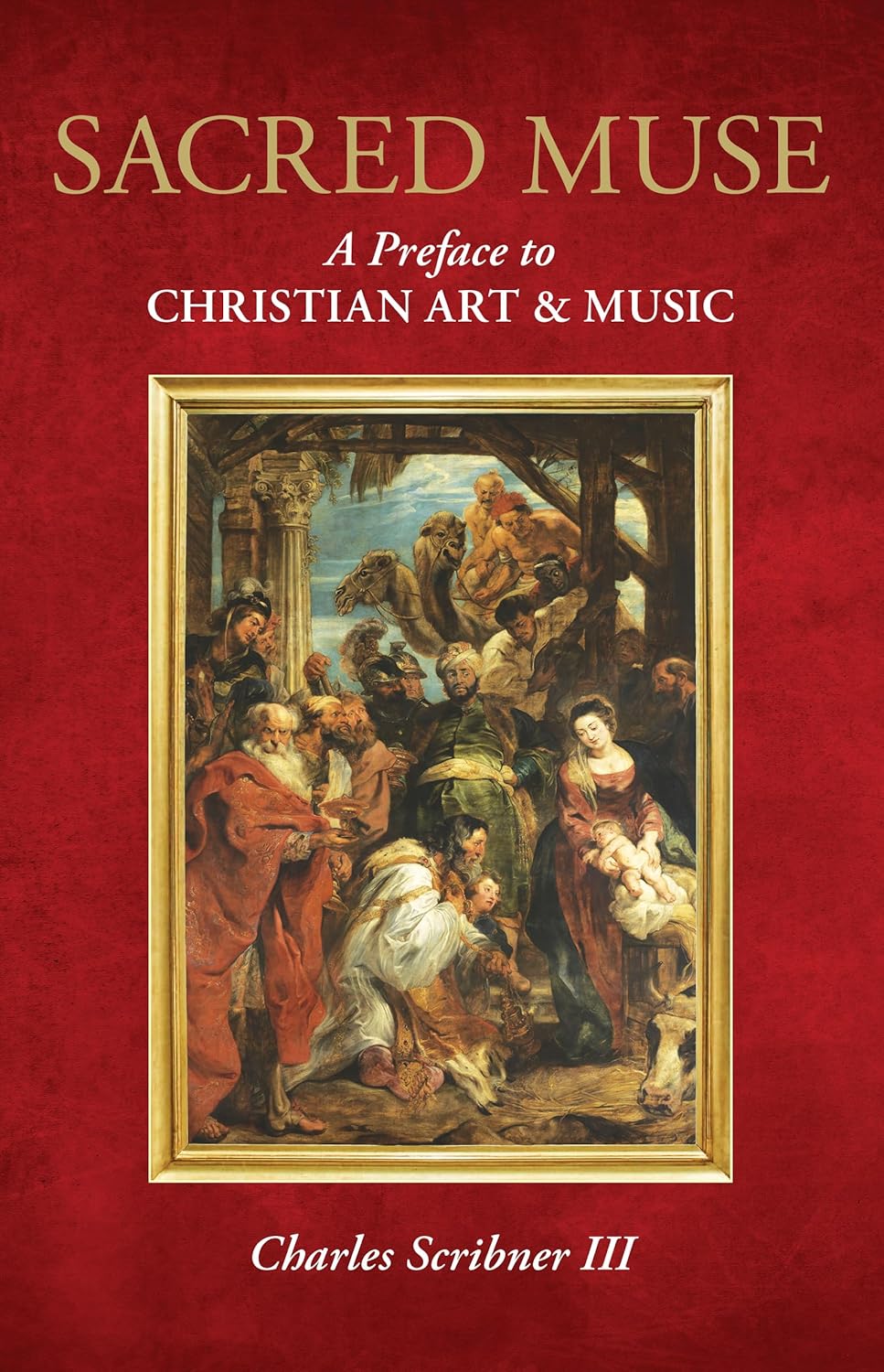 In this brief work, Charles Scribner (a member of the celebrated Scribner publishing family) studies Christian art from the perspective of the Judaeo-Christian doctrine of creation. While this is not an original perspective, Scribner brings an unusual theological sophistication to his analysis of the masterpieces of Christian visual art and music. The hardy perennials of Christian art, such as Michelangelo’s Pietà and Bach’s oratorios, pass in review but Scribner also studies the theological fire in such offbeat works as the Ave Maria in the opera Otello by the anticlerical composer Verdi and Louise Nevelson’s abstractionist Good Shepherd Chapel in the old Citicorp Building in Manhattan.
Scribner’s analysis is especially strong in his presentation of early modern Catholic painting and music. A specialist in the work of Rubens (Scribner published a monograph on him in 1989), Scribner maps the theological complexity of Rubens’s religious paintings. He offers a particularly fine interpretation of Rubens’s Adoration of the Magi, designed to hang behind the high altar in the Norbertine Church of Saint Michael in Antwerp. The painting actually transforms the biblical subject matter by inserting the narrative of eucharistic sacrifice into its narrative. “Rubens’s iconography — his language of images — reflects the liturgical function of the altarpiece as backdrop to the celebration of the Mass. Unlike the artist’s earlier versions and his preliminary modello, the foremost king now no longer offers gold; he is now robed in splendid ecclesiastical vestments as though he were a priest kneeling before the sacrament of the altar. The Virgin is rotated to a frontal view as she displays the body of Christ, whose reclining pose prefigures the Pietà. The close association of nativity and death was common throughout early Netherlandish altarpieces, which likewise employed ‘disguised symbolism’ in the straw (bread), the ox (sacrifice), and the wooden crate with white cloth (altar), together alluding to the Eucharistic sacrifice of the Mass.” Scribner points out that originally the painting was framed by statues celebrating the triumph of truth over falsehood: Saint Michael defeating Satan, the Blessed Virgin Mary crushing the serpent, St. Norbert vanquishing the heretic Tanchelm, a medieval denier of transubstantiation in the Eucharist. The criticism of Protestantism (with its own denial of transubstantiation) and the affirmation of the Catholic doctrine of the Eucharist would not be lost to a viewer in the quarrels of the Counter-Reformation.
Scribner offers an equally penetrating analysis of the religious music of Joseph Haydn. In Haydn’s oratorio The Creation, Scribner describes the orchestral tumult that announces the divine creation of the world. “ ‘I was never so religious as during the composition of The Creation. Daily I fell on my knees and asked God for strength’ . . . At the climactic moment of Creation — the thunderous, exalting fortissimo of chords that accompany and overwhelm the words of God’s command — ‘Let there be light’ — Haydn was himself so deeply moved that he confessed that ‘It was not I, but some Power above that created that.’” Scribner’s empathy for the authors of the artworks he describes is omnipresent in his excavation of the theological soul of the masterworks he analyzes.
When Scribner looks for sacred art in the contemporary world, he admittedly finds a spiritual desert. Matisse’s chapel at Vence and Poulenc’s Dialogues of the Carmelites are rare exceptions to the rule. He rightly praises Pasolini’s The Gospel According to St. Matthew as a cinematic masterpiece. This austere black-and-white film, with its amateur actors and trick photography to portray miracles, has no dialogue other than the text of Matthew’s gospel itself. Its unvarnished version of the gospel trumps the lurid technicolor biblical epics Hollywood flooded on the world at mid-century. The fall from Rubens to Rupnik is a steep and appalling one.
Rev. John J. Conley, S.J., Ph.D., holds the Knott Chair in Philosophy and Theology at Loyola University Maryland.
Lectio Divina with the Spiritual Masters – Peter A. Heasley
Heasley, Peter A. Lectio Divina with the Spiritual Masters: The Gospel of John with St. Augustine. Gastonia, NC: TAN, 2025. 224 pages.
Reviewed by Sr. Maria Veritas Marks, O.P.
 “Of You we must ask, in You we must seek, at You we must knock. Thus only shall we receive, thus shall we find, thus will it be opened to us.” This prayer with which Augustine ends his Confessions reflects the primacy of God in granting understanding of truth and insight in prayer. It is clearly a guiding principle for the creators of TAN Books’ 2025 The Gospel of John with St. Augustine, first in their series of Lectio Divina with the Spiritual Masters. The second in the series, The Gospel of Matthew with St. John Chrysostom, followed five months later, in September of 2025.
The book is a lovely and inviting object; readers will appreciate its rounded page corners, embossed cover, and elegant red titling and black and red designs. They will also notice the plentiful space provided for personal note-taking.
The book covers the entire Gospel of John, chunked into passages of between five and twenty verses. Each passage receives about four pages, which comprise the Biblical text and Augustine’s insights — helpfully culled from his sermons by Fr. Peter Heasley — further thoughts for the meditatio step of lectio, a few thoughtful questions to prompt oratio, and at least one entire blank page for the journaling that may accompany contemplatio.
Fr. Heasley, currently pastor of the Parish of Corpus Christi and Notre Dame in New York, chaplain at Columbia U., and professor of Scripture at St. Joseph’s Seminary in Yonkers, is a native of Detroit and holds a licentiate and doctorate in Biblical Theology from the Pontifical Gregorian University in Rome. His book brings together three of the most powerful aids to prayer we have: Scripture itself, the monastic practice of lectio divina, and the wisdom of St. Augustine.
It joins a growing wave of new Catholic resources for Scriptural study and Scripturally inspired prayer, resources that are faithful to the Magisterium, immersed in the Church’s tradition, and open to the Spirit; other examples are the Catholic contributions to the Brazos Theological Commentaries on Scripture, the Catholic Commentary on Sacred Scripture, and Michael Pakaluk’s new translations and commentaries on the Gospels of Matthew, Mark, and John.
TAN’s volume uses the Douay-Rheims translation of the Bible, which is archaic and does not align with the NAB with which the Lectionary has familiarized us; nevertheless, this book will be helpful for laity and pastors alike and may especially offer priests some fresh takes for Year B’s summer of Sunday readings from John 6.
The book’s blank pages for contemplatio, so unusual in modern publishing, reflect — and in turn may encourage — a reverence for the value of the intangible; this is a book one can pray with, that leaves space for the Spirit.
Sr. Maria Veritas Marks, O.P., is a Dominican Sister of Mary, Mother of the Eucharist. She has taught theology for ten years at the high school and college levels and holds a PhD in systematic theology from The Catholic University of America.
Get Married – Brad Wilcox
Wilcox, Brad. Get Married: Why Americans Must Defy the Elites, Forge Strong Families, and Save Civilization. New York: Broadside Books, 2024. 293 pages.
Reviewed by Fr. Anthony Lusvardi, S.J.
 Marriage is among the most important social justice issues of our day. Classic Catholic social teaching — think Leo XIII in Rerum Novarum — has long recognized the connection between social well-being and a family life built on marriage. As Brad Wilcox points out in Get Married: Why Americans Must Defy the Elites, Forge Strong Families, and Save Civilization, “questions of marriage and family” are better predictors of positive or negative social outcomes than “race, education, and government spending” (xiv). Yet even in Catholic circles, questions of marriage and sexual ethics are often treated not as issues of pressing social concern, but as matters of private morality — or dismissed as “cultural issues.”
Such dismissiveness has little theological basis. And Wilcox — a professor of sociology and the director of the National Marriage Project at the University of Virginia — demonstrates that it is even harder to justify from a sociological point of view. Marriage is good both for society as a whole — a higher percentage of married parents correlates with lower child poverty (73) — and for individuals, both men and women, who report higher rates of happiness, find more meaning in their lives, and are less lonely than their unmarried — and childless — peers (51–52, 115, 121).
While Wilcox’s book is meticulously argued and his claims supported with abundant data and nuanced analysis, Get Married does not assume a neutral stance. The book’s title is an imperative. While Wilcox acknowledges that marriage is not for everyone, he aims to deconstruct many of the popular myths that undercut marriage in contemporary American culture, taking aim at the misogynistic influencer Andrew Tate (ix) as well as feminist columnists who describe children and commitments as burdens (113). Being a part of a larger, future-oriented project that involves commitment and sacrifice, it turns out, is more satisfying in the end than a perpetual adolescence.
One of the ironies the book identifies is the “reverse hypocrisy” of today’s secular elites (218). When it comes to their own lives, upper-crust and educated Americans live traditional family lives — married mother-father households — while promoting a progressive ideology of “family diversity.” The elites can ignore the social consequences of this ideology because they don’t follow its tenets themselves.
Wilcox dedicates a number of chapters to explaining the decline in marriage among the general population — especially the working class — over the past several decades, locating the roots of the problem in the highly individualistic, pro-divorce ethos of the 1970s. He dissects claims bandied about in the popular media that tend to undermine the value of marriage and family — the “soulmate” myth; that “love” and money are better indicators of success than family structure; that children mean the end of happiness; that spouses ought to put their own needs before family; that gender makes no difference when it comes to marital roles.
The tone of the book, however, is not set by the cultural failures of recent decades. Wilcox analyzes certain subgroups in American culture that have maintained strong marital cultures: Asian Americans, conservatives, religious believers, and what he calls “strivers” — the educated classes who walk the walk of a traditional lifestyle even if they talk the usual rainbow-colored pieties. A significant number of strivers are the children of divorce reacting against the “easy come, easy go marital ethics of so many of their parents” (xxi).
Throughout the book, Wilcox provides insights into those habits and attitudes that tend to contribute to stable marriages, making it valuable for those involved in pastoral ministry with married couples. At a time when the Church’s understanding of marriage can no longer be taken for granted — and is often loudly opposed — Catholic leaders must be more proactive in articulating and advocating our teaching. Wilcox’s book is a valuable resource to help us do so. With cultural headwinds against us, we are sometimes at risk of unconsciously adopting a narrative in which Christianity’s marital ethic is seen as unrealistic and curmudgeonly. Wilcox exposes the deception of this trap: the evidence shows that no group of Americans is happier than husbands and wives who share a common faith (227). And no institution is more essential for the well-being of children, as a bulwark against poverty, or for the future of society.
If you want justice, work for marriage.
Fr. Anthony R. Lusvardi, S.J., teaches sacramental theology at the Pontifical Gregorian University in Rome. He is the author of Baptism of Desire and Christian Salvation (Catholic University of America Press).
Some of the Words Are Theirs – Austin Carty
Carty, Austin. Some of the Words Are Theirs: The Art of Writing and Living a Sermon. Grand Rapids, MI: Wm. B. Eerdmans Publishing Co., 2024. 135 pages.
Reviewed by Colin May.
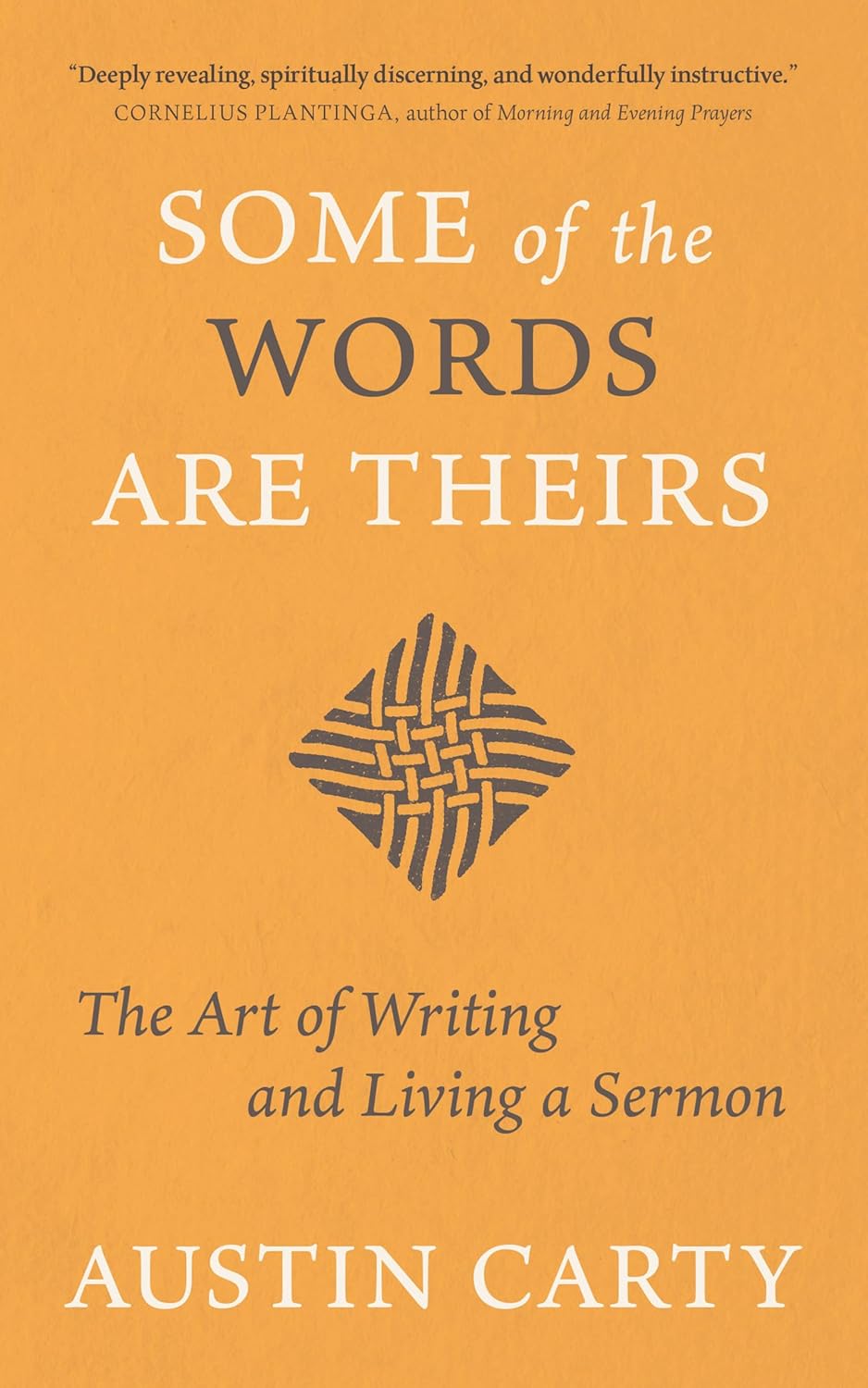 Survivor television contestant turned Baptist preacher Austin Carty delivers a short yet insightful book on writing a homily (or sermon, or spiritual reflection). Carty, who holds a Doctor of Ministry degree from Emory University, believes that our sermons often reflect the people with whom we are most associated. This perspective comes from his close examination of the 500 sermons he has written. His evaluation demonstrates how his personal process has changed over time and how what was happening around him influenced his preaching.
Carty reminds us that we must cooperate with the Holy Spirit to bring the Gospel message. His subtitle notes that we are to live the sermon we preach as role models. There is a raw openness to the stories that Carty tells of his own upbringing and life, particularly regarding his parents and his father’s alcoholism. The stories can feel like a personal documentary. Carty acknowledges this when he quotes Presbyterian writer and theologian Frederick Buechner, who surmised that all theology is autobiographical. Over the course of the book, it brings a sense of realism and understanding of how life — and those we interact with the most — shape our sermons. We must acknowledge that those closest to us and those we interact with, even momentarily, can have an enormous influence on our preaching.
The New Testament is replete with stories of real people, real struggles, and real faith, a reality Jesus encountered often in his ministry. Jesus worked to teach, preach, and heal these people and bolster their faith. This is the goal Carty encourages us to aim for as we preach the Gospel message of faith, hope, and love in meaningful homilies.
Throughout the 135 pages, Carty provides compelling examples and useful standards to employ in the service of preaching the Gospel. Over three phases — the preparation, the drafting, and the revising — Carty proposes 18 unique aspects to consider in writing the homily. Spending time with the table of contents alone will prove valuable as you reflect on your homily writing process.
The preparation, while the shortest in page count, is most important for Carty. Setting aside the proper time is needed to prayerfully reflect and discern the message we are being called to deliver. He provides thoughts on the setting and disciplines needed to write effectively, telling us that homily writing is like swimming in a river: you need to know where you are in the flow so you don’t sink. This is critical to budgeting time amid all the typical priestly constraints, including meetings, hospital visits, home calls, and daily Mass.
He spends six chapters on the process of writing the homily itself, including developing an opening (a “hook”) using a metaphor or illustration that engages the congregation from the beginning. The importance of keeping the main idea concise is underscored repeatedly.
The chapters on the revision process may be the most helpful and provide very practical ideas to remove excess or distractions that limit the listener’s ability to grasp the core message. Carty provides useful guidance, including a series of questions in several chapters which are excellent reflection points to assess our work.
A product of his generation, Carty is well-versed in the issues of today and includes a chapter on the societal secularization and polarization, and how preachers navigate that tension to spread the Gospel message. He writes, “One does not have to be combative as a preacher to be prophetic, and one does not have to shy away from social issues to remain orthodox. In fact, one never knows what the Spirit might do in the world if we will remain faithful to them both” (75).
Given that Carty belongs to a non-Catholic tradition, Catholic readers may notice some gaps, including relatively few scriptural references and a lack of citation of the wisdom of papal and episcopal teaching on the topic. However, that does not dimmish the importance and insight it provides. Carty’s life story is intertwined with his thoughts on sermon-writing, which reminds us that, no matter our vocation, we are human, with human feelings, fears, and foibles.
Members of the congregation are experiencing these emotions as well, and we can use those themes — which often occur in the Gospels — through our homilies, reflections, and sermons to share the Good News of Jesus Christ in our time and place.
Austin Carty’s work validates the idea that we are preaching to a specific congregation, in a unique location, at a specific time in history. The voices that echo in our heads and hearts are important to bring forth, because they represent the people of God and their hopes, needs, and challenges. Our sermons should faithfully contemplate those voices in bringing Christ’s message of salvation — allowing the Holy Trinity to shine through.
Colin May is a Catholic writer and speaker and has been a lector, an OCIA leader, and a second-grade catechist, among others. He blogs at preachingleadership.blogspot.com/
 About Book Reviews
During my diaconate formation, in the 1980s, the priests putting the program together decide to invite an Evangelical minister to teach homiletics. It did not go well. The gap between the Protestant tradition, which centers worship on the sermon, as opposed to the Eucharist in the Catholic Mass, was all too visible. In part, perhaps, because he did not understand the Catholic tradition, he emphasized the evangelical function of the sermon in his tradition. Each sermon tends to have the same structure, like the first days of a Jesuit-led retreat. Sin-Kerygma-Repentance-Altar Call. The problem of course, is in that tradition, there is only one altar call. After that, a person is saved; his or her responsibility is to lead others to the same experience. The Catholic tradition doesn’t end with a once-and-for-all altar call, but the repetition of the liturgy that leads the person and the community into deeper relationship with Christ through Word and Sacrament, to be lived out in the larger world as a witness to the kerygma.