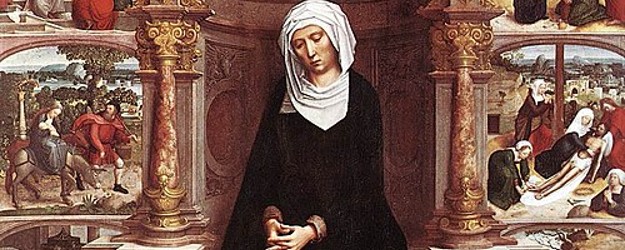
For September 6, September 13, September 14 (Exaltation of the Cross), September 15 (Our Lady of Sorrows), September 20, and September 27
Twenty-third Sunday in Ordinary Time – September 6, 2026
Readings: Ezekiel 33:7–9 • Psalm 95:1–2, 6–7, 8–9 • Romans 13:8–10 • Matthew 18:15–20
bible.usccb.org/bible/readings/090626.cfm
This Sunday’s Gospel passage presents us with something quite uncomfortable: the principle of fraternal correction. Fraternal correction is the art of charitably correcting or reproving another person for their sin and helping to move them to conversion. It runs contrary to our hyper-individualistic culture which admonishes us to “mind our own business” or “stay in our lane.” By contrast, fraternal correction assumes that we are responsible for each other (and we are!). We ought to take note of several important facets of this art:
First, we must engage in fraternal correction. Uncomfortable as it may be, it is an expression of charity. The first reading from Ezekiel explicitly tells us that if we do not dissuade a wicked person from his way, the wicked person will die, but God will hold US responsible for his death. If, on the other hand, we try to dissuade a wicked person from their evil ways and they still do not listen, the wicked person will surely die, but we will be saved. Therefore, no one can excuse themselves from engaging in fraternal correction, as if to say, “That’s none of my business. I’m staying out of it.” We have a responsibility for one another because we are all members of the same Body of Christ. To overlook or ignore another’s sin, says Ezekiel, can get be perilous!
Second, fraternal correction must be regarding sin. Fraternal correction does not apply to tastes or preferences, but to sins. Jesus says, “If your brother sins against you . . .” It is tempting to correct someone under the guise of fraternal correction, when in fact, the infraction involves nothing sinful. But we should not take this so far as to ignore actions that show a lack of prudence. After all, prudence is a virtue and imprudent behavior can be sinful. Moreover, there is always an allowance for fraternal correction when it involves things such as etiquette infractions. Whenever brutish behavior (which is often tied to a lack of charity) is observed, individuals are well within their rights and duties to address such behavior in a kind and loving way.
Third, the art of fraternal correction must be respectful. Not only must correction be done in a spirit of charity, the Gospel passage also warns us that it should be done in privacy. This protects the reputation of the offender and avoids further embarrassment. If that proves fruitless, then others may be brought in to collaborate the correction. If that does not suffice, the matter should be referred to the Church and if that does not satisfy, the person may be penalized by the Church — what Jesus means by treating the offender as a tax collector or Gentile. In canon law, this can include the penalty of excommunication.
It should be noted here that excommunication is a medicinal penalty. It is intended to heal and restore the sinner. The media portrays it as a form of Catholic capital punishment. It is not. In an excommunication, the offender is given time to repent. If they refuse, they are barred from the sacraments, because their participation in the sacraments presents a scandal to Catholics who observe the teachings of Christ and endangers the soul of the person excommunicated. And yet, even an excommunicated person can always return to the Church if they make proper penance and restitution.
St. Paul reminds us, “Love does no evil to the neighbor.” Fraternal correction, when done properly and charitably, is tough love, but love nonetheless. Love, in the writings of St. Thomas Aquinas, is defined as “willing the good of the other as other.” It is no act of love to allow sinners to persist in their evil ways. It is a heroic love to confront the sinner while admitting one’s own sinfulness and having the courage to help move the sinner to repentance and conversion.
Twenty-fourth Sunday in Ordinary Time – September 13, 2026
Readings: Sirach 27:30—28:7 • Psalm 103:1–2, 3–4, 9–10, 11–12 • Romans 14:7–9 • Matthew 18:21–35
bible.usccb.org/bible/readings/091326.cfm
At the outset of the Gospel passage, Peter tries to impress Jesus by offering to forgive his brother seven times. In response, our Lord raises the bar — he tells Peter to forgive always, without counting the number of times. In recent history, the drama of the “eye for an eye and a tooth for a tooth” philosophy has continued in the Holy Land and other places that experience the spiral of recurring conflict and perpetual animosity.
When considering the theme of Christian forgiveness, we might observe the following: First, the reason why we need to learn to forgive others is because we are debtors to God. When we pray the Our Father, we ask God to forgive our sins as we forgive those who sin against us. Considering how slow or unwilling we can be to forgive others at times, we might ask if we really want God forgiving us as we sometimes fail to do. Furthermore, Christian forgiveness can only transpire when we rely on the Lord’s grace to show mercy. Whenever we struggle to forgive, it is imperative that we allow ourselves to participate in the logic of Divine Mercy. In his apparitions to St. Faustina, our Lord reminds us that the greater the sin, the greater the sinner’s claim on God’s mercy. This is the exact opposite of the legal justice system, which is always punitive when it comes to infractions. Genuine Christian forgiveness does not come from us — it comes from the Lord, who invites us to participate in his divine elixir.
Second, we might ask if we are called to forgive and forget. There are many pop songs that tell us to do as much. And yet, God doesn’t! Christian mercy tempers strict justice without ignoring legitimate justice claims. The master of the servants (representing the Father) in the parable forgave the wicked servant but did not forget the wicked servant’s previous debt upon learning of the wicked servant’s lack of forgiveness of a fellow servant who owed much less. Purgatory is evidence that God forgives us by not sending us to hell (thank God) and yet He does not forget that we owe him restitution for the sins of our past and detachment from our past sins — part of the price we pay in purgatory.
Third, we observe that certain types of forgiveness are easy — overlooking another’s faults or looking beyond a momentary hurtful word. And yet other types of forgiveness are more difficult — forgiving those who have so deeply hurt us and yet don’t see their sin and don’t even see that they need to apologize. Or forgiving those who have committed serious crimes against us or our loved ones. And while we seek equity and justice that will lead to peace, even if that sometimes means armed conflict to guarantee our security, we must aspire to rise above an “eye for an eye and tooth for a tooth” mentality. The Lord always calls us to the moral horizon of the peacemakers he extols in the Beatitudes.
Lastly, we recall that the command is to forgive those who sin against us “from the heart.” This is significant. In some cases, it is impossible to be reconciled to an individual in-person. Perhaps they are deceased. Perhaps they are incarcerated and difficult to contact. Perhaps they are a danger (physically or spiritually) to us. Or perhaps there is some other insurmountable obstacle that prevents an in-person reconciliation. But we can still forgive those persons from the heart, even if we never get to say the words.
In the end, we know that genuine forgiveness is possible in and through Christ. It is not only a gift we give to others (when we need to forgive) — it is also a gift we give to ourselves. Might we aspire to the Beatitude that promises that those who are merciful will receive the Lord’s deep and abiding mercy in this life and in the next.
Exaltation of the Holy Cross – September 14, 2026
Readings: Numbers 21:4b–9 • Psalm 78:1bc–2, 34–35, 36–37, 38 • Philippians 2:6–11 • John 3:13–17
bible.usccb.org/bible/readings/091426.cfm
It was a cruel death, really. There was absolutely nothing glamorous about death by crucifixion. Invented by the Persians and perfected by the Romans, crucifixion was not only terribly agonizing but totally humiliating for the victim and his family. The crucified were always displayed at prominent entries to a city as a warning to passers-by that any insubordination to Roman authority could mean a similar fate.
Historians tell us that our Lord probably died, not from blood loss, but from asphyxiation. When hung in the crucified position, the victim would have to pull himself up by his arms and by pressing down on his feet to keep his lungs open. Christ’s crucifixion was rather unusual because He was nailed to a Cross — most victims were tied to their cross and could languish in utter agony for up to three days, fighting for every breath to stay alive. So, our Lord had to pull himself up by his nailed arms and push down on his nailed feet for three hours just to breath. This was the distance he was willing to go in order to redeem us!
And as agonizing as physical torture was, we know that this paled in comparison with the sense of abandonment that Christ felt in his human nature. More agonizing than the defilement of his body was the sense of feeling totally isolated from the Father. This is why he cries, “My God, my God, why have you abandoned me?” (Psalm 22) Jesus was not willing to go the distance for us only by means of physical torture — he wanted to identify with us in every way that we suffer, including that of feeling a sense of despair and hopelessness. Isn’t it our experience that far more painful in life than the wounded body is the broken heart, the sense of rejection, the emptiness of death, and the loneliness that we each experience?
And as if that were not enough, several Church Fathers write that the greatest pain the Lord experienced in his human soul was the poignant realization that while he was suffering, it would mean nothing for those who would refuse to accept Him in faith. It’s not that the Lord’s once and definitive atoning sacrifice was lacking. Instead, it would be man’s obduracy of heart that would prevent its true efficacy in the subjective lives of individuals. Hence, the Lord’s broken heart was not caused simply by a lance — it was born of utter rejection or indifference to what he was accomplishing. And yet, he chose to do it so that at least a few might be saved.
As Christ hung from the Cross, he was pierced with a lance, releasing water and blood, symbols of baptism and the Eucharist. This act of brutality unlocked for us the two most fundamental sacraments of the Church: baptism and the Eucharist. This connection between Christ’s wounded side and the two most fundamental sacraments of the Church is captured in a unique altar piece in a parish church outside of Madrid. Atop the altar of repose is a life-size marble statue of Christ lying on his back, covered with a shroud. At the torso area, one can see the faint outline of the tabernacle doors. To turn the key which opens the tabernacle doors, the priest must literally reach into the side of Christ. By reaching into the statue’s side, the priest unlocks the key to our union with Jesus — the Eucharist. It is a beautiful depiction of how the blood and water that flowed from Jesus on the Cross continues to nourish us as spiritual food.
O glorious Cross — one of the great paradoxes of our Faith! In you, we see glory in suffering; triumph in desolation. The tree which bore the fruit of Adam and Eve’s sin is suddenly replaced with the tree of life and redemption in the Cross. The disobedience of our first parents is reversed by Mary’s fiat at the Annunciation and Christ’s obedience unto death at Calvary. O glorious Cross, in your horizontal beam, you teach us to love one another, and in your vertical beam, you teach us that we must love God first above all things, above any creature — yes, even ourselves and our loved ones, for it is love for you that guides and directs all other loves. In the end, o glorious Cross, you teach us that love conquers hate, that good conquers evil, and that by dying with you, we will be raised to life everlasting. We adore thee, O Christ, and we bless thee, because by thy Holy Cross, thou hast redeemed the world!
Our Lady of Sorrows – September 15, 2026
Readings: 1 Corinthians 12:12–14, 27–31a • Psalm 100:1b–2, 3, 4, 5 • John 19:25–27
bible.usccb.org/bible/readings/091526.cfm
A day after the Exaltation of the Holy Cross and at the completion of the Octave of the Nativity of the Blessed Virgin Mary, we celebrate the Memorial of Mater Dolorosa (aka Our Lady of Sorrows). The seven sorrows or dolors of Mary are:
- The Prophecy of Simeon. (Luke 2:34–35)
- The Escape and Flight into Egypt. (Matthew 2:13)
- The Loss of the Child Jesus in the Temple of Jerusalem. (Luke 2:43–45)
- The Meeting of Mary and Jesus on the Via Dolorosa.
- The Crucifixion of Jesus on Mount Calvary. (John 19:25)
- The Piercing of the Side of Jesus, and His Descent from the Cross. (Matthew 27:57–59)
- The Burial of Jesus by Joseph of Arimathea. (John 19:40–42)
This memorial commemorates the unparalleled human sufferings experienced by the Virgin Mary in her unique role with Jesus in the mission of redemption. In paragraph 25 of Salvifici Doloris (On the Meaning of Christian Suffering), Pope St. John Paul II describes these shared sufferings by Christ’s Mother, particularly during their climactic moments at the foot of the cross, as reaching an “intensity which can hardly be imagined from a human point of view, but which was mysteriously and supernaturally fruitful for the redemption of the world.”
The Church calls us to ponder the sufferings of our Sorrowful Mother, to more deeply appreciate the sacrifice the Virgin of Nazareth endured. Through this suffering, she became the spiritual mother of all peoples, as designated by her crucified Son: “‘Woman, behold your son!’ . . . ‘Behold, your mother!’”
We too are called to enter the mystery of the passion of Christ and the compassion of Mary, to join our sufferings with theirs, in order to mysteriously release the graces of redemption for the many spiritual needs of the Church and world. It is hard to conceive of a mother that does not suffer when her children suffer. Indeed, the maternal heart of Mary continues to suffer mystically in virtue of her role as the spiritual Mother of all peoples amid the dangers and trials facing the human family.
Mary’s sufferings, alongside those of our Lord, provide us with a crucial spiritual insight that is sorely lacking in the world today: the redemptive value of suffering. While we all have a natural aversion to suffering, we must admit that we can never escape it as we traverse this vale of tears. Rather than escape or run from it, our Lord and our Lady invite us to embrace suffering because it is precisely through suffering that Jesus accomplished His greatest work: our redemption. He willingly chose to save us in and through his suffering. Today’s memorial, in conjunction with yesterday’s feast reminds us that we need not truly fear the sufferings we endure in this world — the Lord has conquered all! Instead, we are invited to enter more deeply into the paradox that suffering is both a burden and yet, when viewed through the lens of Christ, a cause for joy. And Christian joy is not superficial happiness — it is a desire for God and things of God.
Might we turn to Our Lady of Sorrows, confident that she understands our sufferings — that she suffers with us and desires to console us in our moment of need. And might we grow in the conviction that as our spiritual mother, she comes to our assistance and gives us courage to bear up against all those things and persons that oppose us. When we begin to ponder how greatly she suffered, it gives perspective to our own trials. Let us beseech her intercession to understand the redemptive value of human suffering and to embrace it as she did — full of faith, hope, and charity.
Twenty-fifth Sunday in Ordinary Time – September 20, 2026
Readings: Isaiah 55:6–9 • Psalm 145:2–3, 8–9, 17–18 • Philippians 1:20c–24, 27a • Matthew 20:1–16a
bible.usccb.org/bible/readings/092026.cfm
Whenever we hear this parable, there may be a part of us that sympathizes with the laborers hired early in the day, who complain to the landowner about their wage. There seems something unfair about their predicament. The passage challenges us in such a way that we can easily recall the words of Isaiah when God says, “For my thoughts are not your thoughts, nor are your ways, my ways.” But before we examine the meaning of the parable, we should say a word about what it does NOT mean. The parable is not intended to be a paradigm for the Catholic understanding of labor relations or just wage. The wage structure model used in the passage would never pass muster in a business school. Rather, the parable’s description of the landowner in the Gospel connotes that he is not strictly a landowner — he’s a metaphor for how God the Father loves us.
On one level, the parable can be understood as an allegory for salvation history, It unfolds in this way: The house of Israel is often compared to the vine of God, who planted and watered it, preparing the Israelites to bear fruits of righteousness (see Isaiah 5:7; 27:2–5). To its shame, Israel failed to yield good fruits and the Lord allowed his vineyard, Israel’s kingdom, to be overrun by conquerors (see Psalm 80:9–20). But God promised that one day he would replant his vineyard and its shoots would blossom to the ends of the earth (see Amos 9:15; Hosea 14:5–10).
The landowner is God. The vineyard is the kingdom. The workers hired at dawn are the Israelites, to whom He first offered His covenant. Those hired later in the day are the Gentiles, the non-Israelites, who, until the coming of Christ, were strangers to the covenants of promise (see Ephesians 2:11–13). In the Lord’s great generosity, the same wages, the same blessings promised to the first-called, the Israelites, will be apportioned to those called last, the rest of the nations. Like the Gentiles, many will be allowed to enter the kingdom late — after having spent most of their days idling in sin. But even these can call upon Him and find Him near, as we sing in today’s Psalm. We should rejoice that God has compassion on all whom He has created. This should console us, too, especially if we have loved ones who remain far from the vineyard. Our task is to continue laboring in His vineyard. As Paul says in today’s Epistle, let us conduct ourselves worthily, struggling to bring all men and women to the praise of His name.
Understood on a more personal level, it’s also the story of those who come to conversion later and those who have remained within the household of Faith all their lives. This dynamic has overtones of the Parable of the Prodigal Son. Recall the resentment that the older son has when the prodigal son returns. His grumbling and the grumbling of those hired early in the day are more similar than they are different.
This dynamic may lead us to ask why we would want to be holy in this life, when it’s possible for “late converts” to enter into heavenly glory. There are at least two reasons: First, it is always better to remain in the Father’s vineyard. Wandering off the vineyard is a perilous venture. We don’t know if we will have time or the opportunity or the grace of reversion. Presuming one’s salvation can be among the most dangerous spiritual maladies — and one we should avoid. Second, St. Thomas Aquinas reminds us that the quality of our heavenly experience will be proportionate to the holiness of our lives here on earth. In other words, there is good reason to seek holiness now, as opposed to delaying. It will have consequences in eternity. When we are moved by love, laboring in the vineyard becomes a joy, even when it is difficult. Let us pray for the grace to relish in the immense privilege we have been given to work for such a generous master!
Twenty-sixth Sunday in Ordinary Time – September 27, 2026
Readings: Ezekiel 18:25–28 • Psalm 25:4–5, 6–7, 8–9 • Philippians 2:1–11 or Philippians 2:1–5 • Matthew 21:28–32
bible.usccb.org/bible/readings/092726.cfm
Today’s parable of the two sons should remind us of another parable that features two sons – the Parable of the Prodigal Son. The Fathers of the Church often refer to today’s Gospel as the abridged version of the Parable of the Prodigal Son. The parable of the two sons reveals very important facts about the condition of the human person after original sin and the possibility of conversion from sin and death to virtue and life. This, in turn, should explain why Jesus said that tax collectors and prostitutes were entering the Kingdom of God before the chief priests and elders, the Jewish religious leaders often thought to be “shoe-ins” to heaven. Finally, the parable should lead us to consider the example of the Lord Jesus and His life of obedience as the great answer to the profiles of the two sons in the parable.
St. Augustine writes that the two sons demonstrate the human condition after the Fall of Adam and Eve. There is an internal rebellion that wells up within each of them to reject the father’s command. We have no reason to believe that the father’s command was illicit or that it commanded immoral behavior, thus causing its rejection. We have no reason to believe that the father had wronged his sons, thus causing them to reject him. Whether we consider the son who said “no” and later obeyed or the son who said “yes” and then failed to act, we know that these two sons somehow saw the father’s command as a restriction on their freedom and their autonomy. The two sons are a caricature of how we can view our Lord and his Church’s teachings — as a limit on our unfettered freedom.
The son who says “no” but later changes his mind proves that conversion and change is possible. The sudden change of heart shows us that no one is beyond conversion and that God’s grace can overcome any hardness of heart. For this reason, we should never think of anyone as “hopeless.” If the human person wants to change, God will always provide the grace to make that happen. And even the desire to change, St. Augustine reminds us, is already itself a grace.
Toward the end of today’s Gospel, Jesus warns the religious leaders of the Jews that tax collectors and prostitutes were entering the Kingdom of God before they were. Why? What did that mean? How could that be possible? After all, tax collectors and prostitutes were considered grade-A sinners. How could such people get into heaven before religious persons, who were considered by the Jews to be sure bets for heaven? The reason is simple: Jesus warns the chief priests and the elders of the Jews not to become overconfident that either their position in society or their lineage as Jews would serve as a free pass into heaven. The conversion of the tax collectors and prostitutes, Christ suggests, was more sincere — more authentic. These conversions were based in humble recognition of sinfulness and a deep-seated desire to repent and make amends. The chief priests and the elders, our Lord suggests, were guilty of the sin of presumption since they saw no need for their own conversion, based on their status. Unlike the religious leaders of the Jews, the tax collectors and prostitutes were learning to become more childlike — completely dependent on God’s grace.
Finally, we should observe that Christ’s obedience is the great answer to the rebellion of the two sons. Christ is the ideal son — the one who says he will obey the Father’s command and actually DOES SO. If the parable were to have included a third son — the ideal son — it would have described the Lord. In Christ, there is no streak of rebellion. He never views the Father’s will as a stricture on His freedom. Rather, He finds freedom and glory in obedience. Christ is always worthy of our imitation — to let our “yes” mean “yes” and to do what we say we’ll do. At times, we can set out with great spiritual ambitions, only to find ourselves coming up short. But this should not leave us discouraged. God’s grace is always sufficient for us to press forward with repentant hearts.
Until we consistently imitate the Lord Jesus and avoid the example of the two rebellious sons, we will find ourselves either fighting God in our hearts or deluding ourselves into thinking that we have no need for continual conversion, much like the Jewish elders and chief priests. Therefore, let us pray that we accept the grace of humility to become like little children once again. Let us pray that this humility will compel us to see the truth about who we really are in the Father’s eyes. And let us pray that we will have the fortitude to follow through on our desire to say a daily “yes” to the Father’s commands as our path to freedom and heavenly glory.
 About Fr. Jerome A. Magat, SThD.
The author appears to understand who is meant by “brother” in his first homily. It means “fellow Christian.” But in his second homily, this distinction appears to be forgotten, and “…if you do not forgive your brother from the heart” is transformed into “…if you do not forgive others from the heart.” An admonition to forgive fellow-members, because they are fellow-members, becomes a general principle of forgiveness-for-everyone. I don’t think that was Jesus’ point in the parable. The fellow-servant whom the servant refuse to forgive represents the “brother” of Peter’s question and Jesus’ summation.