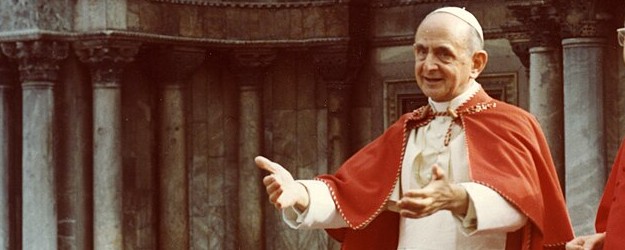
Pope Saint Paul VI’s Credo of the People of God
Question One: I read that Pope Saint Paul VI wrote a Creed. What was it and was it ever prayed at Mass?
Answer: In the turbulent years following the Second Vatican Council, the Catholic Church faced a period of confusion and controversy. Doctrinal disputes, liturgical experimentation, and cultural upheaval led many of the faithful to question or misunderstand the central teachings of the faith. It was in this context that Pope Saint Paul VI, wishing to reaffirm Catholic orthodoxy with clarity and authority, composed a formal profession of faith. This text, known as the Credo of the People of God, was proclaimed on June 30, 1968, at the close of the “Year of Faith,” which had been inaugurated to commemorate the nineteenth centenary of the martyrdom of Saints Peter and Paul.
The Credo of the People of God was not intended as a new formula of belief to replace the Nicene or Apostles’ Creeds, but as an authoritative restatement of the essentials of Catholic doctrine in continuity with tradition. Drawing heavily upon the Nicene-Constantinopolitan Creed of 381, Paul VI expanded its scope with more explicit affirmations of contested doctrines, such as the divinity of Christ, the real presence of Christ in the Eucharist, the sacrificial nature of the Mass, the perpetual virginity of Mary, the hierarchical nature of the Church, and the reality of eternal judgment. The Pope explained that his intention was to “reaffirm with solemnity and clarity the faith of the whole Church” in a time of widespread doubt.
Some of the most striking passages of the Credo highlight the Pope’s concern to reaffirm key Catholic doctrines that were being questioned in the late 1960s. On the Eucharist, Paul VI declared: “The unique and indivisible existence of the Lord glorious in heaven is not multiplied, but is made present by the sacrament in the many places on earth where Mass is celebrated. And this presence is brought about by the conversion of the whole substance of the bread into His Body and of the whole substance of the wine into His Blood, which conversion the Catholic Church fittingly and properly calls transubstantiation” (Credo of the People of God, §24). This statement directly reaffirmed traditional Eucharistic doctrine against symbolic or reductionist interpretations.
On Mary, Paul VI was equally clear in affirming her perpetual virginity and unique role in salvation history: “We believe that Mary is the Mother, who remained ever a Virgin, of the Incarnate Word, our God and Savior Jesus Christ” (Credo, §14). This concise formula underscores her title Aeiparthenos (“ever-virgin”), shared by both Catholic and Orthodox tradition.
Regarding the hierarchical and visible nature of the Church, Paul VI proclaimed: “We believe in one, holy, catholic, and apostolic Church, built by Jesus Christ on that rock which is Peter. She is the Mystical Body of Christ, a visible society with a hierarchical structure” (Credo, §30). Here the Pope emphasized both the invisible and mystical dimension of the Church as well as its visible, institutional reality — a point contested by some theologians of the period.
The Credo also solemnly reaffirmed eschatological truths, including the reality of judgment and eternal life: “We believe that the multitude of those gathered around Jesus and Mary in Paradise forms the Church of heaven, where in eternal beatitude they see God as He is, and where they also, in different degrees, are associated with the holy angels in the divine rule exercised by Christ in glory… We believe in the eternal life. We believe that the souls of all those who die in the grace of Christ… are the People of God beyond death” (Credo, §§28–29, 39).
As to whether the Credo of the People of God was ever prayed at Mass, the answer is more nuanced. The text was not inserted into the liturgy as a replacement for the Nicene Creed, which remains the normative profession of faith at the Eucharist. Instead, Paul VI solemnly proclaimed the Credo in the context of a papal Mass in Saint Peter’s Basilica. On that occasion, the faithful were invited to join the Pope in professing this enriched statement of belief. However, the Church did not adopt it as a permanent liturgical formula. The Nicene Creed, with its ecumenical authority and universal recognition, continues to hold pride of place in the liturgy. The Credo of the People of God thus remains a solemn magisterial act — a papal profession of faith — rather than a liturgical text required for ongoing use at Mass.
Pope Saint Paul VI’s Credo of the People of God was a powerful reaffirmation of Catholic faith in a moment of uncertainty, intended to safeguard the clarity of doctrine and strengthen the unity of believers. With its explicit affirmations of contested teachings on the Eucharist, Mary, the Church, and eternal life, the Credo stands as a landmark expression of Catholic orthodoxy. While it was proclaimed within the liturgy of a solemn papal Mass in 1968, it was not established as a recurring part of the Mass itself. Instead, it remains a monumental act of papal teaching, bridging the timeless Creeds of the early Councils with the challenges of the modern world.
One Faith, Diverse Traditions
Question Two: I was shocked when I went to Mass in Italy and they did not pray the Nicene Creed, but instead recited the Apostles’ Creed! How is this permitted and why do we not do this in the U.S.A.?
Answer: For many Catholics, the profession of faith at Mass is almost synonymous with the Nicene Creed, formally the Niceno-Constantinopolitan Creed of A.D. 381, which has been prayed in the liturgy for centuries. This Creed, solemnly defined at the First Council of Nicaea (325) and expanded at the First Council of Constantinople (381), remains the normative symbol of faith in the Catholic Church and in most Christian traditions. Thus, it can come as a surprise, even a shock, when Catholics travel abroad and hear the Apostles’ Creed instead, as you experienced in Italy. Yet the Church’s liturgical law does, in fact, permit this practice, and the variation between Italy and the United States reflects differing liturgical traditions and episcopal decisions rather than a divergence in doctrine.
The General Instruction of the Roman Missal (GIRM), which governs the celebration of Mass, provides clear guidance on this point. It states: “Instead of the Niceno-Constantinopolitan Creed, especially during Lent and Easter Time, the baptismal Symbol of the Roman Church, known as the Apostles’ Creed, may be used” (GIRM, no. 19 in the U.S. edition; no. 68 in the universal Latin edition). The Apostles’ Creed, though shorter and more ancient in form, is equally orthodox. It originated as the baptismal profession of faith in the Roman Church and continues to be used in the celebration of Baptism and the recitation of the Rosary. Because of its baptismal character, it is particularly fitting for seasons of preparation and renewal such as Lent and Easter.
In Italy and many other parts of Europe, the option of using the Apostles’ Creed has been more broadly exercised. Italian parishes, especially during certain liturgical seasons, often recite the Apostles’ Creed in place of the Nicene Creed. This is not only permitted but encouraged as a way of drawing the faithful into the baptismal themes of repentance, renewal, and Easter faith. The shorter text also has a catechetical value, being simpler to memorize and recite, while still affirming every essential element of the Catholic faith.
In the United States, the bishops have tended to preserve the Nicene Creed as the ordinary profession of faith at Sunday Mass, with the Apostles’ Creed appearing primarily in the context of children’s liturgies, catechesis, and the Rosary. The U.S. edition of the GIRM allows the use of the Apostles’ Creed especially during Lent and Easter, but in practice it is not widely used at parish Masses. This reflects pastoral custom rather than prohibition. American Catholics are accustomed to the Nicene Creed as a sign of doctrinal universality and continuity with the ecumenical councils, and thus pastors generally retain it as the standard form at Sunday Eucharist.
It is important to note that both Creeds are fully Catholic and equally expressions of the one faith of the Church. The Nicene Creed has a special ecumenical weight, as it was defined by the councils shared with the Eastern Orthodox and continues to be professed by most Christian denominations that retain conciliar Christianity. The Apostles’ Creed, by contrast, has a specifically Roman origin and baptismal flavor, serving as a complementary witness to the same faith. The use of one or the other at Mass is not a difference of doctrine but of liturgical discipline and local tradition.
In conclusion, your experience in Italy reflects the legitimate diversity within the Roman Rite. While in the United States the Nicene Creed remains the ordinary form recited at Mass, in Italy the Apostles’ Creed is more frequently used, especially in Lent and Easter, in accordance with the permissions of the General Instruction of the Roman Missal. Both Creeds affirm the same Catholic faith, and their use side by side testifies to the richness and variety of the Church’s liturgical heritage.
 About Rev. John P. Cush, STD
Help me out, please. I am Catholic. What must I do to be saved?
THANK YOU
debbie
Thanks for your question, Debbie. Salvation begins with God, not with us. We cannot save ourselves through our own efforts, no matter how good we try to be. Salvation is a gift of God’s grace, made possible through the Death and Resurrection of Jesus Christ. Even our ability to believe in Him and turn away from sin is made possible by His grace (Eph 2:8–10).
What, then, must we do? We must believe in Jesus Christ, repent of our sins, receive Baptism, and live in communion with Him through His Church. Through Baptism, we receive the forgiveness of sins and the gift of sanctifying grace, becoming adopted children of the Father and temples of the Holy Spirit. God is not bound by His sacraments, however, and the Church recognizes that He can communicate the saving fruits of Baptism to those who have not received the sacrament (CCC 1257–1261).
The Christian life requires our free cooperation with God’s grace. We must love God and our neighbor, keep His commandments, receive the Eucharist worthily, and seek reconciliation through the Sacrament of Penance when we fall into mortal sin. Our good works, performed in charity through God’s grace, are a genuine part of our growth in holiness and our journey toward eternal life. As St. Paul teaches, what matters is faith working through love (Gal 5:6).
The ultimate purpose of salvation is not simply to avoid hell or receive forgiveness for our sins. It is to share in the very life of the Blessed Trinity, a communion that begins through sanctifying grace here on earth and reaches its fulfillment in the beatific vision, when we see God face to face.
In short, we are saved by God’s grace through Jesus Christ. We must respond to that grace through faith, repentance, Baptism, and a life of charity, remaining in communion with Christ and His Church and asking God for the grace to persevere until the end.