For August 2, August 9, August 16, August 23, and August 30, as well as the Solemnity of the Assumption of Our Lady (August 15)
Eighteenth Sunday in Ordinary Time – August 2, 2026
Readings: Isaiah 55:1–3 • Psalm 145:8–9, 15–16, 17–18 • Romans 8:35, 37–39 • Matthew 14:13–21
bible.usccb.org/bible/readings/080226.cfm
Can you recall a time in your life when you didn’t feel like you had the energy to pick up the pieces? It might have been after losing a job or after a divorce. Perhaps it was after the death of a loved one, such as Jesus in today’s Gospel having heard about the death of his cousin, John the Baptist. These are moments when we feel sapped. We don’t know how we will move forward with our lives. The emotion of these moments can often cause us to feel imprisoned and confused. Perhaps this was how Jesus was feeling when he heard about the execution of John the Baptist. We are told that he left the crowd and withdrew to a deserted place. He wanted to be alone. He needed to grieve. He needed to nurse his sadness and pain, rather than take of the needy crowd. He didn’t have the energy to pick up the pieces, and so he withdrew.
When he arrived, however, the crowds had already gotten there before him. Rather than run away from them, he engaged them. When it was late in the day, the apostles recommended that Jesus tell people to go to the neighboring towns to find food. But Jesus didn’t want to send them away. So, he took what little they had, 5 loaves and 2 fish, and gave thanks. And then, he began to share what little he had. At the moment that it didn’t seem like he had any more to give, Jesus prayed. He gave thanks for what little he had. And the miracle happened. The 5 loaves and the 2 fish, the small portion of food, multiplied. It was enough to feed 5000 men, not counting the women and children. Jesus attempted to get away from the crowd after the death of his cousin, John the Baptist, to pick up the shattered pieces of his life. He showed that by praying, giving thanks, and sharing with others, what little we have is multiplied.
The sight where this miracle happened is in a place called Tabgha in Israel. There is a Benedictine Monastery there and a few monks. They are surrounded by misunderstanding and the pain of Muslims, Christians, and Jews. There are few places where Palestinians and Jewish Israelis mingle. Thus, there is even more misunderstanding and division. The monks know that they have very little to offer that will bring peace to this troubled region. But the monks take what little they have, a few cabins on the Sea of Galilee, and offer them to Muslim, Christian, and Jewish families who have handicapped children. They invite these troubled families to enjoy a few days of relaxation in a beautiful place. What they notice is that slowly these troubled families of different cultural and religious backgrounds interact with one another. Mutual understanding grows. Empathy emerges. Compassion multiplies. The miracle of the loaves and fishes that happened there so many centuries ago continues to bear witness.
In a few moments, we will pick up a few pieces of bread and a few drops of wine. The Lord will transform them into HIS living presence: HIS body; HIS blood. He will transform us into HIS Body. HE will give us the strength to pick up the shattered pieces of life around us and transform them.
Nineteenth Sunday in Ordinary Time – August 9, 2026
Readings: 1 Kings 19:9a, 11–13a • Psalm 85:9, 10, 11–12, 13–14 • Romans 9:1–5 • Matthew 14:22–33
bible.usccb.org/bible/readings/080926.cfm
The question isn’t, “Why did Peter get out of that boat?” The question is, “Why did Jesus command Peter and the others to get into the boat?”
Many will say that Peter got out of the boat because Jesus commanded him. Did Jesus really command Peter to get out of the boat? It was Peter, after all, who urged Jesus to command him to get out of the boat. Peter had the urge to get out of the boat and he said, “Lord, if it is you, command me to come to you on the water.” Jesus said, “Come.” This reminds me of a priest-friend of mine whose superior wanted him to take a certain assignment. My friend wanted to do something else, so he kept badgering his superior to command him to do what he, himself, wanted to do. Finally, his superior said, “Fine. Do what you want!” The only command that came from Jesus was the command at the beginning of the Gospel. It says, “Jesus made the disciples get into a boat and precede him to the other side.”
Why did Jesus command the disciples to get into the boat? Because the boat, which symbolizes the church, is the hope of our salvation. Jesus commands the disciples to get into the boat to help one another. When the disciples first set out in the boat and the weather was good, each of them would have been part of the crew needed to set the sails, row, and steer. As the storm approached, everyone would have been needed to take down the sails and secure the oars and the other equipment. They would have relied on one another’s weight to sit in the center of the boat to give it balance against the waves, lest it tilt too much to one side and flip.
So too, in this boat, in this church, the place of seating is even called a “nave.” It comes from the Latin word meaning, “ship.” Every person in this church is a part of the crew. As a member of the crew each of us is needed to pray and support one another. The presence of every member of the crew is important. When you are not here, people miss you. When you are here, people are glad to see you and rely on your prayerful presence. Much is made these days of surveys that say that Catholics don’t believe in the true presence of the Eucharist. But the bigger problem is that many Catholics don’t appreciate the importance of their own presence around the altar. A priest-friend, on the occasion of his 50th anniversary of ordination, was asked how he remained a priest for so long. He immediately replied that he was only able to remain a priest because of the faithful people that joined him around the altar to celebrate the Eucharist. All of us are needed as crew of this boat, called the church. It is in this boat that we journey together toward salvation. Even Jesus doesn’t continue walking to other side. He gets in the boat and journeys with the disciples, as he journeys with us.
Solemnity of the Assumption – August 15, 2026
Readings: Revelation 11:19A; 12:1-6A, 10AB • Psalm 45:10, 11, 12, 16 • 1 Corinthians 15:20–27 • Luke 1:39–56
bible.usccb.org/bible/readings/081526-Day
Why does the Church give us this feast of the Assumption of Mary? Why does the Church teach that before dying, Mary was taken body and soul up to heaven?
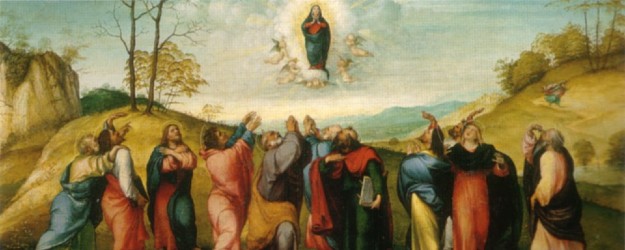
There is a Renaissance painting of the Assumption of Mary in the Brera Museum in Milan, Italy. The painting is by Lorenzo Lotto. In the painting, Mary’s body is ascending to heaven. Beneath are the disciples. Some are gawking, pointing at her body as if it is a spectacle. Others are serious in devout prayer. One is putting on his glasses to be sure he is seeing what he thinks he is seeing. And then, there is Thomas. He is in the background running. Late again!
Lorenzo Lotto is suggesting that this doctrine of the Assumption is meant for us. It is meant for us whether we believe it wholeheartedly like the disciples standing in prayer; whether we look on this doctrine as a supernatural display that has nothing to do with us, like the disciples who are gawking pointing upwards. Whether, when it comes to this doctrine, we don’t know what to believe, like the disciple putting on his glasses to be sure he sees what he is seeing; or whether we are like Thomas who has way too many other things to do and can’t really find the time to think about it, this mystery is meant for us. However we think of this Dogma of the Assumption, the teaching is meant for your and for me. It is meant to remind us that our bodies are engaged in the mystery of Christ. It is meant to remind us that it is no mere accident that we inhabit the body that we inhabit! It is meant to remind us that in and through our bodies, we make Christ present in the world.
In the scriptures today, bodies are front and center. God’s salvation is front and center. In the first reading a woman wails as she about to give birth and a dragon waits to devour the infant as soon as it is born. But the heavens snatch the body before the dragon can devour it. The mother flees to a safe place prepared for her by God. Mary goes in haste to the hill country to visit Elizabeth who is pregnant. As soon as Elizabeth set eyes on Mary, the child in her womb leapt for joy. Mary then speaks of a God who works in a very physical, real way, as God uses the strength of his arm to scatter, to cast down, to lift up and to feed.
Mary’s body was created to give birth to Christ. And our bodies too are created to give birth to Christ through our actions. Without us, as Saint Teresa of Avila observed, Christ has no feet; he has no hands; he has no heart. Our bodies are the body of Christ! In our bodies, Christ lives in the world. Christ feeds the world. Christ saves the world. Our bodies have a special place in God’s plan.
Our faith is not something intangible, something untouchable. Our faith is not something set apart from our regular life. The feast reminds us that our bodies play an important role in God’s plan for salvation.
Twentieth Sunday in Ordinary Time – August 16, 2026
Readings: Isaiah 56:1, 6–7 • Psalm 67:2–3, 5, 6, 8 • Romans 11:13–15, 29–32 • Matthew 15:21–28
bible.usccb.org/bible/readings/081626.cfm
Why did Jesus talk to the Canaanite woman in that way? Why did he tell this desperate woman, “I was sent only to the lost sheep of the house of Israel?” Why did he insult her, saying, “It is not right to take the food of the children and throw it to the dogs?” He said these things to test her spirits. When he tested her spirits, he saw that they were of God! She persevered in her faith in Jesus and his ability to heal her daughter. She remained steadfast in her belief that he was the Holy One of God. By testing her spirits, she became a testament of faithful persistence.
The disciples came to Jesus. They were through with this woman. She had pestered them to have Jesus cure her daughter. They wanted her gone because she got on their nerves. Never mind about whether her spirit was of God or not! Jesus decided to test her faith to see if she might have a lesson for the disciples. “Have pity on me,” she kept screaming. Jesus insulted her, saying, “It is not right to take the food of the children and throw it to the dogs?” But she remained determined in her faith. “Please, Lord, for even the dogs eat the scraps that fall from the table of their masters,” she said. Nothing but Christ mattered to this woman: not her ego, not the feeling of being insulted, not the embarrassment caused by the disciples trying to push her away. Only Christ mattered and for this, Jesus said, “O woman, great is your faith! Let it be done for you as you wish.”
People who hold on to Christ, like the Canaanite woman, realize they have nowhere else to turn. Their spirit is of God because they rely on God entirely. We often think the Christian life is about getting to heaven. But even more importantly, the Christian life is about making earth as it is in heaven. Don’t we pray this in the Lord’s Prayer: “Thy Will be done on earth as it is in Heaven.” Just as in Heaven, the only thing that will matter to us is God. So, for us on earth, the only thing that matters if our Sprit is of God, is our faith in God.
When ideas come into our heads, it is good for us to test them. “Is this from God,” we should ask. If it causes us to lessen our dependence on God, we should let it go.
In a moment, we will receive the body and blood of Christ. We come to communion knowing our dependence on Christ. Receiving Christ in the Eucharist, we know we are sustained. Receiving Christ in the Eucharist allows us to persevere in our Faith.
Twenty-first Sunday in Ordinary Time – August 23, 2026
Readings: Isaiah 22:19–23 • Psalm 138:1–2, 2–3, 6, 8 • Romans 11:33–36 • Matthew 16:13–20
bible.usccb.org/bible/readings/082326.cfm
Often, in the Old Testament, we notice types or foreshadowings of truths spoken in the New Testament. Today, in the Book of the Prophet Isaiah, we see such a foreshadowing. We are told in the Book of the Prophet Isaiah that Eliakim son of Hilkiah was appointed Master of the Palace. As Master of the Palace, Eliakim, son of Hilkiah, was entrusted with great authority. Upon him was placed the keys of the House of David. What he opened, no one — even the King — would shut. What he closed, no one — even the King — would open.
Certainly, the position of Master of the Palace was an institution upon which ancient kings relied. Ancient kings endowed the Master of the Palace with much power and trusted that he would use that power wisely and justly. So much confidence was placed in the Master of the Palace that the King would not open a door shut by him or close a door opened by him. The King trusted and relied on the Master of the Palace to build his kingdom into a just and righteous kingdom.
In today’s Gospel, Jesus calls to mind the position of Master of the Palace when he places the keys of the Kingdom on Peter’s shoulders. In today’s Gospel, Jesus calls to mind the trust and authority ancient kings had in the Master of the Palace when he says to Peter, “What you bound on earth will be bound in heaven. What you loose on earth will be loosed in heaven.” Jesus entrusted Peter to build a Kingdom on Earth — the Church — known for faith, hope and love. Jesus gave Peter and the Church awesome authority. Jesus recognized that he relies on us, His Church, to open and close doors so as to draw others closer to him. Jesus entrusted Peter to save his church as an instrument of justice and forgiveness by loosening and binding. Jesus placed a burden on Peter, the keys to the Kingdom, to give witness to the work of justice and the power of forgiveness.
Jesus called Peter to a new form of life and he calls us to this new form of life. Jesus called Peter to save His Church and He calls us to save His Church by holding fast to this new form of life. Despite large scale structural defects in our world, in our country and in our church, today Jesus calls us to continue on living this new form of life.
“Who do people say that I am?” Jesus asked his apostles. “Some say John the Baptist, others Elijah, still others Jeremiah or one of the prophets,” they told him. People were saying all sorts of things about Jesus. But Jesus needed to know what his friends thought about him. “But you, who do you say that I am,” he asked them? The apostles could have been forgiven if they believed what they heard others saying. They could have been forgiven if they believed what they heard in the news about Jesus — that he was merely one of the prophets. But Peter said in reply, “You are the Christ, the Son of the living God.” When Peter said this Jesus replied, “Blessed are you, Simon son of Jonah. For flesh and blood has not revealed this to you, but my heavenly Father.”
Despite what others were saying all around him, Peter had embraced a new form of life. Despite what others were saying and what seemed possible, Peter believed that Jesus, the Christ, had come to save His people. Peter embraced a new form of life that did not rely on what others were saying and doing. This new form of life informed Peter despite misinformation all around him. Jesus put his own trust in Peter and the new form of life he had embraced. Jesus entrusted Peter to save His church by placing the keys of the Kingdom on his shoulders.
Jesus entrusts us, who have embraced this new form of life in Him, to keep on believing. Do I need to point out the large scale structural defects of our institutions? We have a government that will not work. We have a Church given over to scandal. We, ourselves, even sometimes contribute to the defects by nursing hatred, by ignoring injustices and the needs of others, or by simply gossiping and spreading rumors. In the midst of all of this Jesus calls us to keep on believing in what we do not know from mere flesh and blood. Jesus calls us to save His Church by holding fast to the new form of life we know through Him. Holding fast to this new form of life requires that we never stop calling for the best. Holding fast to this new form of life requires that we never stop saving others by calling what is most hopeful out of them. Holding fast to this new form of life requires that we never stop calling what is most hopeful out of ourselves.
In a few months, along with English-speaking Catholics throughout the world, we will begin using a new translation of the Mass. It will be new and, therefore, odd to us. We might think that there is no reason for this new translation. We might have strong opinions against it. We will have reasons informed by flesh and blood that might cause us to grumble about this new translation. We should remember Peter, who held fast to a new form of life not revealed by flesh and blood. Within the new words Christ will still be calling us to save his Church by holding fast to a new form of life.
Jesus called Peter to a new form of life and he calls us to this new form of life. Jesus called Peter to save His Church and He calls us to save His Church by holding fast to this new form of life.
The Good News is that Jesus calls us to a new form of life not revealed by mere flesh and blood. This new form of life places an awesome burden on us: to loosen and to bind. This new form of life calls us to save our world by continuing to believe.
Twenty-second Sunday in Ordinary Time – August 30, 2026
Readings: Jeremiah 20:7–9 • Psalm 63:2, 3–4, 5–6, 8–9 • Romans 12:1–2 • Matthew 16:21–27
bible.usccb.org/bible/readings/083026.cfm
During the summer months, when seminarians are ordained priests, I think back to my own ordination. I thought I knew what my priestly commitment meant. I thought I knew what the vows I had taken as a religious meant. All these years later I have to say that I really did not know what I was doing. Maybe I was a lot like the prophet Jeremiah, who in today’s first reading says that he “was duped.” He was duped into a way of life that he thought he understood, but as he followed God he discovered more and more what he got himself into was not what he expected. All these years later, if I am honest, I really don’t know what I am doing. Things certainly have not turned out as I anticipated when I was first ordained. And that’s OK, because God has arranged things better than I could have anticipated!
The Christian way of life is not about having it all figured out. The Christian way of life is about being on a journey with Jesus and not knowing where we are going. The Christian way of life is about wrestling with God who wants us to be on this journey with him.
Only last week we heard Jesus give the same kind authority to Peter that was given to the Master of the Palace. What the Master of the Palace closed, no one — not even the King — was to open. What the Master of the Palace opened no one not — not even the King — was to close. The Keys of the Kingdom were given to Peter by Jesus. Jesus gave him the name, “Peter” because he was such a reliable rock upon which the church was to be built. Jesus placed such authority on him because Peter stated that Jesus, was “the Son of God.” But in today’s Gospel Peter rebukes Jesus. Jesus says that he, the Son of God, must suffer and die. When he says this, Peter rebukes him. “That will never happen,” Peter says. Peter thought that the authority Jesus gave him caused him to know it all. Peter shows that he really did not fully understand what he was saying about Jesus as the Messiah. Peter did not fully understand what it meant to be a disciple of Jesus. To follow Jesus means that we don’t have it all figured out. We don’t know it all. We often don’t know where we are going. Peter thought he knew, though. He still thought Jesus was a worldly Messiah. One who would, perhaps, throw the Romans out of Israel or at least get rid of the scribes and the Pharisees. Peter reminds us that we really never have it all figured out. In fact, if we think we have it all figured out, we risk letting our ego cause us to get it all wrong — much like Peter.
The Christian life is not so much about knowing as not knowing. I say it is about not knowing because we never completely possess what God is all about. I say the Christian life is about not knowing because we never completely know what God is going to ask of us or where God will take us. I use myself as an example. I suspect married life is much the same: you probably did not marry the person you thought you were marrying! Often, not knowing turns out to be the biggest surprise! Especially, when things don’t turn out the way we expected, we know that God is on the journey with us. Sometime ago, a young man who wanted to be a priest said he wasn’t ready. I asked him who is ever ready? We would do nothing if we waited until we were ready! Sometimes people say the same thing about marriage. We are not ready, they say, but they are ready to live together. Sometimes people think living together is like a preparation for marriage and that it will clear up any unknowns. The Christian life is not about knowing! It is about loving. It is about persevering. Sometimes, the more we think we know, the less likely we are to rely on God. When we realize that we don’t know, we are more inclined to rely on God to help us figure things out.
The good news is that the Christian way of life is not about having it all figured out. The Christian way of life is about being on a journey with Jesus and not knowing where we are going. The Christian way of life is about relying on God to help in our not knowing and to keep us from straying too far from the right path.
 About Fr. Edward Linton
The Messages in Homiletics and Pastoral Review are still very good; the language is simple, the themes are appropriate; the content is indeed informative, enriching. For one, like me – a Priest in Uganda – serving as Director to the Catechists in Kampala Archdiocese & Director to the Ministry with Grandparents & the Elderly – I find Homiletics and Pastoral Review – an important vademecum!