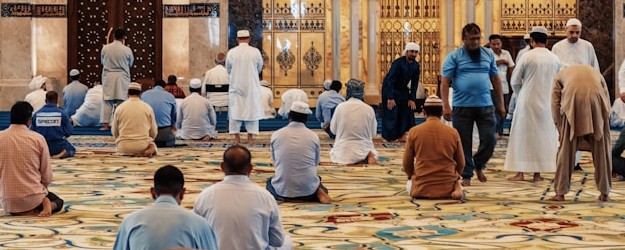
What Do Muslims Believe About Jesus?
Question One: Someone said on a podcast that Islamic theology is tied to a Christian heresy. How can this be the case?
Answer: The emergence of Islam in the seventh century cannot be separated from the complex religious landscape of the Near East, where various forms of Christianity coexisted alongside Judaism and paganism. Among the most influential of these Christian movements was Monophysitism, the Christological heresy that claimed Christ had only one nature after the Incarnation, either divine or a fusion of divine and human. Although condemned by the Council of Chalcedon in 451, Monophysitism flourished in Egypt, Syria, and Armenia — precisely the regions where Islam arose and quickly spread. For this reason, the theology of Islam bears indirect but significant connections to the Monophysite environment in which it encountered Christianity.
The Catholic Church at Chalcedon had solemnly defined that Jesus Christ is one divine person in two natures, true God and true man, “without confusion, without change, without division, without separation” (DS 301–302). Monophysitism rejected this balance, emphasizing Christ’s divinity at the expense of His full humanity. As a result, many Christians in the East lived with a distorted Christology that either blurred or denied the distinction between Christ’s human and divine natures. When Muhammad and the first Muslims encountered Christians, it was primarily through Monophysite or Nestorian communities rather than through orthodox, Chalcedonian teachers.
This background helps to explain why the Qur’an presents such a reductionist view of Christ. Islamic teaching consistently denies the Incarnation, the crucifixion, and the Trinity. “Christ Jesus, the son of Mary, was only a Messenger of Allah, and His Word . . . so believe in Allah and His messengers and say not ‘Three’” (Qur’an 4:171). Similarly, it insists: “They did not kill him, nor did they crucify him; but it was made to appear so” (Qur’an 4:157). These texts reflect not an encounter with the balanced Catholic Christology of Chalcedon but with popular forms of heterodox Christianity that had already failed to safeguard the fullness of the Incarnation. Monophysite tendencies, by confusing Christ’s humanity with His divinity, made the mystery of the Word made flesh appear incoherent. In such an atmosphere, Islam took the further step of rejecting the Incarnation altogether.
In addition, Monophysite and other heretical groups often blurred the distinct roles of Father, Son, and Holy Spirit, which may explain why the Qur’an caricatures the Trinity, sometimes even suggesting it consists of God, Jesus, and Mary. What was already misunderstood within heretical Christianity became codified in Islam as a definitive rejection of the Trinity and of Christ’s divinity.
The scholastic theologians of the Middle Ages recognized these connections. Saint Thomas Aquinas, writing in the Summa Contra Gentiles, identifies Islam as a system that preserves certain truths of natural reason but rejects the mysteries revealed in Christ. He argues that without revelation, human reason cannot adequately grasp divine mysteries such as the Trinity, and when these mysteries are denied, error inevitably results (SCG I, c.6). Aquinas specifically criticizes those who, like Muslims, reduce Christ to a mere creature, noting that such a view undermines the possibility of redemption: “Since by sin man had turned away from the infinite good, the satisfaction of sin had to be infinite . . . This could not be unless God became man” (SCG IV, c.54). For Aquinas, Islam’s Christology is thus fundamentally deficient because it denies the hypostatic union that makes salvation possible.
In the Summa Theologiae, Aquinas defends the Chalcedonian faith against both Nestorian and Monophysite tendencies, emphasizing that Christ’s two natures are united in one person: “The human nature of Christ has no personal subsistence of its own, but is assumed by the Word into unity of person” (ST III, q.2, a.6). He further insists on the reality of Christ’s bodily resurrection: “Christ rose again with the same body in which He suffered, and this is the Catholic faith” (ST III, q.53, a.3). These teachings highlight precisely what Islam denies — the true Incarnation and resurrection of the Word made flesh.
It would be incorrect to call Islam a form of Monophysitism, yet it is accurate to say that Islam’s Christology developed within a Monophysite context. By encountering Christianity in heretical rather than orthodox forms, Islam inherited and radicalized misunderstandings already present in the theological climate of the time. As Hilaire Belloc famously observed, Islam can be considered in part a “post-Christian heresy,” not because it is simply another Christian sect, but because it absorbed and systematized Christological errors already in circulation.
In conclusion, the theology of Islam is connected to Monophysitism not through direct doctrinal borrowing but through historical context. The prevalence of Monophysite and Nestorian communities in the Near East meant that the Christianity Muhammad encountered was not the balanced teaching of Chalcedon but a distorted Christology. This distorted environment prepared the way for Islam’s outright rejection of the Incarnation and the Trinity, and thus its theology bears the imprint of earlier Christian heresies that had weakened or obscured the mystery of Christ. Aquinas recognized this pattern, seeing in Islam both the retention of natural truths about God and the rejection of the supernatural mysteries of the faith, which ultimately renders it an incomplete and erroneous theology.
Who Are Jesus’s “Brothers and Sisters” in the Gospels?
Question Two: Matthew 12:47 and Mark 6:3 directly speak about the brothers and sisters of Jesus. How can this be the case if we as Catholics believe in the perpetual virginity of the Blessed Virgin Mary?
Answer: One of the most frequently raised objections to the Catholic doctrine of Mary’s perpetual virginity comes from the New Testament passages that appear to speak of the “brothers” and “sisters” of Jesus. In Matthew’s Gospel, we read: “Someone told him, ‘Your mother and your brothers are standing outside, asking to speak to you’” (Mt 12:47). Likewise, Mark reports that the people of Nazareth asked: “Is not this the carpenter, the son of Mary, the brother of James and Joses and Judas and Simon, and are not his sisters here with us?” (Mk 6:3). On the surface, such passages might suggest that Mary bore other children besides Jesus. Yet the Catholic Church, together with the Orthodox Churches and in continuity with much of early Christian tradition, holds firmly to the belief in Mary’s perpetual virginity — that she remained a virgin before, during, and after the birth of Christ. This doctrine, far from being contradicted by Scripture, is supported by careful interpretation of the biblical language, by the witness of the Fathers, and by theological reasoning.
First, the biblical term adelphoi (“brothers”) does not necessarily mean blood siblings. In Semitic usage, the word was broad, encompassing not only biological brothers but also cousins, kinsmen, and even close family friends. This is evident throughout the Old Testament: Lot is called Abraham’s brother (Gen 13:8) though he is actually his nephew; Laban calls Jacob his brother (Gen 29:15) though he is his uncle. Thus, when the Gospels speak of Jesus’ “brothers,” they are not necessarily describing children of Mary. Saint Jerome, in his classic work Against Helvidius (c. 383), made precisely this point, arguing that the “brothers of the Lord” were cousins, likely the children of another Mary, identified in John 19:25 as “the wife of Clopas” (Adv. Helvidius 21).
The Fathers of the Church consistently defended Mary’s perpetual virginity against misunderstandings. Saint Athanasius of Alexandria, Saint Epiphanius of Salamis, and Saint Augustine all insisted that Mary bore only Christ. Saint Ambrose famously wrote: “Mary is a virgin not only because she conceived as a virgin, nor merely because she gave birth as a virgin, but because she persevered as a virgin” (De institutione virginis 8). Augustine likewise declared: “A virgin she conceived, a virgin she bore, and a virgin she remained” (Sermon 186). Aquinas, synthesizing this tradition, concludes in the Summa Theologiae: “It is impious to assert that the Mother of God had other children. For this would detract from the dignity of Christ, who is the only-begotten Son, both of His Father and of His Mother” (ST III, q.28, a.3).
From a theological perspective, Mary’s perpetual virginity expresses the singularity of Christ’s birth. Christ is the New Adam, born of the Virgin as a sign of His divine sonship and His unique mission. As Aquinas notes, “It was fitting that He who was the Only Begotten of the Father should also be the Only Begotten of His Mother” (ST III, q.28, a.3, ad 3). The miraculous virgin birth is not merely about Mary’s purity but about the singularity of Christ’s person: God incarnate, born into the world through a woman whose womb was consecrated exclusively to Him.
The Protestant Reformers, interestingly, also upheld Mary’s perpetual virginity. Martin Luther wrote: “Christ, our Savior, was the real and natural fruit of Mary’s virginal womb . . . She remained a virgin after that” (Sermons on John). John Calvin likewise affirmed: “Helvidius displayed excessive ignorance in concluding that Mary must have had many sons because Christ’s ‘brothers’ are sometimes mentioned” (Commentary on Matthew 13:55). Ulrich Zwingli, too, preached: “I firmly believe that Mary, according to the words of the Gospel, as a pure Virgin brought forth for us the Son of God and in childbirth and after childbirth forever remained a pure, intact Virgin” (Corpus Reformatorum). Thus, the belief in Mary’s perpetual virginity was shared widely across early Catholic, Orthodox, and Protestant traditions, even if later Protestant communities became less explicit about it.
The Eastern Orthodox Churches, to this day, also confess Mary as Aeiparthenos — “Ever-Virgin.” The Second Council of Constantinople (553) refers to her in precisely this way, continuing the tradition of the Fathers. The Orthodox veneration of Mary as Theotokos and Ever-Virgin underscores the same truth professed in Catholic theology: that Mary’s womb bore the incarnate Word and was consecrated entirely to Him alone.
Therefore, the references in Matthew 12:47 and Mark 6:3 to the “brothers and sisters” of Jesus do not contradict the doctrine of Mary’s perpetual virginity. Properly understood in light of Semitic language, early Christian testimony, and theological reflection, these passages refer not to Mary’s other children but to Christ’s extended relatives or kin. The Catholic Church, together with the Orthodox tradition and even the Reformers, has consistently confessed that Mary was virgin before, during, and after the birth of her Son. Far from being a minor detail, this belief underscores the uniqueness of Christ, the dignity of His Mother, and the radical newness of the Incarnation.
 About Rev. John P. Cush, STD
Speak Your Mind