
Exegetical Journeys in Biblical Hebrew: 90 Days of Guided Reading. By H.H. Hardy II. Reviewed by Sr. Mary Micaela Hoffmann, RSM. (skip to review)
Priests in Love with God and Eager to Witness to the Gospel. By Archbishop Emeritus Alfred Hughes. Reviewed by Rev. Ryan Connors. (skip to review)
Pray for Us: 75 Saints Who Sinned, Suffered, and Struggled on Their Way to Holiness. By Meg Hunter-Kilmer. Reviewed by S.E. Greydanus. (skip to review)
Were Not Our Hearts Burning? Understanding the Mass – Living the Eucharist. By Marco Benini. Reviewed by Rev. Regis J. Armstrong, O.F.M. Cap. (skip to review)
Spousal Prayer: A Way to Marital Happiness. By Deacon James Keating. Reviewed by James Jansen. (skip to review)
Exegetical Journeys in Biblical Hebrew – H.H. Hardy II
Hardy, H.H., II. Exegetical Journeys in Biblical Hebrew: 90 Days of Guided Reading. Grand Rapids, MI: Baker Academic, 2025. 302 pages.
Reviewed by Sr. Mary Micaela Hoffmann, RSM.
 H.H. Hardy’s volume lives up to its title and stated intent, providing three “journeys” of Hebrew readings, further subdivided into routes and days, to arrive at 90 days of readings. Multiple aids for a “guided” journey are also thoughtfully included, as Hardy states in the introduction: “Everything the reader needs is provided” (3). Each day offers a short segment of text, a chart for parsing verbs, in many cases grammatical structures to identify, a lined space for writing one’s translation, a few significant or unusual vocabulary words, some exegetical points to note, and finally an answer key including a translation for checking one’s work. In addition, a supplemental vocabulary in the back lists Hebrew words in the book’s readings that occur more than 200 times in the Old Testament. It also includes forms with pronominal suffixes listed after the main entries. This appendix can thus serve as a vocabulary review or source for practice, and make the readings in the book largely accessible even without a separate lexicon. Hardy does note in a footnote that a basic grammar may be helpful, and gives a suggested volume for readers who may be interested (fn 2, p. 3). Finally, the three journeys are intended to build towards increasing complexity.
Hardy explains the journey metaphor in his introduction, which is brief but quite useful for understanding what the book provides and its intended audience. Learning has similarities to a journey: you have a destination, make progress, sometimes encounter difficulties, and need fellow travelers and perhaps a guidebook (1). Learning Hebrew is similar. A beginning course in Hebrew may give learners the basics, but a common difficulty is taking the next step and also maintaining facility with what was learned. Especially for those who wish to engage in self-study, the task itself or the perseverance and time required may be daunting. Thus, Hardy has aimed this book at those who “have completed a basic introduction to Biblical Hebrew grammar,” (1) and who want to continue to practice, go deeper, or review after a period of not using the language. Hardy has designedly divided the chosen texts into short segments of about one to three sentences, permitting each day’s exercises to be “completed in about ten to fifteen minutes” (2-3). He emphasizes that “small, incremental, and regular steps” are important for both journeys and Hebrew study, as well as guidance for taking these steps (2). As already mentioned, each day’s reading follows a typical pattern, first encouraging those taking the journey to read each text out loud at least five times — which may be accompanied by “a deep breath, or a sip of coffee” (3), suggesting that Hardy envisions how a Hebrew lesson could be worked into a morning routine.
Hardy’s choice of texts also seems felicitous, and likely to motivate students to want to read them in full. Journey One takes passages from Genesis 1, Deuteronomy 6 (including the Shema), Exodus 20, and 2 Samuel 7. These texts highlight important themes from creation, God’s covenant through Moses, and God’s promises to David. In addition to the grammatical and vocabulary aids already mentioned above, after each day’s readings a “For the Journey” section address some of the exegetical topics, background information, or brief theological implications that Hardy finds noteworthy. One sometimes finds hints of the author’s interpretive viewpoint in these sections, but more often encounters word studies or explanations of literary or Near Eastern context. Journey Two includes Joshua 24, Isaiah 6, and Exodus 2. The text from Isaiah is a narrative, but is a significant introduction both to the commissioning of the prophet and to his vision of God. Journey Three makes the same pairing of the book of Ruth with Proverbs 31 that occurs in the ordering of these two books in the Masoretic Text, and includes Ruth’s moving choice to accompany Naomi back to Bethlehem. This Journey concludes with Psalms 1 and 23, introducing theologically rich and prayerful poetic texts, as well as some characteristic wisdom themes.
Overall, this manual seems to have all the tools needed to accomplish its stated goals. It cannot, of course, guarantee that a student with good intentions will follow through on them, but the book does help to make the undertaking seem simpler, with well-portioned tasks and several types of resources rolled into one compact location. Two small points perhaps needing supplemental materials or attention are a grammar for reference or review, as noted by Hardy, and also a careful read of footnote 4 on p. 3, in which Hardy explains his terminology and abbreviations for verb forms. Without this information in mind, understanding some of the answers provided may at first be unclear.
Sr. Mary Micaela Hoffmann is a member of the Religious Sisters of Mercy of Alma, MI. She holds an M.A. in theology from Ave Maria University and a License in Sacred Scripture from the Pontifical Biblical Institute.
Priests in Love with God and Eager to Witness to the Gospel – Alfred Hughes
Hughes, Archbishop Emeritus Alfred. Priests in Love with God and Eager to Witness to the Gospel. San Francisco, CA: Ignatius Press, 2021. 172 pages.
Reviewed by Rev. Ryan Connors.
 In certain ecclesial circles, sometimes you will hear the phrase “a priest’s priest.” This attribution refers to a cleric who enjoys the admiration of his fellow priests. The moniker indicates high praise and accurately describes priests who strive to love with the heart of Christ.
Archbishop Alfred Hughes, priest of the Archdiocese of Boston and Emeritus Archbishop of New Orleans, is what you might call “a bishop’s bishop.” In a unique way, he enjoys the admiration of his fellow bishops. They, quite rightly, find in him a man of spiritual purpose, love for priests, and possessed of a wisdom born from years of service to the Church. The book’s foreword by Bishop Robert Barron (Winona-Rochester) attests to this episcopal esteem. Hughes, former Rector of St. John’s Seminary in Brighton, Massachusetts, (1981–1986), has spent his retirement on the faculty of Notre Dame Seminary in New Orleans, serving as spiritual director and lecturer, aiding yet another generation of priests.
For several decades, Archbishop Hughes has labored to ensure that Catholic school textbooks and religious education materials contain sound theology according to the mind of the Church. His discreet service on behalf of the Bishops of the United States to ensure that catechetical materials remain in conformity with the Catechism of the Catholic Church will provide a service to the Church in our country for decades to come. Archbishop Hughes has put his knowledge and love of the priesthood to work in his latest volume Priests in Love with God and Eager to Witness to the Gospel (San Francisco, CA: Ignatius Press, 2021).
The book contains seventeen short chapters. Each of these readable essays offers a summary of the contribution that a particular Saint, theologian, or ecclesial period renders to the Church’s understanding of the Catholic priesthood.
Chapters on Martin Luther (71–78), the French School of Spirituality (86–92), the Council of Trent (79–85), and the Second Vatican Council (93–102) each offer lessons useful for the present day. To his great credit, the author appears as comfortable when quoting Pope John Paul II, Pope Benedict XVI, Pope Francis, or writers from the pre-modern period.
A central theme of the book is the special call to holiness to which the Church invites every priest. “People do not expect perfection,” he explains. “But they do look for concrete evidence that the ordained man is practicing what the Gospel teaches” (130).
This short book allows seminarians and priests the chance to hear from a contemporary guide whose faithfulness through the decades has borne fruit for the Church. He rightly emphasizes that a flourishing priesthood can exist only when lived from the heart of the Church. As Archbishop Hughes explains: “Since a priest is ordained into a corporate reality, he needs to embrace ever more fully his spiritual sonship with his bishop, his spiritual brotherhood with his fellow priests, and his spiritual fatherhood of those entrusted to his care” (101).
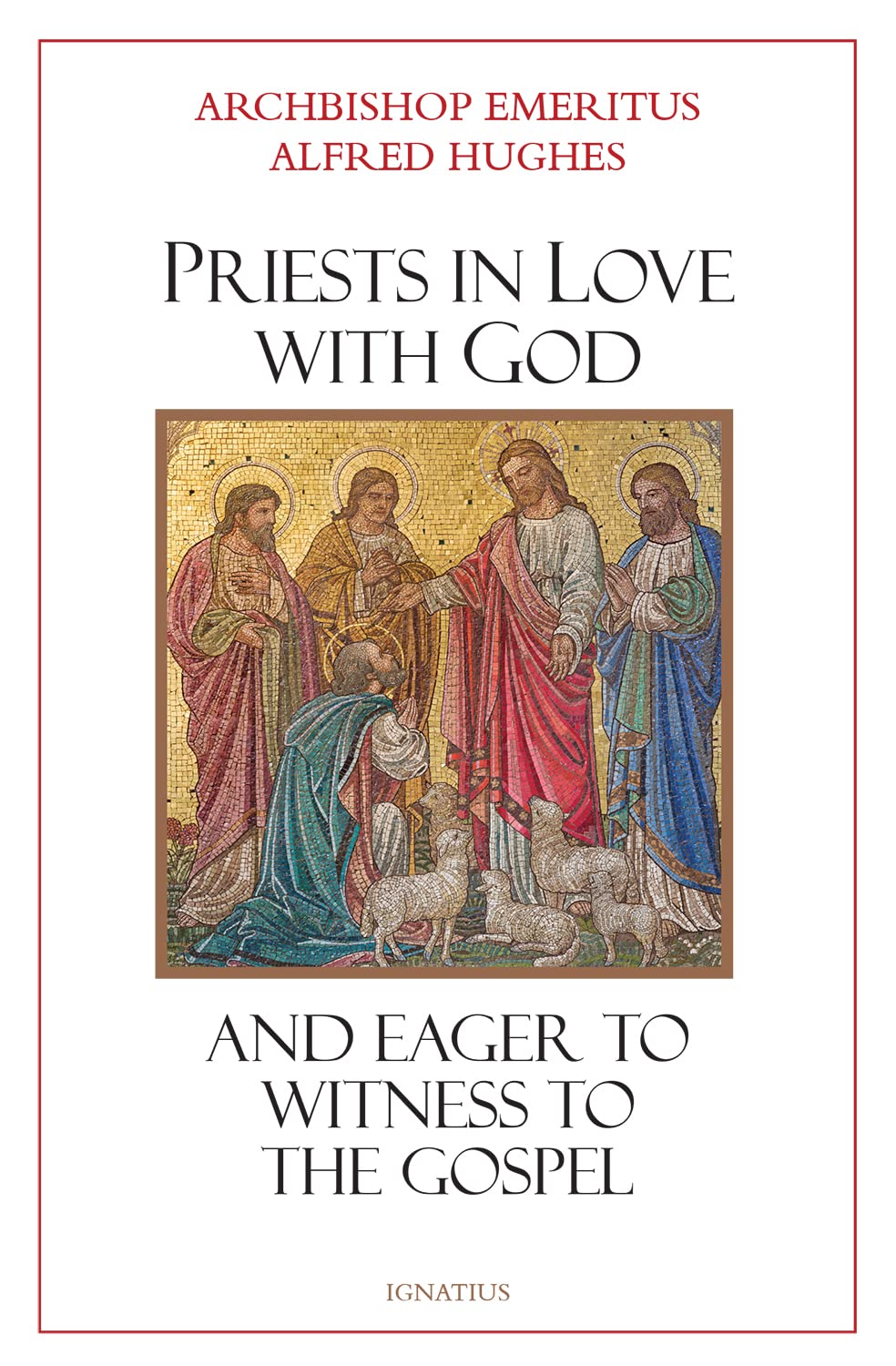
The book comes complete with images of the figures or events the prose elucidates before almost all of the chapters. Use of the images credit both the National Gallery in Washington, DC, and the Rijksmuseum in Amsterdam. To the reader’s benefit, the author is as comfortable discussing the implications on the Church’s life of Otto von Bismarck and the Kulturkampf (95) as he is the spiritual and financial consequences of the suspension of public Masses during the Covid-19 pandemic (142–47).
The spiritual insights contained in this volume promise wisdom for the present ecclesial moment and, for that matter, for whatever challenges future priests may face. The book maintains the delicate balance of providing the Church’s perennial wisdom and, at the same time, ensuring that it is applied adeptly for the present day. Priests and those who support priests will find in this book edifying advice, consoling reflections, and sound exposition of the Church’s teaching on Christ’s priesthood.
With the text under review, a legend of the Church in the United States has offered future generations fruitful reflections on the priesthood and the Christian spiritual life more generally. Seminary formators and those who guide seminarians and priests will benefit from this volume and the balanced wisdom of its author.
Rev. Ryan Connors is a priest of the Diocese of Providence and Rector of the Seminary of Our Lady of Providence (Rhode Island). He is the author of Rethinking Cooperation with Evil: A Virtue-Based Approach (Washington, DC: The Catholic University of America Press, 2023); Moral Theology: An Introduction (Cape Girardeau, MO: ECT Press, 2025); and co-author with J. Brian Benestad of Church, State, and Society: An Introduction to Catholic Social Doctrine, Second Edition (Washington, DC, The Catholic University of America Press, 2025).
Pray for Us – Meg Hunter-Kilmer
Hunter-Kilmer, Meg. Pray for Us: 75 Saints Who Sinned, Suffered, and Struggled on Their Way to Holiness. Notre Dame, IN: Ave Maria Press, 2021. 270 pages.
Reviewed by S.E. Greydanus.
 Those who are familiar with “saint of the day” biographies have some idea of how rare and challenging it is for an author to capture the extraordinary quality of someone’s life in a page or two. These summaries tend to fall into a simple formula: date and place of birth, accomplishments, and date of death, perhaps followed by a line to draw a moral. While understandable (how much can one say in such a narrow space?), this pattern can create an impression that the saints are more or less all the same, and have little to say to one’s own particular circumstances. A “universal call to holiness” would then make little sense.
This may be why Meg Hunter-Kilmer opens her collection of vivid biographies — many of which originally appeared at Aleteia — by tackling this all-too-common idea. Earlier in her life, she explains, she suffered from the same misconception: “The Saints I knew were dull outlines of immaculate lives, saccharine plaster images gazing vapidly heavenward” (xi), a model of sanctity that was hardly encouraging for someone with her lively personality. She later discovered that many other people had similar confusions:
My brilliant friends looked at the simpleminded Saints and thought the academically minded didn’t belong in their ranks. My less intellectual friends were sure that if they couldn’t be St. Thomas Aquinas, they might as well give up. The quiet ones thought they had to shout the name of Jesus from the rooftops. The excitable ones thought only mellow people could be Saints. (1–2)
In this book, Hunter-Kilmer makes abundantly clear the discovery that liberated her: “that these [Saints] were real people, broken people made whole by grace, and that far from being the impossible standard I’d thought they represented, they offered nothing but hope” (xi).
The 75 saints (or “Saints,” capitalized as a technical distinction, referring to their status of honor from the Church, with “saints” being anyone in heaven) are categorized by themes uniting their lives. These themes include “Saints Who Defied Expectations,” “Saints Who Lived Ordinary Lives,” “Saints with Difficult Families,” and “Saints Whose Ruined Plans Opened the Way to More Beautiful Things,” to name just a few. These Saints are from all across Church history, represent a wide array of racial and ethnic backgrounds, and lived wildly different lifestyles.
Most of these holy figures are relatively unknown even among lifelong readers of saint biographies. Consider yourself invited to comment if you had already heard of St. Hyacintha Mariscotti, Ven. Teresa Chikaba, or Bl. Augustine Thevarparambil Kunjachan. While some of those included are fairly well known — St. Jerome, St. Carlo Acutis, St. Charles Lwanga and the other Ugandan martyrs — reading their stories here may well help one to connect with them more deeply. These biographies focus on the reality of the Saints’ human lives, drawing out their personalities and emotions, quoting when possible from writings by them or those who knew them, and clearly distinguishing as needed between history and legend.
The historical, human reality of these people, in turn, shows their journeys to God to be no less real. Pray for Us breathes with conviction of the discovery that started St. Ignatius of Loyola on his spiritual journey: that the Saints are men and women as we are, so we can and must pursue the same holiness. Hunter-Kilmer’s biographies are hardly unique in concluding by relating the saint’s life to the reader’s, but these commentaries are no mere platitudes. What does a Japanese samurai-missionary-priest-martyr have to say to twenty-first century Americans? He became a priest and martyr by living with iron perseverance, again and again, that can also be applied to our own daily challenges. Why should we be interested in a seventh-century Egyptian hermit with a secret apostolate to prostitutes? His life is a powerful witness to the sacredness of human dignity, to true Christian love that sees the most despised as God sees them, a love that can freely lay down even reputation and life.
Challenges to common conceptions of holiness run throughout the book. These chapters often begin by expanding on the author’s opening insights, cutting away the nonessentials that are sometimes confused with the essence of sanctity. One can still become holy in the midst of exciting adventures, seemingly unimportant tasks, apparent failure, a life that hasn’t unfolded as one thought it should, a past rife with sin and shame. What, then, is necessary in holiness? Simply following, in whatever way one can, the great twofold commandment of love of God and neighbor — so simple and yet so all-consuming — or, as the Introduction puts it, following the call “to run after Jesus, however often we may stumble” (xii).
Specific virtues are sometimes cross-examined as well. For instance, in the introduction to “Saints Who Lived with Great Humility,” Hunter-Kilmer comments, “True humility is not, of course, self-loathing veiled in piety. It’s a conviction that we are everything the Father sees in us and only what the Father sees in us” (177). Given the linguistic and cultural barriers that often confuse word usage in older devotional works, such clear and thoughtful explanations aimed at twenty-first century readers are most welcome.
Also in keeping with the “ever ancient, ever new” spirit of the Church, Hunter-Kilmer frankly engages with uncomfortable aspects of the Saints’ lives in light of the Church’s moral teaching. As the book deals with Saints from all cultures, backgrounds, and historical periods, many of their stories involve facing — and, in at least one case, repenting of — racial prejudice, even from within the Church. Rather than attempting to paper over dark realities, these stories invite readers to join the Saints in combating these evils, in ourselves and our world, by the love of Christ. These Saints also include women who suffered sexual abuse and other forms of violence, some of whom were obliged to flee abusive marriages. The honest, compassionate treatment of these stories, so rarely told, could be of particular pastoral benefit to survivors of abuse or those who support them.
Pray for Us is for everyone, a warm, vibrant introduction to a sampling of our heavenly family and a ringing call to find one’s own way, by God’s grace, to join their ranks. It could be excellent as a confirmation gift for an older teen, a resource for a pastor or spiritual director seeking examples to share, a book club read (a discussion guide is also offered), or simply an aid for any Catholic seeking to connect their heart more deeply with the Lord. This, after all, is why knowing the saints is so valuable: The beauty of their lives points us to Him Who is beauty and goodness itself.
S.E. Greydanus is a freelance writer/editor, a lay Dominican, and managing editor of Homiletic & Pastoral Review.
Were Not Our Hearts Burning? – Marco Benini
Benini, Marco. Were Not Our Hearts Burning? Understanding the Mass – Living the Eucharist. New York/Mahwah, NJ: Paulist Press, 2026. 128 pages.
Reviewed by Rev. Regis J. Armstrong, O.F.M. Cap.
 Marco Benini, holder of the chair of liturgical studies at the Faculty of Theology in Trier, Germany, and research professor at The Catholic University of America in Washington, D.C., presents these easy-to-read reflections on the Mass, full of insights into ritual, theology, and spirituality. Quotations from the Council’s Constitutions on the Liturgy and Divine Revelation are stitched together with others from the General Instruction of the Roman Missal and the Roman Missal, which provide the underpinnings for his reflections on the Mass.
The erudition of this liturgical scholar is quickly recognizable, as is his pastoral zeal enabling his readers to effortlessly absorb, in the words of Bishop Stephan Ackermann, “how much the Eucharist opens life for all those who ‘consciously and actively’ celebrate it.” The just over one hundred pages of Benini’s text seamlessly present the depths of his liturgical knowledge, the breadth of his pastoral zeal, and the integrity of his biblical-liturgical spirituality.
“Life and Liturgy,” the book’s first chapter, is subtitled “The Longing Call of Bells.” It becomes a provocative invitation to the remaining six chapters beckoning and guiding his readers step-by-step” through the unfolding “Mystery of Faith.” Benini quickly acknowledges his inspiration for this approach as that of Romano Guardini’s Sacred Signs (1937). “How is this call of the bells received today?” Benini asks and, after teasing out Guardini’s poetic resonances, leads his readers to respond as he considers, in his second chapter, “The Introductory Rites.”
In what follows, Benini opens for us the significance of not only of the words but, more importantly, of the gestures or signs of what God reveals to us. (Significantly in this Augustinian Era of Pope Leo XIV in which we now live, we become confronted with Augustine’s influential Teaching Christianity [De Doctrina Christiana] that accentuates both elements, words and signs, in passing on the Gospel). Benini’s third chapter, “The Liturgy of the Word,” struck this reader, formed as he was years ago by a blind teacher of homiletics who taught him the power of spoken word and how to interpret it vocally. Of the many gestures that Benini highlights, those of the Presentation of the Gifts, the Offertory, will resonate with those who find significant that unassuming, silent mixing of a drop of water into the wine.
From “the beginning of the Eucharist Prayer (Preface) as well as at its end (Doxology),” Benini reminds his readers, “we are participating in the praise of Christ to the Father.” The author sagely remarks: “One can tell whether a priest only reads the Eucharistic Prayer or prays it.” From that passage, the author proceeds to reflect upon remaining passages of the Mass, presuming, in the words of St. Cyril of Jerusalem, “Everything that the Holy Spirit touches is sanctified and transformed.”
Benini’s book might well be a vade mecum for those eager to live a Eucharistic spiritual life, not simply through adoration as much as through a living conformity with the Lord whom they gaze upon. Were Not Our Hearts Burning? aptly expresses the author’s hope that these reflections will help his readers to recognize and understand the everyday words and gestures of the Mass and, as a result, become words of contemporary disciples who recognize the Risen Lord in the breaking of the bread.
Capuchin Father Regis J. Armstrong, Ph.D., is Emeritus Professor at the Catholic University of America in Washington, DC.
Spousal Prayer – Deacon James Keating
Keating, Deacon James. Spousal Prayer: A Way to Marital Happiness. Steubenville, OH: Emmaus Road Publishing, 2026. 104 pages.
Reviewed by James Jansen
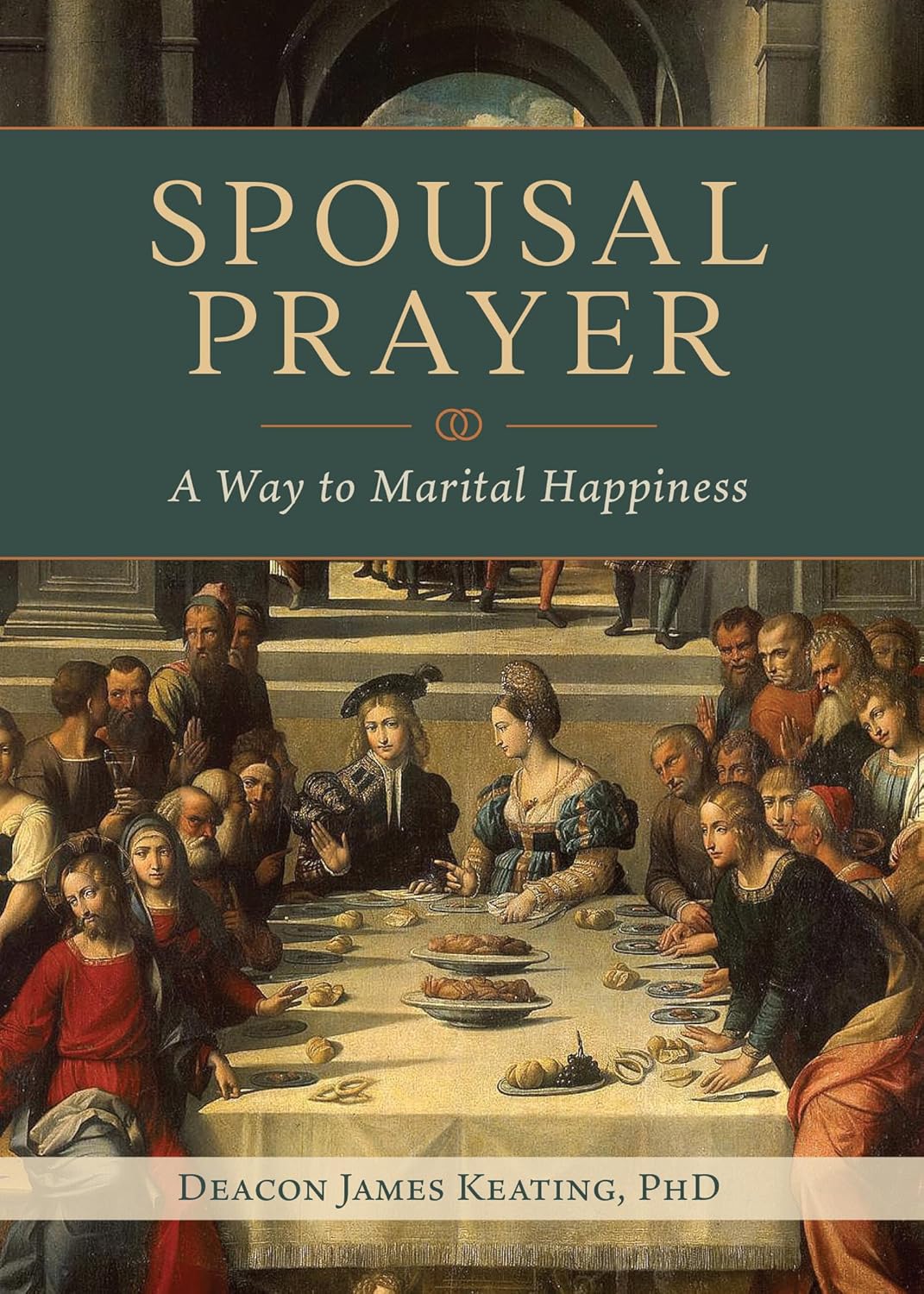 I dare you. Write a book on both prayer and the Sacrament of Marriage. Make it deep enough for theologians but practical and accessible for the average lay couple. It needs to be filled with personal stories and practical tools but built on the foundational principles of prayer and the sacrament. One more thing: it needs to be short and small enough to fit in your pocket. This is exactly the gift Deacon James Keating has provided in Spousal Prayer: A Way to Marital Happiness, republished by Emmaus Road.
Keating undergirds his work with a simple premise: our relationships with our spouse and with the Lord are mutually enriching, and prayer is the linchpin of both. In just three short chapters, he lays out a plan for becoming one, praying more deeply, and staying in love. He calls spouses to grow closer to each other and the Lord through a threefold movement of behold, listen, and repent/forgive. In the process, he provides a powerful resource for spouses, clergy, and anyone who supports them as couples and as individuals called to holiness.
Keating is a master spiritual director, and it is clear from the outset that this work has depth. “Prayer,” he says, “is powerful because it gives permission to God to affect your heart and mind and will. In prayer God wants to ‘permeate’ you; and if you let Him permeate your being, you will see how prayer moves from being simply your words on your lips to His word speaking within your heart.” He slowly unfolds a vision of the depth of prayer offered by the Lord with examples from everyday married life. In turn he unfolds the depth of love and unity possible in marriage by helping couples recognize the perfect love of the Lord given them through the imperfect love of their spouse.
Part of the genius of this little book is that it is so practical and accessible. Sprinkled throughout the book, Keating offers exercises for spouses to pray together and individually. He encourages young couples to fill their home with beautiful Christian art, but more than that, he teaches them how to use it for prayer. In one such exercise, he talks about taking the art off the wall to hold or lay on a table in front of themselves. He instructs them to ask the Holy Spirit to lead their prayer so that as they gaze on the image of Christ, they let that image “move you to speak to Him in some way about what is foremost in your heart.” More than simply alleviating distractions, Keating makes couples aware that the art helps them attend to the person and presence of Christ. With that practical tool for entering into His presence, they can now begin the challenge of listening to Him.
Despite how accessible and practical Spousal Prayer is, Keating does not shy away from the deep challenges of marriage and our relationship with the Lord. Instead, he leans into our familiarity with the challenge of marriage and family to sacramentally draw us closer to Christ. “Praying can be intimidating for the same reason falling in love can be: to do so brings us to the core meaning of human life.” He goes on to explain that in prayer we are forced to let go of “artificially consoling” attachments like the distractions of media, while in marriage we let go of all the options of remaining single. In this way, both prayer and marital love bring us into reality, that is, our sinfulness and need for salvation.
But Keating doesn’t leave couples or those who support them without hope. This book is deeply consoling in that while it is honest about the challenge, it is even more direct about the solution. The salvation needed is close at hand in the Sacrament of Matrimony. “Marriage is a sacrament because the love between you and your spouse is a ‘place’ to receive and be received by God. So, first, realize in faith that when you behold your spouse you are beholding Christ.” Keating goes on to help couples realize that their whole lives can be prayer as they recognize God’s love made flesh in their spouse and their love for God reciprocated in their love for their spouse.
Two particularly helpful examples come in the practical guidance offered for forgiveness and discerning the voice of the Lord. Keating instructs those wounded by their spouse to bring the wound to the Lord in prayer without minimizing its effects on them. They are to continue to bring that wound to the love of the Lord until it can be gently caught up in the love they have for their spouse. In similar fashion, he is clear that God’s voice never condemns us as a person. When we, in turn, need repentance, God’s voice will gently call us away from sin. If the message is that we are “bad, a failure, or unworthy,” that is either an unhealed wound which must be brought to the Lord or the voice of the enemy to discourage us.
Finally, Keating offers a series of short answers to common questions and another simple way to pray. The questions include topics such as how we talk through our differences, how do I know I am hearing the Spirit and not my own voice, and what it is reasonable to expect in terms of consolation and dryness in prayer. The method of prayer teaches couples to attend to the fundamental movements in their thoughts, feelings, and desires taught by the Institute for Priestly Formation. The method provided is simple, memorable, and translates to every form of prayer from devotions, Lectio Divina, and the Mass.
If there is any limitation in this book’s ability to draw couples deeper into prayer and the grace of the sacrament, it may be in the limits of the affective capacity of spouses to receive it. One need not be an expert in marriage preparation to recognize that many couples who present themselves for the sacrament seem to be lacking the fundamental dispositions of disciples of Jesus. So too, faithful married couples often lack the interior awareness of the movements of their hearts and minds which form the foundation of the depth of prayer Keating is inviting couples to enter. And yet, that is precisely why such a book is needed.
What if Spousal Prayer became a tool for those who support couples to help draw them deeper into prayer and to the grace of the sacrament? What they may not be able to accomplish themselves could be fostered by the accompaniment of wise spiritual directors, pastors, and other mature mentor couples. This book offers a tool for those guides as they accompany individual spouses and couples together. In the context of accompaniment, the depth and practical accessibility of this book could be a tool to help transform Christian marriages.
Overall, this little book is a gem. It is clear that Keating is both a scholar and practitioner. He is no stranger to prayer and to the gift of spousal love. He has, in his own life, lived the hopeful reality he preaches: “The two relationships work interdependently and utilize the same habits to guard your unity with one another and with God through one another.” The result is a gift for couples and all those who support them in their life of prayer and their vocation to marriage.
James M. Jansen, M.T.S., is the Director of the Parish Support Team for the Archdiocese of Omaha and author of A Clear Path: How to Make Missionary Disciples in Your Parish.
 About Book Reviews
Recent Comments