Peace in the Forgiveness of Sins
“On the evening of that first day of the week, when the doors were locked, where the disciples were, for fear of the Jews, Jesus came and stood in their midst.”
Jesus Christ, crucified and risen from the dead, stands in the midst of human fear. He comes to the disciples, who out of fear of the murderous wrath of those who crucified the Lord locked themselves in an upper room. This door that was locked kept the disciples in as much as it kept the leaders of the Jewish people out. The disciples were trapped — they trapped themselves out of fear, with no escape, in an upper room: a precarious situation!
Yet Christ comes to stand in their midst. He comes not to bring condemnation. These disciples had abandoned him before his Passion. These disciples were now fearful of human power. These disciples were mere men before the Lord. And Christ stood in their midst, disregarding the locked door, and spoke a word of peace to these troubled hearts. Jesus Christ brought to the fearful men his peace, a peace won by the wounds he showed them. In this peace and in the victory of the passion, the disciples rejoiced in the Lord. The defeat of the cross and the confusion of resurrection morning has given way for these disciples to true joy in the presence of the risen Lord.
Mark well this truth: Christ’s peace is brought to the disciples; their fear is dispelled, their courage restored. Yet to what end was Christ’s appearance behind these locked doors? “Jesus said to them again, ‘Peace be with you. As the Father has sent me, so I send you.’ And when he had said this, he breathed on them and said to them, ‘Receive the Holy Spirit. Whose sins you forgive are forgiven them, and whose sins you retain are retained.’”
The forgiveness of sins. This power, given to the disciples, is the urgent message — the first message — of the Resurrection. For this Christ suffered: that man might be reconciled to God. In this consists true peace: the man might become one with God. The external fear of the disciples was brought to nothing because they were returned to union with Christ. In speaking his word of peace, the Lord united his disciples to himself and gave them the power to apply the fruits of the Passion to all to whom they preach.
The Door to the Feast
In the book of Revelation it is written, “Behold, I stand at the door and knock; if any one hears my voice and opens the door, I will come in to him and eat with him, and he with me.” (Rev. 3:20). This door that Jesus stands before is not a door of wood and iron, but rather the door to our hearts. If we invite the Lord into our heart, he enters into our lives as Lord and dines with us. This meal, shared in the opening of our hearts to Christ, is the Eucharist that we share. He stands at the door and knocks — we must accept his grace of conversion. He stands at the door; with St. Augustine we can say that he who created us without our approval will not save us without our consent.1 It is an invitation to join the Eucharistic banquet which leads to the eternal banquet. But to us alone belongs the power to open this door.
A Spirit of Freedom
St. Paul tells us that “those who are led by the Spirit of God are sons of God. For you did not receive a spirit of slavery to fall back into fear.” What is it that causes us to fear the Lord? What keeps our hearts so tightly shut from his light and his peace? We hear that we are “heirs of God and joint heirs with Christ, if only we suffer with him.” Does this make us afraid? Our hearts are human, marred by concupiscence. We say that we are Christians, but we need daily conversion. To follow Christ means to give up everything, to take up our crosses, and follow him. This indeed is daunting! Our hearts are laden with sorrow, for we have many attachments to the things of this world. What we fear to lose the most we must pray to be freed from. “For if you live according to the flesh, you will die.” And Christ came to bring life, and to bring it more abundantly! We are not alone in this task of conversion: the grace of Christ is constantly at work in us, calling us onward towards union with Him.
Slavery to fear is the fruit of attachment. To follow Christ means not only to be rid of mortal sins — although it certainly means this — but to do the will of God in every moment of our lives. This is the path to holiness. This is the call that Christ gives to each and every one of us — to be saints, to surrender our hearts to the one who made us and to the only one who can fulfill the longing of our hearts. To receive the peace he gives us this Pentecost, let us open our hearts before him, allowing the Lord to take possession over those attachments which bind our hearts to this world. Allow the Lord to enflame your heart — set it ablaze and consume what keeps us from loving him fully and from loving our neighbor as ourselves!
Conversion that Leads to Unity
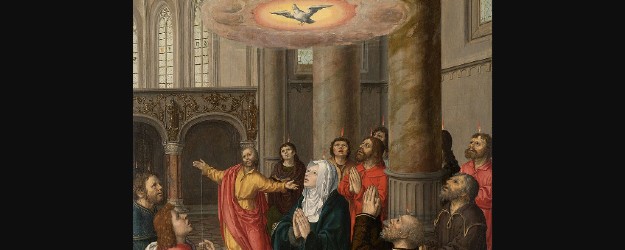
“When the time for Pentecost was fulfilled, they were all in one place together. And suddenly there came from the sky a noise like a strong driving wind, and it filled the entire house in which they were.” Where the Holy Spirit dwells there is no room for useless things. Scripture tells us that in this descent of the Spirit, the whole house was filled. There was no room for sin; there was no room for disordered affections. And if the Holy Spirit fills a house completely, there can be no doubt that the hearts of the disciples were filled to the brim — overflowing, in fact — with the Holy Spirit.
This is what it means to accept Christ as Lord: that he have dominion over those who serve him, a dominion of love to save those who cry out to him. This is why we have celebrated Easter, to receive the Mercy of God. This is why we profess our faith in the risen Christ who will raise us again on the last day. If even death is subject to Christ, how can we withhold our hearts?
Brothers and sisters, what must we do to open the doors of our hearts? Christ has shown us the way. For freedom has Christ freed us — let us no longer wander the path of slavery to sin. We must invite the Holy Spirit to break the bonds of disordered affections and attachments to sin; today is the acceptable day to open our hearts in response to his grace. He gives us the grace of repentance as the first fruits of his resurrection: “whose sins you forgive are forgiven.” Let us invite the Spirit to illuminate our conscience, to liberate us from our sinful inclinations; let us accept his invitation to confess our sins, to be washed clean again.
When we are cleansed, we know that we shall be one: one with the Lord, who calls us to himself, and to the Church, which is the Body of Christ. This is the meaning of languages spoken and understood at Pentecost: that we might acknowledge in one another the oneness of the Church, that all of us, baptized in the risen Lord, are true brothers and sisters in Christ. This is the meaning of the scripture which says, “They were all in one place together.” Christ has given us the Church as the sacrament of salvation — let us joyfully confess our sins and, one with another, take our place around the table of the Eucharist, the sacrament of unity. St. Paul tells us, “As a body is one though it has many parts, and all the parts of the body, though many, are one body, so also Christ.”
Unity in the Church
What, therefore, can we do to make ourselves ready to receive the Holy Spirit today? We know that where the Spirit is, there is life: so let us examine today where in our hearts we remain afraid. Let us take stock of our disordered affections — what do we love on this earth more than Christ? And, having uncovered these attachments, let us humbly pray that the Holy Spirit might draw us from them and unite us more fully with one another in the Church. Let us bring these attachments to the sacrament of penance and be washed clean through the blood of Christ. Then, having been cleansed and filled with the spirit, let us join at the Eucharistic sacrifice with a greater love in our hearts. Christ appeared to the disciples to dispel their fear and to embolden them to be his missionaries. He sent them as the Father had sent Christ. Christ was sent to offer himself out of love for humankind to reconcile us to God; when we have been reconciled and are filled with the peace of a right conscience, let us make of ourselves a gift for one another, serving the needs of those around us and praying with an for our brothers and sisters.
Pentecost is a celebration of the whole Church together as one. Let us mark this feast with joy, welcoming into our daily lives this same Holy Spirit who guides the Church. Let this Pentecost be for each of us a new outpouring of the Holy Spirit in order that we might have the courage and strength to become missionary disciples, as the Church and Christ calls us, to love our brothers and sisters and bring them too into the grace of that same Spirit. Amen.
- C.f. St Augustine, Sermo 169, 13 (PL 38,923). ↩
 About Patrick A. Gill
Recent Comments