For Holy Thursday, Good Friday, Holy Saturday (Easter Vigil), Easter Sunday, Divine Mercy Sunday, and the Third Sunday and Fourth Sunday of Easter
Holy Thursday – April 2, 2026
Readings: Exodus 12:1–8, 11–14 • Psalm 116:12–13, 15–16bc, 17–18 • 1 Corinthians 11:23–26 • John 13:1–15
bible.usccb.org/bible/readings/040226-Supper.cfm
With this Mass of the Lord’s Supper, we begin a great journey — a journey in the form of liturgy, but no less real a journey for all that — which will take us in just a few days from the Lord’s final meal with his disciples through his suffering and death and burial to his resurrection from the dead. This is not intended to be simply a remembrance on our part of the sacred journey that the Lord undertook some two thousand years ago, in the same way, for example, that we might remember someone’s birthday or the anniversary of a wedding; it is not just the anniversary of the first Holy Thursday, the first Good Friday, the first Holy Saturday and the first Easter Sunday, which we observe every year out of a sense of religious duty. The intention of the liturgy that we will celebrate during these days is that we be participants and not merely observers of this great drama that infinitely surpasses every other imaginable drama; the intention is that we make the journey ourselves. For it is certainly possible to attend this service, and the ones that will follow in the days to come, as observers — as believing and sympathetic observers who may even be moved to tears by what they are observing. But wouldn’t it be possible for non-Christians and atheists to be sympathetic observers as well, and even to be moved to tears by the gripping story of Holy Thursday, Good Friday, Holy Saturday and Easter Sunday? The question that we should ask ourselves this evening, then, is how we Catholic Christians may be participants rather than mere observers.
Do you remember what St. Paul said in his Letter to the Romans, that, when we were baptized, we were baptized into Christ’s death, burial, and resurrection? Now, especially, is the time to recall these words and to re-activate this truth, which for so many of us — myself included — is something mysteriously beautiful but, practically speaking, almost meaningless; dormant at best, rather than an active force.
For St. Paul’s words to be meaningful, we must put on the mind of Christ, as he says elsewhere, in his Letter to the Philippians. This means uniting ourselves with him not only by attending these services, as we have begun to do this evening, but also by allowing these same services to have an effect on us. I am speaking here of something deeper and richer than experiencing the emotional effects that so often occur to us naturally during these sacred days, especially, probably, on Good Friday, which non-believers, too, may experience. I am speaking instead of allowing ourselves to be impelled by these services to put on the mind of Christ, to think as he did and to act as he did. If we discover something compellingly loving and lovable about Christ in the liturgies of these days, particularly in the readings from Scripture, then, because love impels us to imitate the Beloved, we will want to imitate Christ, and by imitating him we will be thinking like Christ and acting like Christ; we will be putting on the mind of Christ.
Two loving and lovable actions of Christ dominate this evening’s readings from Scripture. The first is the washing of his disciples’ feet, as recorded in the Gospel of John, and the second is his institution of the Eucharist, which St. Paul recounts in the second reading, taken from his First Letter to the Corinthians.
If we think about it, it must strike us as very strange indeed, that, when St. John writes of the Last Supper, he has nothing whatsoever to say of the Eucharist. In that regard he differs from the other Gospel writers — Matthew, Mark and Luke — who each tell us of how Jesus took bread and wine, blessed them and gave them to his disciples, saying, “This is my body . . . This is my blood.” Why St. John chose not to record this, we do not know. But he recorded something else that the others did not — the washing of the feet. Did John think that the one brought the other to mind? Did he intend to say that, when Jesus stripped himself of his outer garments, bent down, and took in his hands his disciples’ feet and with those hands washed the most soiled parts of his disciples’ bodies, he was giving himself to his disciples in some way similar to the way that he would give himself to them in the Eucharist, and that his readers would grasp the connection, the complementarity, between the footwashing and the Eucharist so spontaneously that there would be no need to explain it? That Jesus was giving himself symbolically in the washing of the feet, while giving himself really and truly in the Eucharist? That he was giving himself visibly in the washing of the feet, while giving himself invisibly in the Eucharist? That in each there was a total gift of self, although expressed differently, and that one gift was incomplete without the other? For, without the visible gift of bending down in humble service, the invisible gift of the divine eucharistic presence is incomplete, just as the visible gift is incomplete without the invisible gift.
As we reflect on these two displays of Christ’s love, one menial and the other sublime, and seek to understand them together, what else does it mean to put on the mind of Christ and to enter into his death, burial, and resurrection than to embrace the gifts of his footwashing and his Eucharist, which together make a complete whole, and to show him our gratitude by giving something similar to one another — the outer act of charity, whatever it may be, along with the inner gift of love?
Even tonight, this very moment, as we celebrate this Mass together, the Lord is on his way to Calvary and from there to the garden where he will be buried and where he will also rise from the grave. If we want to go with him and share in who he is and what he does, instead of merely standing at a distance like observers, even respectful observers, then let us grasp the significance of both the menial washing of the feet and the sublime offering of the Eucharist and make them, together, our own.
Good Friday – April 3, 2026
Readings: Isaiah 52:13—53:12 • Psalm 31:2, 6, 12–13, 15–16, 17, 25 • Hebrews 4:14–16; 5:7–9 • John 18:1—19:42
bible.usccb.org/bible/readings/040326.cfm
We have just heard the lengthy account of Jesus’ suffering, death, and burial, which was taken from the Gospel of John; it is the same account that has been read for centuries every Good Friday. If we were at Mass on Palm Sunday, this past weekend, we would have heard another long account of the events that occurred at the end of Jesus’ life, but taken instead (this year) from the Gospel of Matthew. The Gospel of John and the Gospel of Matthew tell the same basic story but somewhat differently. In fact, each of the four Gospels — Matthew, Mark, Luke, and John — tells the same story with variations, and each contains certain elements of this narrative that the other three do not, although none of them leaves out anything that is not central to the narrative. Those crucial elements, of course, include Jesus’ trial and condemnation, his torture, the carrying of the cross, his crucifixion and death and, finally, his burial.
One of the elements that all four evangelists include is the account of Peter’s denial. It is like a mini-drama that has been inserted into the infinitely greater drama of Jesus’ suffering and death; the setting is different, the actors are different, and the purpose is different. This brief episode — this interlude in the narrative of Jesus’ suffering and death — does not move the whole story forward in the way that, for example, the actions of Judas or the high priest or Pontius Pilate do. Jesus’ fate would have been exactly the same regardless of whether Peter denied him or not. All in all, the story of Peter’s denial offers a moment to pause and reflect on the meaning of the fact that someone who loved Jesus and had sworn his fidelity to him had now hurt him terribly. The Gospel of Luke brings this home when it says that Jesus was aware of what Peter did and gazed at him when he did it: “The cock crowed, and the Lord turned and looked at Peter, and Peter remembered the word of the Lord, how he had said to him, Before the cock crows today, you will deny me three times.” And Matthew, Mark, and Luke all say that Peter wept bitterly after doing what he did.
What did Peter think when Jesus told him, “You will deny me three times before the cock crows”? Did he take those words seriously? (The evangelists sometimes provide us with a glimpse of Peter’s bravado and self-assuredness, which give the impression that he thought he knew better than Jesus did.) All that we know is that Peter did the worst thing that he could possibly have done, and at the worst time. Peter’s denial of his Lord, who also happened to be his best friend, brings everything to an abrupt halt for just a moment, before the story continues. We know, of course, that Peter denied Jesus out of fear, but why couldn’t courage and faith and love have conquered his fear? For an answer, we may turn to the prophet Jeremiah, who says, “The heart is more devious than any other thing, perverse too. Who can understand it?” Does anyone think that he or she has a heart that would not have surrendered to the same fear that overcame Peter? No one with any self-knowledge would ever dare to think that! Even the martyrs who, throughout Christian history, have gone bravely to their deaths have been fearful and have needed the courage that for some reason Peter could not summon up. We must not fall into the trap of looking down our noses at Peter and disdaining him, as if he were utterly different than we are. And so, for one thing, although we may be saddened by what Peter did, we should not be surprised or shocked. For another thing, we must forgive him, as we know that Jesus did, in the expectation that our own sins and betrayals will be forgiven as well.
If only Peter could have realized that, in his suffering and death, Jesus was laying out the pathway of courage and faith and love for us all, so that he and we could follow the Master on that path all the way to the resurrection! But he realizes it now, and so do we on this Good Friday.
The Easter Vigil – April 4, 2026
Readings: Options can be found at USCCB.org
(This homily presupposes that the Easter Vigil will include the administration of the sacraments of initiation and also that Genesis 1:1–2:2 will be used as the first reading.)
Let me begin by greeting those who are with us who are going to receive the sacraments of baptism and confirmation tonight and, for the first time, the Eucharist, along with your guests and, indeed, the whole congregation. We are one in Christ, joined together in him and in joy and anticipation. At a moment such as this, we are more than a mere community; I would like to think that we are a communion.
We began this liturgy, the longest of the whole church year, with the ceremonial lighting of the paschal candle. As you know, the lighted paschal candle symbolizes Christ, the light of the world. With the light from that candle the other candles, which you were holding, were lit, and thus Christ’s light was spread throughout the congregation in a symbolic way. Once the paschal candle was set in place at the front of the church for all to see, a beautiful and ancient song of praise and gratitude was sung over it, which linked the candle’s light to Christ, the Light, himself.
Then we experienced the most extended part of tonight’s liturgy — a series of readings, along with their responses and prayers, from the Old and New Testaments. The readings started with the story of creation itself, from the Book of Genesis, which is at the very beginning of the Old Testament. They reached a climax with two selections from the New Testament — a wonderful passage about baptism from St. Paul’s Letter to the Romans and then the account, from the Gospel of Matthew, of the risen Jesus’ appearance to Mary Magdalen and “the other Mary.” It would be surprising if in this lengthy series of readings we didn’t notice a movement from non-life, indeed, non-existence, the nothingness before creation, to the new and abundant life of the risen Christ; from the darkness of the void, of the nothingness, to the brightness of the morning of the first Easter; from the plan, sketched out in the Law and the Prophets of the Old Testament, to the fulfillment of the plan in the resurrection of Christ.
And yet, in everything that was read to us from the Old and New Testaments, there was a piece that was missing. We are that missing piece. Eternal life is incomplete without us; Easter is less bright if we are not experiencing it; the plan remains unfulfilled if we are not an integral part of it. As St. Paul says in one of his letters, speaking of the ultimate aim of the divine plan, “God wills all to be saved and to come to the knowledge of the truth.”
And so the purpose of this night’s liturgy is to extend this plan to us, as something for us to embrace and to make our own. Most obviously it does this through the administration of the sacraments of baptism, confirmation and the Eucharist, which some of you will receive in the next few moments. Baptism unites us to Christ in his death, burial and resurrection, as St. Paul says in his Letter to the Romans. Confirmation seals and strengthens that union; it confirms it. The Eucharist joins us to the risen Christ in his humanity and his divinity and also to one another in his Body. In the words of St. Paul: “All of us, in union with Christ, form one body, and as parts of it we belong to each other.”
For those of us who were already gifted with these sacraments in the past, when the time comes for us tonight to receive Communion, then we will once more be joined body and soul to the risen Christ in communion with him and with one another. What greater good could this liturgy offer us than that?
Easter Sunday – April 5, 2026
Readings: Acts 10:34a, 37–43 • Psalm 118:1–2, 16-17, 22–23 • Colossians 3:1–4 or 1 Corinthians 5:6b–8• John 20:1–9 or Matthew 28:1–10
bible.usccb.org/bible/readings/040526.cfm
Morning Mass
As we go through the Gospels of Matthew, Mark, Luke, and John, in order to read the story of Jesus’ resurrection as each one of them told it, we discover something quite astounding, which has puzzled the readers of the Gospels for centuries: there is no story of the resurrection! The evangelists restrict themselves to telling us just two things — first, that the tomb where Jesus was buried was empty on Sunday morning, when the disciples came to look for his body; and second, that Jesus, no longer buried in the tomb but risen from the dead, appeared on many different occasions to his disciples, sometimes soon after his resurrection, and sometimes weeks later. There is no description, not the slightest hint of a description, of Jesus’ actual resurrection itself. Nor, for more than a thousand years, did any artist ever try to depict what Jesus’ resurrection might have looked like. Was this because the moment of the resurrection was considered too sacred to describe or depict, so that it should be left untouched like a mystery that ought not to be probed too deeply? As the Book of Sirach says in the Old Testament, “Do not seek the things that are too high or search into things that are beyond your ability.” Was, is, the resurrection one of those things that are beyond our ability to grasp? Was it, is it, something unimaginable, inconceivable, incapable of being described or depicted, too glorious, too awesome, too amazing, almost something like God himself, whom no one on this earth has ever seen or can see?
The overwhelming quality of it all may help to explain the unexpected way that the disciples’ discovery of the empty tomb is presented in the Gospel that we heard just a few minutes ago. Why this focus on things that are secondary and even trivial in comparison with the fact of Jesus’ shocking absence from his own grave? Why the details about which disciple ran faster, and who entered the tomb first, and how the burial cloths were arranged? Scholars tell us that these seemingly unimportant parts of the story help to establish the truthfulness of the narrative, because only someone who was there could have remembered such apparently insignificant things. But couldn’t it be, too, that the prominence given to these seemingly unimportant details is a testimony to the evangelist’s inability to come to grips with the infinitely greater thing that he had experienced — that Jesus was not where he was expected to be?
Have we ever wondered why, when we say the Creed, we profess our belief not only in Jesus’ death but also in his burial? “For our sake he was crucified under Pontius Pilate, he suffered death and was buried.” It is because his burial is central to the story and not merely the next step after his death, as though we were mentioning something in the Creed that really should be taken for granted and didn’t actually need to be mentioned. Rather, Jesus’ burial, his placement in the tomb at the hands of Joseph of Arimathea, brings to a conclusion the sequence of events associated with his death and serves as the proof that he had really and truly died. “Dead and buried” is the expression that we often use when we want to say that something is conclusively over and done with — not just dead, but buried too. And saying that the place of burial was empty was a way of saying that burial no longer applied to Jesus, and that thus death no longer applied to him either.
There is no mention of an appearance of the risen Christ in the passage from the Gospel of John that we heard a short while ago. If we were to continue reading, though, we would learn of a number of appearances — to Mary Magdalen and, on several different occasions, to the disciples. If we were to read the other Gospels, Matthew, Mark, and Luke, we would learn of still more. And, most astonishing, if we looked into St. Paul’s First Letter to the Corinthians, we would see there that Jesus “appeared at the same time to more than five hundred of the brothers,” some of whom, Paul says, were still alive when, less than twenty years after the resurrection, he recorded that remarkable appearance to such a great crowd. And how many other appearances of the risen Lord were never written about at all!
Yet, despite the extensive testimony of the Gospels and St. Paul, there is no proof of Jesus’ resurrection that would satisfy a skeptic. A skeptic could rightly ask, “How can we trust such outlandish stories, like fairy tales, which were written two thousand years ago by people who must have had something to gain by writing them?” I doubt that we could ever convince such a person; we could never come up with any evidence apart from the Scriptures that would make someone believe that Jesus rose from the dead. For our part, we are fortunate because we believe the Scriptures, which is a gift that not everybody has, even though we may have questions about this or that detail.
Easter is not only about Jesus’ resurrection from the dead — about the empty tomb and the appearances of the risen Lord. Those are the realities that the Scriptures present to us. Easter is also about us and whether we believe in those realities. Without belief in the resurrection, belief in everything else that counts collapses — belief in a world where justice ultimately prevails, belief in the goodness of creation, belief in the triumph of life over death, belief in the eternity of love, belief in the truth of God’s word in the mouth of Jesus and in the testimonies of his followers, belief in a God who cares for humanity, in other words, belief in the very relevance of God. If we don’t believe in what the Scriptures have to say about the resurrection, which they obviously consider the most important thing that they have to tell us, why should we believe anything else that they have to tell us? On the other hand, if we believe what they have to say, if, against all disbelief, we believe in the resurrection, then we believe in justice, goodness, life, love, truth, God. Amen.
The Gospel for the afternoon Mass on Easter Sunday is the same this year as the Gospel for the Third Sunday of Easter, April 19, 2026.
Second Sunday of Easter – April 12, 2026
Readings: Acts 2:42–47 • Psalm 118:2–4, 13–15, 22–24 • 1 Peter 1:3–9 • John 20:19–31
bible.usccb.org/bible/readings/041226.cfm
Jesus is of course the central personage of the Gospels, but there are other important characters as well. Some of those others have major roles, whether they appear frequently or not, like Mary and John the Baptist and Peter and Judas, too, for that matter. Still others, however, have their great moment, their star turn, so to say, and then recede into the background. Of those I could name, for instance, Mary’s cousin Elizabeth and her husband Zechariah, the parents of John the Baptist, and the wise men from the East, and Joseph of Arimathea. And also the apostle Thomas, without whose presence Jesus’ second appearance to his disciples would have been entirely different.
The Gospel that we just heard tells us that Thomas was not there when Jesus appeared for the first time to his disciples on the very evening of his resurrection, when the disciples were gathered together behind locked doors because they were afraid. Why, out of all of them, was Thomas the only one who was absent? As the evangelist John tells us at the end of this passage from his Gospel, he did not record everything that he could have recorded, but only those things that would help us to believe in Christ. Knowing why Thomas was absent might have satisfied our curiosity, but it would not have helped our belief. Nevertheless, his absence itself — regardless of what caused him to be absent — clearly played into God’s plan.
As it turns out, Thomas’s hostile resistance when the other disciples told him that they had seen the risen Lord while he was absent (was he jealous of them because they had experienced something that he hadn’t?), and his rude insistence on looking closely at Jesus’ wounds and probing them, sets the stage for the greatest act of faith in the whole New Testament.
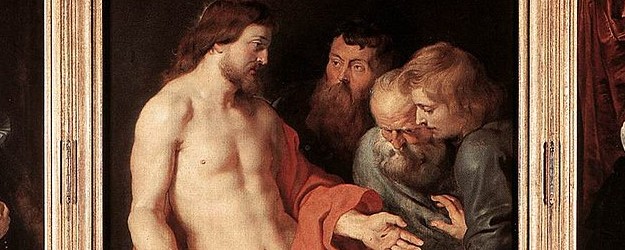
When Jesus appeared to his disciples a second time, on the Sunday after the Sunday when he rose from the dead, Thomas was now present. Jesus was aware of Thomas’s unbelief and addressed it straightforwardly. First he greeted his disciples by extending his peace to them — “Peace be with you” — and then he said to Thomas, “Put your finger here and see my hands, and bring your hand and put it into my side, and do not be unbelieving, but believe.” In the past, people had touched Jesus, and he had touched them, but Jesus had never invited the physical intimacy with which he invited Thomas in those words, “Put your finger here . . . and bring your hand and put it into my side.” Over the centuries artists have liked to depict Thomas putting his hand into the wound of the lance on Jesus’ side, but in fact the Gospel does not tell us that Thomas actually did such a thing; perhaps he was too stunned at Jesus’ appearance and too surprised by his invitation to carry out what he had told the others he wanted to do. What the Gospel does tell us is that Thomas said, “My Lord and my God” and that Jesus uttered a mild reproach in response: “Have you come to believe because you have seen me? Blessed are those who have not seen and have believed.”
“My Lord and my God” is the most extraordinary confession of faith that is to be found in the New Testament. Before Thomas’s act of faith no one else had ever said that Jesus was both Lord and God, and even after Thomas’s act of faith, which is so simple and definitive, there is really nothing comparable elsewhere in the New Testament. We should understand how remarkable it is that Thomas said what he did, and that he moved so totally from one position to another, from unbelief in Jesus’ resurrection to belief in his lordship and his divinity. No need to say that he believed in his resurrection when, after all, the risen Christ was standing right in front of him! Thomas could simply have said, “I believe,” and added, “Forgive my unbelief,” and that certainly would have been enough. Instead, he passed from unbelief in Jesus’ resurrection to believing all the essential truths about Jesus — that he was a wounded, crucified man who had died and was now alive, whose wounds he could have touched if he had wanted to; that he was his Lord, meaning his master and his mentor; and, infinitely more than that, that he was his God. This was Thomas’s important moment, his very reason for being, and from then on he never says another word in the Gospels.
Thomas needed to appear on the scene to say the things that he did, at the time that he did. He needed to speak as harshly and as crassly as he did — “Unless I see and touch, I will not believe” — so that he could say as humbly and acceptingly as he did, “My Lord and my God,” so that the contrast between the former and the latter would be all the greater.
While we have focused on Thomas and what he said nearly two thousand years ago, we ought not to forget what the Lord said to him: “Have you come to believe because you have seen me? Blessed are those who have not seen and have believed.” Those words apply to us.
A question naturally comes to mind: Was Thomas better than we are for having seen what we haven’t seen? Once he had seen the wounded and risen Christ, there was no other option for him than to accept the evidence that was before his eyes, which we ourselves will never see in this life. Yes, what Thomas experienced was extraordinary, but his experience came without a blessing. Jesus did not say to Thomas, “Blessed are you because you have seen me,” but when he said, “Blessed are those who have not seen and have believed,” he was referring to you and me.
Like Thomas, we too have doubted — it would be most unusual if we haven’t — and we have never had the experience that Thomas had, which would have relieved us of our doubt. But in the end we have believed without seeing. Thomas and the other disciples had the advantage of knowing Christ in the flesh, which is of course impossible for us, and perhaps inconceivable as well. But the blessing that accompanies faith in what we cannot see but that his disciples could see — that great gift has been promised to us, and we share it with all the saints throughout the centuries who never saw Jesus, never heard Jesus, never touched Jesus, but who knew and believed Jesus as if they had seen and heard and touched him.
Third Sunday of Easter – April 19, 2026
Readings: Acts 2:14, 22–33 • Psalm 16:1–2, 5, 7–8, 9–10, 11 • 1 Peter 1:17–21 • Luke 24:13–35
bible.usccb.org/bible/readings/041926.cfm
Is there any Gospel story more evocative than the one that we just heard from the Gospel of Luke, which tells us of Jesus’ sudden appearance to two disciples on Easter Sunday itself, the very day of the resurrection, as they are on their way from Jerusalem to the village of Emmaus? Jesus seems to come from nowhere and joins the two of them, walking along with them and conversing with them, and all the while they have no idea who this person is. When all three have arrived at their destination and are having supper, Jesus takes bread, blesses it, breaks it and gives it to them. All at once the two recognize him, but instantly he vanishes from their sight. Then, as the Gospel recounts for us, they tell each other so beautifully and memorably, “Were not our hearts burning within us while he spoke to us on the way and opened the Scriptures to us?” With that they rush back to Jerusalem to tell the others there what they have experienced, and the disciples there confirm that Jesus was indeed alive.
Central to this story is the simplicity — could we call it innocence or naïveté? — of those two disciples, who know all about Jesus and who, as they walk along, share that knowledge with their mysterious guest, who allows them to go on about something that he himself has no need to be told. They clearly wanted to believe that “Jesus the Nazarene, a prophet mighty in deed and word before God and all the people,” as they refer to him, was going to be the savior and redeemer whom they had been looking for, but they cannot help but be deeply confused. They know that Jesus was put to death by crucifixion, but they have also heard that his body was not in the tomb where it was supposed to have been buried; more than that, they have even heard a rumor that Jesus was alive. What were they to make of all of this?
Here Jesus intervenes and takes over the conversation, starting with a rebuke: “Oh, how foolish you are! How slow of heart to believe all that the prophets spoke! Was it not necessary that the Christ should suffer these things and enter into his glory?” And Luke, who is recording the disciples’ encounter with Jesus, continues: “Then, beginning with Moses and all the prophets, he interpreted to them what referred to him in all the Scriptures.”
Let us pause here for a short while to reflect on what Luke says that Jesus did.
I, for one, have to confess that I find it hard to believe that Jesus could have interpreted everything that pertained to him in the Hebrew Scriptures, the Old Testament (which was what Luke meant when he used the term “Scriptures”), in the course of that seven-mile walk from Jerusalem to Emmaus. For, if you read it with the eyes of faith, you can see that the Old Testament is filled from start to finish with allusions to Christ and with prophecies of his birth, his ministry, and his suffering, death and resurrection. So true is this that St. Jerome, one of the greatest of all biblical scholars, said some 1600 years ago that, if a person did not know the Old Testament, he or she would be ignorant of Christ.
Be that as it may, during their walk, Jesus would probably have had something to say at least briefly about each of the prophets, from Isaiah, the first of them, to Malachi, the last of them, since each of them had something to say about him, especially Isaiah, whose prophecy about Jesus’ conception and birth is the most famous of all the Old Testament prophecies: “Behold, a virgin shall conceive and bear a son and shall call him Emmanuel.” He would surely have spoken about the Psalms, which, like many Jews, he would very likely have memorized. The so-called Wisdom Literature, among the last writings of the Old Testament, would have received his attention. He might have pointed out that he was the bridegroom who appears in the Book of the Song of Songs, and that his bride was the Church, composed of his disciples. He might have explained how the great figures of the Old Testament — men like Noah and Abraham and Isaac and Jacob and Moses and Joshua and David and Solomon and Elijah, and Adam too, the first of them — foreshadowed and anticipated him, each in his own imperfect way. Yet in all of this he did not make it clear to those two disciples that he himself was the very one about whom the Scriptures were speaking; he did not make clear to them who he was until he took bread, blessed and broke it and gave it to them, and then vanished from their sight.
And that brings us to the moment when Jesus and his two disciples were at table in Emmaus and Jesus took bread, blessed and broke it, and gave it to the two. What could this be alluding to if not the Eucharist itself? When the Gospel of Luke describes the institution of the Eucharist at the Last Supper, it says very much the same thing as it does when it describes the supper at Emmaus: “He took some bread, and, when he had given thanks, he broke it and gave it to them, saying, ‘This is my body….’” Early in the history of the Church, “breaking bread” became a metaphor for the Eucharist, and the two disciples made use of that metaphor when they told the others back in Jerusalem that Jesus “was made known to them in the breaking of bread” – in other words, in the Eucharist, where he is made known to us as well, if we are as open to his presence as his disciples were, whose hearts had been prepared by his explanation of the Scriptures, as they walked along together on the road to Emmaus.
Speaking of metaphors, it may seem trivial to bring up the old metaphor of life as a journey and to apply it to this story from the Gospel of Luke. Yet, of course, the story of the disciples on the road to Emmaus is the story of a journey – not a long or difficult journey but a journey nonetheless, and a metaphor for our journey, during which Christ accompanies us, unbeknownst to us. Our journey is marked by doubt and confusion, as that of the two disciples was, because that is how life is. We are good people, as those two disciples were, but, like them, we cannot arrive at the truth of things on our own, we cannot achieve completion or happiness on our own; we need someone else for that. When Jesus makes himself known to us, however briefly, we catch a momentary glimpse of that truth and are struck by a sudden sense of that completion, of that happiness. But that glimpse and that sense do not remain long with us, but he remains with us, and that is the meaning of the Eucharist that Jesus shared with his disciples at Emmaus just before he vanished from their sight.
Fourth Sunday of Easter – April 26, 2026
Readings: Acts 2:14a, 36–41 • Psalm 23: 1–3a, 3b4, 5, 6 • 1 Peter 2:20b–25 • John 10:1–10
bible.usccb.org/bible/readings/042626.cfm
This is the fourth Sunday of the Easter Season, and every fourth Sunday of Easter we hear a passage from the tenth chapter of the Gospel of John, in which Jesus refers to himself as a shepherd. Because of that, this Sunday is often known as Good Shepherd Sunday, Jesus himself, of course, being the Good Shepherd. This is also the Sunday when vocations to the priesthood are emphasized and encouraged; the Latin word for shepherd is pastor, and to some extent all priests are shepherds, even if not all of them have the title of pastor.
The image of a shepherd is probably an attractive one for most of us, just as sheep are probably attractive animals for most of us. A petting zoo without a young sheep, a lamb, would be a poor petting zoo indeed! Yet in Jesus’ day being a shepherd was not an attractive profession, and shepherds were not necessarily attractive people. I’m sure you remember that, according to the familiar story in the Gospel of Luke, shepherds were the first to learn of the miraculous event of Jesus’ birth, and they learned of it from angels no less! However, like all shepherds at that time in Palestine, those shepherds were at the bottom of the social ladder; they spent most of their lives outdoors and in rough shelters and were poor and uneducated. Not only that, but some scholars of Jewish history at the time of Jesus suggest that, for all intents and purposes, shepherding was an unclean profession, which meant that a practicing Jew might keep his distance from a shepherd just as he would from a leper. And so the fact that shepherds were the first persons to see the infant Jesus, apart from Mary and Joseph themselves, is a foreshadowing of the adult Jesus’ openness to and concern for those who, like shepherds, were poor and outcasts. And that he would refer to himself as a shepherd meant that he was willing to be considered as much of an outsider as a shepherd was.
And yet, despite their lowly position in society, shepherds had serious responsibilities. A flock of sheep was a valuable commodity, although quite likely someone else’s valuable commodity, which a shepherd was responsible for taking care of. And shepherds had a certain authority, as well, in regard to their flock, since the sheep were entirely in their hands and depended absolutely on them.
In the Gospel that we heard, Jesus describes what a shepherd did: He brought the sheep out of the sheepfold, where they were kept at certain times, usually at night. He knew the individual sheep well enough to have given each one of them a name, and he called each one by that name. He went ahead of his flock, and the sheep followed him, which is worth noting, because in some cultures the shepherd followed his flock or even walked in its midst. In Palestine, though, it was apparently the custom for the shepherd to precede his flock, and of course that is the image that Jesus intended us to have of him as the leader of his flock; we couldn’t imagine him at the back of the flock.
The role of the shepherd was not only to lead his sheep but also to protect them from strangers and thieves and robbers, who, Jesus, says would “steal and slaughter and destroy.” And, in terms of the dangers that the sheep faced and that a shepherd had to deal with, we all remember one of the most familiar parables in the Gospels – the one about the lost sheep, which reminds us that, after all, sheep are animals that could go astray, and the shepherd would have to search for sheep that went astray and bring them back again, sometimes at the cost of much effort and exertion.
Jesus is not just the sort of good shepherd whose responsibilities he describes, who leads and protects his sheep. He is also the gate of the sheepfold: “Amen, amen, I say to you,” he tells his listeners, “I am the gate for the sheep…. Whoever enters through me will be saved and will come in and go out and find pasture.” It seems strange that Jesus would compare himself to a gate – or to a door, as some translations have it – but it makes sense when he explains it: “Whoever enters through me will be saved.” As he says elsewhere, “I am the way and the truth and the life.” He is both the way and the gate, and the way leads to eternal life, and the gate opens up to it.
And we, of course, are the sheep. In the joyful words of one of the Psalms: “Know that the Lord is God! It is he who made us, and we are his; we are his people and the sheep of his pasture.”
In the Gospel that we heard, Jesus is telling a parable, even though he doesn’t say that it is a parable, because in a parable the things that are spoken of are images of other things, sometimes greater things, sometimes lesser things. And so the shepherd and the gate are images of Jesus, and the sheep are images of us, and the strangers and the thieves and the robbers are images of bad people or even bad things or bad ideas that threaten the good people in the flock and seek to lead them astray and hurt them. We know very well who those bad people are, and what those bad things are, and what those bad ideas are; they are a temptation to us many times over the course of the day, often –but not only – via the internet and via our wandering eyes and thoughts.
The Pharisees, Jesus’ antagonists, who were in the crowd that Jesus was speaking to, didn’t understand the parable: “The Pharisees did not realize what he was trying to tell them.” But we know what Jesus is trying to tell us, and, although we are an imperfect flock of sheep, we trust that Jesus will not let us be led astray by strangers and thieves and robbers, much less become like such people, but will lead us and protect us and guide us all the way on our long journey and through the gate to eternal life.
 About Fr. Boniface Ramsey, OP
Speak Your Mind