
Marie-Dominique Chenu: Catholic Theology for a Changing World. By Mary Kate Holman. Reviewed by Rev. Ryan Connors. (skip to review)
The Spirit of God: Short Writings on the Holy Spirit. By Yves Congar, O.P. Trans. Susan Mader Brown, Mark E. Ginter, Joseph G. Mueller, SJ, and Catherine E. Clifford. Reviewed by Rev. John J. Conley, S.J. (skip to review)
Children of Slate. By Thom Brucie. Reviewed by Rev. Dennis J. Billy. (skip to review)
Mind, Heart, and Soul: Intellectuals and the Path to Rome. Edited by Robert P. George and R. J. Snell. Reviewed by Clara Sarrocco. (skip to review)
A Very Little Office of Compline: Night Prayer for Children. By B.G. Bonner. Reviewed by Christopher Siuzdak. (skip to review)
Marie-Dominique Chenu – Mary Kate Holman
Holman, Mary Kate. Marie-Dominique Chenu: Catholic Theology for a Changing World. Notre Dame, IN: University of Notre Dame Press, 2025. 284 + x pages.
Reviewed by Rev. Ryan Connors.
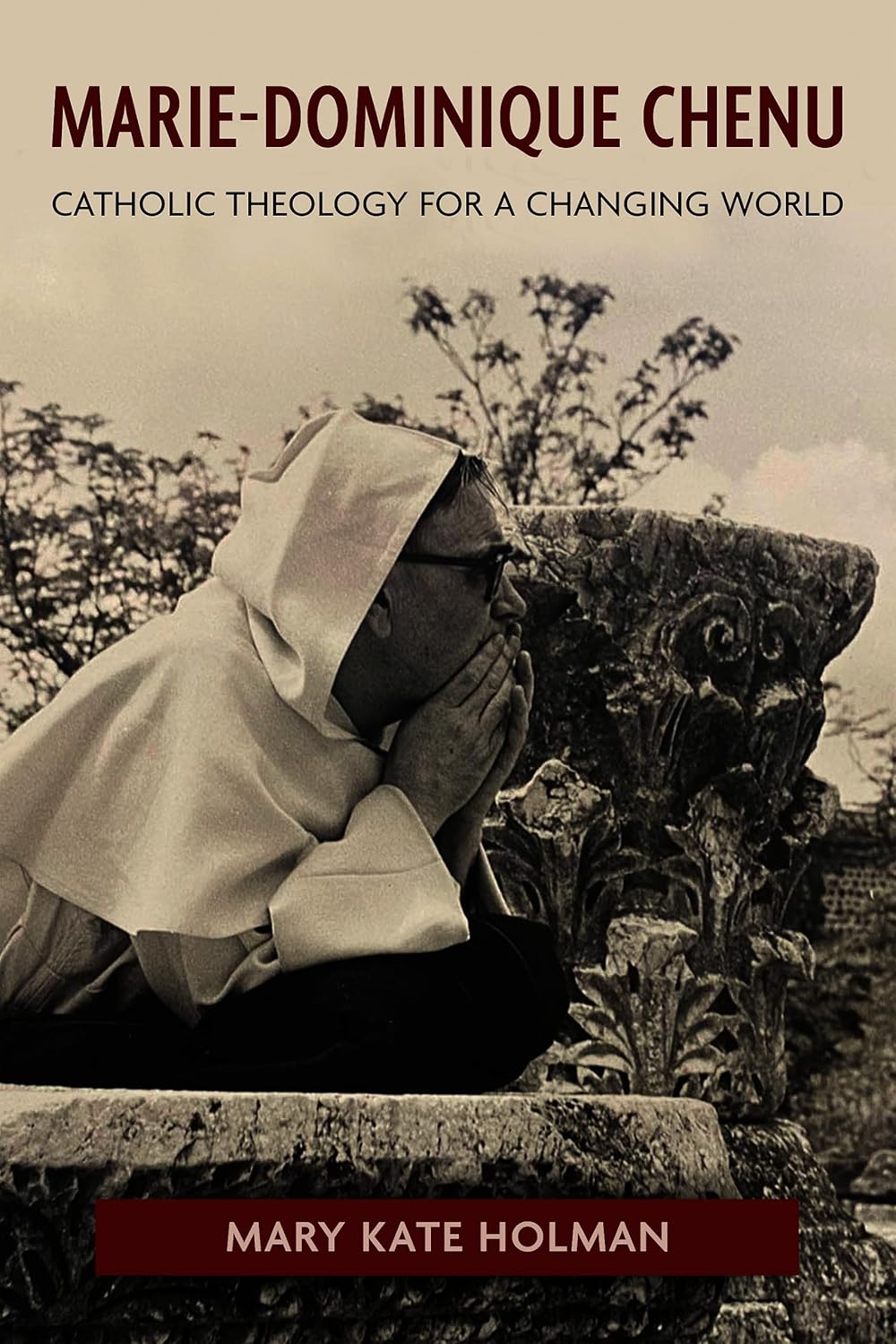 The French Dominican Marie-Dominique Chenu (1895–1990) stands at a crucial turning point in the history of Catholic theology. His life and work mark a “before and after” between the predominant theology that preceded him and the theological method invoked by those who came after him. In Marie-Dominique Chenu: Catholic Theology for a Changing World, Mary Kate Holman offers an intellectual biography and apologia for Chenu as a theologian and priest with relevance for today. Scholars and others will welcome this important book.
Studies at the Angelicum in Rome prepared Chenu for his intellectual vocation. Like the future pope Karol Wojtyla (Pope John Paul II), the Toulouse Dominican M. Michel Labourdette, and other luminaries of the twentieth century, Chenu composed a doctoral dissertation under the legendary French Dominican Reginald Garrigou-Lagrange (1877–1964). Chenu parted ways with the so-called “Sacred Monster of Thomism” in that Chenu desired a reading of Aquinas — and of theology more generally — that was, to his mind, more attentive to history. He worried that scholastic formulations common in his youth did not account sufficiently for their historical variation. Chenu could claim as his students the accomplished Dominicans Yves Congar (1904–1995) and Edward Schillebeeckx (1914–2009).
On the feast of St. Thomas Aquinas, 7 March 1936, Chenu delivered one of the most noteworthy theological lectures of the last century. Published a year later as Une école de théologie: le Saulchoir, Chenu praised the then-distinctive theological method practiced in his Belgian Dominican studium. Roman theologians of the time worried that this method risked the relativization of dogmatic truth and thus compromised the Church’s clarity of theological teaching. For that reason, Chenu’s book eventually was placed on the Index of Forbidden Books. In 2023, along with Joseph Komonchak, Professor Holman published an English translation of this, Chenu’s most well-known work.
The French Dominicans of the pre-conciliar period, especially those in Toulouse, debated with the Jesuits of Fourvière about the best theological method for the Church in the first half of the twentieth century. While this narrative offers portrays the Jesuits as sympathetic to the new theology of the age, Holman chronicles the diverging positions of the French Jesuit Henri De Lubac (1896–1991) from Chenu. According to Holman, it was De Lubac who recognized the excesses of some post-conciliar theology while Chenu continued to embrace the progressive spirit of the age (166).
The text under review recalls many interesting historical details of the travails of Chenu’s life. For example, in February 1942, his A School of Theology was placed on the Index. The only public explanation came from Msgr. Pietro Parente, consultor to the Holy Office. He authored an essay in L’Osservatore Romano in which, evidently for the first time, invoked the phrase “nouvelle théologie.” Parente’s essay critiquing both Chenu as well as the Leuven Dominican Louis Charlier appeared four years prior to the classic Angelicum article of Reginald Garrigou-Lagrange, “Where is the New Theology Leading Us?”
While Chenu’s advocacy for a more historically conscious theology may be fairly well-known in theological circles, Holman chronicles his less well-known but extensive engagement with social issues, including with Liberation Theology (9). The book offers an extended treatment of Chenu’s work with the so-called Worker Priest movement active in France during his lifetime. Holman maintains: “Both the historically conscious theology Chenu had pioneered at the Saulchoir and the theological engagement in social issues he had promoted in Parisian worker communities helped to blaze the trail that Vatican II followed” (8).
The text under review chronicles Chenu’s criticisms of magisterial teaching, from the methodology of Pope Paul VI in his 1968 encyclical Humanae vitae (165) to the social teaching of Pope John Paul II both in Laborem exercens (1981) and in the 1987 encyclical Solicitudo rei sociales (198–99). To this reviewer, it is unfortunate that Holman’s text does not engage with the teaching of Pope Benedict XVI in his December 2005 Address to the Roman Curia. As an exercise of his Petrine ministry, Benedict recognized the need to perceive a hermeneutic of continuity within the theological tradition.
The great question of post-conciliar theology remains how theologians can be attentive to history while not allowing dogmatic truth to be relativized by history. For the great essay on this matter interested readers should consult the important work of Father Thomas Joseph White, OP, “The Precarity of Wisdom: Modern Dominican Theology, Perspectivalism, and the Task of Reconstruction,” in Ressourcement Thomism: Sacred Doctrine, the Sacraments, and the Moral Life, eds. Matthew Levering and Reinhard Hütter (Washington, DC: The Catholic University of America Press, 2009), 92–122.
Some readers will question why the emphasis on historical consciousness could not be applied to the assessments of those theologians at work in the early part of the twentieth century. A narrative which speaks exclusively in a negative fashion about figures like Garrigou-Lagrange disappoints. In truth, no one should speak about twentieth-century theology without a sense of the essential goods Garrigou and others were trying to preserve. Indeed, such a lack of generosity of interpretation suggests an ideology unwilling to acknowledge nuance, complication, and the challenge those seeking to preserve the deposit of faith face. For her part, Holman declares herself a “self-proclaimed feminist theologian” and wonders if she is neglecting the marginalized figures of the Tradition by studying Chenu at all (9–10).
Rahner, Ratzinger, Wojtyla, De Lubac: there is no question that these figures remain more well-known today than is Marie-Dominique Chenu. For that reason, the text under review is a welcome volume to recall the influence of Chenu on Catholic theology in the last century and today. Scholars and others likely will object to Holman’s strong narrative against virtually any magisterial intervention in the work of theology. Others will object to her critique of those who sought to preserve immutable Catholic teaching throughout history. Nonetheless, interested parties should welcome this text for its significant historical value and the author’s careful scholarship. Its attention to history Marie-Dominique Chenu would certainly applaud.
Rev. Ryan Connors is a priest of the Diocese of Providence and Rector of the Seminary of Our Lady of Providence (Rhode Island). He is the author of Rethinking Cooperation with Evil: A Virtue-Based Approach (Washington, DC: The Catholic University of America Press, 2023); Moral Theology: An Introduction (Cape Girardeau, MO: ECT Press, 2025); and co-author with J. Brian Benestad of Church, State, and Society: An Introduction to Catholic Social Doctrine, Second Edition (Washington, DC, The Catholic University of America Press, 2025).
The Spirit of God – Yves Congar, trans. Brown et al.
Congar, Yves, O.P. The Spirit of God: Short Writings on the Holy Spirit. Trans. Susan Mader Brown, Mark E. Ginter, Joseph G. Mueller, SJ, and Catherine E. Clifford. Washington, DC: The Catholic University of America Press, 2018.
Reviewed by Rev. John J. Conley, S.J.
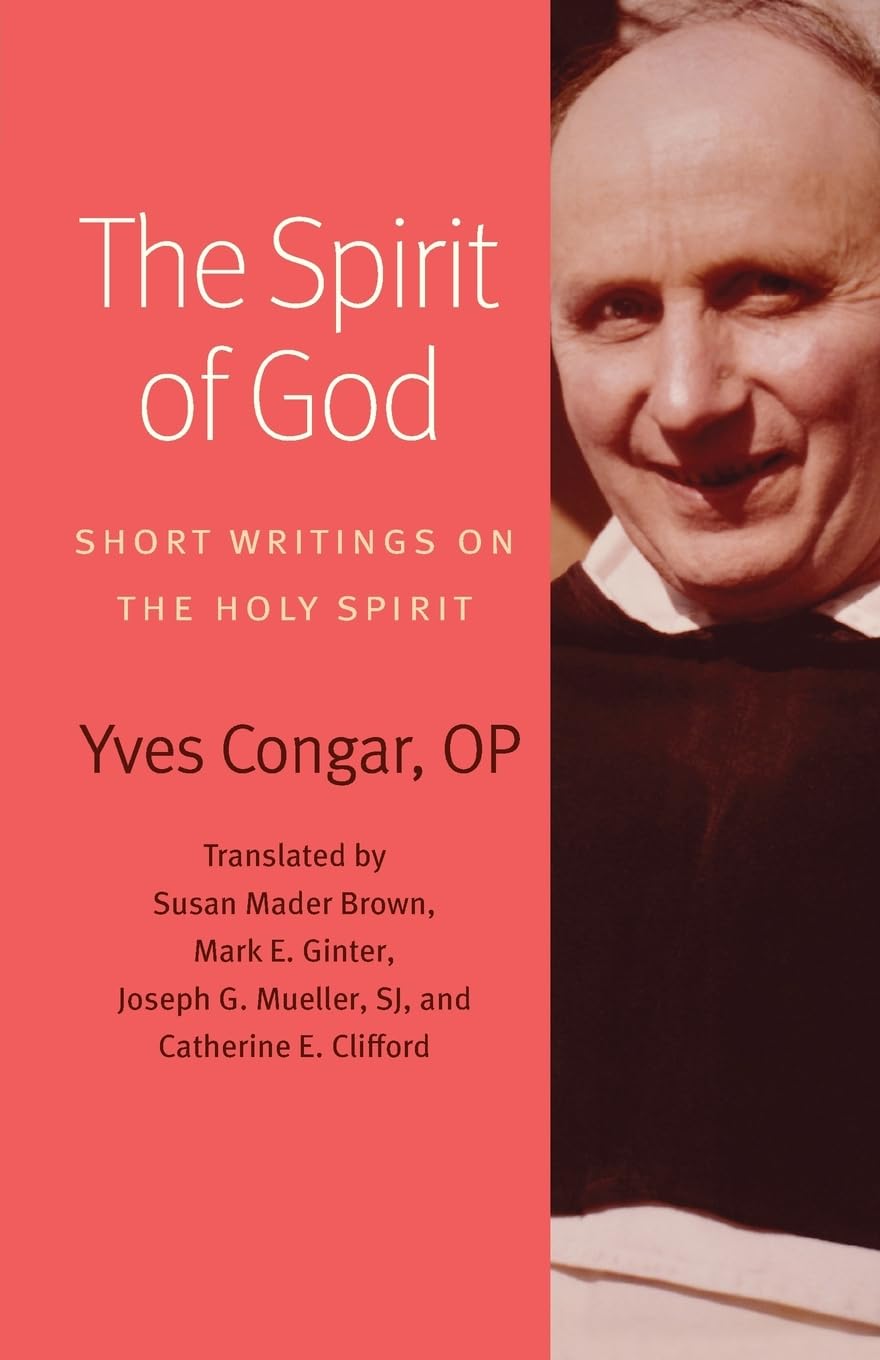 One of the leading theologians at Vatican II, the Dominican Yves Congar (1904–1995) devoted many of his prolific writings and professional addresses to pneumatology. Accepting the Eastern Christian criticism that Western theology suffered from an inflated Christology and an impoverished pneumatology, Congar attempted to describe in greater detail the action of the Holy Spirit in the Church’s worship, doctrine, and moral decision-making. This collection of short texts on the Holy Spirit illustrates Congar’s concern to delineate the work of the Holy Spirit in the practical life of Christian piety and moral discernment.
“Testimony About the Holy Spirit” argues that the Holy Spirit, the Breath of God, manifests himself in the particular work undertaken by the disciple of Christ. This inspired work is characterized by communion with God and with the saints of the Church. This supernatural love goes beyond simple unity in the Church. It is also characterized by prophecy as the inspired Christian proclaims the Gospel message with new insights and applications. “The apostolic testimony is not a simple repetition of facts. It incorporates insight into and articulation of the facts.” Like Christ in his Passion, authentic prophecy will lead to the violent opposition of the world.
“The Spirit in the Personal Prayer and the Personal Lives of Christians” argues that the presence of the Holy Spirit can only be measured by the fruits of the allegedly Spirit-inspired action. The gifts of the Holy Spirit transcend the natural moral virtues inasmuch as they free the moral agent to participate in the very life of God.
Especially helpful is “The Holy Spirit in the Thomist Theory of Moral Action,” where Congar explains how the Summa Theologica’s account of morality cannot be reduced to the natural-law principles inherited from Aristotle and Stoicism. Under the influence of grace, the Christian receives the gifts of the Holy Spirit, which transcend without contradicting the natural moral virtues. The gift of wisdom permits the Christian to perceive the right order of things from a supernatural perspective. Counsel perfects prudence by deepening it with charity. Justice is elevated by the gift of piety, which promotes a special reverence toward those who have given us life. Rooted in the gifts of the Spirit, the Christian moral life becomes an exercise in freedom. “St. Thomas offers us not a morality of law but an ethics of the personal use of our freedom under grace.” Congar recognizes that Aquinas operates within a metaphysics of substances (where human beings and other beings have a fixed nature) and of telos (where human beings and other beings pursue a goal appropriate to their given nature), but by his account of the gifts of the Holy Spirit in the moral life, Aquinas discloses a moral and spiritual freedom absent in the classical philosophical sources of ethics.
Like other theologians and spiritual directors who stress the role of the Holy Spirit in moral discernment, Congar runs the risk of a certain antinomianism in his encomium of freedom. The ecclesial context of this discernment, especially the teaching of the magisterium on faith and morality, could be more explicit. Nonetheless, his pneumatology does indicate how the palpable gifts of the Spirit can lead the Christian beyond simple fidelity to the law.
Rev. John J. Conley, S.J. holds the Knott Chair of Philosophy and Theology at Loyola University, Maryland.
Children of Slate – Thom Brucie
Brucie, Thom. Children of Slate. St. Louis, MO: En Route, 2018. 303 pages.
Reviewed by Rev. Dennis J. Billy.
 In his “Letter on the Role of Literature in Formation” (2024),1 the late Pope Francis observes that the study of literature seems not to play a major part in programs for ordained ministry and is generally considered “non-essential” (no. 4). He believes this tendency needs to be corrected, since literature focuses on “our deepest desires in life” and “engages our concrete existence, with its innate tensions, desires and meaningful experience” (no. 5). Literature, he maintains, enables the reader to listen to another person’s voice, aids the process of discernment, and helps one to see the world through the eyes of others (nos. 20, 267, 34). For this reason, novels like Thom Brucie’s Children of Slate should be incorporated in some way into today’s seminary curriculum.
Brucie sets his novel in the coal mining region of Pennsylvania during the Pre-Vatican II era, somewhere in the late 1950s or early 1960s. The novel follows the vocational discernment of Morgan O’Bryan, the son of poor Irish immigrants, who at seventeen years of age is in his third year in the minor seminary (what at the time was called the scholasticate or pre-novitiate) of a small TOR Franciscan order. His family and the Irish community to which it belongs work in the coal mines near Galeton, Pennsylvania, and the seminary is a few hours’ bus ride away. It would be impossible to summarize all of the nuances contained in this carefully crafted work of narrative fiction. What follows is a brief summary of its major themes.
During the course of the novel, various secondary characters pressure Morgan into either staying or leaving the seminary. His mother, Annie O’Bryan, sees his becoming a priest as a means for her family to climb America’s social ladder. His mother’s sister, his Aunt Lillian, tells him he represents the hope of the entire neighboring immigrant community of one day rising above their menial, lower class status. His best friend and fellow seminarian, Peter DiFlavio, has ulterior motives for their friendship that come to light later in the novel. Nadine Shearwater, a local girl who lives within walking distance of the seminary grounds, falls in love with Morgan (and he with her), yet refuses to marry him after having intimate relations with him for reasons that become clear as the story unfolds. Fr. Gale, the head of the seminary, uses psychology to analyze Morgan’s motives for becoming a priest, yet does not seem to relate to him very much on a human level. The most influential character on Morgan throughout the novel is Fr. Christopher (whose name means “Christ-bearer”), a TOR Franciscan, who suffered shell shock when he was a chaplain during World War I, has been assigned to the seminary as a confessor, and has a reputation of being crazy and out of touch with reality. Throughout the novel, Morgan spends much of his time in Fr. Christopher’s workshop, where he receives from him various lessons about life (e.g., pruning, concentration, creating wind, telling stories, the power of belief). He trusts Fr. Christopher, but has a difficult time understanding the meaning of these lessons, due in part to the priest’s forgetfulness and stream-of-conscious way of relating. He also spends a great deal of time talking with Nadine, a girl about his age, in a secluded and abandoned apple orchard on the seminary grounds. She lives nearby and had experienced sexual abuse from her older cousins when she was a young girl.
The novel is about Morgan’s transition from adolescence to manhood. As the novel unfolds, he recognizes that his decision to stay in the seminary or leave should not come from the outside, but from within. This is what the crazy and unpredictable Fr. Christopher was trying in his own way to teach him all along and why, when Morgan questions him about the point of each lesson, he simply responds, “What do you think?” Fr. Christopher believes in the power of faith to produce miracles, seeks throughout the novel to communicate this conviction to Morgan, and in some ways even succeeds. His fascination with a crucifix he is making in his workshop, however, leads him to identify with Christ so closely that, in a moment of insanity, he slits his hand and wrist to imitate the stigmata and, despite Morgan’s panicked efforts to miraculously save his life, bleeds to death. Three days later, after a long, deep, and uninterrupted sleep, Morgan encounters Fr. Christopher in a vision, who tells him that God loves those who listen to him with their heart, that his real gifts are the people he gives us, and that love for him and of the love of those we love are deeply connected and, in fact, very much the same. Morgan is then blessed with a deep mystical experience of God’s unconditional love for the world and the need to forgive as he has forgiven us.
Morgan takes this advice to heart and begins to see that he needs to forgive his mother and aunt for their selfish reasons for wanting him to become a priest, that he needs to forgive Peter, who had a homosexual interest in him all along, and Nadine, as well, who had an abortion, never told him about their child, and refused to marry him. He sees that he even needs to forgive Fr. Gale who, despite his shortcomings as head of the seminary, always has had genuine interest in his future well-being.
In the end, Morgan decides to leave the seminary. He does so, however, not because of the outside pressures placed on him but because he recognizes that the protective atmosphere of the seminary would be, at this moment in his life, more an escape than meeting the challenges of the world head-on. The title of the novel, Children of Slate, refers to a seminarian named Francis Eastbrook, who decades earlier was buried in a shaft under tons of slate in a seminary cave used at one time to quarry the brittle rock for the upkeep of the seminary. The point of the novel is that all of its characters are, in some sense, “crushed under the weight of slate and time.” The purpose of the Gospel is to free us from these burdens, an insight which Fr. Christopher, in his own limited way, was able to recognize. The Children of Slate, we might say, are all called to become Children of God.
The Program for Priestly Formation (2022)2 identifies four interrelated dimensions of seminary formation: the human, spiritual, intellectual, and pastoral (no. 34). Children of Slate addresses in narrative form some of the pressing human issues many young men face when discerning a call to the priesthood: dysfunctional family ties, romantic love, sexual abuse, the dignity of human life, same-sex attraction, the nature of friendship, the proper use of psychology, the power of faith ¾ to name but a few. Reading and discussing this novel will help young men to sift through the narrative of their own lives and determine if their vocational discernment is coming from within or from some outside pressures. It can be used as assigned reading in a number of different venues such as human formation conferences, counseling, spiritual direction, and others. Seminary formators should be aware of the scope of this novel and use it at their discretion, especially whenever they find one of the seminarians under their care struggling with one or more of the vocational issues outlined above.
Rev. Dennis J. Billy, C.Ss.R., is Professor Emeritus of Rome’s Pontifical Lateran University with many years of experience as a seminary professor, formator, and spiritual director.
Mind, Heart, and Soul – ed. Robert P. George and R.J. Snell
Mind, Heart, and Soul: Intellectuals and the Path to Rome. Edited by Robert P. George and R. J. Snell. TAN Books, Charlotte, NC. 2018. 224 pp.
Reviewed by Clara Sarrocco.
 I am what was known as a “cradle Catholic.” That means that most likely there was no conversion story. It also probably means that all of your family and most of your friends are Catholics. It also means that you grew up in what was called a “Catholic ghetto.” Truthfully, life was pretty good in that “ghetto.” We did not identify friends and acquaintances by their neighborhoods but by their parishes. (Are you from St. Joseph’s? No, I’m from Mt. Carmel, etc.) We shared stories, played on opposing sports teams, and visited the other parishes. The downside was complacency. Your religion was just always there. It was what you were born to and just took for granted. Not so for converts. They had to struggle, go through anguish, lose friends, family, and jobs, all for what we possessed as an inheritance.
Mind, Heart, and Soul: Intellectuals and the Path to Rome tells the stories of sixteen adult converts to the Catholic Church told in an interview format. Robert George, a Catholic, and R.J. Snell, an adult convert, compiled their stories. Some of the interviewers are converts themselves. All are intellectuals and have made noteworthy contributions to their respective fields. They freely describe the sacrifices, very often serious, they had to make to join the Catholic Church, but they also express a heartfelt joy and a deep sense of gratitude in finding their true home — all of which mostly escapes cradle Catholics. “Many of their contemporaries regarded the idea of a ‘Catholic intellectual’ as a contradiction in terms, believing that the repressive Roman church prohibited freedom of thought. The converts were eager to prove otherwise. . . .” (xi).
Among the sixteen is a bishop, Most Reverend James D. Conley, a priest, Father Thomas Joseph White, OP, and Father Michael Ward, who entered the Catholic Church under the Anglican Ordinate (Anglicanorum Coetibus) promulgated by Pope Benedict XVI. A religious sister, Sister Prudence Allen, RSM, who became a religious in the Religious Sisters of Mercy of Alma, Michigan, was a philosophy professor and is now assigned to open a new convent in Ohio. They not only converted but then continued to enter religious life.
Hadley Arkes, an attorney and a convert from Judaism, had to experience the rift his conversion created between him and his parents. Adrian Vermeule also is an attorney from Harvard, and was a law clerk for the late Justice Antonin Scalia.
Ulf Ekman (a Lutheran minister) and his wife, Birgitta Ekman (a child of missionaries in India) converted from a Swedish megachurch. Kirsten Powers is a journalist and writer, as are Joshua Charles and Matthew Schmitz. It was Chesterton who led Karen Oberg, an astronomer, to examine the Catholic Church. Timothy Fuller read his way into the Catholic Church from the Episcopal Church (Anglo-Catholic branch) because of his interest in church history and theology. Chad C. Pecknold was influenced by St. Augustine’s City of God and the conversion story of St. John Henry Newman.
Lucy Beckett, a novelist, became a Catholic at the age of nineteen to the great dismay of her parents. Because of a sudden and unfortunate marriage, and her eventual divorce and remarriage, she lived thirty years of Catholic life without the sacraments. She stated that she never regretted her conversion and understood the Church’s logic concerning her situation. Because of changed circumstances, she has been able to return to the Sacraments, as she has said, “with great joy.” Erika Bachiochi is a revert. She was baptized as a child but was raised in a dysfunctional family life. Her attendance in a Twelve Step program and learning of the Catholic Worker Movement reminded her of the importance of religion. She became involved and found friendships in the Newman Club in college. C.S. Lewis’s Mere Christianity became an influence to her return to her childhood faith.
All the conversion stories show us the vitality of the Catholic Church and the great joy it can bring to those who are on a pilgrimage of learning and discovery. The stories also show the difficulties and the sacrifices that had to be made to accept Catholicism. These sixteen Catholic converts stand on “giants’ shoulders.” Many intellectuals preceded them — people like St. John Henry Newman who was banned as a persona non grata at his beloved Oxford. He could not enter the university for forty years and had to longingly look at its ancient spires only from a distance. St. Edith Stein knew that her conversion and eventual entrance into Carmel tore at her Orthodox Jewish mother’s heart. She died at Auschwitz both for being a Jew and for being a Catholic.
These stories and more should be very edifying and inspiring to cradle Catholics because we take for granted that we were given the “pearl of great price” and, too often, treat it as a mere bauble.
Clara Sarrocco is the longtime secretary of The New York C.S. Lewis Society. Her doctoral dissertation was on C.S. Lewis and von Hildebrand.
A Very Little Office of Compline – B.G. Bonner
Bonner, B.G. A Very Little Office of Compline: Night Prayer for Children. Gastonia, NC: TAN Books, 2025. 40 pages.
Reviewed by Christopher Siuzdak.
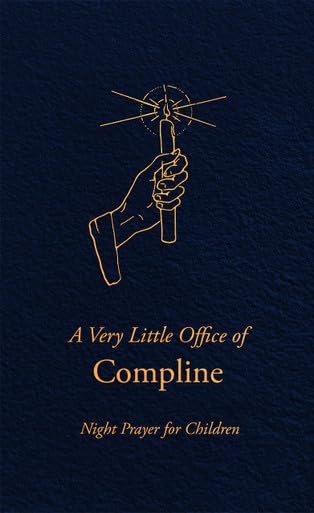 Significantly shortened and set to rhyme — that’s what’s special about this version of compline. There is no better way to complete the day than at bedtime to kneel and pray. Leaving the bustle of daytime behind, and entrusting our hearts to the Divine, allows for finding peace of mind, and bestows graces that truly make the soul shine.
Some of the faithful have the misimpression that the Liturgy of the Hours is exclusively the province of clergy and vowed religious. The truth is that the laity, likewise, are called to participate in this time-honored form of prayer. As the General Instruction of the Liturgy of the Hours issued by the Congregation for Divine Worship and Discipline of the Sacraments states, “It is desirable that the family, the domestic sanctuary of the Church, should not only pray together to God but should also celebrate some parts of the Liturgy of the Hours as occasion offers, so as to enter more deeply into the life of the Church.” Praying compline can foster sanctification and is, therefore, a recommended component of a well-balanced diet of spiritual practices.
In this compact work, the venerable tradition of compline is rendered accessible to all regardless of age. The simplicity of this adaptation removes the obstacles of having to flip back and forth through a breviary or contend with long readings. This distilled version is a wonderful way to introduce children to the spiritually profitable practice of night prayer. It lowers the barrier of entry, making compline approachable even to those of elementary school age.
Parents, caregivers, and primary school educators will find this prayerbook to be a useful way of introducing children to nighttime prayer. The prayers can be recited individually or with the accompaniment of family members (in unison or taking turns responsively). The book itself is sturdy and durable, but a drawback is that it contains some antiquated language (e.g., “We beseech thee,” “ye,” “lo”) and some Latin headings which would have benefitted from an accompanying translation (i.e., “Incipit,” “Lectio Brevis,” “Confiteor,” and “Nunc Dimittis”). All in all, this prayerbook is a commendable spiritual resource.
Christopher Siuzdak is Book Review Editor for the Homiletic & Pastoral Review.
- The Holy See, “Letter of His Holiness Pope Francis on the Role of Literature in Formation,” (July 17, 2024), accessed February 13, 2026, https://www.vatican.va/content/francesco/en/letters/2024/documents/20240717-lettera-ruolo-letteratura-formazione.html. ↩
- United States Conference of Catholic Bishops, Program of Priestly Formation, 6th ed. (June 24, 2022), accessed February 13, 2026, https://usccb.cld.bz/Program-of-Priestly-Formation-6th-edition. ↩
 About Book Reviews
Speak Your Mind