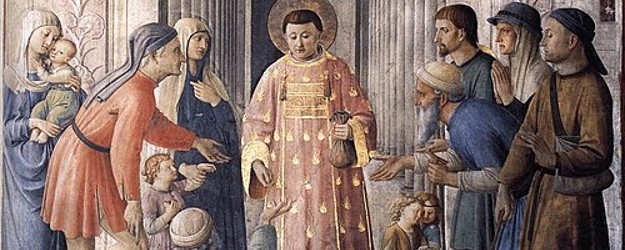
“If you cannot find Christ in the beggar at the church door, you will not find Him in the chalice.”
These words, attributed to St. John Chrysostom’s sermon on St. Matthew 25:31–46, carry in them a powerful challenge: See Christ in others as we see Him in the Eucharist. Heeding such a call demands faith, for, in both instances, appearances tell far from the whole story. Yet, as the oft-cited adage goes, the cover of a book does not necessarily indicate what is inside.
The necessity of this approach is attested to by Scripture. We read in Proverbs 14:31 that “he who oppresses the poor, insults man’s Maker,” while he that practices charity towards the needy does honor to God. We read further in Deuteronomy 15:11 that God commands us to “be open-handed” to the needy and poor who are our countrymen and brothers in the land.
We also read in Sirach 21:6 and Job 36:15 that the prayers of the poor are efficacious in heaven, and that the poor in this world have an opportunity to grow in holiness in a way that many others do not. For this reason, there are numerous affirmations in Scripture that the righteous poor shall be satisfied in heaven, culminating in Christ’s promise in St. Matthew 5:3, “Blessed are the poor in spirit; the kingdom of heaven is theirs.”
Of importance is this qualifying factor of righteousness. For, St. Paul also condemns those who cling to their victimhood in 2 Thessalonians 3:10, writing that “the man who refuses to work must be left to starve.” The Apostle’s words here mirror the Sacred Author’s in Sirach 25:3–4, where he writes that his soul is disturbed at the life of a “poor man that is proud,” condemning those who take pride in taking from others as it were. But even beyond this, there is a further consideration that we find in Christ’s teaching in the New Testament. In St. Matthew 26:11, Jesus tells His apostles, “The poor you have always with you: but Me you have not always.”
This verse at first glance appears perplexing, but in view of those whom He is addressing, it makes perfect sense. His addressees — those who will go on to guide the Church after his resurrection and ascension into Heaven — are being instructed at this time regarding the priorities that the Church is to maintain after Christ’s bodily ascent.
We find confirmation of this in the 10th sermon of St. Augustine: “For Thou hast called us to love Thee, and to love our neighbor in Thee. This is the whole purpose of the Law and the Prophets.” Here, the saint considers both the spiritual and temporal aspects of the Church’s mission, but, importantly, places the temporal in its right relationship to the spiritual, as proceeding from it, and being realized in relation to it.
Such a clarification is an important one, for especially in the last century, one sees in certain mainstream currents of thought a noticeable increase in emphasis upon the corporal works of mercy, in a manner that de-emphasizes the spiritual to the level of a superficial identity rather than the overarching telos that it truly is.
Pope Pius XI clarifies against this notion admirably, writing in his landmark encyclical Quadragesimo Anno: “Certainly the Church was not given the commission to guide men to an only fleeting and perishable happiness, but to that which is eternal.”
In this context, the perennial motto of the Church, salus animarum lex suprema (the salvation of souls is the highest law), which appears on the final page of the Code of Canon Law, takes on a new significance. A principle of Church law for centuries, this principle is a modification of a tenet in Roman law which Cicero cites in his De Legibus (On the laws): Salus populi lex suprema: (the welfare of the people is the highest aim). The Catholic conception is remarkable precisely for its reversal of this natural supposition. For the Catholic, it is spiritual welfare that must come before physical welfare. The two are not mutually exclusive. Instead, they represent an ordered chain of priorities, one which is directed towards the ultimate good of all men, at all times, and in all places.
Relating to the sphere of political governance with which Cicero primarily concerned himself, Holy Scripture also clarifies its instruction with regard to the more imminent duties required of a ruler. Jeremiah 22:13–19, for example, informs us that the ruler who “sets his fellow-man vainly drudging, and leaves his wages unpaid” will have infamy live long after him, and that he will have a disgraced burial place “beyond the gates of Jerusalem” — an allusion which St. Jerome interprets in the commentary his 22nd letter provides on the book, as referencing the earthly king losing his place in the kingdom of heaven. By way of contrast, within the same passage, the Prophet tells us that he who does justice to the poor does a good work unto himself as well as God. Jeremiah writes that the just king “gave every man his just due, and was content,” continuing that in the sight of the Lord, it was “well for him that he gave the friendless and the poor redress.”
Relating to those who perhaps have need of such an approach, the prophet Daniel concurs. In Daniel 4:24, the Prophet counsels King Nabuchodonosor, telling him that “with almsgiving, with mercy to the poor,” the king may “make amends” before the Lord for his “fault and wrong-doing.” In a related counsel to rulers found within the Old Testament, we also find the eerie warning of the Sacred Author in Proverbs 21:13 that he who “shuts his ear to the poor man’s” cry shall cry himself one day, and not be heard.
The truth of this imagery is incorporated into the Inferno by the poet-genius Dante Alighieri in truly inimitable style. Dante places those who exploit the poor — usurers and the like — into his seventh circle of Hell, where the violent are punished. The poet seems to be of one mind here with the Sacred Author, who proclaims in Sirach 36:25 that “a poor man’s bread is poor man’s life; cheat him of it, and thou hast slain him,” with the poet condemning these men for having committed violence against the poor.
The treachery of these brutal souls becomes the worse when one considers the unsatisfactory aims which formed the altar upon which the poor, the laborers, and the fellow-countrymen of these criminals were sacrificed — the fleeting promise of the transitory — possessions, power, and glory. The punishment of one damned soul in this seventh circle typifies the fate that this cohort of men share. Covered in molten metal, gold at his head, silver and bronze upon his torso, and iron down his legs to all but one of his feet, he stands with his weight balanced upon this foot, hewn of dusty terra-cotta, which signifies the worth of his empty ambitions. Bearing out the truth of the Sacred Author’s warning that he who abuses the poor shall cry and not be heard, from this being flow without ceasing a tears of precious metal. These tears – precious in the world’s eyes yet worthless in God’s — flow into a ravine beneath the tortured soul into the river Styx which forms the border of Hell.
This powerful image, however, does not originate with Dante. In fact, it is a mere re-presentation of an Old Testament archetype that appears in Daniel 2:31–35. The context for this first appearance of the image is within a dream that King Nabuchodonosor experiences, which leaves him troubled when he awakes. The king, fascinated but unsure of the meaning of the image, searches across his kingdom to find an explanation. Discovering Daniel, he obtains understanding yet fails to heed immediately the prophet’s advice. Driven from his kingdom, the king rages for seven years outside the city like a wild animal before repenting before the Lord and being restored to his throne as a changed man.
Like King Nabuchodonosor, we too can be transformed through tribulation. St. Paul teaches precisely this, proclaiming in 2 Corinthians 8:1–5 that the saints of the Church in Macedonia who have experienced great tribulation “have rejoiced over it, how abject is their poverty, and . . . the crown of all this has been a rich measure of generosity in them.” A few verses later, the Apostle continues that imitation of the Macedonian saints constitutes his “advice” to the Church in Corinth, and indeed it remains the same for us today. For, whether we find ourselves in poverty or in a place to assist those who are, we have a blessed opportunity to carry out the work of Christ in the world — a truly priceless opportunity as well, for to paraphrase St. John Chrysostom’s conclusion in Sermon 50 on St. Matthew, “What you give to the poor is laid up safe in heaven, and is a source of great confidence before God.”
 About Frederick Woodward
[…] The Christian Responsibility for the Poor in the Scriptures (Homiletic & Pastoral Review): “If you cannot find Christ in the beggar at the church door, you will not find Him in the chalice.” […]