For the Second Sunday, Third Sunday, Fourth Sunday, and Fifth Sunday of Lent, the Solemnity of Saint Joseph, the Solemnity of the Annunciation, and Palm Sunday
Second Sunday of Lent – March 1, 2026
Readings: Genesis 12:1–4a • Psalm 33:4–5, 18–19, 20, 22 • 2 Timothy 1:8b–10 • Matthew 17:1–9
bible.usccb.org/bible/readings/030126.cfm
“Don’t touch that!” My friend and I were in a field on a sunny, summer afternoon when he pointed to a curious, little bashful plant in the shrubs. “Look what happens!” He lightly touched a sprig. Leaf by leaf it began to fold in on itself. After a few seconds, all that was left was a dry looking twig. The leaves looked like they were hiding. “Don’t be afraid,” I whisper. The plant is known by many names: the touch-me-not, the sensitive plant, or, more aptly for this season of Lent, the shameplant.
For do not our sins lead us to that same posture — folded in on ourselves, little by little? Upon his first encounter with the Lord, Peter once said, “Depart from me, Lord, for I am a sinful man” (Cf., Luke 5:8). This is how we are when we know that something in our lives isn’t quite what it should be, when the shame of sin finally catches up. The child hides the crumbs of the cookie he wasn’t supposed to eat. The alcoholic tries to hide the bottles. The unfaithful deletes the messages. Sin was supposed to be freeing and yet why do we find ourselves hiding?
At the great divine revelation before him, Peter once again responds boldly if not all too eagerly: “Let us build tents.” When the voice speaks from the bright cloud, all three — Peter, James and John — fall on their faces, for they “were very much afraid” (Matthew 17:6). Would they be struck? Would they be destroyed? Surely, they had heard of the man who touched the Ark and was struck down (Cf., 2 Samuel 6:6-11). Would they be next? They fold all at once.
“But Jesus came and touched them” (Matthew 17:7). The human and divine touch doesn’t destroy. It soothes. It heals. It frees, for it belongs to the one “who destroyed death and brought life” (2 Timothy 1:10) and in whom we can place our trust (cf., Psalm 33:22). The shame of sin makes us fold. This Lent, the touch of Christ bids us: “Rise!” Rise from sin, and “do not be afraid” (Matthew 17:7).
Third Sunday of Lent – March 8, 2026
Readings: Exodus 17:3–7 • Psalm 95:1–2, 6–7, 8–9 • Romans 5:1–2, 5–8 • John 4:5–42
bible.usccb.org/bible/readings/030826.cfm
“Are we there yet?” Anyone who has been in a car for more than an hour has asked themselves that question. Perhaps you’ve even heard the question more than once from a little one in the backseat. Little Johnny, after all, just wants to know that you are going where you said you would. He needs the reassurance that you are going to get ice cream this time and this isn’t just another trick to get him to the dentist. Maybe a rest stop would be in order? He is thirsty, after all.
We may find ourselves sympathizing with the Israelites. After all, did they not wander in that same place for days, months, and years on end? Surely, Moses could at least stop for water. If God could deliver them from Egypt, could he also give them some water? The deeper underlying question, however, is, “Is the Lord in our midst or not?” (Exodus 17:7). Is he really bringing them where he said he would?
Even Jesus begged for water. “Give me a drink” (John 4:7), he bids the Samaritan woman. She responds in disbelief. She has had to walk in the scorching, midday sun. How many times did she make that trip to and from the well while asking her own version of, “Are we there yet?” It’s been the same question she’s been asking for years to different men, different husbands. She has never quite found where “there” is. All she knows is that she must go to and from the well day in and day out. And yet now her deeper question is, “Could he possibly be the Christ?” (John 4:29). Is he finally here?
We’ve come to the third week of Lent and it feels like there is so much left to go. We are wandering. We are thirsting. We are asking. Will I finally keep my resolutions? Will I finally get to the “spiritual heights” I would like to get to? Will I ever be spiritually “there”?
In the “not yet” of our wandering, he answers and says, “I walk with you in the desert.” “I seek you in the noonday heat.” “I am with you” (Matthew 28:20). He will bring water. He will bring more than enough to quench our thirst. On Calvary, his side will be opened, and on Easter, he will wash us with this water! Still he will give even more. He will feed us with bread and wine — his Body and Blood. Then we will “know that this is truly the savior of the world” (John 4:42) and he is here.
Fourth Sunday of Lent – March 15, 2026
Readings: 1 Samuel 16:1b, 6–7, 10–13a • Psalm 23: 1–3a, 3b–4, 5, 6 • Ephesians 5:8–14 • John 9:1–41
bible.usccb.org/bible/readings/031526.cfm
Are you afraid of the dark? Whether young or old, there’s something that doesn’t quite sit well with us when we find ourselves having to go through dark places. Every now and then, as I close and lock our church for the night, I would shut off all the lights and find myself walking in darkness. Sometimes I would use my phone’s flashlight to make it through, but more often than not, I would make my way out clinging to the little light that seeps in from outside through the cracks. Not being able to see in the dark does make us uncomfortable. Who knows what might be in the dark? After all, we don’t know what we’re not seeing! And yes, I have hit my shin on a pew while walking in the dark. I couldn’t see it! In the dark, it is far too easy to be surprised at what was in front of us all along.
Samuel, the disciples, the blind man’s neighbors, and the Pharisees find themselves in darkness. They can’t quite see what or who is in front of them. Samuel, who Jesse calls the “seer,” tries to look for the Lord’s chosen one. Samuel looks at Eliab, the eldest, and says, “Surely the LORD’s anointed is here” (1 Samuel 16:7). Immediately the Lord makes it clear that “not as man sees does God see” (1 Samuel 16:7). Only after going through all of Jesse’s sons does it become clear to Samuel that the Lord’s anointed isn’t there. It is the Lord who enlightens Samuel upon David’s arrival, “There — anoint him, for this is the one!” (1 Samuel 16:12). He finally saw.
While the blind man in the Gospel lived in darkness all his life, it is those who have sight that fail to see God in front of them. Echoing Paul, it is Christ who will give them light (Cf., Ephesians 5:13). The man was born blind because God wanted to use his infirmity to give them a sign. The disciples, the neighbors, and the Pharisees, on the other hand, could not see. They chose not to see. They preferred the obscurity of their assumptions to the Light of the World. We are no better than them when we choose the darkness of sin.
As we celebrate this Sunday called Laetere, when the Lenten purple is lightened to rose, let us ask for the grace to see — to see ourselves, our faults, our infirmities, but most of all to see and follow the Light of Christ — so that we may “live as children of light” (Ephesians 5:8). “Lord, please let me see!” (Luke 18:41).
Solemnity of St. Joseph – March 19, 2026
Readings: 2 Samuel 7:4–5a, 12–14a, 16 • Psalm 89:2–3, 4–5, 27 and 29 • Romans 4:13, 16–18, 22 • Matthew 1:16, 18–21, 24a
bible.usccb.org/bible/readings/031926.cfm
My grandfather didn’t talk to me about faith, but he showed me how to believe. He took my sister and me to Sunday Mass, dipped his fingers at the holy water font, and offered it to both of us. He didn’t explain to me what “transubstantiation” or the “real presence” meant, but he, as a man over 80, genuflected as best as he could with his right knee. He didn’t explain the faith. He just tried his best to live it.
We hear about the “descendants of Abraham” and the “son of David.” Abraham could never quite explain to Isaac why he was being bound for the sacrifice. David could never quite explain to his children why, despite all his wealth and power, the ark of the Lord had to remain in a tent. Joseph could never quite explain why Mary was with child before they shared a home. And yet, Abraham, David, and Joseph simply did because the Lord had commanded it.
Far more is accomplished in taking the Lord at his Word than is accomplished when we try to understand every little detail. “Credo ut intelligam,” Saint Anselm of Canterbury says, “I believe so that I may understand.” These men showed much by their actions more than their explanations. It is only after the Lord’s gracious and generous revelation that we can make fuller sense of what transpires.
Sacred Scripture has no accounts of Joseph’s explanations. Neither do we have a record of his protestations — if he ever had any. What we do have is the record of a man who did “as the angel of the Lord had commanded him” (Matthew 1:24). We have a man who knew the will of God and obeyed — just as his forefathers, Abraham and David, did.
In celebrating the memory of our foster father, let us call to mind our own forefathers in the faith. May we have the grace to live our faith like they did so that one day so “shall your descendants be” (4:18).
Fifth Sunday of Lent – March 22, 2026
Readings: Ezekiel 37:12–14 • Psalm 130:1–2, 3–4, 5–6, 7–8 • Romans 8:8–11 • John 11:1–45
bible.usccb.org/bible/readings/032226.cfm
When was the last time you cried? We cry, first of all, when we see someone we love hurting. Parents shed tears when their children are sick or away from them. We cry also for ourselves when we are hurt, frustrated, sad, or lonely. Our tears are personal — they are for someone. Rarely do we weep for those we do not know. Our cries are also cries for justice, piercing heaven with the question, “God, why? Why is this so? This can’t be it!” Surely, there must be more to this, Lord. But until then, we cry.
Our Lord’s beloved friend Lazarus has been dead four days. “By now there will be a stench,” his sister says. Our Lord’s response is the same as ours: tears. Our Lord Jesus Christ, the second person of the Blessed Trinity, the Word Incarnate, God made flesh, weeps — and his tears are also personal. When he sees Martha and Mary grieving for their brother, he grieves with them. When he sees his Lazarus — “the one whom he loves” — dead in the tomb, he weeps. “See how he loved him!” they said when they saw him break down. See how the love of God is not general — it is profoundly personal. No one loves you more than the one who created you, the one who knows you best. And it is he who weeps with you and for you because he so desperately wants to free you.
Martha says, “Lord, if you had been here, my brother would not have died.” This wouldn’t have happened. She also cries for justice. And I tell you “from the beginning it was not so.” Death came into the world as a result of original sin. Lazarus is dead because he too suffers from the consequences of our first disobedience. Here then is Our Lord. He comes face-to-face with this sad mortal reality and weeps, for this is not the will of the Father. Parents’ hearts bleed when they see their children do things that hurt them. Even more so, infinitely more so does the Most Sacred Heart of our Lord Jesus Christ bleed when we choose to wound ourselves by sin. Tradition holds that during his agony in the garden of Gethsemane, Our Lord saw every sin ever committed — past, present, and future, and Scripture says that his soul became “sorrowful unto death.” Despite all the good that the Father prepares for us, we still choose that which can never satisfy. And I tell you, “It was not so from the beginning.”
Our Lord declares: “I am the resurrection and the life.” This, this is what he wills. This is what he came for. “I have come that they may have life, and have it to the full” (John 10:10). The Father in his goodness will not let death have the final word. He sends our Lord Jesus to awaken us from the sleep of death: “Lazarus, come out!” The Lord calls his beloved friend from the tomb by his name — Lazarus. He calls us to himself.
In these last remaining days of Lent, come to Confession where Christ calls you by name, wanting to clothe you again with the white garment of your baptism. In the confessional, weep for your sins with him. Wipe away your tears and his when you resolve, “by the help of his grace, to do penance, to amend your life, and to avoid the near occasions of sin.” Ask for this same grace again when you meet him today in Holy Communion. Stay close to him as he ascends Calvary on Good Friday. Keep watch at his tomb on Holy Saturday. Then, rejoice with him when he brings you to the joy of Easter, and ultimately, leads you to the glory of eternal life — where he “will wipe every tear from our eyes, and there shall be no more death or mourning, no more crying or pain” (Cf., Rev. 21:4).
Solemnity of the Annunciation – March 25, 2025
Readings: Isaiah 7:10–14; 8:10 • Psalm 40:7–8a, 8b–9, 10, 11 • Hebrews 10:4–10 • Luke 1:26–38
bible.usccb.org/bible/readings/032526.cfm
God has no time for false humility. Ahaz, the faithless king of Israel, receives an incredible offer from the God of Israel: “Ask for a sign from the LORD, your God; let it be deep as the nether world, or high as the sky!” He could have received anything he asked for and yet, the man who had never been faithful now chooses to feign piety: “I will not ask! I will not tempt the LORD!” It is anything but humility. Isaiah sees through the act and declares that even God tires of Ahaz’s pretenses. A sign will come. The sign Ahaz never asked for. The sign he could never have dreamed of. The sign, however, that Ahaz and all of humanity needed most: a Virgin giving birth to Emmanuel.
Ahaz in all his humility says to the Lord, “No, not for me!” Mary in her virginal beauty, on the other hand, says, “How can this be?” The first is a denial of God’s sovereignty. If Ahaz asks for a sign, then he would be acknowledging the Lord’s fidelity to the house of his father David, but it would also reveal Ahaz’s infidelity. God has been faithful. Ahaz has not. A sign would make that all too clear.
Mary, little Mary, does not hesitate. All she asks the angel is “how” not “why.” For if this is indeed the will of the God of David and Jacob, then all she would have to do is say “yes.” He was faithful to them before; he will be faithful to her now too. Humility consists in recognizing how things truly are. Ahaz refused to recognize his need for God. Mary knew she could do nothing without him. “Behold, I am the handmaid of the Lord. May it be done to me according to your word.”
As we celebrate God’s power in the childbearing of the Blessed Virgin Mary, may we also recognize our great need for his saving power. As we continue with Lent, put away false humility. Be bold in recognizing your poverty. Ask for a sign — the saving sign of the Cross — and be delivered from sin.
Palm Sunday of the Lord’s Passion – March 29, 2026
Readings: Matthew 21:1–11 • Isaiah 50:4–7 • Psalm 22:8–9, 17–18, 19–20, 23–24 • Philippians 2:6–11 • Matthew 26:14—27:66
bible.usccb.org/bible/readings/032926.cfm
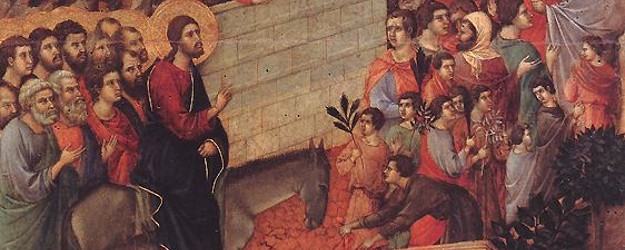
“Who is this?” the whole city asks as this man enters Jerusalem, the holy city. A great crowd precedes him, crying out, “Hosanna to the Son of David.” Could it be? Could it really be that the promised one has finally come to save his people? But why does he ride on a beast of burden? If he is the Son of David, where is his mighty steed?
Who is this? The chief priests see none other than a false prophet, a rabble rouser, a rebel — “it is better for you that one man should die instead of the people, so that the whole nation may not perish” (John 11:50). A bag of thirty pieces of silver is a small price to pay for national security. If Judas is so willing to hand him over, then perhaps there is nothing more to this man from Nazareth. After all, is Judas not one of the Twelve?
Who is this? A robber that they should come at him with clubs and swords? A blasphemer who makes the high priest tear his garments? A failed revolutionary before a powerless governor? A condemned man? A crucified man? A dead man? It is only a centurion who recognizes who he truly is. A Roman centurion — to whom nothing had been promised, whose gods turn away from the grisly events, who expects absolutely nothing from this man — is the one who declares who this is: “Truly, this was the Son of God!”
It is only Jesus Christ, the God-man, who stays true to who he is throughout. His people fail to recognize their king. One of the Twelve loses faith and despairs. The High Priest rejects his long-awaited Messiah. The governor barely holds onto power. “All have sinned” — you and I have sinned, “and fall short of the glory of God” (Romans 3:23, RSVCE). We find ourselves in the crowd confused by our sin. One moment, we cry, “Hosanna!” Next, we plead, “Crucify him!”
As we journey towards Calvary, Christ passes by carrying his cross. “Who do you say that he is?” (Matthew 16:15)
 About Fr. Aaron Salvan
Speak Your Mind