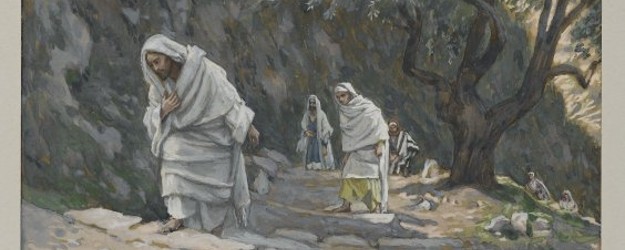
If our Church is a pilgrim Church, then we all are pilgrims, traveling to Heaven by way of death. And if the members of the Church are pilgrims, what of the Head? Is He not a pilgrim too? He walked a path that would end in death, as was known from his birth, and thus the third king sings:
Myrrh is mine; its bitter perfume
breathes a life of gathering gloom;
sorrowing, sighing, bleeding, dying,
sealed in the stone-cold tomb.1
But, with Jesus as with us, death is only a stopping-point on the way to the pilgrim’s final goal: the heavenly Jerusalem. This is what St. John of Ávila teaches us in one of his Lenten sermons, fittingly titled, “The Life of Christ, a Pilgrimage.”2
We men are created as pilgrims, born as pilgrims, set on the pilgrim way without a choice. We can choose to turn aside from the pilgrim path, to wander off and collapse in the Slough of Despond or fritter our lives away at the Vanity Fair, or we can choose to pass through the Wicket Gate, to join the procession of the Church, and embrace the pilgrim way.
It is different with Christ, though. His pilgrimage on earth is of His own will; like an earthly king undertaking the pilgrimage to Santiago de Compostela, “Christ disguises Himself,” “He takes on the mask of a pilgrim,” St. John says. Being God, He need not have dressed so: He could have taken on “the disguise of a knight, of a king, of an emperor, of a consul, of a high priest, of a prophet,” but instead “He takes the mask of a pilgrim.”3 This is that divine condescension so often spoken of by St. John Chrysostom, when, as St. Proklos of Constantinople said, Christ “remaining what He was, became what He was not”:4 remaining God, He became man; remaining King of All, He became a pilgrim.
When a king goes on pilgrimage, he does not bring his royal retinue, his servants and his gold: instead, he becomes like any other man, poor and coarsely-dressed. So, too, Christ “put on clothes of thick cloth, the sackcloth of our humanity,” so that He might “pass by, unknown, with this clothing” and suffer “that rain of lashes and hail of pains, flood of blows and wounds, injuries, that whole whirlwind unleashed upon that clothing of His humanity.”5 With the coarse clothes, He also takes on the poverty: the pilgrim has no home on his journey, but sleeps in the inns and hostels and monasteries along the way. So Christ was even born in a borrowed room, and, when He left His home in Nazareth, He stayed in fields and on mountains, in rooms borrowed from His disciples and admirers. “Foxes have holes, and birds of the air have nests; but the Son of man has nowhere to lay his head” (Mt 8:20). Like us, He even brings back souvenirs from His journey:
Just as men hang their statues in the temples they have visited, He wanted to follow this rite in a strange way, being a pilgrim to the Cross. He was not content to leave His statue of wax, but His statue of Himself, a body hung, nailed on the Cross. And as they are wont to carry back insignia from their pilgrimages, in testimony of having walked them, like those who come from Santiago laden with scallop shells, with jet from Montserrat, with certain images from Guadalupe, Christ took those scallop shells, the precious wounds: His feet, hands, and side remained signed. “See that I am the pilgrim (Lk 24:39). I come from there. You see the signs.” And the Father in heaven, and the apostles on earth, and the wicked in the judgment, shall always remember such a meritorious pilgrimage . . .6
As a man may make many pilgrimages in his life, so does Christ embark on three pilgrimages, St. John tells us. But whereas a man often travels to many shrines — one year to Compostela, one year to Czestochowa, one year to Lourdes — all three of Christ’s pilgrimages shared the same goal: Jerusalem. His first pilgrimage was from the womb, a pilgrimage that lasted all of His life until His death on the Cross, outside the Jerusalem gates. (Here St. John conflates the many trips to Jerusalem that Jesus took, for He went to Jerusalem to be presented in the Temple as an infant, to attend the Feast of Booths, to attend Passover, and so on.)
This first pilgrimage ended on the Cross, and, while His body was taken from the Cross to the tomb, His soul went on its second pilgrimage: to hell, to Sheol, to Hades. Unlike the faithful before Him who had ended their pilgrimage in Sheol, though, He, “alone among the dead, [was] free to not stay there”; He is “the only who does not go to be captive,” but, rather, He goes “to snatch them out, a spirit going and returning (Ps 78:39), to be lord of the demons.”7 Breaking the brazen gates of Hades, He frees the faithful departed, leading them up to Heaven, and then He comes back to earth to resurrect His body and return, glorified, to Jerusalem. As St. John beautifully describes it, “At dawn’s laughing, that blessed soul departs from paradise to the sepulcher; He dresses in His body, to which He communicated His glory, as brocade; thus He departs” on His third pilgrimage, “to the Jerusalem on high.”8
For those forty days between the Resurrection and the Ascension are themselves a pilgrimage, those forty days during which, as Pierre de Bérulle said, Jesus “suspends the place of [His] glory, and Jesus is living between heaven and earth.”9 Jesus’ body had reclaimed the glory He put aside at His birth, but it had not yet taken its place on the heavenly throne, its “place of glory”: this would instead occur at the end of His third and final pilgrimage. It is unfortunate that St. John of Ávila left his marvelous sermon on the pilgrim Christ incomplete: he gives merely a sketch of this third pilgrimage, when “For forty days He detained Himself in the world to confirm the faith in His disciples, to attend to matters touching the foundation and increase of His Church.”10 But if St. John does not show us the path in all its detail, we know the end: Jesus arrives at the final, the heavenly Jerusalem, where, we hope, our pilgrimage also ends.
St. John draws some beautiful parallels between Christ’s pilgrimages and that of an earthly pilgrim: the “disguise” of coarse clothing, the trip in poverty, the homeless wandering, the pilgrim’s emblems or “souvenirs.” Following St. John’s descriptions, we can certainly connect Christ’s pilgriming life with our own pilgrimages to shrines, but can we relate it to our own pilgriming life? Surely we will not have a threefold pilgrimage like Him? Certainly, most of us will not even reach the earthly Jerusalem once, let alone twice.
Yet we can still find a reflection of that threefold pilgrimage in our own lives. Christ’s first pilgrimage covers most of His life, from His childhood through His preaching, but it ends in the Paschal Mystery. Christ’s dying and rising is the end of His first pilgrimage, the whole of His second, and the beginning of His third. In Baptism, we partake of this Mystery: we are “baptized into His death,” that is, into the end of His first pilgrimage, and, rising from the pool, we are also “raised with Him through faith in the working of God,” as we mystically follow His second pilgrimage (Rom 6:3; Col 2:12). So our life after our rebirth in Baptism is like Jesus’ third pilgrimage, that time of “suspension” between the Resurrection and the Ascension. But our flesh is not yet glorified, as His was; in our fallen flesh, the struggle of our pilgrimage is often akin to the struggles of Christ’s first pilgrimage. As for His second pilgrimage, St. John urges us to follow Antonio de Guevara’s advice, to “descend into Hell alive” in our meditations,11 so that the fear of Hell shall keep us from sin, and so that we shall not end up there after death. Thus we can, in one way or another, imitate all three of Christ’s pilgrimages in our own lives.
If we imitate Christ in His solitary prayer, in His healing, in His teaching, in His Passion, so should we imitate Him in His pilgrimage. As He “set His face like flint” (cf. Is 50:7) toward the goal of His wandering, so should we. So we hear in St. Bernard of Clairvaux’s sermon on the pilgrim, which St. John himself references:
A pilgrim, indeed, walks along the royal way; he does not turn to the right nor to the left. If, perhaps, he sees men quarreling, he does not attend to them; if getting married, or leading dances, or doing anything else whatsoever, he nevertheless passes by, since he is a pilgrim, and such things do not pertain to him. He sighs after the fatherland, he tends towards the fatherland; having clothing and food, he doesn’t want to be burdened with anything else.12
“Are you alone a pilgrim in Jerusalem?” (Lk 24:18) This is the text St. John of Ávila took for his sermon, clipping part of what Cleopas said on the way to Emmaus. On His earthly pilgrimage, Jesus was “alone amidst all His labors,” since, “in the end, the disciples fled” (Mt 26:56). But our pilgrimage to the heavenly Jerusalem is not alone: Christ is our forerunner, our guide, and our fellow-pilgrim, and the rest of the Church walks alongside us. So let us take up scrip and staff, go pilgriming with Christ, and — so we hope — pick scallop shells on Heaven’s shores of light.
- John H. Hopkins, “We Three Kings of Orient Are,” Stanza 4. ↩
- For the full text of this sermon, see Saint John of Ávila, My Burden Is Light: Suffering and Consolation in the Christian Life, ed. and tr. Brandon P. Otto (Gastonia, NC: TAN Books, 2024), 79–92. ↩
- Saint John of Ávila, My Burden Is Light, 80. ↩
- St. Proklos of Constantinople, Homily 4.2 (PG 65:846A). ↩
- Saint John of Ávila, My Burden Is Light, 81. ↩
- Saint John of Ávila, My Burden Is Light, 83. ↩
- Saint John of Ávila, My Burden Is Light, 86. ↩
- Saint John of Ávila, My Burden Is Light, 88. ↩
- Pierre de Bérulle, Discourses on the State and on the Grandeurs of Jesus XII.II, in Œuvres complètes de de Bérulle, ed. Jean-Paul Migne (Paris: J.-P. Migne, 1856), 392. For more on Bérulle’s view on this topic, see Brandon P. Otto, “Christ’s Suspended Glory,” Undusted Texts, May 9, 2024, at https://blog.undustedtexts.com/2024/05/christs-suspended-glory.html (accessed June 10, 2025). ↩
- Saint John of Ávila, My Burden Is Light, 88. ↩
- For St. John’s reference to de Guevara, see My Burden Is Light, 85. A portion of the relevant text from de Guevara is found in My Burden Is Light, 85, n. 219. For a longer passage, see Brandon P. Otto, tr., “Antonio de Guevara: ‘Let Them Descend Into Hell Alive,’” Undusted Texts, October 15, 2023, at https://blog.undustedtexts.com/2023/10/antonio-de-guevara-them-descend-into.html (accessed June 10, 2025). ↩
- St. Bernard of Clairvaux, Lenten Sermons VII, tr. Brandon P. Otto, in “St. Bernard of Clairvaux: On the Pilgrim, Dead and Crucified,” Undusted Texts, October 19, 2023, at https://blog.undustedtexts.com/2023/10/st-bernard-of-clairvaux-on-pilgrim-dead.html (accessed June 10, 2025). For St. John’s reference to St. Bernard, see My Burden Is Light, 80. ↩
 About Brandon P. Otto
Speak Your Mind