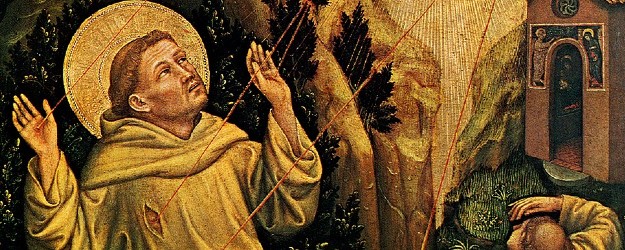
I begin with an admission that may surprise some readers. When I was discerning my vocation, Franciscanism never appealed to me. I never quite got it. To my young clerical imagination, Saint Francis of Assisi was a kind of “hippie saint,” all birds and flowers and pious sentimentality, and Assisi itself struck me — at least from afar — as something like a Catholic Disneyland: beautiful, yes, but curated, sanitized, and safely distant from the hard theological and ecclesial questions that actually matter. Being forced to watch the film Brother Sun, Sister Moon at school certainly did not help in my estimation of the mendicant way.
I was wrong. Profoundly wrong.
It took my years of study in Rome — and, more decisively, my first pilgrimage to Assisi — to undo those caricatures. What I encountered there was not a naïve romantic or a proto-ecologist detached from doctrine, but a man seized by Christ, broken open by obedience, and commissioned — quite literally — to rebuild the Church from within. It is no exaggeration to say that Saint Francis reordered my understanding of reform, tradition, religious life, and hope.
It is precisely for this reason that Pope Leo XIV’s declaration of 2026 as the Year of Saint Francis is not only timely, but providential. Far from being a nostalgic exercise or a devotional sidebar, this year invites the Church to contemplate Francis as a guide for ecclesial renewal in continuity, a living icon of the Church’s eschatological hope, and — perhaps most urgently today — a witness to the Catholic “et-et,” the Synthetic Principle so desperately needed in an age of polarization.
Standing before the crucifix of San Damiano in Assisi—now famous, perhaps too famous—I finally understood what I had missed. Francis was praying before that crucifix not as a dreamer or a protester, but as a penitent. He was a man already stripped of illusions: of wealth, of social standing, of self-determination. When the Crucified Lord spoke — “Francis, go and rebuild my Church, which you see is falling into ruin” — Francis did not hear a manifesto. He heard a command.
And, crucially, he obeyed it literally before he ever obeyed it symbolically.
He began by repairing that small, crumbling church with his own hands, stone by stone. Only later — under obedience to the local bishop and in fidelity to the Church’s sacramental and hierarchical life — did Francis come to see that Christ’s words were not limited to mortar and beams, but extended to the entire Body of Christ. This order matters. Francis does not begin with critique; he begins with conversion. He does not start outside the Church; he kneels within her wounds.
That experience in Assisi shattered my old assumptions. This was not rupture masquerading as reform. This was reform born of radical fidelity.
The movement that emerged from Francis’s conversion was unlike anything the medieval Church had seen — and yet, in a deeper sense, it was a retrieval of something ancient. The Order of Friars Minor did not begin as an abstract theological project but as a concrete way of living the Gospel sine glossa — without commentary, without excuses.
Francis did not reject doctrine; he assumed it. He did not disdain the hierarchy; he sought papal approval. He did not romanticize poverty; he embraced it as a form of eschatological freedom, a way of living now what the Church believes will be fully revealed in the Kingdom to come.
The early Franciscan movement — missionary, itinerant, joyfully austere — became one of the great engines of renewal in the High Middle Ages. Universities, urban preaching, care for the poor, catechesis of the laity, missionary outreach: all of these were shaped decisively by Franciscan friars. And even when internal tensions arose — between rigor and adaptation, between contemplation and apostolate — the Franciscan family remained within the Church, struggling with her rather than against her. This is why Francis matters so much now.
It is impossible to speak of Pope Leo XIV’s declaration without acknowledging the profound influence of his predecessor and namesake, Pope Leo XIII. Leo XIII, the great pope of Catholic social teaching, understood something essential about religious life: that it is not an ornament of the Church, but a prophetic sign within her.
Leo XIII gave renewed juridical clarity and ecclesial support to the Franciscan family at a time when modernity threatened to hollow out both faith and hope. His vision of poverty was not ideological but evangelical; his concern for workers and the poor was not political posturing but theological realism. For Leo XIII, the Franciscan charism was not antiquated — it was urgently modern, precisely because it resisted reduction of the human person to economic utility.
Pope Leo XIV’s Year of Saint Francis thus stands in conscious continuity with this legacy. It is not an isolated initiative, but part of a longer papal discernment about how the Church speaks to the modern world without surrendering to it.
Interpreted rightly, the Year of Saint Francis is a continuation — almost an extension — of the Jubilee of Hope recently celebrated by the Church. Jubilees remind us that history is not closed in on itself, that forgiveness, restoration, and joy are possible because God is faithful.
Francis embodies this hope not as abstraction but as lived eschatology.
The religious vows — poverty, chastity, obedience — are not moral feats. They are signs. They point beyond themselves to a future already breaking into the present. Poverty announces that God alone suffices. Chastity proclaims that love is destined for communion beyond possession. Obedience witnesses to a freedom deeper than autonomy: conformity to Christ who “learned obedience through what he suffered” (Heb 5:8). Francis lived all of this with terrifying consistency — and radiant joy.
Perhaps the most urgent contribution Francis makes to the Church today is his embodiment of what we now call the hermeneutic of continuity. He reformed nothing by negation. He renewed everything by intensification.
Francis did not oppose institution with charism; he united them. He did not pit Gospel against Tradition; he lived the Gospel as Tradition. This is the Synthetic Principle in flesh and blood — the Catholic et-et: contemplation and mission, poverty and beauty, obedience and freedom, Christological focus and ecclesial belonging.
Here Francis stands remarkably close to the great insights of Communio theology and even to the heart of Thomism. Saint Thomas Aquinas reminds us that grace does not destroy nature but perfects it. Francis shows us that reform does not destroy the Church but purifies her. Both resist reductionism. Both insist on fullness.
The Church today is tempted by false binaries: progress versus tradition, mercy versus truth, reform versus continuity. Francis exposes these as illusions. He shows us that the Church is renewed not by severing her roots, but by returning to them more deeply.
Pope Leo XIV’s declaration of the Year of Saint Francis is, therefore, not about nostalgia or sentiment. It is about hope — real hope, eschatological hope, hope born of the Cross and radiant in the Resurrection.
I went to Assisi thinking I would encounter a saccharine relic of the past. Instead, I met a saint for the future. And perhaps that is the greatest gift of this year: to rediscover Francis not as a “hippie saint,” not as a plaster statue or a tourist slogan, but as a man who heard Christ clearly, obeyed Him completely, and rebuilt the Church — without ever leaving her. May we learn to do the same.
 About Rev. John P. Cush, STD
Father John Cush, thank you for your excellent article on the Year of Francis. I have found similar truths regarding Francis, who differs so much from the “hippie Saint” profile.
FYI, my dispute resolution manual based on the legend of Francis taming the fierce wolf of Gubbio—a story from the Little Flowers of St. Francis (Demaray)—duplicates the arc of mediation, of conflict resolution. Taming the Wolf: Peace through Faith can be found at https://tamingthewolf.com/.
(A FREE PDF download can be found at: https://tamingthewolf.com/wpcontent/uploads/Taming_the_Wolf_Peace_through_Faith_Book.pdf )
In addition to my work, I was impressed with the true nature of Francis presented in The Admonitions of St. Francis by Karris, O.F.M. This work shows a disciplined Francis few know.
Also, I recommend (for more academic readers) Joseph Ratzinger’s PhD thesis The Theology of History in St. Bonaventure,” which is available in book form. Ratzinger’s assertion that what we see now is not the true order, but rather that a new Seraphic order of contemplatives will emerge is provocative and worth reflection.
While I understand your background is in Thomism, I believe there is something to be gained in turning to St. Bonaventure (who contended with Aquinas at the Academy). The disagreements between Aquinas and Bonaventure are worth consideration as, at the end of his life, Aquinas turned toward the arguments Bonaventure put forth. Bonaventure’s The Soul’s Journey Into God (translation by Cousins) is a must read.)
So much more but time limits my response. Hope you receive this message. Not always certain that my posts are received.
Thank you for this. I really appreciated it.
Every word in transcendental synthesis. Reading this was like experiencing an icon with a beating heart.
Father is there a reason you did not choose to use the word “integration”, at any point? Is it lacking, or culturally loaded, or not as seamless as “synthesis”? The absence of this word seems key for some reason.
I begin to understand our Holy Father’s intent for us in declaring this Year of Saint Francis, which leads me deeper in relationship with him. With them both! Sincere thanks to you.