Over the next three years (2025–2028), the Church is undergoing a three-year implementation phase of the Synod on Synodality. The Holy See has cited a variety of goals for this phase, but the following is a general summary: “The implementation phase of the Synod should be understood not as merely the ‘application’ of directives from above, but rather as a process of ‘reception’ of the orientations expressed in the Final Document, adapted appropriately to local cultures and the needs of communities. At the same time, it is essential to move forward together as the whole Church, harmonizing this reception across different ecclesial contexts.”1 Because moral theology is one of the ecclesial contexts in which reception of the Synod remains a work in progress, this article will point out some of the intrinsic relationships between the Synod on Synodality and Veritatis Splendor, focusing particularly on their mutual appeal to a logic of encounter.
The Truth That Frees
The Second Vatican Council called for moral theology to be increasingly based on Sacred Scripture, a directive that neither the Synod on Synodality nor Veritatis Splendor have failed to heed (cf. Optatam Totius, no.16). One biblical passage frequently referenced in Veritatis Splendor as foundational for Catholic moral theology is John 8:32: “And you will know the truth, and the truth will set you free.”2 Although not obvious at first, the logic of encounter permeates this passage, especially when it is considered in context of a larger pericope (vv. 31–47) that explains how one comes to “know the truth” in the first place.
The introductory phrase for this pericope is significant: “Jesus then said to those Jews who believed in him . . .” (v. 31). This introduction creates an intriguing paradox, for these people who “believed” in Jesus are the same persons who, later in this passage, are accused by Jesus as belonging to the devil, and they prove their allegiance when they throw stones at Jesus and drive him out of the temple. On the level of appearance, these people are disciples of Christ, but according to Christ himself, they follow someone else.
After establishing the hypocritical substrate of the audience, the passage so critical to Veritatis Splendor appears, but it is prefaced with one important condition: “If you continue in my word, you are truly my disciples, and you will know the truth, and the truth will make you free” (vv. 31–32). Jesus is telling these persons who believe in him about what it takes to be his disciple, not in appearance but in essence. It is not enough, he says, to follow me and admire my miracles. It is not enough to come and hear me and even invite others to listen to me. What is needed, first and foremost, is to “continue in my word.”
This theme recurs throughout the pericope, such as the moment when Jesus asks, “If I tell the truth, why do you not believe me?” Jesus’ statements of absolute truth were rejected by some hearers, and Jesus gives some insight into the cause of this rejection: “The reason why you do not hear [my words] is that you are not of God.” A similar idea reappears in v. 43, when Jesus asks and answers a similar question, “Why do you not understand what I say? It is because you cannot bear to hear my word.”
So, when considering the pericope as a whole, only those who “belong to God” and who “continue in my word” can ever come to know the truth that will set one free. While it is an urgent moral imperative to know the truth, Christ states that knowledge of this truth is predicated on a substantial and living relationship with God. It is worth repeating, as John Paul II did many times, that “the truth will set you free,” but it is equally important to incarnate John Paul II’s insistence that only an encounter with God can provide this truth (cf. Veritatis Splendor, no. 87). This encounter with God must extend to the deepest levels of the human person, engaging the heart in a formal act of assent, not only to the teachings of Christ, but to an authentic discipleship with Christ.3
None of the above was glossed over by John Paul II, who explained that Christian faith “is not simply a set of propositions to be accepted with intellectual assent. Rather, faith is a lived knowledge of Christ, a living remembrance of his commandments, and a truth to be lived out” (no. 88). Here, John Paul II resists the debilitating lacuna of considering the truth as propositional; rather, it is relational, and it requires a “lived knowledge of Christ” to be the truth as such.
Therefore, if the Church is concerned not only with discovering moral truths but also with helping others to live moral truths, then it must pay particular attention to the means by which this truth is known. It is not enough to repeat, with greater emphasis and increased volume, absolute moral norms; what is needed for receiving moral truth is an ongoing encounter with Christ, an encounter that is more than formal attraction to his teachings and familiarity with the propositional truths of faith and morality.
Encountering Christ in Synodality
Based on the teachings of recent pontificates, the pastoral consequences to John 8:31–47 do not seem to be fully embedded into the psyche and structures of the universal Church, for these consequences resonate throughout Veritatis Splendor and have persisted with increased volume in the pontificates that followed its publication. The most immediate instance of such recurrence is found in the critical concepts undergirding the Synod on Synodality, which itself has roots in prior pontificates.4 For his homily at the opening mass for the Synod, Francis articulated some of these critical concepts by using the parable of the rich young man as a hermeneutical key for understanding the mission of the Synod. This is the same parable used by John Paul II to introduce the fundamental truths of Veritatis Splendor (nos. 6–24), and some of the parallels between these two texts will be pointed out because they converge on the interdependence of freedom, truth, and discipleship as articulated in John 8:31–59.
In his homily for opening the Synod on Synodality, Francis celebrates the example of Jesus’ openness to the rich young man, seeing in it a paradigm for the Church to follow: Jesus “meets us where we are, on the often rocky roads of life. Today, as we begin this synodal process, let us begin by asking ourselves — all of us, Pope, bishops, priests, religious and laity — whether we, the Christian community, embody this ‘style’ of God, who travels the paths of history and shares in the life of humanity.”5 For Francis, this style of God is characterized by “being completely present to this person,” and such an attitude involves “encountering faces, meeting eyes, sharing each individual’s history.” Francis thinks that openness to such encounters is critical for the Church to fulfill the mission entrusted to her by Christ, and thus he hopes that, through synodality, all the faithful may “become experts in the art of encounter” by “taking time to encounter the Lord and one another.”
Such a teaching has deep roots in Veritatis Splendor, both implicitly and explicitly. Explicitly, Veritatis Splendor demonstrates a great reverence for the role of encounter in the Church’s mission; in fact, Veritatis Splendor goes so far as to describe “encounter” as the fundamental mission of the Church: “In order to make this ‘encounter’ with Christ possible, God willed his Church. Indeed, the Church ‘wishes to serve this single end: that each person may be able to find Christ, in order that Christ may walk with each person the path of life’” (no. 7). This assertion by John Paul II demonstrates how the Synod’s appeal to encounter is not some isolated papal campaign but rather a pastoral consequence of fundamental teachings articulated in Veritatis Splendor, for both the Synod and Veritatis Splendor are built upon the conviction that Christ must walk with each person in order for that person to know the truth that will set them free. According to Francis, the Church’s mission is not about “organizing events or theorizing about problems”; rather, it is to ensure that every human person encounters Christ in a personal way.6 Thus there is also an implicit resonance between the Synod on Synodality and Veritatis Splendor, for fostering an encounter with Christ flows from the moral principles of John 8:32 in which knowledge of the truth is predicated on an ongoing discipleship with Christ, a discipleship that must be lived in order to be true.7
In Veritatis Splendor, John Paul II condenses all of the above into a simpler and paradigmatic dictum that undergirds the moral theology of his and future pontificates: “Following Christ is thus the essential and primordial foundation of Christian morality” (no. 19). What Christ ultimately demands is not mere adhesion to the commandments (which is presumed) but rather a deeper, primordial moral imperative: “Come, follow me!” Francis explains that this rich young man “cannot attain happiness by filling his life with more religious observance, but by emptying himself.” The moral limitation of “religious observance” is affirmed not only by Francis but also within Veritatis Splendor, where John Paul II states that the Church’s evangelizing mission is focused “not so much in doctrinal statements and pastoral appeals to vigilance, as in constantly looking to the Lord Jesus” (no. 85).8 Similarly, he stated that following Christ “is not a matter only of disposing oneself to hear a teaching and obediently accepting a commandment. More radically, it involves holding fast to the very person of Jesus, partaking of his life and his destiny, sharing in his free and loving obedience to the will of the Father” (no. 19). Thus for Francis and for John Paul II, neither “religious observance” nor “doctrinal statements” nor “obediently accepting a commandment” are equivalent to moral freedom; rather it is discipleship with Christ which alone reaches a truth that can set others free. By first encountering the Lord and seeking his face, the Church is then prepared to help others encounter the truth, not only by sharing the moral norms learned through this personal encounter, but especially by sharing the person Jesus Christ who has been revealed.9 Without this lived and personal relationship with Christ, all truths (including moral truths) can be heard but not deeply received; without firm and persistent attention to building this lived relationship with Christ, the Church risks being caught in the wearisome cycle of telling the truth to people who do not yet “continue in my word” and thus have not yet accepted the foundation of all truth. By asking the Synod on Synodality to make encounter a primary pastoral objective, Francis is asking this Synod to help propagate the fundamental moral principle of Veritatis Splendor, which is not principally a set of behavioral rules but rather a real, active, and living person.
Pope Benedict and the Logic of Encounter
Because difficulties with reception of the Synod are often tied to questions of theological continuity, it is worth remembering how Benedict XVI also promoted this logic of encounter. Besides the footnotes throughout this article, one additional document deserves special mention, which is the Pontifical Biblical Commission’s The Bible and Morality. The introduction explains that this document was initiated in 2002 “at the behest of the then President Card. Joseph Ratzinger,” and it was released in 2008 during Benedict’s pontificate. It is a document that endorses a logic of encounter in a variety of ways, but especially when it describes the hierarchy of Catholic moral theology in the following manner: “Moral instruction certainly forms part of the Church’s essential mission, but only secondarily, i.e. in relation to our appreciation of the gift of God and of a spiritual experience. This is something which our contemporaries often find it difficult to understand and adequately appreciate” (no. 4). When the Pontifical Biblical Commission sought to explore thoroughly the foundations of a moral theology based on Sacred Scripture (thus following the mandate given by the Second Vatican Council), the logic of encounter emerged as a key theme, noting that ongoing encounters with God are the metaphysical foundation upon which all biblical moral norms are built and give life. The Pontifical Biblical Commission also noted that this elevation of encounter (or, in language that is even more ambiguous, a “spiritual experience”) over moral instruction is often difficult to understand and not always sufficiently appreciated by “contemporaries.” In the eighteen years since the publication of The Bible and Morality, difficulties with appreciating and elevating the logic of encounter persist, hence the need for an implementation phase of the Synod which will try to increase receptivity to this logic which has deep roots in both scripture and tradition.
On the Relationship Between Synods and Schism
Despite these points of continuity, not everyone is convinced that the Synod on Synodality harmonizes with the Church’s moral principles. According to some commentators, discussions in and around the Synod have threatened fundamental moral principles that were “definitively settled” in Veritatis Splendor. Such a threat is no little concern, which is why I have treated this topic at length elsewhere.10 For the purpose of this article, it only needs to be mentioned that an excessive focus on this threat involves dangers of its own, foremost of which is its tendency to generate a skeptical attitude toward the Synod on Synodality and toward synods in general. The problem with such skepticism is that it contradicts more weighty principles held by the Church.
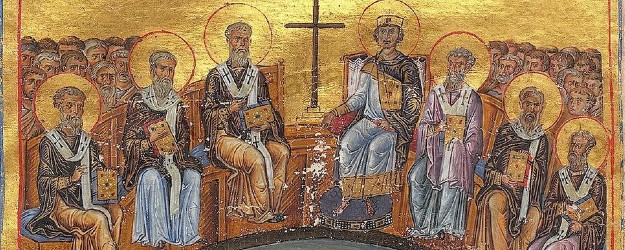
Consider, for example, the dramatic events surrounding the Council of Nicea (AD 325). Although the Gospel of John “definitively settled” the question of Christ’s divinity, that did not stop the Council of Nicea (literally “the Synod of Nicea,” according to its Greek title) from discussing Christ’s divinity thoroughly and dramatically, nor did it stop the subsequent Council of Constantinople (AD 381) from debating further this same theological question. But with the wisdom of time now on their side, the Fathers of the Second Council of Constantinople (AD 553) stated their belief that this near-reckless methodology of Nicea was life-giving, not destructive: “The holy fathers [at Nicaea and Constantinople] . . . dealt with heresies and current problems by debate in common, since it was established as certain that when the disputed question is set out by each side in communal discussions, the light of truth drives out the shadows of lying.”11 Deep skepticism toward the Synod on Synodality may have the preservation of moral principles in mind, but it risks the neglect of other principles still, one of which is this conciliar certainty (and therefore magisterial certainty) that ongoing communal debate of foundational theological principles leads to clearer truths, not greater deceptions. For all the drama that unfolded in early synods, the Church emerged from these experiences with a greater trust in synods, not skepticism toward them.
In his own study of the 2000 years of synodal history in the Catholic Church, Norman Tanner converges with the logic of these fathers at Constantinople, noting that the greatest risk to the Church is not the gathering of synods but rather the neglect of synods, that the historical record proves that heresy and disunity “occurred in the absence of councils, not because of them.”12 While the Church’s synodal gatherings have often involved intrigue, politicking, and dramatic disputes, the Fathers at Constantinople were certain that the truth would always win out in these dramatic debates, that all theological and moral truths are strengthened, not diminished, by synodal events. Time will tell whether the Synod on Synodality is continuous with this magisterial belief or an exception to it, but a present evaluation requires only the use of sight, not the wisdom of time, to discern within its theoretical framework some relevant points of continuity with Veritatis Splendor. Any scandalous or dramatic debate at the Synod on Synodality over “settled” moral principles within Veritatis Splendor is, paradoxically, another point of continuity with the Church’s venerable theological tradition, and is one additional reason to believe that the implementation phase of this Synod merits not just skepticism but also some protagonism.
- “Press Release of the General Secretariat of the Synod and Letter on the Accompaniment Process of the Implementation Phase of the Synod,” 15 March 2025, https://press.vatican.va/content/salastampa/en/bollettino/pubblico/2025/03/15/250315a.html. ↩
- All translations from scripture in this article come from the Revised Standard Version Bible, Ignatius Edition (San Francisco: Ignatius Press, 2006). ↩
- Thus Bonaventure commented on this pericope by affirming that it is only through “imitation and conformity” that a person can receive the words of Christ, a type of imitation that happens “by means of the heart, not of the body” (Commentary on John, 8.72). ↩
- Benedict said that one of his top priorities for his papacy was to “strengthen the synodal element” of the church. Benedict XVI and Peter Seewald, Last Testament: In His Own Words, trans. Jacob Phillips (London and New York: Bloomsbury, 2016), 190. Cf. International Theological Commission, Synodality in the Life and Mission of the Church, 41–42. ↩
- Pope Francis, “Opening of the Synodal Path: Homily of His Holiness Pope Francis,” 10 October 2021, www.vatican.va/content/francesco/en/homilies/2021/documents/20211010-omelia-sinodo-vescovi.html. ↩
- The Synod’s Final Document (no. 115) labels the Church as “a sacrament of encounter and salvation,” thus highlighting encounter as intrinsic to the Church’s work of salvation and even imbuing encounter with a sacramental dimension. ↩
- Pope Benedict XVI spoke similarly, saying that Jesus’ method of teaching is one which leads “gradually to the hidden reality that can truly be discovered only through discipleship.” Benedict XVI, Jesus of Nazareth (New York: Doubleday, 2007), 324. ↩
- In commenting on this passage, Ratzinger states that “in the contemplation” of Christ “and in listening to him, we find the answer to moral problems.” Joseph Ratzinger, “Perché un’enciclica sulla morale?” in Veritatis Splendor: Genesi, elaborazione, significato, ed. Giovanni Russo (Rome: Edizioni Dehoniane, 1994), 18. ↩
- In his motu proprio Porta Fidei (no. 11), Benedict XVI remarked that, in the Catechism of the Catholic Church, “on page after page, we find that what is presented here is no theory, but an encounter with a Person who lives within the Church.” See also Bivin Varghese, “Faith as an encounter with a ‘Personal God’ in Joseph Ratzinger,” in Alessandro Clemenzia and Roberto Regoli, eds., Ratzinger e la Chiesa: Approcci di ricerca (Firenze: Nerbini, 2023), 73–80. ↩
- Anthony Hollowell, “Divine Authority and Absolute Moral Norms,” Journal of Moral Theology 14, special issue no.1 (2025): 182–201, doi.org/10.55476/001c.136490. ↩
- Decrees of the Ecumenical Councils, ed. Norman Tanner (London: Sheed & Ward, 1990), 108. ↩
- Norman Tanner, Was the Church Too Democratic? Councils, Collegiality and the Church’s Future (Bangalore: Dharmaram Publications, 2003), 4. ↩
 About Fr. Anthony Hollowell
Thank you, Padre. I do have one observation on the synod itself.
I found it quite odd there was only one man whose ministry is as a Deacon invited to the Synod and this invitation happened kind of late. There were multitudes of others. Now while Priests and Bishops will always be Deacons at their foundation, excluding the lowest order is quite odd considering the idea of the synod – on synodality.
A synod is a meeting of bishops. One of the problems with the “Synod of Synodality” is that it does not mean anything, especially to the average Catholic. We must encounter Christ and we do that through the Sacraments, prayer, contemplation, reading Scripture, and good works. But that is not the takeaway that most Catholics get from the Synod of Synodality or from Pope Francis who talked endlessly about encountering Christ but who didn’t say how this was to happen. The bottom line is that unless this project urges Catholics to return to prayer and the Sacraments, it is not going to lead us to a real encounter with Christ, and will ultimately fail in its objectives. In twenty years it will be irrelevant.
Mary,
Encountering Jesus Christ in prayer and the Sacraments as we encounter the suffering people of this world. Pope Francis said in an interview, “Thinking of the migrants, those who have had to leave their homeland, who are welcomed by so many good people or even indifferent people, who are on the road of exile, far from their homeland, longing for friends, family, the beauty of their homeland. To all migrants, I give my blessing in the name of the Father and of the Son and of the Holy Spirit.” Here Pope Francis leads us to a real encounter with Christ.” I encounter Christ every time I see a mother with a baby on her back walking between cars as a means to feed her hungry child. I confess my sin of neglect every time I miss a personal encounter with Christ in a suffering human being.
Anthony,
Your article is much needed. You draw clear lines of continuity between the papal teaching of most recent popes and the present movement of the Holy Spirit, calling us to Synodality. When we encounter Jesus by listening to and encountering the greatest need, we are opened to being disarmed from our need to defend what is ours. Transformed by an encounter with Christ, we can be open to live the WAY of Jesus in this world now.