For the Solemnity of Mary Mother of God, the Epiphany of the Lord, the Baptism of the Lord, and the Second Sunday and Third Sunday of Ordinary Time
Solemnity of Mary Mother of God – January 1, 2026
Readings: Numbers 6:22–27 • Psalm 67:2–3, 5, 6, 8 • Galatians 4:4–7 • Luke 2:16–21
bible.usccb.org/bible/readings/010126.cfm
To those who have not grown up in the Catholic or Orthodox Churches, Mary seems to occupy an outsize place in the Church’s life and teaching. Of the six holy days of obligation currently observed in the United States, three are Marian: Mary Mother of God (today), the Assumption, and Immaculate Conception. A fourth, Christmas, gives Mary a prominent place beside her child. The last two solemn exercises of papal authority were to confirm the dogmas of the Immaculate Conception and the Assumption. Doesn’t this seem like a mountain made out of a proverbial molehill? Pious sentimentality unmoored from Scripture, where Mary appears to have only a cameo role?
But the answer to these questions comes from Scripture’s description of Mary’s response to the visit of the shepherds: “And Mary kept all these things, reflecting on them in her heart” (Lk 2:19). In commending Mary’s contemplative attitude, Scripture suggests that some of its key truths do not lie on its surface. Some mysteries disclose themselves only to those who have attained a certain purity of heart — to those who have fasted, watched, given alms, and meditated day and night. Mary was not only such a meditator. She is also such a mystery.
For Mary’s true greatness comes into view only for those who ponder the few descriptions of Mary found in Scripture against the background of the great pattern of redemption. Throughout the history of salvation God has certain characteristic ways of acting. First, he doesn’t act alone. He calls servants. Second, he equips those servants whom he calls with the graces and privileges necessary for their mission. We need only think of Abraham, whom God called to be the father of a great nation, but to whom he also granted visions and covenants. We can think of Elisha, whom God called to rebuke kings, but to whom he first granted a double portion of Elijah’s spirit.
All who meditate on Mary within this broader pattern eventually come to realize that her relationship to Jesus must extend beyond mere biology. After all, even a normal human mother must provide her children with more than nutrition. To those who are body and soul she supplies many other things besides: encouragement, love, instruction. How many more graces will a woman need to be a fitting mother to one who is not only body and soul but also divinity? Elizabeth seems to have realized this instinctively when Mary came to visit her bearing her son: “Most blessed are you among women . . . how does this happen to me, that the mother of my Lord should come to me?” (Lk 1:42–43). St. Augustine would likewise say of Mary that she “conceived in her spirit before she conceived in her womb” (Sermo 215.4). In other words, her spiritual closeness to her son, her sinlessness, her intercessory power, precede her biological closeness.
Mary’s spiritually protective and sustaining role in the life of her Son did not end with his Ascension. It continues even now in the life of the Church. For the idea that God became man is a deep mystery, liable to misunderstanding in two directions. Mary, when understood as Catholic doctrine professes her, guards against both.
The first great misunderstanding is to imagine that God became less than fully human. We know that God pervades all things. And so we perhaps imagine that God was just “in” Jesus like He is in everything else. Perhaps He controls him like the avatar in a video game or inspires him like the other prophets. But can we say that God really “became” man? That God suffered and died for me in Christ? To these doubts Mary provides an enduring answer: God became human enough to have a mother. This is the point the Council of Ephesus made in the fifth century when it declared Mary the theotokos. It is the point of the Letter to the Galatians when it affirms, “God sent his Son, born of a woman” (4:4).
The second and opposite misunderstanding is to imagine that Jesus is only a perfect human, a great moral teacher or mystic. But when we understood the true stature of Mary, we realize that this would be redundant. She is already sinless, perfect, exalted above the angels. Her greatness prompts us to ask, “If the Mother had such gifts by grace, then what must her Son be by nature?” Mary guards both Christ’s humanity and his divinity. She is thus rightly called, as St. John Henry Newman points out, “Tower of David.”
We do well to ask her to be a tower of strength for us as well.
The Solemnity of the Epiphany – January 4, 2026
Readings: Isaiah 60:1–6 • Psalm 72:1–2, 7–8, 10–11, 12–13 • Ephesians 3:2–3a, 5–6 • Matthew 2:1–12
bible.usccb.org/bible/readings/010426.cfm
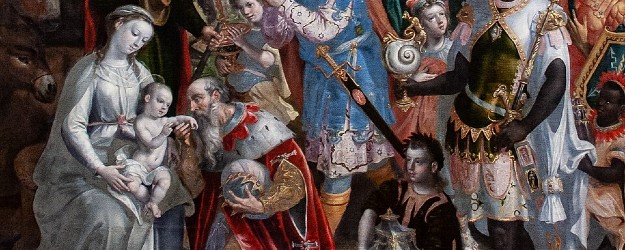
Not long ago I came a across a writing from the early second century of the Church that cast a new light on the central images of this great Solemnity of the Epiphany: the wise men who come bearing gold, frankincense, and myrrh to the Christ Child in Bethlehem. The writing, originally composed in Syriac, is called The Cave of Treasures. It is a theological reflection on the meaning of the Adam’s sin and Christ’s Epiphany. But it uses a genre no longer familiar to us. Instead of boiling the truths of the faith down into catechism points, it opts instead to extend the biblical story. We actually do this all the time in modern film and theater. When I was studying philosophy in New York more than twenty years ago, a Broadway musical named Wicked extended the story of the Wizard of Oz, telling it from the perspective of the Wicked Witch of the West.
In a similar way, The Cave of Treasures extends the story of Adam after the Fall. In his justice, God strips Adam of his first glory and expels him from the Garden. But in his mercy, God clothes Adam in a robe of grace and appoints him his priest. God directs Adam to a cave on the outskirts of paradise, just a little way down the mountain. Then the interesting part: Adam does not curse the cave but blesses it and places in it some gold, frankincense, and myrrh that he finds nearby. These are signs of the higher life to which he wants to return. This is the “cave of treasures” from which the story takes its name.
The “cave of treasures” is also, of course, a symbol of the Church. Adam prays, watches, and waits for the one who will restore him. After he dies, his few faithful descendants keep his bones and the gold, frankincense, and myrrh, preserving the same hope. Noah carries them in the Ark. Eventually, it is implied, these relics end up in the hands of the magi. These wise men bring them to Jesus. They thereby prophesy that mankind is approaching the gates of paradise once again, the place from which Adam is exiled and to which he longed to return.
By building this narrative bridge between Adam and Christ, what does The Cave of Treasures help us understand about the Epiphany? What truths does it cast into starker relief that we would otherwise be tempted to overlook? Two readily present themselves.
First, Christ is the source of salvation for all. We live now in an age of considerable pluralism, surrounded by people of different religious convictions. Very often these people live exemplary lives, raise polite children, contribute to the common good. There is a temptation to think, then, that some people are better off not being Christian. “There are many paths up the same mountain,” we might be tempted to say. But The Cave of Treasures and the Gospel of Matthew disagree. The magi come from peoples outside the covenant, Matthew reminds us. And they bring the heirlooms of Adam, The Cave of Treasures reminds us. Everyone who is a Son of Adam and a Daughter of Eve draws closer to paradise by drawing closer to Christ. Do I prudently share my faith as if this were true? As if it were a treasure?
Second, the conviction that in Christ I have received life’s greatest treasure — a treasure meant for all — goes hand in hand with deep humility. I stress this because many object that fervent Christianity leads to pride and violence. Isn’t it the height of arrogance to claim that any one person or even religion has the truth? Here it is important to note how Truth appears. It comes as a gift and a mercy. This is true of the gold, frankincense, and myrrh, which God gives us to keep the desire for salvation alive in our hearts. This is true of Christ himself, who “appears” unexpectedly. When the shepherds and the magi find the Christ child, they do not congratulate themselves for being the cleverest. They do not scheme how to use this knowledge to dominate. They instead prostrate themselves, doing Christ and Mary homage (Mt 2:10). They offer their gifts (Mt 2:11), fulfilling Adam’s great hope. They go back changed, “by another way” (Mt 2:12).
They model for us, in short, the attitude we should bring to every Mass, and to every encounter with someone estranged from Christ.
The Baptism of the Lord – January 11, 2026
Readings: Isaiah 42:1–4, 6–7 • Psalm 29:1–2, 3–4, 3, 9–10 • Acts 10:34–38 • Matthew 3:13–17
bible.usccb.org/bible/readings/011126.cfm
The mystery of the baptism of the Lord, which the Church throughout the world celebrates today, reminds me of a scene from the classic children’s book The Magician’s Nephew, one of the seven volumes of the Chronicles of Narnia. There the author, C.S. Lewis, describes the creation of Narnia. Aslan, the lion and Christ-figure, creates by singing. The forms of plants and animals emerge from the ground. After finishing his song, Aslan proceeds to breathe upon all plants and animals, giving them powers beyond their ordinary capabilities. “Narnia, Narnia, Narnia, awake. [he says] Love. Think. Speak. Be walking trees. Be talking beasts. Be divine waters” (Ch 9).
In much the same way that Lewis describes the effect of Aslan’s breath, the Church’s great doctors describe the effect of Christ’s baptism in the Jordan: an awakening of the creature; a bestowal of divine power upon the waters; in short, a kind of recreation. One of the earliest homilies that comes down to us links Christ’s baptism backward to the waters of creation and forward to the fount of our own baptisms:
Let peoples of every nation come and receive the immortality that flows from baptism. This is the water that is linked to the Spirit, the water that irrigates Paradise, makes the earth fertile, gives growth to plants, and brings forth living creatures. In short, this is the water by which a man receives new birth and life, the water in which even Christ was baptized, the water into which the Holy Spirit descended in the form of a dove (Ps.-Hippolytus, Office of Readings, Tuesday after Epiphany).
The exuberance with which the doctors of the Church speak of the effects of baptism should perhaps give us pause. Baptism for them was obviously more than a quaint ritual in which children are welcomed into family and society. It is the moment when God says to us, Love (= Holy Spirit). Think (= faith). Speak (= ephphatha). In the normal course of things, it is the moment when eternal life is opened to us and we’re freed from the power of evil: “Do you reject Satan? . . .”
Given the true significance of baptism, it follows that mindfulness of our individual baptisms can serve as a pretty good gauge for our mindfulness of all that we owe Christ. A recent conversation with a saintly old Jesuit really drove this point home for me. He remarked that as he grew older, he became more aware of the fact that everything good in his life was far more God’s gift than his own achievement. He likewise grew in devotion to the day of his baptism, the day that God made him “His beloved Son, in whom He is well pleased.”
For very much the same reason Pope Francis assigned a bit of homework to the tens of thousands of people at a Wednesday audience some years ago. He urged them to go home and look up the date of their baptism. He explained: “To know the date of our Baptism is to know a blessed day. The danger of not knowing is that we can lose awareness of what the Lord has done in us, the memory of the gift we have received.” Those who have been married for any length of time doubtlessly know how easy it is to take husband or wife for granted. As a stay against forgetfulness, most celebrate their anniversary once a year. Perhaps we could mark the day of our baptism in a similar way.
At all events, it’s clear that Aslan’s summons are like the summons of today’s mystery: Narnia, Narnia, Narnia, awake. Love. Think. Speak. The baptism of our Lord invites us to increase our love by thinking often what Christ he has done for us, and by speaking this gratitude in the language of our lives.
Second Sunday in Ordinary Time – January 18, 2026
Readings: Isaiah 49:3, 5–6 • Psalm 40:2, 4, 7–8, 8–9, 10 • 1 Corinthians 1:1–3 • John 1:29–34
bible.usccb.org/bible/readings/011826.cfm
Almost twenty years ago now, there was a survey studying religious attitudes among American teenagers. A sociologist conducted on-site interviews with 257 teenagers from 45 different states and from (mostly) Christian backgrounds. The results are sobering. And they help, I think, to clarify the difference between the Catholic faith, as presented in today’s Scripture readings, and the conventional religious beliefs of most Americans.
The survey had good news and bad news — but mostly bad news. The good news: most American teenagers were not rebellious with respect to their religious beliefs. For the most part, they were content to follow the traditional religion of their parents and felt positive about it. The bad news: the traditional religion that they inherited from their parents was not exactly Christianity. The default religion of two generations of Americans is what the author calls Therapeutic, Deistic, Moralism.
This religion is therapeutic in the sense that most young people thought that the point of faith was to help them be happy and secure, live up to their potential, and feel good about themselves.
It’s Deistic in that most teenagers seemed to think that God made the world like an artisan makes a clock. But he doesn’t get involved — at least, not unless we want Him to. He intervenes just enough to be a good therapist.
It’s moralistic in that most folks thought the main purpose of organized religion was to reinforce good morals, though most everyone agreed that one didn’t need to be religious to be good.
As for believers who thought religion should be something more, young people generally regarded them as “too religious.” These were the folks who would try to evangelize others and held their religion as the true faith. I think it’s important to notice this dynamic. Since this is the default religion of the U.S., it will exert a pressure on us Catholics and on our religious imagination. We can easily start thinking like this 17-year-old Protestant girl quoted in the study: “God’s all around you, all the time. He believes in forgiving people and whatnot and he’s there to guide us, for somebody to talk to and help us through our problems. Of course, he doesn’t talk back” (165).
The Scripture that the Church presents to us on this Second Sunday of Ordinary Time, however, presents to us a very different image of God and of our relation to him. Opposing the image of God the therapist, we have this beautiful image of the servant in Isaiah:
You are my servant,
Israel, through whom I show my glory.
Now the LORD has spoken
who formed me as his servant from the womb . . .
God does not exist for our benefit; we exist for his service.
Opposing the image of God the uninvolved clockmaker, we have Paul explaining the origin of his ministry: “Paul, called to be an apostle of Christ Jesus by the will of God” (1 Cor 1:1). If Paul is called, then God speaks. He is involved, whether we want him to be or not.
Opposing moralism, we have the prophetic word that John the Baptist received: “‘On whomever you see the Spirit come down and remain, he is the one who will baptize with the Holy Spirit.’” (Jn 1:33) Jesus doesn’t just come like Santa Claus, to check on who’s naughty or nice. He comes in the power of the Holy Spirit, and he comes to give the power of the Holy Spirit. He comes to transform us — our life, our priorities, our desires.
As we move toward the Eucharist, let’s ask that His Spirit come to reside within us, that we be made his servants, his apostles, his dwelling place.
Third Sunday in Ordinary Time – January 25, 2026
Readings: Isaiah 8:23—9:3 • Psalm 27:1, 4, 13–14 • 1 Corinthians 1:10–13, 17 • Matthew 4:12–23 or 4:12–17
bible.usccb.org/bible/readings/012526.cfm
“Repent, for the kingdom of heaven is at hand” (Mt 4:17).
The Gospel of Matthew tells us that from the time Jesus moved to Capernaum, after the imprisonment of his cousin John, repentance was the substance his preaching. Since it was the substance of Jesus’ own preaching, we do well to make it the substance of our preaching about Jesus. It will help just to point at the basic pattern and point out an implication.
The basic pattern of Jesus’s preaching is what we might call “bad news” followed by “good news.” The “bad news” is implied by Jesus’s initial summon: “Repent.” The word is a command. And Jesus uses it in a special way. To the pagan Greeks, the word usually meant “to have second thoughts” or “to reconsider” a particular action or opinion. But it never meant for them, as scholars tell us, ”a profound change in life’s direction, a conversion which affects the whole of conduct” (TNDT 4:979). But Jesus uses it in this new and totalizing way. He does not say “repent about this” or “reconsider that.” He speaks absolutely, “Repent.” This is a fearful command. How can we transform our way of thinking and acting from the ground up? This is the “bad news” of Jesus Christ.
Happily for us, this “bad news” is not the whole of Jesus’ preaching. He immediately follows with the words, “For the kingdom of heaven is at hand.” This is the good news. This is not because the news of an approaching kingdom can automatically be presumed to be good news. Everything depends on the king. And in this case the king is Christ himself. Already in the early third century the Christian confessor Origen observed that Christ is the “kingdom in person” (autobasileia). The coming of Christ is like the coming of a kingdom because Christ brings a new rule. He sets a new example for conduct. But he also gives us grace to live by that example. That grace rules over our thinking so that we can believe firmly in the teaching of Christ and the Church. That grace rules over our conduct so that we can keep his commandments. That grace so rules over us that it becomes possible to obey Christ’s bracing imperative, “Repent.”
This bad-news-good-news pattern of Christ’s own preaching has an implication for today that is easily overlooked. Authentic conversion requires meditation on the Scriptures and the frequent reception of the sacraments. There is a broad current of thought that identifies spirituality exclusively with “mindfulness.” It encourages us to pray not by filling the mind with Christ’s words and deeds, or by repenting of our sins before the priests who hold Christ’s place; but by emptying the mind, by inducing relaxation through techniques of posture and breathing. Repentance becomes a project of self-rule and self-soothing.
If we take Christ’s own preaching seriously, however, we see that these can only be preliminaries to true prayer. For Christ’s whole way of acting suggests that we do not have the inner resources for authentic repentance. In the ancient world it was the students who went “walking about” in search of a teacher. Followers of Aristotle in the ancient world were called Peripatetics, which literally means those who go “walking about” in philosophical schools. In Matthew’s Gospel, by contrast, it is Jesus who goes “walking about” (peripatōn) in search of disciples (4:18). He knows that we cannot find our way to Him, so He takes the initatiative, bringing His kingdom to us.
God’s extravagant efforts to bring us to true conversion should prompt self-examination. Do I take seriously the “bad news” of Jesus Christ — namely, that I am a sinner who can neither save myself nor undeceive myself? Do I take seriously the “good news” of Jesus Christ — namely, that God has made salvation and light available to me in His Word and in His sacraments? If we discover something lacking in our convictions or practice on this score, we do well to hear Christ’s words addressed to us too: “Repent, for the kingdom of heaven is at hand.”
 About Fr. Aaron Pidel
Recent Comments